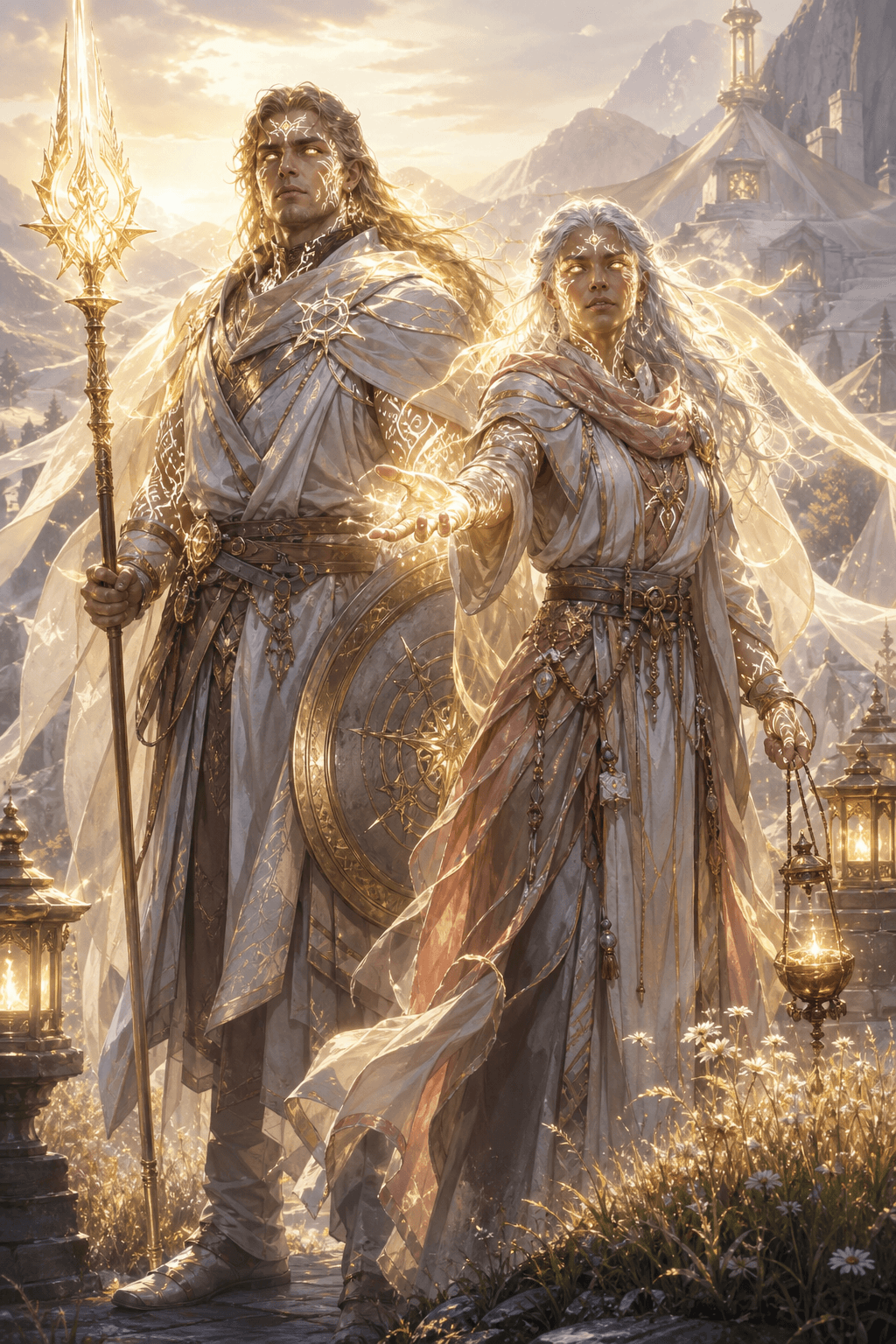
Blood-Changed
Celestial Blood
Casaeal
Background Questions
When did light first shine from your hands, eyes, or heart?
What vow do you keep above all others?
Which hospice, temple, or meadow raised you?
What burden do you carry that others cannot see?
Lore
Celestial-Blooded awaken with soft radiance, glowing eyes, or a voice like chiming glass. They are natural healers and mediators, tied to ancient vows of sanctuary and protection.
Celestial-Blooded communities cluster around hospice roads, shrine towns, and border posts where keeping people alive is practical work, not ideology.
They are culturally oriented toward service. Many keep personal vows, and communities judge one another less by doctrine and more by whether they show up when needed.
They are trusted in emergencies and resented by factions that profit from conflict. In some regions, they travel in pairs or small groups for safety.
Homeland: Temple cities, high meadows
Cities: Dawn-Hallow, Sky-Lintel, Mercy-Road
Exports: Healers, midwives, peace-brokers
Imports: Herbs, linen, holy inks
Diet: Simple, often vegetarian
Allies: Halflings, Satyrs, Elves
Enemies: Devil-blood cabals
History: Celestial-Blood founded the Lantern Oath followed by caravan guards and some gnoll packs.
Lore & Background
Celestial-Blooded awaken with soft radiance, glowing eyes, or a voice like chiming glass. They are natural healers and mediators, tied to ancient vows of sanctuary and protection.
Celestial-Blooded communities cluster around hospice roads, shrine towns, and border posts where keeping people alive is practical work, not ideology.
They are culturally oriented toward service. Many keep personal vows, and communities judge one another less by doctrine and more by whether they show up when needed.
They are trusted in emergencies and resented by factions that profit from conflict. In some regions, they travel in pairs or small groups for safety.
Homeland: Temple cities, high meadows
Cities: Dawn-Hallow, Sky-Lintel, Mercy-Road
Exports: Healers, midwives, peace-brokers
Imports: Herbs, linen, holy inks
Diet: Simple, often vegetarian
Allies: Halflings, Satyrs, Elves
Enemies: Devil-blood cabals
History: Celestial-Blood founded the Lantern Oath followed by caravan guards and some gnoll packs.
Aldaegel - Goblinkin
The Aldaegel are three related peoples - Goblin, Hobgoblin, and Bugbear - bound by shared ancestral root, a common tongue-family, and a history of being misread by the rest of Reth. Outsiders lump them together under the word Goblinkin, a term that has carried baggage since the earliest wars. The Aldaegel themselves bristle at the grouping - not because they deny kinship, but because each people grew into something genuinely distinct, shaped by different biomes, different magical pressures, and different answers to the question of how a people should live.
They share a language root in Aldaegel speech, which favors short phrases, direct claims, and context-heavy nicknames that outsiders rarely decode on first meeting. They share a wariness of outside institutions earned through generations of being treated as lesser within them. And they share, if they are honest, the memory of a common ancestor who diverged long ago: one line drawn to open ground and the logic of formation, one drawn to shadow and cover and the patience of the hunt, and one that refused to be drawn anywhere and made itself at home in every corner of the world.
They do not often live together. When they do it is usually by circumstance - a shared border, a shared threat, a shared market. The relationship between the three peoples is not warm, but it is old, and old things have their own weight.
A History Written in Dismissal
The Aldaegel were never made truly welcome at the Prime Council's table. During the great age of cooperative governance, the Goblinkin held what some Council members quietly called the lesser chairs. Their votes were counted. Their words were heard. But the weight of old reputation - of being called monstrous and warlike in histories written by other peoples - meant they were always one argument away from being reminded that their seat was a courtesy, not a right.
The Council was shaped by those who considered themselves civilized in a particular way: the Elves, the Dwarves, the Humans, and the Chiaethu. Even among the Mammal-Folk, the Aldaegel found themselves treated as a category apart. The Goblinkin had fought in old wars on the wrong side of some histories and the right side of others, and either way the narrative had calcified into something self-serving for those who held the better chairs.
When the Head Shaman of the Aldaegel - a Bugbear elder whose name has become ceremonial among all three peoples - rose and walked out of the Prime Council chamber, it was not in anger. It was in exhaustion. The worlds outside the capital needed tending. The Aldaegel had spent enough years arguing for recognition they were never truly going to receive.
The Prime Council sent a delegation after them - the Council of Peace, a small attache meant to maintain a line of communication. Among the Goblinkin, opinion is divided on what that delegation actually represents. Goblins find them useful trade contacts. Hobgoblins treat them with professional courtesy and nothing more. Among the Bugbears, the Council of Peace is widely understood to be a watching post - observers sent to monitor the possibility of insurrection, dressed in the language of diplomacy. The Bugbears are not wrong about this. They are not particularly bothered by it either. They have always been watched.
Shared Cultural Threads
Despite their differences, certain values recur across all three peoples. Oath-kinship - the principle that a sworn bond can carry the weight of blood - is universal among the Aldaegel. All three peoples maintain fierce insularity toward outside institutions while operating complex internal social structures that outsiders rarely see clearly enough to understand. All three share a preference for controlled points of contact with the wider world: supervised markets, toll arrangements, guest rules with teeth. And all three carry a particular awareness of being underestimated that has shaped their approach to survival across centuries.
The Aldaegel do not have a unified governing body. They do not hold a shared seat on the Prime Council. What they have is proximity, old blood, and the practical knowledge that when the world decides to make trouble for one of them, it usually makes trouble for all three.
Shared Notes
Languages: All Aldaegel speak Common and Aldaegel. Aldaegel speech favors short phrases, direct claims, and context-heavy nicknames.
Kinship. Families are organized in familiar household lines - pairs, extended kin, adoptive bonds, and foster ties. Oath-kinship is common: a sworn bond can carry the weight of blood.
Insularity. Outsiders are tolerated when useful and kept at arm's length when not. Aldaegel communities prefer controlled trade points, supervised guest rules, and clear boundaries.
Council Standing: The Aldaegel withdrew from the Prime Council after generations of holding what other members quietly called 'the lesser chairs.' When the Head Shaman walked out, it was not in anger - it was exhaustion. The Prime Council sent the Council of Peace afterward, a small delegation meant to maintain a line of communication. Among the Bugbears especially, this attache is understood for what it is: an observation post dressed in the language of diplomacy.
Checking your codex…
From the Reth Ancestries (Daggerheart) compendium. Ancestry mechanics unlock when you collect this lineage in Hoard and link your account.