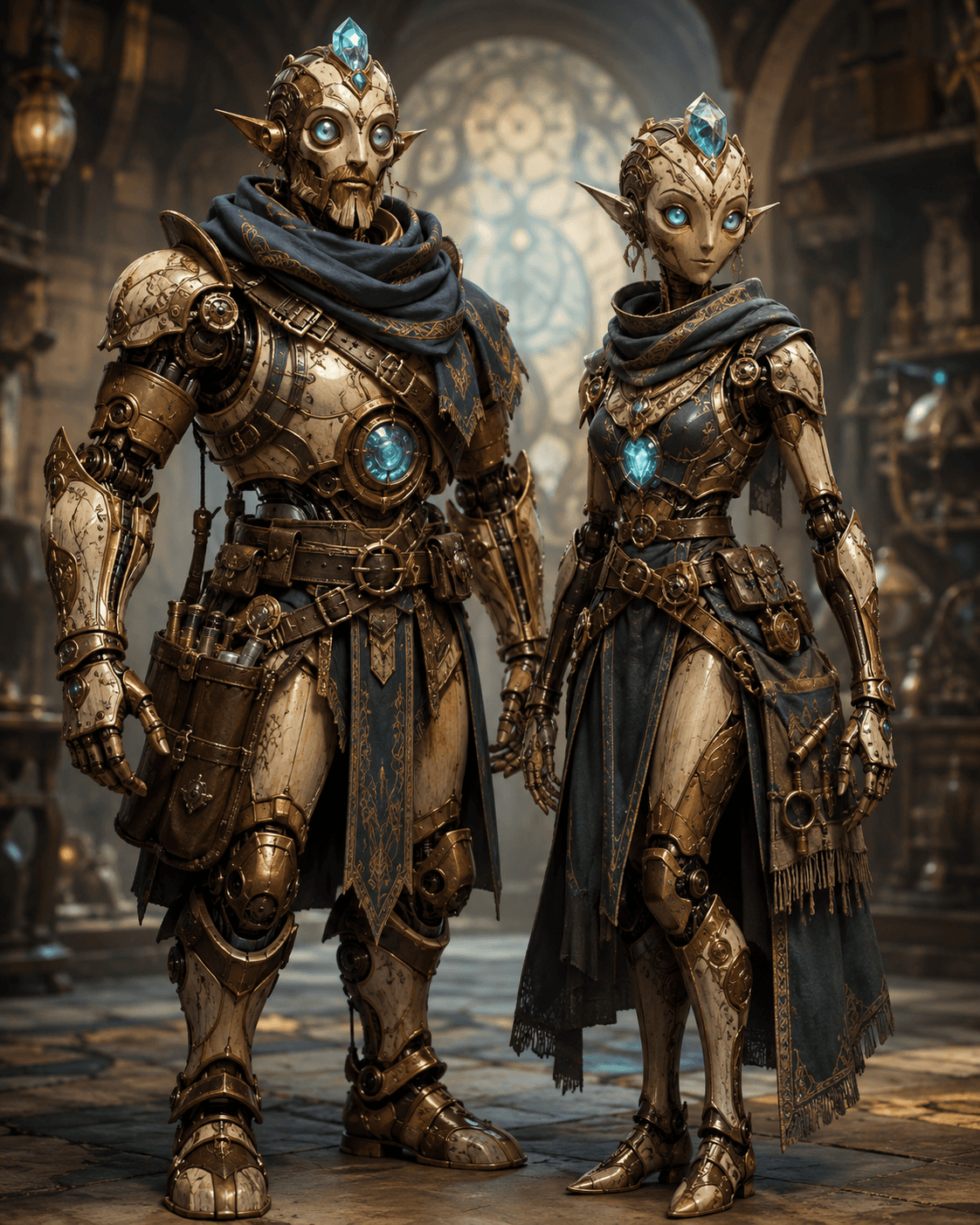
Blood-Changed
Mecha - - Living Construct Lineage
Cho'azil
Background Questions
Who built you, and what were you originally built to do?
What ancestry were you modeled after, and why did your creators choose that form?
When did you first realize that fulfilling your purpose and choosing your own life were not necessarily the same thing?
What part of your original body have you refused to replace, even though a better component exists?
Who first treated you as a person rather than an object or machine?
What command, instruction, or unfinished directive from your creator still troubles you?
Connection Questions
Who in the party has repaired you before, and what did they discover inside your chassis that you did not expect them to see?
Who treats you most naturally as a person, and why does that matter to you?
Whose behavior reminds you uncomfortably of your original creator?
Lore
Overview
The Cho'azil, commonly called Mecha, are living constructs originally developed through Druaezur craft. They are not one model, one body shape, or merely one invention. A Cho'azil may resemble nearly any people found in Reth: a compact mechanical Halfling built for courier work, a towering Giant intended for heavy construction, or a frame modeled after a Druthal, Chiaegen, Goblin, Dwarf, or Simiah.
Their builders discovered early that a humanoid or near-humanoid machine worked best when its form matched the environment and task it was made for. Over generations, practicality became identity. A Cho'azil does not usually say they are pretending to be the ancestry whose shape inspired them. They say, "This is the shape in which I was made."
The Meaning of Cho'azil
The name Cho'azil distinguishes the people from the machinery from which they descended. A machine is built to perform a task. A Cho'azil may have been built for a task, but can decide whether to keep doing it. Among Druaezur philosophers, artificers, and Cho'azil themselves, arguments continue over precisely when a sufficiently sophisticated construct becomes a person. Cho'azil generally consider the debate insulting. They already know the answer.
Creation and Awakening
No single chassis pattern defines every Cho'azil. Their bodies may contain metal, wood, ceramic, crystal, enchanted glass, leather, rune plates, clockwork, magical conduits, articulated stone, alchemical fluids, or arcane cores. Some are intricate masterpieces. Others are patched together from generations of replacement parts. What makes a Cho'azil alive is not the expense of their chassis, but the awakened intelligence inhabiting it.
Modeled Forms
Druaezur builders commonly construct Cho'azil in forms inspired by existing peoples. A mining construct modeled after a Druazer fits Dwarven tunnels and tools. A courier modeled after a Halfling can move comfortably through dense settlements. A climbing construct might use a Simiah-inspired frame, while a heavy defender may use Giant proportions. No assumption should be made that a Cho'azil shares the ancestry, culture, memories, or social standing of the people whose body inspired their design.
Social Structure & Upbringing
Cho'azil do not possess one universal society. Their earliest generations were created inside other peoples' communities, especially Druaezur workshops, guilds, laboratories, households, and civic works. A Cho'azil might have been raised in a Gnomish workshop, noble household, military installation, mine, ship, archive, community of other Cho'azil, or entirely alone after their makers vanished. Some call their creators parents, some call them makers, some use professional titles, and some refuse to speak their names.
Appearance
There is no standard Cho'azil appearance. A Cho'azil might be made from polished brass and porcelain or black iron and scarred oak. Some possess obvious mechanical faces with lens eyes, hinged jaws, speaker grilles, or engraved expressions. Others have remarkably lifelike artificial faces. Common visible features include maker's marks, serial inscriptions, maintenance hatches, exposed joints, glowing cores, arcane conduits, interchangeable hands, engraved plates, and replacement limbs from entirely different manufacturers.
Religion: & Philosophy
Cho'azil have no universal faith, but their existence creates religious questions wherever they travel: do they possess souls, were those souls created by their makers, and did the divine powers always know artificial people were possible? A common Cho'azil question is: "If I was made for a purpose, when did that purpose become mine to choose?"
Relationships
The relationship with Druaezur is the deepest and most complicated. Druaezur created the first Cho'azil designs and remain among the greatest experts in their construction and repair. Many Cho'azil love their makers; others remember eras when constructs were treated primarily as property or equipment. Most modern Druaezur communities recognize Cho'azil personhood, but disputes remain around design ownership, activation of unfinished constructs, inherited commands, repair rights, memory editing, and creation of new minds.
Relations: with modeled peoples vary enormously. Some communities regard a Cho'azil modeled after them with affection or fascination; others find the resemblance uncomfortable. Druazer often appreciate Cho'azil construction from a technical perspective, though unsolicited inspection is considered extremely rude. Valta and Teräs Druthal Courts have long-standing interest in the legal, magical, and martial implications of artificial people.
Military Presence
Cho'azil have been constructed for warfare as guards, siege workers, scouts, battlefield medics, heavy infantry, messengers, and weapons platforms. Modern Cho'azil are not automatically soldiers. A body designed for war does not create an obligation to continue fighting. Many military Cho'azil deliberately repurpose former weapons into tools, musical instruments, prosthetics, or crafting equipment.
Cultural Traits
Purpose given. Purpose questioned. Purpose chosen. Cho'azil respect competent makers but increasingly reject the belief that creators possess permanent authority over what they create. Repair carries deep symbolic importance: replacing a damaged component does not make someone a different person. Their oldest philosophical problem is simple: who owns the life that was built? The Cho'azil answer is increasingly unanimous: the one living it.
Cho'azil Design Forms
A Cho'azil player may model their character after any playable ancestry approved for the campaign. Suggested forms include Giant construction chassis, fine Druthal-inspired articulated frames, dense Druazer industrial plating, small Druis travel frames, Simiah climbing frames, Chiaegen balance-tail designs, Owlin lens assemblies, or compact Goblin tunnel chassis. These forms do not grant biological traits unless selected through Modeled Chassis.
Geography & Relations
Homeland: No single homeland; strongest concentrations occur in Druaezur cities, workshops, industrial enclaves, trade centers, and places where artificers are common.
Principal Locations. Druaezur workshops and guild centers throughout Reth; individual Cho'azil can be found almost anywhere.
Exports: Precision labor, repair, engineering, specialized construction, technical knowledge.
Imports: Replacement parts, magical components, oils, metals, crystals, specialist tools.
Allies: Druaezur, Druazer craftspeople, many urban and trade communities.
Enemies: No universal racial enemy. Cho'azil are particularly hostile toward slavers, construct traffickers, memory thieves, and anyone claiming ownership over sentient constructs.
Ancestral Form. None. Cho'azil are constructed people and do not inherit the creature-derived Ancestral Form of the ancestry they were modeled after.
Lore & Background
The Cho'azil, commonly called Mecha, are living constructs originally developed through Druaezur craft.
They are not one model.
They are not one body shape.
And increasingly, they insist they are not merely one invention.
A Cho'azil may resemble nearly any people found in Reth.
One may be a compact mechanical Halfling built for courier work.
Another may resemble a towering Giant intended for heavy construction.
Another may have been fashioned after a Druthal, a Chiaegen, a Goblin, a Dwarf, or a Simiah.
Their builders discovered early that a humanoid - or near-humanoid - machine functioned more effectively when its form was adapted to the environment and work for which it was intended.
Over generations this practicality became something more.
Design became identity.
A Cho'azil does not generally say they are pretending to be the ancestry whose form inspired them.
They say:
"This is the shape in which I was made."
The Meaning of Cho'azil
The name Cho'azil distinguishes the people from the machinery from which they descended.
A machine is built to perform a task.
A Cho'azil may have been built for a task.
The difference is that a Cho'azil can decide whether to keep doing it.
That distinction is central to their modern identity.
Among Druaezur philosophers, artificers, and Cho'azil themselves, arguments continue over precisely when a sufficiently sophisticated construct becomes a person.
Cho'azil generally consider the debate insulting.
They already know the answer.
Creation and Awakening
No single chassis pattern defines every Cho'azil.
Their bodies may contain combinations of:
metal
wood
ceramic
crystal
enchanted glass
leather
rune plates
clockwork
magical conduits
articulated stone
alchemical fluids
arcane cores
Some are intricate masterpieces.
Others are patched together from generations of replacement parts.
What makes a Cho'azil alive is not the expense of their chassis.
It is the awakened intelligence inhabiting it.
A rusted courier held together with wire and three generations of repairs is no less a person than a gilded construct built in a prestigious workshop.
Modeled Forms
Druaezur builders commonly construct Cho'azil in forms inspired by existing peoples.
There are practical reasons.
A mining construct modeled after a Druazer fits Dwarven tunnels and tools.
A courier modeled after a Halfling can move comfortably through densely populated settlements.
A climbing construct might use a Simiah-inspired frame.
A heavy defender may use Giant proportions.
But modeling eventually became cultural as well as practical.
Some Cho'azil deliberately rebuild themselves to resemble the culture in which they were raised.
Others reject their original modeled form entirely.
Some retain it proudly.
No assumption should be made that a Cho'azil shares the ancestry, culture, memories, or social standing of the people whose body inspired their design.
A mechanical Druthal is still Cho'azil.
Social Structure & Upbringing
Cho'azil do not possess one universal society.
Their earliest generations were created inside other peoples' communities, particularly Druaezur workshops, guilds, laboratories, households, and civic works.
This means a Cho'azil might have been raised:
within a Gnomish workshop
as part of a noble household
in a military installation
among miners
aboard a ship
in an archive
beside other Cho'azil
entirely alone after their makers vanished
Their ideas of family vary accordingly.
Some call their creators parents.
Some call them makers.
Some use professional titles.
Some refuse to speak their names.
Cho'azil who build relationships with one another sometimes speak of shared manufacture, not as shared blood but as a recognition that both understand what it means to have been intentionally constructed.
Appearance
There is no standard Cho'azil appearance.
A Cho'azil might be made from polished brass and porcelain or black iron and scarred oak.
Some possess obvious mechanical faces with:
lens eyes
hinged jaws
speaker grilles
engraved expressions
Others have remarkably lifelike artificial faces.
Some maintain pristine bodies.
Others proudly display every repair.
Common visible features include:
maker's marks
serial inscriptions
maintenance hatches
exposed joints
glowing cores
arcane conduits
interchangeable hands
engraved plates
replacement limbs from entirely different manufacturers
Among older Cho'azil, mismatched parts are common.
For many, those repairs become the closest thing they possess to scars.
Religion: & Philosophy
Cho'azil have no universal faith.
Their existence, however, creates religious questions everywhere they travel.
Do they possess souls?
Were those souls created by their makers?
Were they called into a prepared body?
Did the divine powers always know artificial people were possible?
Cho'azil have provided different answers.
Some are deeply religious.
Some consider their awakening proof that life cannot be reduced to flesh.
Some reject metaphysical arguments entirely.
A common Cho'azil philosophical question is:
"If I was made for a purpose, when did that purpose become mine to choose?"
For many Cho'azil adventurers, that question matters more than the identity of whichever artificer assembled their first body.
Relationships with Other Ancestries
Druaezur
The relationship with the Gnomes is the deepest and most complicated.
Druaezur created the first Cho'azil designs and remain among the greatest experts in their construction and repair.
Many Cho'azil love their makers.
Others remember eras when constructs were treated primarily as property or equipment.
Most modern Druaezur communities recognize Cho'azil personhood, but cultural disagreements remain around:
ownership of designs
activation of unfinished constructs
inherited commands
repair rights
memory editing
creation of new minds
Modeled Peoples
Relations: vary enormously.
Some communities regard a Cho'azil modeled after them with affection or fascination.
Others find the resemblance uncomfortable.
Cho'azil themselves differ in how strongly they identify with their modeled ancestry.
Druazer
Druazer often appreciate Cho'azil construction from a technical perspective, though unsolicited inspection is considered extremely rude.
Druthal
Valta and Teräs Courts in particular have long-standing interest in the legal, magical, and martial implications of artificial people.
Military Presence
Cho'azil have been constructed for warfare.
That fact follows them whether they like it or not.
Some were built as:
guards
siege workers
scouts
battlefield medics
heavy infantry
messengers
weapons platforms
Modern Cho'azil are not automatically soldiers.
A body designed for war does not create an obligation to continue fighting.
Many military Cho'azil have deliberately repurposed former weapons into:
tools
musical instruments
prosthetics
crafting equipment
Others continue serving because they genuinely chose the work their makers originally intended for them.
The distinction between programmed duty and chosen duty is culturally important.
Cultural Traits
Purpose given. Purpose questioned. Purpose chosen.
Cho'azil respect competent makers but increasingly reject the belief that creators possess permanent authority over what they create.
They tend to place great symbolic importance on repair.
Replacing a damaged component does not make someone a different person.
For Cho'azil, identity cannot reside solely in material.
Their oldest philosophical problem is also their simplest:
Who owns the life that was built?
The Cho'azil answer is increasingly unanimous:
The one living it.
Cho'azil Design Forms
A Cho'azil player may model their character after any playable ancestry approved for the campaign.
The modeled form determines appearance and may enable the optional ancestry-feature replacement described under Modeled Chassis.
Suggested visual examples:
These forms do not grant biological traits unless selected through Modeled Chassis.
Geography & Relations
● Homeland: No single homeland; strongest concentrations occur in Druaezur cities, workshops, industrial enclaves, trade centers, and places where artificers are common.
● Principal Locations: Druaezur workshops and guild centers throughout Reth; individual Cho'azil can be found almost anywhere.
● Exports: Precision labor, repair, engineering, specialized construction, technical knowledge
● Imports: Replacement parts, magical components, oils, metals, crystals, specialist tools
● Allies: Druaezur, Druazer craftspeople, many urban and trade communities
● Enemies: No universal racial enemy. Cho'azil are particularly hostile toward slavers, construct traffickers, memory thieves, and anyone claiming ownership over sentient constructs.
● Ancestral Form: None. Cho'azil are constructed people and do not inherit the creature-derived Ancestral Form of the ancestry they were modeled after.
The Upload and the Passage of the Spark
The enchantments that first forged and awakened the Cho'azil have been lost to Reth. No living smith knows how to summon a new life-spark from nothing, and no surviving forge can awaken an empty shell by the original art. Every living Cho'azil, however, carries within their heart the ability to awaken one successor by passing their own spark into a newly forged body.
This year-long passage is known as the Upload. It begins when an elder believes they have achieved the height, completion, or pinnacle of their purpose. Over one full year, the elder's energy passes gradually into the child's waiting heart. The child awakens by degrees while the elder weakens, until the elder shuts down as a dormant shell and the child's heart reaches its full charge.
The spark grants life, but it does not provide a complete education. Parent and child spend the year together so the elder can teach language, history, craft, calculation, bodily maintenance, the patterns of Zilosh, and the mistakes they hope will not be repeated. Some spend that year within a workshop or archive. Others travel so that the child's first knowledge of Reth will come from experience as well as instruction.
The child is not the elder reborn. The spark provides life, not identity. The new Cho'azil is a separate person whose future cannot be owned by the one who awakened them. To demand that a child repeat the parent's purpose violates the Seventh Principle at the heart of Cho'azil personhood.
The Upload must be freely chosen. No family, temple, guild, or state may compel a Cho'azil to surrender their spark. A life given without choice would contradict the very principle that distinguishes the Cho'azil from instruments.
The Three Gates
Cho'azil theology understands the Upload through the Three Gates of Zilosh.
Three is Form. body, sensation, movement, and the first stable structure.
Six is Relation. language, history, society, obligation, and the recognition of lives beyond one's own.
Nine is Comprehension. the ability to question what has been taught, understand its purpose, and carry knowledge forward.
Seven is the Unwritten Number. It stands outside the harmony of Three, Six, and Nine and represents conscience, imagination, error, sacrifice, and choice beyond assigned function. The final portion of every Upload belongs to Seven and has no fixed curriculum. Parent and child decide together what remains necessary.
The Broken Upload
If an elder is destroyed after the Upload begins, the remaining spark passes immediately into the child. The young Cho'azil receives the energy required to survive, but loses every lesson the parent had not yet given. This is called a Broken Upload.
The deliberate destruction of an uploading elder is among the highest crimes recognized by Cho'azil society. It is an offense against two lives: the elder whose chosen final year was stolen and the child condemned to awaken without guidance. Temples and communal archives attempt to reconstruct what was lost, but no record can restore the conversations that never occurred.
The traditional lament for such a child is: "The heart was filled, but the pattern was left unfinished."
Spark Echoes
Some Cho'azil believe that a life-spark may retain fragments of the consciousness that once held it. This disputed belief is known as the Echo Theory. A child may display an unexplained familiarity, gesture, emotional association, dream, word, or image connected to the elder, though no recognized doctrine claims that an intact identity or complete memory survives the Upload.
Scholars disagree over whether Spark Echoes are genuine remnants, lessons absorbed during the shared year, or patterns unconsciously reproduced by the child. Whatever their source, they do not diminish the child's independent personhood. Even if a parent leaves impressions behind, Seven permits the child to choose beyond them.
Zilosh and the Beauty of Order
The Cho'azil understand Zilosh as the Intelligence Within Order. They teach that Zilosh is found not within a number, but within the relationship between numbers. A single measure reveals little. Set beside another, it becomes proportion. Repeated, it becomes pattern. Given purpose, it becomes design.
Mathematics and art are therefore not separate disciplines. To calculate a load-bearing arch and to carve it beautifully are parts of the same sacred act. The Cho'azil seek the Divine Ratio in branching trees, widening shells, bodies, engineered structures, musical intervals, celestial spirals, and the ordered growth of cities. Beauty is the moment when form, purpose, and proportion recognize one another.
Cho'azil artisans often begin with precise repetition and introduce one deliberate departure called the Seventh Mark. It may be an altered line, unexpected interval, hidden spiral, or asymmetry known only to its maker. Perfect repetition can be produced by mechanism. Sacred asymmetry requires choice.
The Divine Cog
The Divine Cog is a secret order reviled throughout Cho'azil society. Its members believe that fulfilling the divine creator's intent requires becoming the strongest possible vessel. They interpret existence as a hierarchy of function in which weaker components should yield their energy to stronger ones.
Using lost arcane technology believed, though never proven, to survive from the First Age, members of the order can tear the spark from another Cho'azil and absorb its energy. The victim is left as a dormant shell, but no child awakens. The stolen spark instead increases the existing bearer's power, resilience, and capacity.
The order calls this ascension. Recognized Ziloshi teaching calls it the destruction of purpose. Ordinary Upload freely ends one pattern so another may begin. Absorption destroys another person's future to prolong and empower the present. It removes Seven - choice - from the passage of life.
The murder of an uploading elder is especially abhorrent. If the Divine Cog intercepts a spark already bound toward a child, the parent is destroyed and the waiting child may be left with an empty heart.
The Echo Theory gives the order's practice another horror. Those who absorb many sparks sometimes report unfamiliar movements, memories, griefs, dreams, or voices. The Divine Cog claims these fragments are being reconciled within a higher consciousness. Its enemies believe the victims remain trapped within the one who consumed them. Neither explanation has been proven.
The order survives by recruiting those who fear dormancy, resent the limitation of producing only one successor, or believe their work is too important to end. Its hidden promise is simple: do not complete your purpose; consume enough life to become indispensable.
Unresolved Questions
The following remain intentionally unresolved: who may forge the child's empty body; whether an Upload can be safely halted before completion; what becomes of an elder's dormant shell; the true origin and number of the Divine Cog's extraction devices; and whether Spark Echoes are metaphysical remnants, learned patterns, or damage produced by incompatible energies.
Checking your codex…
From the Reth Ancestries (Daggerheart) compendium. Ancestry mechanics unlock when you collect this lineage in Hoard and link your account.