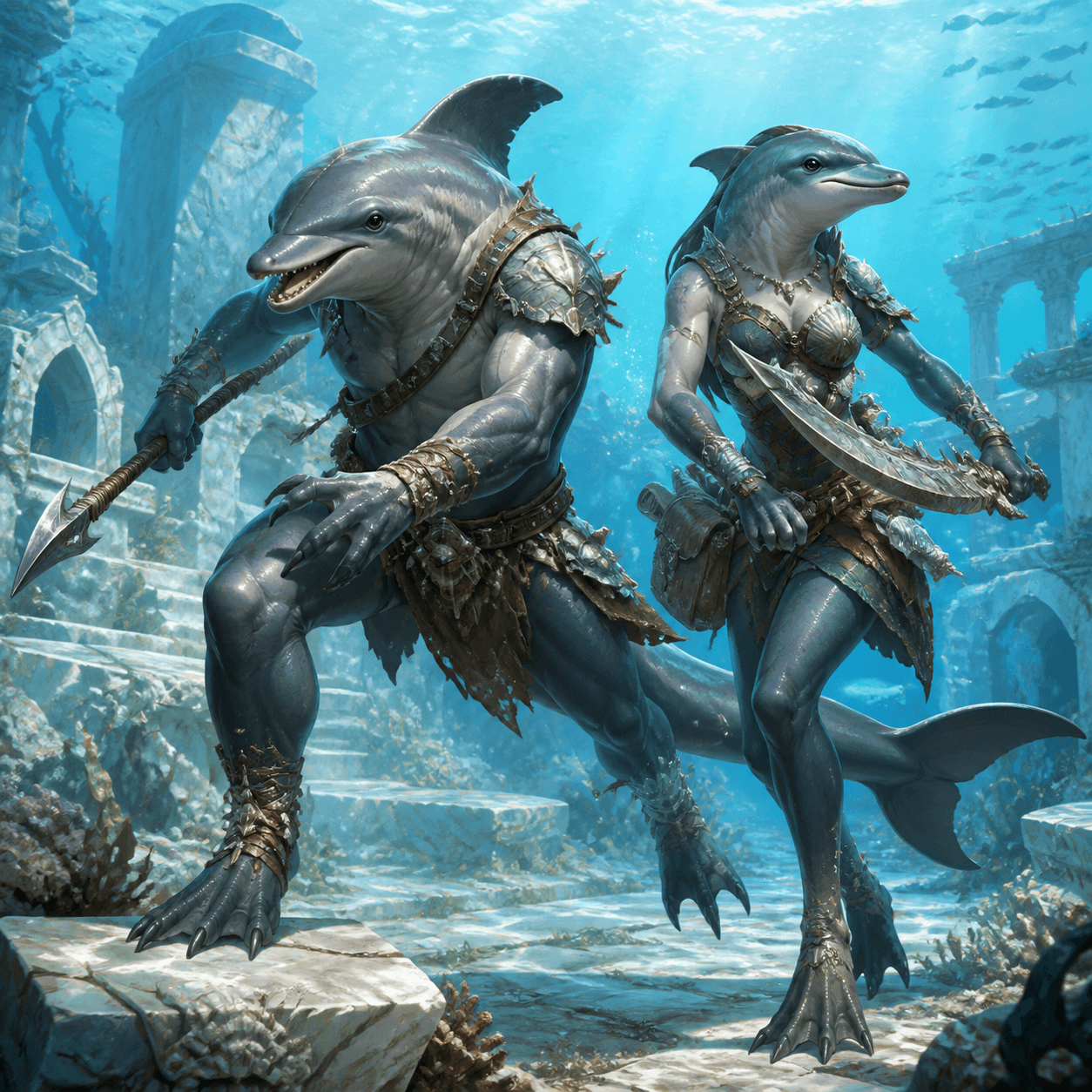
Sea-Folk (Water)
Dolphin Folk
Chisan
Background Questions
What role did you (or your family) serve in Chisan civic duty?
What law or principle of the republic do you treat as sacred?
Why did you leave a society that punishes corruption so severely?
What freedom do you refuse to give up?
Lore
The Chisan are a sea-republic of dolphin folk known for disciplined self-rule, mandatory education, and strict public accountability. They value independence, but they also hold that freedom only lasts when the rules apply to everyone - especially the people trusted with power.
Government: and civic duty
Chisan governance is built on two ruling bodies:
Executive Council. manages public works, safe-route marking, patrol schedules, emergency response, and day-to-day enforcement of civic decisions.
Judicial Council. interprets law, issues warrants, oversees investigations, and conducts trials.
All major offices are elected on a 4-year cycle. A citizen may serve no more than two terms in a lifetime, regardless of office. Public service is treated as a responsibility, not a career. Chisan culture distrusts anyone who seeks authority for its own sake; ambition is watched closely, and every official is expected to return to ordinary life when their term ends.
Elections and public records
Chisan elections are protected by widely accepted magical safeguards and witnessed procedures. Votes are counted with oversight, and results are recorded in civic archives. Government decisions are documented as public minutes - formal records of debates, votes, and enacted measures - kept in multiple archives across different reef-cities so no single disaster or raid can erase them.
The law on corruption
Chisan law treats corruption as an existential threat to the republic. Bribery, vote-buying, hidden patronage, falsifying records, tampering with elections, and misuse of public authority are prosecuted as major crimes. The standard penalty for proven corruption by an office-holder is expulsion from Chisan society, along with loss of civic rights and seizure of illicit gains. This punishment is severe by design: the Chisan would rather cut a rot out quickly than argue over it for years.
Education and culture
All Chisan citizens are taught to read civic records, understand legal procedure, and participate in public debate. Public speaking and structured argument are common skills. Disagreement is not treated as disloyalty; it is expected. What is not tolerated is deception in public governance - false minutes, suppressed testimony, or secret arrangements that bypass the system.
Cities: and architecture
Chisan do not gather their entire nation into a single throne-city. They prefer a network of reef-cities and coordinated districts, each with local assemblies and shared law. Their architecture is designed for public use:
Assembly Chambers. built for clear hearing and orderly debate.
Record Vaults. sealed archives with controlled access and redundant copies.
Current Forums. civic plazas used for public notices, hearings, and trade.
Reef Markers. carved route-pillars that mark safe lanes, hazards, and civic boundaries.
Trade and diplomacy
Chisan trade is formal and contract-driven. Large agreements are recorded. Officials are forbidden to accept private gifts connected to public decisions. This makes Chisan reliable partners for anyone willing to deal openly, and difficult partners for powers that expect personal favors.
Internal tensions
Hardliners vs. emergency pragmatists. whether to bend rules during war, famine, or disaster.
Expulsion aftermath. expelled citizens sometimes become enemies, pirates, or advisors to rivals.
Network disputes. reef-cities argue over patrol burdens, taxes, and resource allocation.
Taboos
• Altering public minutes, suppressing testimony, or hiding records.
• Taking gifts tied to a vote, ruling, or investigation.
• Election tampering of any kind.
• Using sonar/scrying to violate private chambers without lawful cause.
CHISAN CITY. SEAGLASS FORUM
Core principle (how every Chisan city is built)
All Chisan cities are constructed in two parts:
The Above-City - piers, courts, markets, assembly halls, and visitor districts in open air
The Below-City - sheltered chambers under the tide for residences, civic record vaults, submerged travelways, and protected meeting spaces
CHISAN PRINCIPAL CITY. SEAGLASS FORUM
Role. Major civic city; the public face of Chisan law and order on the eastern waters.
Build. Marble terraces, pearl-inlaid seam lines, ivory-toned pillars; twin-city design (Above + Below).
Overview
Seaglass Forum is the first great Chisan city most travelers reach after leaving Sauropod Isle. It is designed to be read at a glance: where you may walk, where you may trade, where you may speak, and where you must not go. Chisan don't rely on "good intentions" to keep a city stable - they rely on clear procedure, written record, and predictable enforcement.
The Above-City
Lantern Piers. Wide docks with posted rules and posted fees. Dock-scribes record ship name, cargo class, and purpose of arrival.
Commonswalk. A market promenade where trade happens under stamped contracts and verified weights.
Wavecourt. An open amphitheater court built around a shallow basin; rulings are delivered in public, with witnesses present.
Beacon Galleries. Pearl-lensed towers used for lane signals, hazard marking, and emergency alerts.
The Below-City
Record Vaults. Archive chambers sealed against salt and sabotage; the civic spine of the city.
Assembly Pools. Under-tide chambers where deliberations are held in water, away from dock noise and outsider ears.
Currentways. Protected swim corridors for officials and messengers; restricted to citizens and escorted visitors.
Pearlworks. Craft halls where lenswork, inlay, and civic seals are made.
What Seaglass Forum is known for
Arbitration that moves quickly and cleanly
Lane permits and harbor clearance
Public ledgers that make agreements hard to twist
A polite but firm refusal to "do favors" off the books
CHISAN PRINCIPAL CITY. WAVEWATCH ASSEMBLY
Role. Reef-sentinel and rescue hub; the city that keeps the waters safe and the coast from becoming a graveyard.
Build. Marble seawalls shaped like long breaking waves; pearl-inlaid markers; ivory-toned staircases descending into the tide.
Overview
Wavewatch Assembly exists because the sea punishes delays. Where Seaglass Forum governs through courts and procedure, Wavewatch governs through readiness: rescue crews, hazard runners, and patrols that mark the reef approaches before storms and shifting currents turn them lethal. It is the most "active" of the Chisan cities - always moving, always listening.
The Above-City
The Signal Steps. A terraced ridge of marble platforms where scouts read tide, wind, and reef-line changes; conch calls and mirror flashes relay warnings.
The Rescue Docks. Fast-launch slips for escort craft and recovery boats; crews drill in full view, like a reminder to the city.
The Marker Yard. A staging ground of carved ivory-and-marble buoy-stones, chain-weights, and beacon lenses set for deployment.
The Public Board. Notices of hazards, missing ships, wreck locations, and escorted lanes - updated daily.
The Below-City
The Quiet Shelves. Underwater shelter chambers for survivors, refugees, and storm-displaced vessels; calm-water holding bays.
The Reefmap Vault. A living archive of reef shifts - channels, collapses, predator routes, and safe passages - kept by trained map-keepers.
The Current Clinic. Healing pools for hypothermia, crush injuries, and reef poison; staffed by tide-trained healers.
The Diveways. Submerged launch corridors that let responders exit under the swell without exposing craft to surface chaos.
What Wavewatch Assembly is known for
Rescue and escort contracts
Reef hazard intelligence
Recovery of wrecked cargo (under strict provenance rules)
"No delay" decision culture - if someone is drowning, procedure is built to move fast
CHISAN PRINCIPAL CITY. TIDECOURT HAVEN
Role. Legal academy and treaty city; the place where Chisan law is taught, refined, and written into agreements with foreign powers.
Build. Ivory-toned halls with pearl-script inlays; marble courtyards above, deep deliberation chambers below.
Overview
Tidecourt Haven is where Chisan turn law into a craft. It trains arbiters, treaty-writers, and civic auditors. Foreign captains who want long-term access to Chisan lanes come here to make terms that will actually hold. Tidecourt is quieter than the other two cities, but it has sharp edges: a contract written here will be enforced.
The Above-City
The Treaty Stairs. An open hall of ascending marble steps where public treaty readings occur; terms are spoken aloud before they are sealed.
The Sealhouse. Where civic seals are minted and registered; counterfeit seals are treated as a serious crime.
The Petition Walk. A corridor of marked stations where citizens submit disputes, appeals, and civic proposals.
The Scholar Courts. Training courts where disputes are argued as instruction; observers learn by watching.
The Below-City
The Deep Deliberatorium. A submerged chamber where senior arbiters debate complex cases without interruption; sound is controlled and carries cleanly.
The Ledger Reef. Vaulted archive shelves holding contract copies, lane charters, rulings, and election records.
The Oath Pools. Under-tide chambers where officials swear office duties, bound by witnessed record and civic seal.
The Quiet Corridors. Restricted routes linking the academy vaults to enforcement officials without crossing public docks.
What Tidecourt Haven is known for
Training arbiters and civic officers
Writing and maintaining treaties with outsiders
Lore & Background
The Chisan are a sea-republic of dolphin folk known for disciplined self-rule, mandatory education, and strict public accountability. They value independence, but they also hold that freedom only lasts when the rules apply to everyone - especially the people trusted with power.
Government: and civic duty
Chisan governance is built on two ruling bodies:
Executive Council. manages public works, safe-route marking, patrol schedules, emergency response, and day-to-day enforcement of civic decisions.
Judicial Council. interprets law, issues warrants, oversees investigations, and conducts trials.
All major offices are elected on a 4-year cycle. A citizen may serve no more than two terms in a lifetime, regardless of office. Public service is treated as a responsibility, not a career. Chisan culture distrusts anyone who seeks authority for its own sake; ambition is watched closely, and every official is expected to return to ordinary life when their term ends.
Elections and public records
Chisan elections are protected by widely accepted magical safeguards and witnessed procedures. Votes are counted with oversight, and results are recorded in civic archives. Government decisions are documented as public minutes - formal records of debates, votes, and enacted measures - kept in multiple archives across different reef-cities so no single disaster or raid can erase them.
The law on corruption
Chisan law treats corruption as an existential threat to the republic. Bribery, vote-buying, hidden patronage, falsifying records, tampering with elections, and misuse of public authority are prosecuted as major crimes. The standard penalty for proven corruption by an office-holder is expulsion from Chisan society, along with loss of civic rights and seizure of illicit gains. This punishment is severe by design: the Chisan would rather cut a rot out quickly than argue over it for years.
Education and culture
All Chisan citizens are taught to read civic records, understand legal procedure, and participate in public debate. Public speaking and structured argument are common skills. Disagreement is not treated as disloyalty; it is expected. What is not tolerated is deception in public governance - false minutes, suppressed testimony, or secret arrangements that bypass the system.
Cities: and architecture
Chisan do not gather their entire nation into a single throne-city. They prefer a network of reef-cities and coordinated districts, each with local assemblies and shared law. Their architecture is designed for public use:
Assembly Chambers. built for clear hearing and orderly debate.
Record Vaults. sealed archives with controlled access and redundant copies.
Current Forums. civic plazas used for public notices, hearings, and trade.
Reef Markers. carved route-pillars that mark safe lanes, hazards, and civic boundaries.
Trade and diplomacy
Chisan trade is formal and contract-driven. Large agreements are recorded. Officials are forbidden to accept private gifts connected to public decisions. This makes Chisan reliable partners for anyone willing to deal openly, and difficult partners for powers that expect personal favors.
Internal tensions
Hardliners vs. emergency pragmatists. whether to bend rules during war, famine, or disaster.
Expulsion aftermath. expelled citizens sometimes become enemies, pirates, or advisors to rivals.
Network disputes. reef-cities argue over patrol burdens, taxes, and resource allocation.
Taboos
• Altering public minutes, suppressing testimony, or hiding records.
• Taking gifts tied to a vote, ruling, or investigation.
• Election tampering of any kind.
• Using sonar/scrying to violate private chambers without lawful cause.
CHISAN CITY. SEAGLASS FORUM
Core principle (how every Chisan city is built)
All Chisan cities are constructed in two parts:
The Above-City - piers, courts, markets, assembly halls, and visitor districts in open air
The Below-City - sheltered chambers under the tide for residences, civic record vaults, submerged travelways, and protected meeting spaces
CHISAN PRINCIPAL CITY. SEAGLASS FORUM
Role. Major civic city; the public face of Chisan law and order on the eastern waters.
Build. Marble terraces, pearl-inlaid seam lines, ivory-toned pillars; twin-city design (Above + Below).
Seaglass Forum is the first great Chisan city most travelers reach after leaving Sauropod Isle. It is designed to be read at a glance: where you may walk, where you may trade, where you may speak, and where you must not go. Chisan don't rely on "good intentions" to keep a city stable - they rely on clear procedure, written record, and predictable enforcement.
The Above-City
Lantern Piers. Wide docks with posted rules and posted fees. Dock-scribes record ship name, cargo class, and purpose of arrival.
Commonswalk. A market promenade where trade happens under stamped contracts and verified weights.
Wavecourt. An open amphitheater court built around a shallow basin; rulings are delivered in public, with witnesses present.
Beacon Galleries. Pearl-lensed towers used for lane signals, hazard marking, and emergency alerts.
The Below-City
Record Vaults. Archive chambers sealed against salt and sabotage; the civic spine of the city.
Assembly Pools. Under-tide chambers where deliberations are held in water, away from dock noise and outsider ears.
Currentways. Protected swim corridors for officials and messengers; restricted to citizens and escorted visitors.
Pearlworks. Craft halls where lenswork, inlay, and civic seals are made.
What Seaglass Forum is known for
Arbitration that moves quickly and cleanly
Lane permits and harbor clearance
Public ledgers that make agreements hard to twist
A polite but firm refusal to "do favors" off the books
CHISAN PRINCIPAL CITY. WAVEWATCH ASSEMBLY
Role. Reef-sentinel and rescue hub; the city that keeps the waters safe and the coast from becoming a graveyard.
Build. Marble seawalls shaped like long breaking waves; pearl-inlaid markers; ivory-toned staircases descending into the tide.
Wavewatch Assembly exists because the sea punishes delays. Where Seaglass Forum governs through courts and procedure, Wavewatch governs through readiness: rescue crews, hazard runners, and patrols that mark the reef approaches before storms and shifting currents turn them lethal. It is the most "active" of the Chisan cities - always moving, always listening.
The Above-City
The Signal Steps. A terraced ridge of marble platforms where scouts read tide, wind, and reef-line changes; conch calls and mirror flashes relay warnings.
The Rescue Docks. Fast-launch slips for escort craft and recovery boats; crews drill in full view, like a reminder to the city.
The Marker Yard. A staging ground of carved ivory-and-marble buoy-stones, chain-weights, and beacon lenses set for deployment.
The Public Board. Notices of hazards, missing ships, wreck locations, and escorted lanes - updated daily.
The Below-City
The Quiet Shelves. Underwater shelter chambers for survivors, refugees, and storm-displaced vessels; calm-water holding bays.
The Reefmap Vault. A living archive of reef shifts - channels, collapses, predator routes, and safe passages - kept by trained map-keepers.
The Current Clinic. Healing pools for hypothermia, crush injuries, and reef poison; staffed by tide-trained healers.
The Diveways. Submerged launch corridors that let responders exit under the swell without exposing craft to surface chaos.
What Wavewatch Assembly is known for
Rescue and escort contracts
Reef hazard intelligence
Recovery of wrecked cargo (under strict provenance rules)
"No delay" decision culture - if someone is drowning, procedure is built to move fast
CHISAN PRINCIPAL CITY. TIDECOURT HAVEN
Role. Legal academy and treaty city; the place where Chisan law is taught, refined, and written into agreements with foreign powers.
Build. Ivory-toned halls with pearl-script inlays; marble courtyards above, deep deliberation chambers below.
Tidecourt Haven is where Chisan turn law into a craft. It trains arbiters, treaty-writers, and civic auditors. Foreign captains who want long-term access to Chisan lanes come here to make terms that will actually hold. Tidecourt is quieter than the other two cities, but it has sharp edges: a contract written here will be enforced.
The Above-City
The Treaty Stairs. An open hall of ascending marble steps where public treaty readings occur; terms are spoken aloud before they are sealed.
The Sealhouse. Where civic seals are minted and registered; counterfeit seals are treated as a serious crime.
The Petition Walk. A corridor of marked stations where citizens submit disputes, appeals, and civic proposals.
The Scholar Courts. Training courts where disputes are argued as instruction; observers learn by watching.
The Below-City
The Deep Deliberatorium. A submerged chamber where senior arbiters debate complex cases without interruption; sound is controlled and carries cleanly.
The Ledger Reef. Vaulted archive shelves holding contract copies, lane charters, rulings, and election records.
The Oath Pools. Under-tide chambers where officials swear office duties, bound by witnessed record and civic seal.
The Quiet Corridors. Restricted routes linking the academy vaults to enforcement officials without crossing public docks.
What Tidecourt Haven is known for
Training arbiters and civic officers
Writing and maintaining treaties with outsiders
Registry standards (ships, lanes, civic service)
A culture that treats "loophole thinking" as a vice, not cleverness
Homeland: Central East Sea
Cities: Seaglass Forum (major civic city), Wavewatch Assembly, Tidecourt Haven
Exports: Shell-sculpted furniture and jewelry, reef charts, civic scribes, safe-route mapping
Imports: Dwarven tools and smelted equipment
Diet: Fish (raw), spiced prawn, halibut fillet
Society: Representative republic; elections every 4 years; Executive and Judicial councils; two-term lifetime limit; mandatory education and civic duty; corruption punished by expulsion
Buildings: Assembly chambers, record vaults, current forums, reef-lane markers and hazard pillars
Allies: Whale Folk (Chison)
Enemies: Shark Folk (Chisin)
History: Chisan republic law and election customs were formed to prevent capture by private interests and to keep sea routes open through enforceable, public rules.
Checking your codex…
From the Reth Ancestries (Daggerheart) compendium. Ancestry mechanics unlock when you collect this lineage in Hoard and link your account.