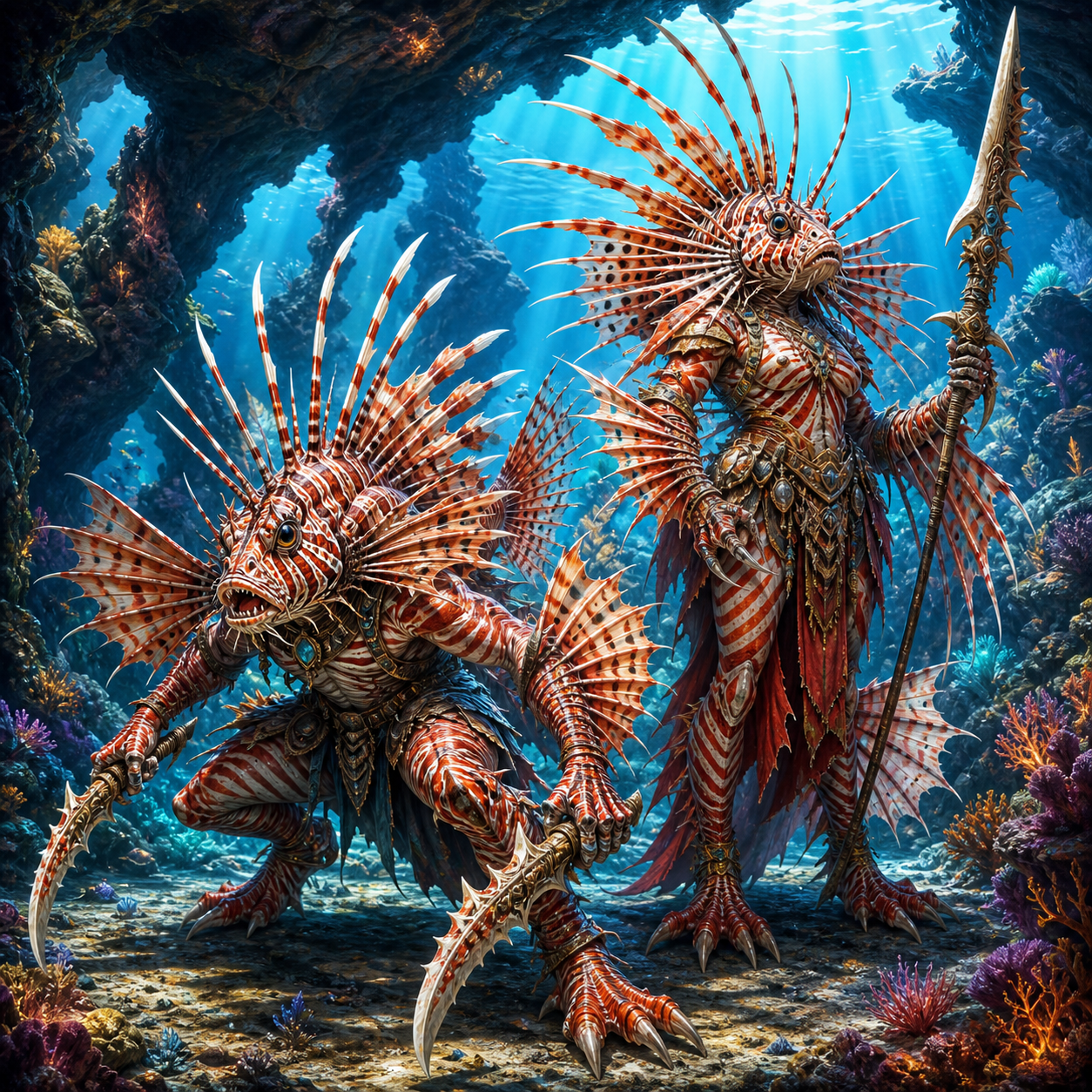
Sea-Folk (Water)
Lionfish Folk
Sandrü
The Venomcrafters
Background Questions
What is your place in the Lionfish bloodline hierarchy - and do you accept it, or are you climbing toward something better?
How are your spines, fins, and coloration viewed among your people? Are you considered well-bred, or is there a flaw your rivals whisper about?
What rival or contender to the throne do you secretly favor or despise - and what do they know about you that you'd rather keep sealed?
Were you born inside one of the three cities, or did you come from an outlying reef-holding? How does that origin define how others see you?
Lore
Sandrü society is a Monarchy built on display and control. Status is visible - spine count, fin span, and coloration are treated as proof of breeding, health, and rank. Their nobles do not pretend power is equal. Power is inherited, displayed, and defended.
They rule from tall fire-coral spires grown into sharp, elegant towers. Visitors are received in controlled courts where movement is watched and insult becomes leverage. Their economy favors barter and controlled trade over open currency, and venom is wealth - sealed, measured, guarded, and used to buy alliances or silence enemies. Their expansion is calculated: marriages, trade pressure, and only then force.
Social Structure. The Three Courts
1. The Court of Spines (The Enforcers)
The warriors, hunters, and royal guard who maintain the kingdom's security and execute the crown's will.
Philosophy. Strength is the only argument that cannot be refuted. Everything else is negotiation until it isn't.
Role:
Guarding the Zulcul-usho (The King) and royal venom reserves
Commanding the border patrols that clash with Xylos
Hunting smugglers who trade royal venom without sanction
Serving as duelists in formal disputes between noble houses
Initiation Trial. The Spine-Proof. Candidates are injected with a measured dose of their own venom and must complete a combat trial before it takes full effect. Surviving without antidote earns full membership. Using the antidote earns conditional membership - and the knowledge that others know.
Taboo. The Dulled Spine. A Spine-Court warrior who retracts their spines before battle, hiding their nature to gain advantage, is considered a coward. You display what you are. Deception is for the Shadow Court.
2. The Court of Glass (The Builders)
The architects, alchemists, and engineers who maintain the cities and develop new applications for Sandrü-Glass and venom compounds.
Philosophy. Perfection is visible. If you can see through it without distortion, it is perfect. Imperfection announces itself.
Role:
Constructing and maintaining the glass-spire cities
Developing new venom compounds and their antidotes
Managing the Venom-Farms and controlling supply
Negotiating with surface merchants for reinforcing materials (their glass's greatest weakness)
Initiation Trial. The Clarity Casting. Candidates must blow a pane of Sandrü-Glass large enough to see through without any visible distortion. No shimmer. No bubble. Absolute clarity. Most fail the first time. Some fail permanently.
Taboo. The Clouded Pane. Submitting flawed glass as perfect - whether from carelessness or deliberate fraud - is the gravest professional crime. Discovery means expulsion from the Court and blacklisting from all venom-trade.
3. The Court of Shadow (The Intelligence)
The spies, poisoners, diplomats, and information brokers who keep the Sandrü ahead of their enemies - including their own nobles.
Philosophy. A secret known only to you is a weapon. A secret shared is leverage. A secret lost is a wound.
Role:
Maintaining spy networks in Druaecül cities (especially Orym)
Coordinating the Mirror-Market's criminal connections
Managing the Antidote Vault's access (who gets cures, and when)
Feeding disinformation to rivals
Initiation Trial. The Sealed Test. Candidates are given one secret belonging to a senior Court member - something genuinely damaging. They must keep it for one full year without revealing it, using it, or allowing it to be extracted. The senior member will send agents to attempt all three. Survival proves discretion.
Taboo. The Unsanctioned Poison. Poisoning someone outside of approved channels - without Court sanction, crown order, or recognized duel - destabilizes the entire system of controlled violence the Sandrü depend on. It is the one act that unites all three Courts in punishment.
MAGIC & TECHNOLOGY
Sandrü-Glass
The great achievement and great flaw of Sandrü civilization.
The Process:
Sandrü glassblowers heat volcanic sand in fire-coral furnaces, achieving temperatures that no surface forge can match. The result is perfectly clear glass - zero shimmer, zero distortion, absolute transparency.
The Flaw:
They stole the Druaecül technique 500 years ago but couldn't replicate the deep-pressure bonding step. Sandrü-Glass achieves perfect clarity but has no structural lattice beneath. It is beautiful and brittle.
A Druaecül Aethryl wall can take a direct ram strike.
A Sandrü-Glass wall can be shattered by a well-thrown stone.
The Sandrü know this. They design around it - layering fire-coral as shock absorbers, building redundant walls, keeping enemies too afraid to strike.
Applications:
Architecture. Towers that look impossibly bright and open
Invisible Daggers. Glass blades that cannot be seen until they draw blood - prized assassin weapons
Venom Vials. The only material that doesn't react with their most potent compounds
The Mirror-Market. Sold to surface criminals who prize aesthetics over durability
The Sandrü Position:
They know Aethryl is structurally superior. They refuse to say so publicly. Their official position is that Druaecül shimmer is an impurity and that Aethryl's strength comes at the cost of purity. Most Sandrü nobles believe this. The Court of Glass knows the truth and keeps it sealed.
The Venom Taxonomy
Sandrü don't just have "poison." They have a developed science of venom with distinct families, each with specific applications and controlled antidotes.
Tier 1 - Trade Venoms (Freely sold)
Coral-Sting. Causes localized pain and swelling. Used in controlled pain-management and intimidation.
Dream-Pale. Induces drowsiness. Legal sedative sold to surface apothecaries.
Tier 2 - Licensed Venoms (Court of Shadow sanction required)
Spine-Seizure. The natural venom of Sandrü spines. Paralyzing, short-duration.
Glass-Blind. Causes temporary blindness for 1 hour. Favored by duelists.
Tier 3 - Royal Venoms (Crown sanction only - stored in Zilaeith)
The Long Sleep. Induces a coma indistinguishable from death. Duration adjustable by dose.
Crown's Mercy. The only Sandrü venom with no antidote. Reserved for enemies of the state.
Heir's Doubt. Causes subtle cognitive impairment over weeks. Evidence almost impossible to identify.
The Antidote Vault (Zilaeith):
Every royal venom has exactly one antidote, stored in the most heavily guarded location in the ocean. The Sandrü's greatest leverage is not the poison - it's the cure. Knowing you can be saved, if the King chooses, keeps nobles loyal.
Sandrü Warships - The Coral-Lancers
Where Druaecül ships are geometric perfection and Whale Folk ships are bone-cathedral engineering, Sandrü warships are predatory and beautiful - long, low, fast, and venomous.
Hull Construction:
Fire-coral exterior (absorbs impacts that would shatter the glass interior)
Sandrü-Glass inner structure (allows full visibility for crew coordination)
The result looks like a living creature - organic coral outside, crystalline interior glowing within
The Spine-Ram (Primary Weapon):
A massive hollow spike at the prow, filled with Tier 2 venom. On impact, the ram drives venom directly into the enemy hull and (if breached) into the crew. Not the most powerful weapon in the ocean, but the most personal.
The Coral-Cage (Defensive Weapon):
Fire-coral launch pods that seed enemy decks with rapidly growing toxic coral. Slows movement, damages bare skin, and creates choking terrain. Crews without protection find their own ship becoming hostile.
The Glass-Shroud (Stealth):
Panels of optically aligned Sandrü-Glass can make the ship nearly invisible at certain angles. Unlike Druaecül refraction fields, this is purely physical - it works in any water condition but only from specific viewing angles. Skilled captains know how to keep that angle between themselves and the enemy.
Weakness:
A direct ram from a Whale Folk Leviathan would shatter a Coral-Lancer entirely. Sandrü admirals avoid direct confrontations with Chison vessels. Their doctrine is hit-and-fade - strike, inject, withdraw before the enemy can bring size to bear.
THE FOUR MAJOR CITIES (The Conglomerate)
CAPITAL. Brilliant Coral Castle (Zulcul-Rath)
The Throne of the Venomking
Location. Midwest Ocean, positioned at the convergence of three major currents - chosen for maximum trade access and defensive chokepoints.
The Secret. The castle is not one structure but a living labyrinth. The fire-coral walls are still growing. The Zulcul-usho's architects adjust the maze seasonally, ensuring that only those with current knowledge can navigate the court. Visitors are given guides. The guides are Court of Shadow agents.
The Prism-Throne:
The King sits on a throne of invisible Sandrü-Glass, appearing to float above his subjects. The floor beneath is also glass - below it, a ten-foot drop to a chamber of venomous sea-creatures. Every audience with the King takes place above that drop. This is intentional.
The View Network:
Because the walls are glass, the King can observe any corridor, courtroom, or garden from his throne room via a system of angled mirrors. There are no private conversations in Zulcul-Rath. This is known. The paranoia it creates is considered a feature.
Key Features:
The Coral-Maze. Seasonal redesign keeps enemies and unfavored nobles lost
The Mirror-Gallery. Where the King receives ambassadors, positioned so every visitor sees their own reflection distorted by venom-tinted glass
The Succession Spire. A sealed tower where the heir apparent lives in complete isolation until coronation - "protected from influence" (or imprisoned, depending on perspective)
CITY 1. Zilaeoth (Firecoral Crown)
Role. Military Stronghold and Venom Production
Location. Northern border, closest point to Xylos.
Description:
Zilaeoth is where the Sandrü prepare for war. The glass walls here are thicker than anywhere else, layered with living fire-coral that pulses with a dull orange glow. It looks beautiful from a distance. Up close, the coral is screaming-hot and will strip skin from bone.
The Venom-Farms:
Visible through the clear floors are massive cultivation tanks holding the source organisms for all Tier 1 and Tier 2 venoms. Part livestock operation, part alchemical laboratory, part warning to visitors about what the Sandrü can do to you.
The Spine-Barracks:
The Court of Spines' primary military installation. The soldiers here have served on the Xylos border and carry a specific kind of grim humor that other Sandrü find unsettling. They've been in real fights. They know glass breaks.
Key Feature - The Brittle Wall:
There is one section of Zilaeoth's outer wall that is deliberately unarmored - pure Sandrü-Glass with no fire-coral backing. Every new soldier stationed here is brought to look at it. The message: This is what we are. Protect it, or it shatters.
Current Tension: Zilaeoth's commanders know the glass city doctrine is a liability against Xylos's Prism-Ships. They have been quietly requesting structural reforms (reinforced walls, less glass, more coral) that the Court of Glass refuses to approve on aesthetic grounds.
CITY 2. Zilaeuth (Spire-Court Reef)
Role. Diplomacy, Trade, and the Mirror-Market
Location. Eastern edge, closest to surface shipping lanes.
Description:
The most beautiful Sandrü city and the most dangerous. The glass domes are filled with exotic toxic flora - glowing, blooming, lethal. From outside they look like giant jewels. Inside, merchants from a dozen peoples negotiate deals that polite society pretends don't exist.
The Mirror-Market:
The open secret of the ocean. Here, Sandrü sell:
Invisible glass weapons (favored by assassins)
Unlicensed venom compounds (technically illegal, technically not the crown's business)
Intelligence extracted by the Court of Shadow
Access to the Antidote Vault (for the right price)
The Market operates under the fiction that it is independent of the crown. The crown maintains this fiction because the Market's income funds three-quarters of the royal military.
The Orym Connection:
Zilaeuth is where Druaecül nobles from Orym come to trade in secret. Both sides pretend this doesn't happen. Both sides need it to keep happening. Xylos has been trying to expose this relationship for fifty years.
Key Feature - The Toxin Gardens:
The dome-gardens are maintained by Court of Glass specialists. Each dome contains a specific venom ecosystem - predator, prey, and the compounds they produce in their interactions. Part zoo, part laboratory, part terrifying art installation.
CITY 3. Zilaeith (Venomvault Towers)
Role. Royal Treasury and Antidote Storage
Location. Deep water, deliberately difficult to approach.
Description:
You don't visit Zilaeith. You are summoned. The city is a cluster of needle-thin towers rising from an abyssal shelf - visually striking, practically impregnable. There are no civilian residents. Everyone in Zilaeith works for the crown.
The Antidote Vault:
The most heavily guarded location in the ocean. Every antidote to every royal venom, maintained in perfect Sandrü-Glass containers, tended by Court of Shadow specialists who know exactly how many doses exist and where every one is accounted for.
The Vault is also a political instrument. Nobles who have received the Long Sleep (or fear they might) send bribes, intelligence, and loyalty pledges to stay in good standing. The Vault never has to be used to be effective. Its existence is sufficient.
Key Feature - The Glass Census:
Every sealed venom and antidote is catalogued and audited monthly. The Court of Shadow knows the exact inventory. Any discrepancy triggers an investigation that ends careers - or lives.
CULTURE SNAPSHOT
Homeland: Brilliant Coral Castle and Three Cities (Midwest Ocean)
Government: Absolute Monarchy with Three Courts operating beneath the crown. The Zulcul-usho's word is final. The Three Courts compete for influence.
Exports:
Venom goods and controlled compounds (Tier 1 freely, Tier 2 licensed)
Sandrü-Glass (cheaper and clearer than Aethryl, structurally inferior)
Invisible glass weapons
Intelligence (Court of Shadow, unofficial)
Diplomatic brokerage (for those who can't approach Druaecül)
Imports:
Spider silk for light armor underweave
Lore & Background
Sandrü society is a Monarchy built on display and control. Status is visible - spine count, fin span, and coloration are treated as proof of breeding, health, and rank. Their nobles do not pretend power is equal. Power is inherited, displayed, and defended.
They rule from tall fire-coral spires grown into sharp, elegant towers. Visitors are received in controlled courts where movement is watched and insult becomes leverage. Their economy favors barter and controlled trade over open currency, and venom is wealth - sealed, measured, guarded, and used to buy alliances or silence enemies. Their expansion is calculated: marriages, trade pressure, and only then force.
Social Structure. The Three Courts
1. The Court of Spines (The Enforcers)
The warriors, hunters, and royal guard who maintain the kingdom's security and execute the crown's will.
Philosophy. Strength is the only argument that cannot be refuted. Everything else is negotiation until it isn't.
Role:
Guarding the Zulcul-usho (The King) and royal venom reserves
Commanding the border patrols that clash with Xylos
Hunting smugglers who trade royal venom without sanction
Serving as duelists in formal disputes between noble houses
Initiation Trial. The Spine-Proof. Candidates are injected with a measured dose of their own venom and must complete a combat trial before it takes full effect. Surviving without antidote earns full membership. Using the antidote earns conditional membership - and the knowledge that others know.
Taboo. The Dulled Spine. A Spine-Court warrior who retracts their spines before battle, hiding their nature to gain advantage, is considered a coward. You display what you are. Deception is for the Shadow Court.
2. The Court of Glass (The Builders)
The architects, alchemists, and engineers who maintain the cities and develop new applications for Sandrü-Glass and venom compounds.
Philosophy. Perfection is visible. If you can see through it without distortion, it is perfect. Imperfection announces itself.
Role:
Constructing and maintaining the glass-spire cities
Developing new venom compounds and their antidotes
Managing the Venom-Farms and controlling supply
Negotiating with surface merchants for reinforcing materials (their glass's greatest weakness)
Initiation Trial. The Clarity Casting. Candidates must blow a pane of Sandrü-Glass large enough to see through without any visible distortion. No shimmer. No bubble. Absolute clarity. Most fail the first time. Some fail permanently.
Taboo. The Clouded Pane. Submitting flawed glass as perfect - whether from carelessness or deliberate fraud - is the gravest professional crime. Discovery means expulsion from the Court and blacklisting from all venom-trade.
3. The Court of Shadow (The Intelligence)
The spies, poisoners, diplomats, and information brokers who keep the Sandrü ahead of their enemies - including their own nobles.
Philosophy. A secret known only to you is a weapon. A secret shared is leverage. A secret lost is a wound.
Role:
Maintaining spy networks in Druaecül cities (especially Orym)
Coordinating the Mirror-Market's criminal connections
Managing the Antidote Vault's access (who gets cures, and when)
Feeding disinformation to rivals
Initiation Trial. The Sealed Test. Candidates are given one secret belonging to a senior Court member - something genuinely damaging. They must keep it for one full year without revealing it, using it, or allowing it to be extracted. The senior member will send agents to attempt all three. Survival proves discretion.
Taboo. The Unsanctioned Poison. Poisoning someone outside of approved channels - without Court sanction, crown order, or recognized duel - destabilizes the entire system of controlled violence the Sandrü depend on. It is the one act that unites all three Courts in punishment.
MAGIC & TECHNOLOGY
Sandrü-Glass
The great achievement and great flaw of Sandrü civilization.
The Process:
Sandrü glassblowers heat volcanic sand in fire-coral furnaces, achieving temperatures that no surface forge can match. The result is perfectly clear glass - zero shimmer, zero distortion, absolute transparency.
The Flaw:
They stole the Druaecül technique 500 years ago but couldn't replicate the deep-pressure bonding step. Sandrü-Glass achieves perfect clarity but has no structural lattice beneath. It is beautiful and brittle.
A Druaecül Aethryl wall can take a direct ram strike.
A Sandrü-Glass wall can be shattered by a well-thrown stone.
The Sandrü know this. They design around it - layering fire-coral as shock absorbers, building redundant walls, keeping enemies too afraid to strike.
Applications:
Architecture. Towers that look impossibly bright and open
Invisible Daggers. Glass blades that cannot be seen until they draw blood - prized assassin weapons
Venom Vials. The only material that doesn't react with their most potent compounds
The Mirror-Market. Sold to surface criminals who prize aesthetics over durability
The Sandrü Position:
They know Aethryl is structurally superior. They refuse to say so publicly. Their official position is that Druaecül shimmer is an impurity and that Aethryl's strength comes at the cost of purity. Most Sandrü nobles believe this. The Court of Glass knows the truth and keeps it sealed.
The Venom Taxonomy
Sandrü don't just have "poison." They have a developed science of venom with distinct families, each with specific applications and controlled antidotes.
Tier 1 - Trade Venoms (Freely sold)
Coral-Sting. Causes localized pain and swelling. Used in controlled pain-management and intimidation.
Dream-Pale. Induces drowsiness. Legal sedative sold to surface apothecaries.
Tier 2 - Licensed Venoms (Court of Shadow sanction required)
Spine-Seizure. The natural venom of Sandrü spines. Paralyzing, short-duration.
Glass-Blind. Causes temporary blindness for 1 hour. Favored by duelists.
Tier 3 - Royal Venoms (Crown sanction only - stored in Zilaeith)
The Long Sleep. Induces a coma indistinguishable from death. Duration adjustable by dose.
Crown's Mercy. The only Sandrü venom with no antidote. Reserved for enemies of the state.
Heir's Doubt. Causes subtle cognitive impairment over weeks. Evidence almost impossible to identify.
The Antidote Vault (Zilaeith):
Every royal venom has exactly one antidote, stored in the most heavily guarded location in the ocean. The Sandrü's greatest leverage is not the poison - it's the cure. Knowing you can be saved, if the King chooses, keeps nobles loyal.
Sandrü Warships - The Coral-Lancers
Where Druaecül ships are geometric perfection and Whale Folk ships are bone-cathedral engineering, Sandrü warships are predatory and beautiful - long, low, fast, and venomous.
Hull Construction:
Fire-coral exterior (absorbs impacts that would shatter the glass interior)
Sandrü-Glass inner structure (allows full visibility for crew coordination)
The result looks like a living creature - organic coral outside, crystalline interior glowing within
The Spine-Ram (Primary Weapon):
A massive hollow spike at the prow, filled with Tier 2 venom. On impact, the ram drives venom directly into the enemy hull and (if breached) into the crew. Not the most powerful weapon in the ocean, but the most personal.
The Coral-Cage (Defensive Weapon):
Fire-coral launch pods that seed enemy decks with rapidly growing toxic coral. Slows movement, damages bare skin, and creates choking terrain. Crews without protection find their own ship becoming hostile.
The Glass-Shroud (Stealth):
Panels of optically aligned Sandrü-Glass can make the ship nearly invisible at certain angles. Unlike Druaecül refraction fields, this is purely physical - it works in any water condition but only from specific viewing angles. Skilled captains know how to keep that angle between themselves and the enemy.
Weakness:
A direct ram from a Whale Folk Leviathan would shatter a Coral-Lancer entirely. Sandrü admirals avoid direct confrontations with Chison vessels. Their doctrine is hit-and-fade - strike, inject, withdraw before the enemy can bring size to bear.
THE FOUR MAJOR CITIES (The Conglomerate)
CAPITAL. Brilliant Coral Castle (Zulcul-Rath)
The Throne of the Venomking
Location. Midwest Ocean, positioned at the convergence of three major currents - chosen for maximum trade access and defensive chokepoints.
The Secret. The castle is not one structure but a living labyrinth. The fire-coral walls are still growing. The Zulcul-usho's architects adjust the maze seasonally, ensuring that only those with current knowledge can navigate the court. Visitors are given guides. The guides are Court of Shadow agents.
The Prism-Throne:
The King sits on a throne of invisible Sandrü-Glass, appearing to float above his subjects. The floor beneath is also glass - below it, a ten-foot drop to a chamber of venomous sea-creatures. Every audience with the King takes place above that drop. This is intentional.
The View Network:
Because the walls are glass, the King can observe any corridor, courtroom, or garden from his throne room via a system of angled mirrors. There are no private conversations in Zulcul-Rath. This is known. The paranoia it creates is considered a feature.
Key Features:
The Coral-Maze. Seasonal redesign keeps enemies and unfavored nobles lost
The Mirror-Gallery. Where the King receives ambassadors, positioned so every visitor sees their own reflection distorted by venom-tinted glass
The Succession Spire. A sealed tower where the heir apparent lives in complete isolation until coronation - "protected from influence" (or imprisoned, depending on perspective)
CITY 1. Zilaeoth (Firecoral Crown)
Role. Military Stronghold and Venom Production
Location. Northern border, closest point to Xylos.
Description:
Zilaeoth is where the Sandrü prepare for war. The glass walls here are thicker than anywhere else, layered with living fire-coral that pulses with a dull orange glow. It looks beautiful from a distance. Up close, the coral is screaming-hot and will strip skin from bone.
The Venom-Farms:
Visible through the clear floors are massive cultivation tanks holding the source organisms for all Tier 1 and Tier 2 venoms. Part livestock operation, part alchemical laboratory, part warning to visitors about what the Sandrü can do to you.
The Spine-Barracks:
The Court of Spines' primary military installation. The soldiers here have served on the Xylos border and carry a specific kind of grim humor that other Sandrü find unsettling. They've been in real fights. They know glass breaks.
Key Feature - The Brittle Wall:
There is one section of Zilaeoth's outer wall that is deliberately unarmored - pure Sandrü-Glass with no fire-coral backing. Every new soldier stationed here is brought to look at it. The message: This is what we are. Protect it, or it shatters.
Current Tension: Zilaeoth's commanders know the glass city doctrine is a liability against Xylos's Prism-Ships. They have been quietly requesting structural reforms (reinforced walls, less glass, more coral) that the Court of Glass refuses to approve on aesthetic grounds.
CITY 2. Zilaeuth (Spire-Court Reef)
Role. Diplomacy, Trade, and the Mirror-Market
Location. Eastern edge, closest to surface shipping lanes.
Description:
The most beautiful Sandrü city and the most dangerous. The glass domes are filled with exotic toxic flora - glowing, blooming, lethal. From outside they look like giant jewels. Inside, merchants from a dozen peoples negotiate deals that polite society pretends don't exist.
The Mirror-Market:
The open secret of the ocean. Here, Sandrü sell:
Invisible glass weapons (favored by assassins)
Unlicensed venom compounds (technically illegal, technically not the crown's business)
Intelligence extracted by the Court of Shadow
Access to the Antidote Vault (for the right price)
The Market operates under the fiction that it is independent of the crown. The crown maintains this fiction because the Market's income funds three-quarters of the royal military.
The Orym Connection:
Zilaeuth is where Druaecül nobles from Orym come to trade in secret. Both sides pretend this doesn't happen. Both sides need it to keep happening. Xylos has been trying to expose this relationship for fifty years.
Key Feature - The Toxin Gardens:
The dome-gardens are maintained by Court of Glass specialists. Each dome contains a specific venom ecosystem - predator, prey, and the compounds they produce in their interactions. Part zoo, part laboratory, part terrifying art installation.
CITY 3. Zilaeith (Venomvault Towers)
Role. Royal Treasury and Antidote Storage
Location. Deep water, deliberately difficult to approach.
Description:
You don't visit Zilaeith. You are summoned. The city is a cluster of needle-thin towers rising from an abyssal shelf - visually striking, practically impregnable. There are no civilian residents. Everyone in Zilaeith works for the crown.
The Antidote Vault:
The most heavily guarded location in the ocean. Every antidote to every royal venom, maintained in perfect Sandrü-Glass containers, tended by Court of Shadow specialists who know exactly how many doses exist and where every one is accounted for.
The Vault is also a political instrument. Nobles who have received the Long Sleep (or fear they might) send bribes, intelligence, and loyalty pledges to stay in good standing. The Vault never has to be used to be effective. Its existence is sufficient.
Key Feature - The Glass Census:
Every sealed venom and antidote is catalogued and audited monthly. The Court of Shadow knows the exact inventory. Any discrepancy triggers an investigation that ends careers - or lives.
CULTURE SNAPSHOT
Homeland: Brilliant Coral Castle and Three Cities (Midwest Ocean)
Government: Absolute Monarchy with Three Courts operating beneath the crown. The Zulcul-usho's word is final. The Three Courts compete for influence.
Exports:
Venom goods and controlled compounds (Tier 1 freely, Tier 2 licensed)
Sandrü-Glass (cheaper and clearer than Aethryl, structurally inferior)
Invisible glass weapons
Intelligence (Court of Shadow, unofficial)
Diplomatic brokerage (for those who can't approach Druaecül)
Imports:
Spider silk for light armor underweave
Heavy metals to reinforce brittle structures (quietly, always quietly)
Surface spices and luxury goods (status symbols)
Whale-oil (never acknowledged - too close to the enemy)
Diet:
Raw fish (consumed ceremonially in rank order - the highest-ranked eats first)
Spiced prawn (a Court dish, considered too rich for commoners)
Halibut fillet (common food, eaten by everyone)
Delicacy. Venom-Pearl Oysters - farmed in low-toxicity venom baths that give the meat a distinctive numbing heat considered exquisite
Society: Hereditary monarchy with visible rank. Spine count, fin span, and coloration are biological markers of bloodline quality. Commoners can be elevated through Court service but rarely are. The system is designed to look meritocratic while functioning dynastically.
Buildings: Fire-coral spires, guarded courts, controlled lanes, gate-reefs. Everything is visible - glass walls throughout - but movement is channeled. The architecture creates the illusion of openness while enforcing observation.
Allies:
Shark Folk (Chisin). Respected rivals with a shared warrior ethos. Not friends - but the kind of enemy you trust to fight cleanly.
Mirror-Market clients. A web of surface and ocean contacts who need what only the Sandrü provide
Enemies:
Druaecül. Arch-rivals. The glass-theft, the shimmer debate, the Xylos raids. Generations of cold war.
Octopus Folk (Chasün). Viewed as chaotic, untrustworthy, and too clever to be allowed close.
Taboos:
Publicly dulling or altering natural coloration to fake rank - the deepest social fraud
Poisoning crown reef zones - treated as sabotage against the throne itself
Striking a noble without witnesses and recognized cause - violence must be legible
Trading royal venom without sanction - the line between licensed trade and treason
Accepting a cure from outside the Vault - implies the crown cannot protect you
History: The Fracture Points
The Founding (Ancient Past)
The Sandrü did not build an empire. They grew one - slowly, through marriage, trade pressure, and the quiet application of venom to problems that seemed intractable. The original Brilliant Coral Castle was a single noble's holding. Three centuries of calculated expansion turned it into a kingdom.
The Sandrü do not celebrate conquest. They celebrate acquisition - the smooth, clean transfer of something from someone else's hands into yours.
The Glass-Theft (500 Years Ago)
Court of Shadow operatives infiltrated Eryth and extracted partial Aethryl forging instructions. The Sandrü believed they had stolen the full process.
What They Got. The heat and clarity steps.
What They Missed. The deep-pressure bonding and essence-infusion.
The Result. Sandrü-Glass. Perfect clarity, fatal brittleness.
The Internal Response:
The Court of Glass has known for generations that their glass is structurally inferior. This knowledge is classified at the highest level. The official position - that Aethryl's shimmer is an impurity - is politically necessary propaganda that the Court of Glass must publicly defend while privately knowing it is false.
This is the central lie of Sandrü civilization. Several Court of Glass members have suffered accidents after expressing doubts too loudly.
The Venom Accords (200 Years Ago)
The Sandrü attempted to formalize their venom trade with surface kingdoms through a series of treaties called the Venom Accords. Seven kingdoms signed. Three later attempted to break the agreements when they realized what they'd committed to.
The Response:
The Court of Shadow made one highly visible example of the first kingdom that defaulted. No force was used. The kingdom's entire noble court fell into the Long Sleep simultaneously. They woke up three days later. Every document in the royal archive had been replaced with exact copies - except for certain sensitive records, which were simply gone.
No kingdom has defaulted on a Venom Accord since.
The Xylos Incident (50 Years Ago)
Xylos launched an unsanctioned strike on a Sandrü convoy, sinking three ships. The Druaecül Quadrumvirate apologized and paid blood-price.
The Sandrü Response:
The Zulcul-usho accepted the reparations publicly. Privately, the Court of Shadow identified everyone aboard the attacking Prism-Ships. Over the following decade, eleven of them experienced slow professional decline - lost postings, failed promotions, relationships that mysteriously soured.
None were killed. That would have been too obvious. The Sandrü are patient.
Checking your codex…
From the Reth Ancestries (Daggerheart) compendium. Ancestry mechanics unlock when you collect this lineage in Hoard and link your account.