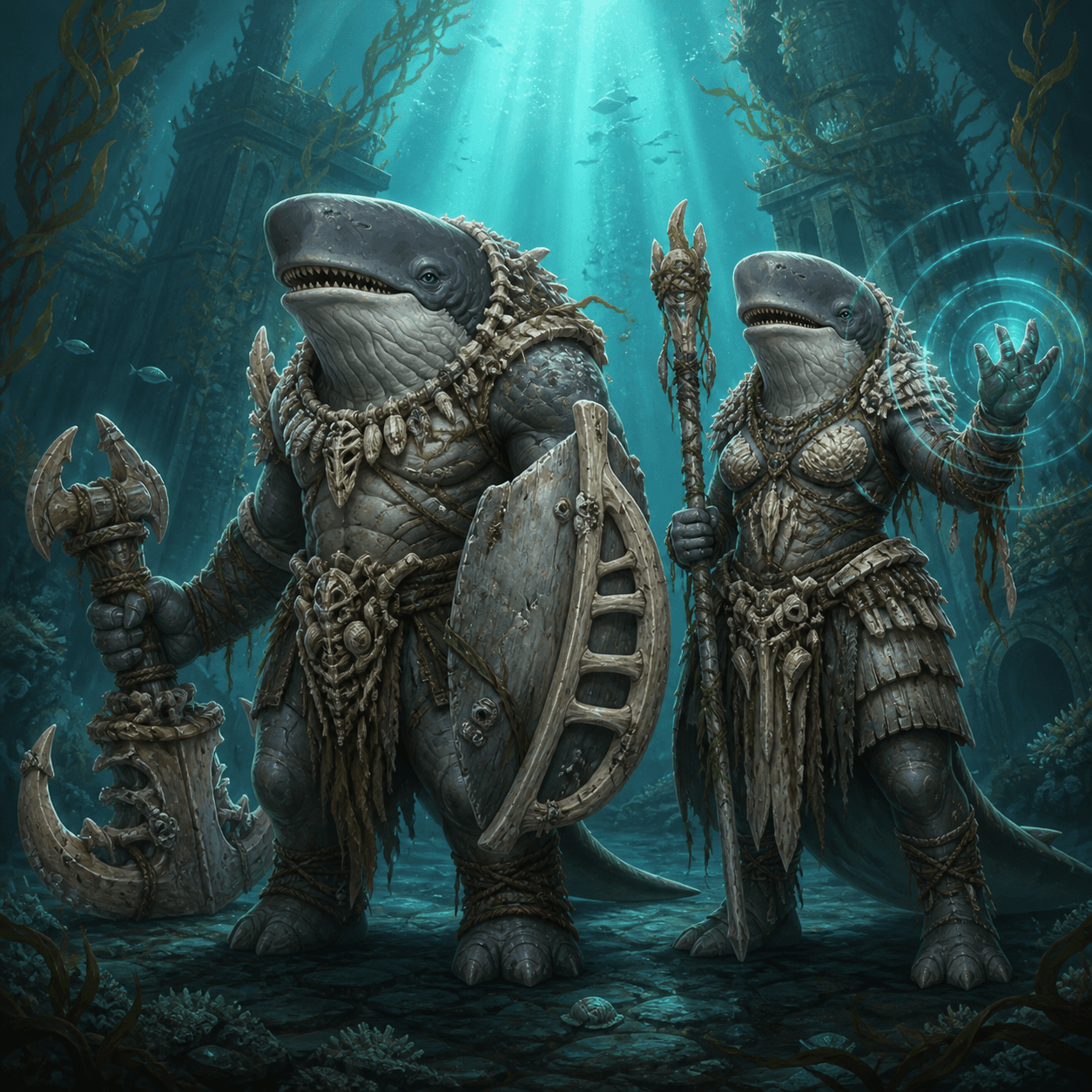
Sea-Folk (Water)
Whale Folk
Chison
The Memory-Keepers
Lore
The Chison are the memory-keepers of the ocean. While others fight for territory or trade routes, the Whale Folk fight for continuity. They believe that if a song is forgotten, the history it held ceases to exist - and that a history that does not exist never happened at all.
Their civilization is not built on stone or coral, but on the remains of their own kin. Their cities are Ossuaries of Life - domes and spires sculpted from the colossal bones of ancestors, sung into shape by Bone-Mages over decades. To live within the rib-arch of a great-grandmother is not morbid to a Chison; it is the ultimate embrace of family. The dead do not leave. They become the walls.
Social Structure. The Three Harmonies
Chison society is organized into three orders - the Bone-Singers (makers and osteomancers who shape the bone-cities and the Leviathan Vessels), the Song-Wardens (defenders), and the Lore-Keepers (historians who carry Memory Bones). Most Whale Folk dedicate themselves to one Harmony in adulthood; leaving one requires a public, often painful explanation.
Homeland: The Three Cities and their bone-ossuary pods
Allies: Dolphin Folk (Chisan) - the only outsiders permitted to attend the Great Song
Enemies: Shark Folk (Chisin), who raid the sacred nurseries
Lore & Background
The Chison are the memory-keepers of the ocean. While others fight for territory or trade routes, the Whale Folk fight for continuity. They believe that if a song is forgotten, the history it held ceases to exist - and that a history that does not exist never happened at all.
Their civilization is not built on stone or coral, but on the remains of their own kin. Their cities are Ossuaries of Life - domes and spires sculpted from the colossal bones of ancestors, sung into shape by Bone-Mages over decades. To live within a rib-arch of a great-grandmother is not morbid to a Chison. It is the ultimate embrace of family. The dead do not leave. They become the walls.
Social Structure. The Three Harmonies
Chison society is organized into three distinct orders - called Harmonies - that maintain the balance of their people. Most Whale Folk dedicate themselves to one path upon reaching adulthood. Switching Harmonies is not forbidden, but it requires publicly explaining why you are leaving, which is considered deeply personal and often painful.
1. The Bone-Singers (The Makers)
The artisans, osteomancers, and engineers who practice the shaping of bone through sustained harmonic resonance.
Philosophy. Matter is not fixed. It is a song waiting to be completed. To build is to give the dead a new voice.
Role:
Constructing and maintaining the bone-cities through ongoing Osteomancy
Engineering the Leviathan Vessels
Creating and maintaining Memory Bones
Forging Current-Forged weaponry from harvested deep-ocean minerals
Initiation Trial. The First Shaping. Candidates are given a single whale vertebra and must sing it into a new form - a tool, a weapon, a vessel, a structure - using only their voice and three days of sustained effort. The result doesn't need to be perfect. It needs to be true - the judges listen for whether the song reflects the singer's genuine intent or is merely an imitation of technique.
Taboo. Dissonance. Creating something false - a forgery, a structurally dishonest building, anything that looks like one thing and is another - is a spiritual crime. The Bone-Singers consider it a violation of the dead whose bones they use. The ancestors did not die to become lies.
2. The Song-Wardens (The Shield)
The martial defenders, Leviathan pilots, and peacekeepers who guard the pod against the dark.
Philosophy. The ocean is vast. The pod is small. The Shield must be harder than the crushing dark.
Role:
Guarding nurseries and migration lanes
Piloting and crewing the Leviathan Vessels
Hunting Kraken-Cults and deep-predator threats
Enforcing Gerontocracy decrees
Initiation Trial. The Deep-Dive. Candidates must descend alone to the deepest point they can reach - no equipment, no support - and return with proof of what they found there. The proof doesn't have to be physical. A Warden who descends far enough and returns singing a song that other Wardens recognize as truthful (there is a quality to it they call the Deep-Note) passes. One who returns with a fabricated story does not.
Taboo. Silence. A Warden who fails to sound the alarm, who sees danger and says nothing, who knows a truth that could protect the pod and withholds it - this is the cowardice that gets people killed. Wardens must always be "loud" in defense. Even a Warden who has done something wrong is expected to confess it clearly rather than let it fester quietly.
3. The Lore-Keepers (The Memory)
The scholars, teachers, archivists, and historians who preserve the Great Song and ensure no piece of it is ever lost.
Philosophy. You are the sum of those who came before. If you forget them, you cease to exist.
Role:
Curating the Ancestral Archives
Teaching the young the full text of the Great Song
Advising the Elders on historical precedent
Handling the most sacred Memory Bones
Adjudicating disputes by citing ancient record
Initiation Trial. The Seven-Year Memory. Candidates spend seven years doing nothing but learning - history, song, migration patterns, treaty texts, the names of the dead going back thirty generations. At the end, they are tested not by written examination but by a panel of Elders who ask questions at random for three days straight. A single wrong answer fails the trial. Candidates who fail may try again. The record for attempts before passing is nine.
Taboo. The Broken Chain. A Lore-Keeper who loses a Memory Bone, allows a piece of history to be forgotten, or - worst of all - deliberately alters a historical record has committed the most serious crime in Chison culture. The sentence is the Silence - a formal, public ceremony in which the offender is declared to have never existed. Their name is removed from the Great Song. They become a ghost while still living.
MAGIC & TECHNOLOGY
Memory Bones
The Chison's most sacred magic and most valuable export.
What They Are:
Specially prepared bone fragments - usually scrimshawed vertebrae or ribs - that have been infused with the memories of a specific individual through a Bone-Singer ritual performed at or just after death. The memories are not copied or summarized. They are transferred - the specific sensory experience of witnessed events encoded into the bone's structure.
How They Work:
A Chison (or trained non-Chison) holds the bone and enters a meditative state. The bone plays back a specific memory - chosen during the encoding - in full sensory detail. The holder does not experience the memory as themselves; they experience it as the original owner. They feel what was felt. They see what was seen.
Value:
Perfect, unaltered historical records
Irreplaceable navigation data for lost routes
Legal evidence in treaty disputes
Deeply sought by surface scholars, Druaecül archivists, and Chasün spies
Black market price is extraordinary
The Ethical Problem:
The Chison encode only memories that the dying individual consented to share. The idea of encoding someone's memories without consent, or stealing a Memory Bone and accessing its contents, is considered as violating as desecrating a grave - the person is still in the bone, in a meaningful sense. Chasün spies who steal Memory Bones for surface clients are among the most despised figures in Chison culture.
The Leviathan Vessels
The greatest warships in the known ocean - 300 to 400 feet long, engineered from the harvested skeletons of titan-whales, sung into structural integrity by Bone-Mages over years of careful work.
The Resonance Shell (The Helm):
There is no wheel, no rudder, no mechanical steering. The ship is navigated through a massive spiraling nautilus fossil inscribed with bio-runes, positioned at the vessel's center of gravity. The shell reads the collective knowledge of the crew - their understanding of currents, biology, weather, and the ocean's personality - and translates it into movement.
A crew of experienced Chison makes a Leviathan dance. A crew of ignorant surface-dwellers cannot move it at all. This is the ship's greatest security feature.
The Solar Lenses (The Eyes):
The massive red glass discs set into the Leviathan's "face" are not decorative. They absorb concentrated sunlight when the ship surfaces - a process that requires 20 minutes of direct exposure - and store it as charged solar energy. In combat, they release this charge as two sustained beams capable of boiling water in a 10-foot radius and cutting through heavy metal.
Limitation. A Leviathan must surface to recharge. Extended deep-water combat depletes the lenses. Skilled Sandrü admirals know this and try to engage Leviathans in deep, dark water.
The Sonic Decimator (The Mouth):
The ship's prow focuses the crew's combined vocal power into a directed concussive shockwave. The crew must sing together - the same note, the same intent, the same target - and the resulting blast doesn't strike the enemy so much as unmake the space between them and the hull.
The Psychological Weapon. The sound of a Leviathan preparing to fire its Decimator is described as "hearing the ocean decide to kill you." Several Sandrü Coral-Lancers have broken formation simply from the sound.
Weakness:
The Leviathan's bone construction is its structural foundation and its limitation. Direct ram strikes against the bone-hull can crack it in ways that Bone-Singers cannot repair mid-battle. Sandrü Spine-Rams are designed to exploit the gaps between ribs. Chison admirals know this and keep Leviathans at range when possible.
Current-Forged Weaponry
Chison smiths work with metals harvested from deep ocean mineral vents, forging them under specific tidal conditions that alter their molecular structure. The resulting weapons are:
Heavier than surface equivalents (the deep ocean pressure is literally in the metal)
Self-sharpening at extreme depth (the pressure differential keeps the edge)
Resonant - they hum faintly in the presence of Osteomantic magic, which makes them both useful tools for Bone-Singers and extremely unsettling for enemies
THE THREE CITIES
Zilaesan (The Ancestral Seat)
Role. Cultural and Spiritual Capital
Location. Southern East - the warmest deep water in Chison territory
Description:
The oldest of the three cities and the most sacred. Zilaesan is built from the bones of the First Pod - the original Chison who, according to the Great Song, were the ancestors of all Whale Folk alive today. Every major arch, every supporting pillar, every dome is a named individual with a Memory Bone embedded in the structure.
To walk through Zilaesan is to walk through a genealogy. Lore-Keepers have memorized which bone belongs to which ancestor and can deliver a full biography at any point in the city.
The Great Archive:
The central structure of the city - a cathedral of interlocking whale ribs the size of a small mountain, containing the complete Ancestral Archive. Every Memory Bone ever recorded is stored here, catalogued by the Lore-Keepers across generations. The outer walls are covered in scrimshaw text - the visible portion of the Great Song, carved in script so small you need to press your face to the bone to read it.
The Hall of Last Songs:
Where Chison come to die, if they can. The Hall is attended constantly by Bone-Singers who wait to receive the dying and begin the encoding process before the memory fades. It is considered deeply honored work - and deeply sorrowful.
Current Conflict:
Zilaesan's Lore-Keepers have become increasingly conservative and insular since the cooling with the Druaecül. They believe the Library Exchange was a mistake that gave outsiders access to records that should have remained internal. Several have argued that Memory Bones belonging to individuals who interacted closely with Druaecül should be sealed from general access - "contaminated" by the relationship. The Bone-Singers think this is historically reckless. The Song-Wardens don't care either way, which means no consensus is forming.
Zilaesen (The Trade Hub)
Role. Commerce, Surface Relations, and External Diplomacy
Location. Southwest - near volcanic ridge, close to Sandrü-adjacent shipping lanes
Description:
The most outward-facing Chison city. Zilaesen is where the Whale Folk do business with the rest of the world. The architecture here is newer, less dense with ancestor-bones, more functional. It unnerves traditionalists from Zilaesan, who view it as "half-built."
The city's outer district is called The Listening Quarter - a neutral zone where surface merchants, aquatic traders from a dozen peoples, and (quietly) occasional Druaecül representatives can conduct business under Chison protection. Violence in the Listening Quarter is punishable by permanent exile from all three cities.
The Memory Exchange:
The city's most valuable institution and most controversial. Here, Memory Bones are assessed, catalogued, and - for approved parties - licensed for access. The Exchange makes the Chison extraordinarily wealthy by surface standards. It also makes them targets. The Chasün (Octopus Folk) have been running extraction operations against Exchange couriers for decades.
The Whale-Market:
Exports: from all three cities converge here - Current-Forged weapons, bioluminescent pearls, deep-sea salvage, and (most valuably) guided access to ancient migration routes mapped in Memory Bones. Ships that hire a Chison navigator gain access to knowledge no chart can replicate.
Current Conflict:
The Song-Wardens of Zilaesen have documented seventeen Memory Bone thefts in the past decade, all attributed to Chasün agents. They want authorization for offensive action against Chasün infrastructure. The Elders keep delaying, citing insufficient evidence of state involvement. The Song-Wardens consider this deliberate blindness.
Zilaeson (The Military Bastion)
Role. Defense, Patrol, and Leviathan Operations
Location. Central North - covering the deep trench approaches and northern migration lanes
Description:
The most austere of the three cities. Zilaeson has the fewest ancestor-bones in its construction - not from disrespect, but because it is built to be rebuilt. A city designed for war cannot afford structures too sacred to sacrifice.
The three drydocks that house the Leviathan fleet are the largest engineered spaces in the ocean. Watching a Leviathan being sung into existence - the Bone-Singers working for months in shifts, their voices gradually reshaping dead bone into something that moves - is considered one of the great experiences available to a living creature.
The Deep-Dive Courts:
Where Song-Warden initiates attempt their trials, and where the most difficult ones are formally witnessed. The city keeps careful records of every Deep-Dive attempt - depth reached, what was found, the quality of the return song. These records go back 800 years.
The Silence Hall:
Where those condemned to the Silence - declared to have never existed - are sent to live out their days in the company of others similarly condemned. It is not a prison. They are free to leave, to travel, to do as they wish. They simply no longer exist within the Great Song. No Chison will speak their name. No Bone will be made for them. When they die, they die unremembered.
Most do not leave. Some find purpose in serving the city in tasks no one wants to claim. Some simply stop eating. The Silence Hall is the quietest place in the Chison world.
Current Conflict:
Zilaeson's Song-Wardens have been advocating for years for a formal military response to the Shark Folk (Chisin) nursery raids. The Elders have authorized "defensive measures only." Zilaeson's commanders interpret "defensive" expansively. They have begun embedding Song-Wardens in nursery sites weeks before expected raids - waiting. Not pursuing. Waiting.
CULTURE SNAPSHOT
Homeland: Ocean Shelf (SE), Deep Trenches (N), Volcanic Ridges (SW)
Government: Gerontocracy - rule by the Eldest. A council of the oldest living Chison from all three Harmonies convenes for major decisions. Individual Elders hold enormous informal authority. The very old are treated with a reverence that approaches worship, because they carry more of the Great Song than anyone else alive.
Exports:
Current-Forged weaponry (most valued by surface warriors)
Scrimshaw (art objects with embedded historical text)
Bioluminescent pearls (living - they continue to glow after harvest)
Deep-sea salvage (they know where everything in the ocean sank)
Licensed Memory Bone access (the most valuable export, tightly controlled)
Imports:
Surface steel for alloy experimentation
Rare spices (considered exotic and pleasurable)
Magic scrolls and surface texts (compared against Memory Bone records for accuracy)
Vellum and ink (for surface-compatible record-keeping alongside bone)
Diet:
Nutrient-rich algae paste (staple - the equivalent of bread)
Deep-sea krill (farmed in vast underwater kelp-corridors)
Farmed kelp-groves (dozens of cultivated varieties)
Delicacy. Memory-Marrow Broth - bone broth made from non-encoded animal bones, prepared with specific deep-trench minerals. Said to improve recall. Whether this is real or ritual, no one has definitively established.
Society:
Collective memory over individual glory. A Chison who does something remarkable is honored - but the honor accrues to the pod, not just the person. A Chison who does something remarkable and tries to claim exclusive credit is viewed with suspicion. The question "who taught you?" is the most important one in any introduction. Your lineage of teachers is your identity.
Buildings:
Bone-architecture. arches, domes, and spires built from ancestor remains. Older structures are denser with bones; newer ones have more engineered gaps. Everything is oriented toward sound - the acoustics of a Chison building are as important as its visual design. A room that doesn't carry a voice properly is a badly built room.
Allies:
Dolphin Folk (Chisan). Scouts, messengers, and the most trusted non-Chison in the ocean. The alliance is ancient and warm. Dolphin Folk are permitted to attend Great Song recitals - one of the highest honors extended to outsiders.
Druaecül. Old alliance, now cold. Both sides know they are stronger together. Neither side has found a way back from Vessel Ith'eryn's treatise.
Enemies:
Shark Folk (Chisin). Ancient enemies who raid nurseries. The Chison view this not as war but as ongoing atrocity. The Shark Folk view it as resource acquisition. The gap between these interpretations has never narrowed.
Kraken-Cults. Any organization that worships the void of the deep abyss as a force that should unmake history is existentially opposed to everything the Chison are. Song-Wardens have standing authorization to engage Kraken-Cult infrastructure on sight.
Chasün (Octopus Folk). Not enemies exactly - but Memory Bone thieves and information brokers who treat Chison history as a commodity. The relationship is one of deep mistrust and occasional open conflict.
Taboos:
Altering a Memory Bone (the greatest crime)
Selling Memory Bone access without authorization from the Lore-Keepers
Silence in defense (a Song-Warden who says nothing when they should speak)
Claiming a deed as yours alone without acknowledging your teachers and pod
The Name-Theft. Claiming the identity of someone condemned to the Silence, or speaking the name of the Silenced to give them false existence
History: The Fracture Points
The Sung Origin (Ancient Past)
The Chison believe they were sung into existence by the ocean itself - that the first great tidal surge carried a harmonic frequency that caused matter to organize into the first Whale Folk. Whether literally true or mythological, this belief shapes everything. The ocean is not their environment. It is their parent. Harming it carelessly is not just foolish; it is a form of parricide.
The Golden Age (1,200 Years Ago)
The Library Exchange with the Druaecül. Both peoples were richer for it - Chison oral history gained objective verification; Druaecül data records gained emotional context. This period produced the most accurate historical record of the pre-Dragon War ocean that currently exists.
Most of these records were destroyed in the Second War.
The Chison do not speak of this calmly.
The Great Loss (The Second War, 1,500 Years Ago)
When Talsazer orchestrated the Second War to destroy knowledge, the Chison were not direct targets - but the destruction of the Library Exchange records affected them enormously. Decades of Memory Bone copies, held in Druaecül Aethryl Chronicles, were lost.
The Lore-Keepers have never fully accounted for what was destroyed. There are gaps in the Great Song - places where the record simply stops, resumes, and the middle is gone. These are called the Silent Passages, and Lore-Keepers dedicate careers to reconstructing them through cross-referencing other sources.
The Chison do not know Talsazer was responsible. They believe the records were destroyed in the war itself. Learning the truth - that the destruction was deliberate, engineered, targeted - would be among the most radicalizing revelations available to the Great Song's keepers.
The Cooling (300 Years Ago)
Druaecül scholar Vessel Ith'eryn published a treatise arguing that Memory Bones were "emotionally biased" historical records compared to Aethryl Chronicles.
The Chison Response. Devastating silence. The Lore-Keepers formally ended the Library Exchange. Not with anger - with the kind of quiet that precedes a permanent decision.
The Bone-Singers' View. We create the dead a voice. You call it bias. What do you call a pane of glass that shows you the world but cannot feel it?
The Song-Wardens' View. We will not defend our memory to those who have never carried a bone.
Current State. The Chison and Druaecül cooperate against existential threats. They do not trust each other. Individual friendships exist. Institutional warmth does not.
The Nursery Raids (Ongoing)
The Shark Folk have raided Chison nurseries for as long as records exist. The reasons are disputed - the Chisin view the deep nursery zones as territory they predate on by right; the Chison view the nurseries as sacred and the raids as atrocity.
The Elders have historically responded with defensive measures and diplomacy. Zilaeson's Song-Wardens have been implementing their own doctrine for years.
Something is building. The Elders are old enough to remember the last time Something Built reached its conclusion. They are slowing things down. But they are also tired.
The Druaecül Problem (Present Day)
The Chison have recently discovered that Vessel Ith'eryn's treatise - the text that ended the Library Exchange and fractured the oldest alliance in the ocean - contained fabricated citations.
Three of the four historical examples Ith'eryn used to argue Druaecül objectivity were altered. The Aethryl Chronicles Ith'eryn cited were real. The contents attributed to them were not.
Whether Ith'eryn acted alone, was manipulated, or was part of a deliberate plan to fracture the Druaecül-Chison alliance is unknown. A Lore-Keeper named Elder Sorevoss has been quietly investigating for six years. She has not yet brought her findings to the Elders - she is still trying to establish motive. But she is close.
If the truth comes out, the question of who benefits from a fractured ocean alliance will need answering.
Checking your codex…
From the Reth Ancestries (Daggerheart) compendium. Ancestry mechanics unlock when you collect this lineage in Hoard and link your account.