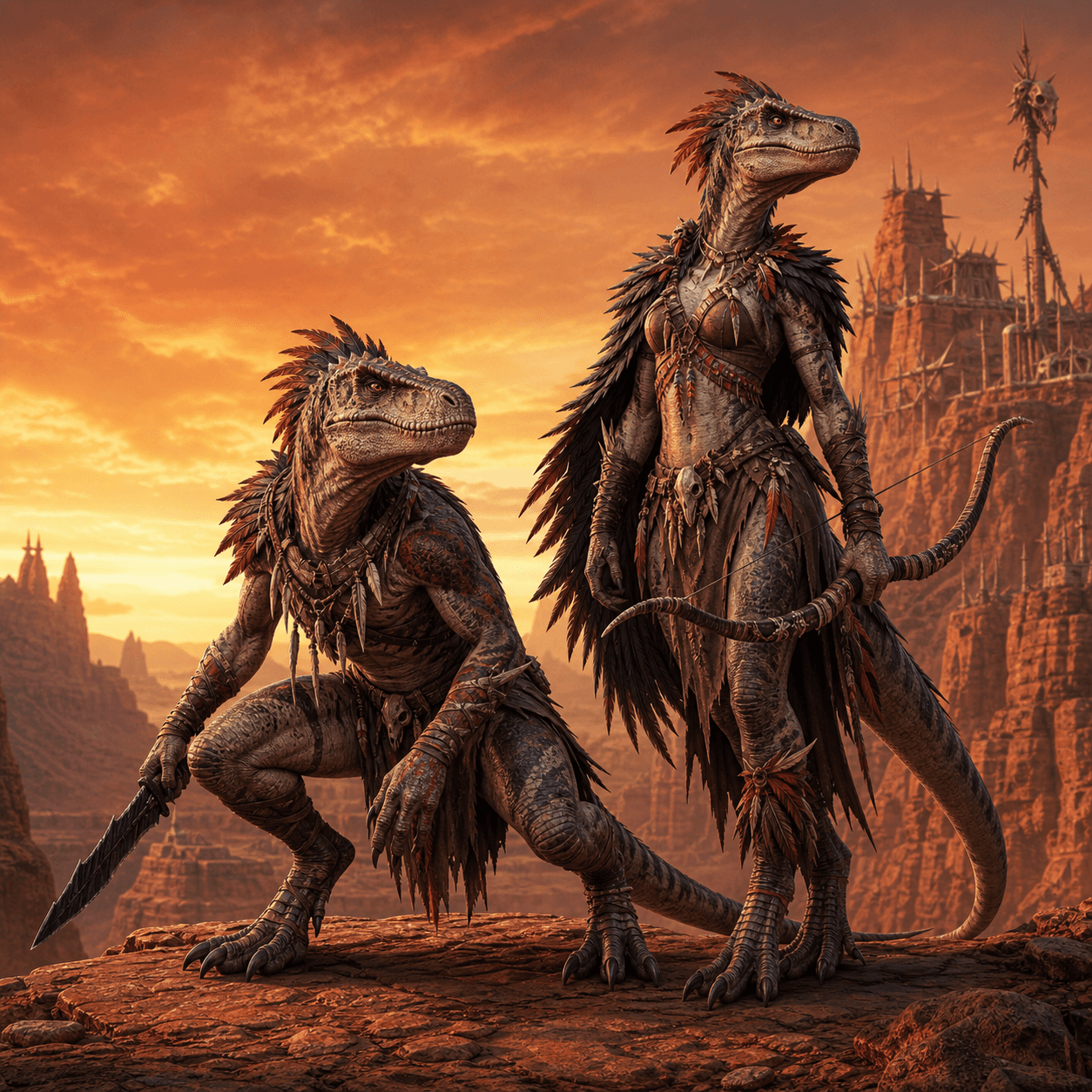
Saurids
Therapod
Draegul
Background Questions
What tribe forged you into who you are?
Who do you hope Tyrannax remembers when your story ends?
Which rival chief do you want to surpass?
What hunt defined your youth?
Lore
Draegul society is competitive, but not random. They respect strength and dominance, but they also build rules around those instincts so their people don't tear themselves apart. The end result is a culture where contests are constant, but most of them are controlled: leadership challenges, hunt claims, and formal trials that decide status without forcing a civil war every season.
They worship Tyrannax, the many-toothed God of War, and they do not spread their devotion around other gods. Strength is treated as proof of favor. Victory is treated as clarity.
Draegul are organized into two related forms:
Roving warbands that travel across the southern ranges and badlands, following prey, staging raids, and moving before a region collapses from overhunt.
Fortress clans hold permanent lodge-fortresses such as Bone-Lash, Fang-Ridge, and Ember-Hunt. These clans smoke meat, maintain armories, and act as supply anchors and meeting grounds for warbands.
That split solves an evolutionary problem. large carnivore societies can't stay static everywhere without stripping territory. Warbands keep them fed; fortress clans keep them equipped and coordinated.
Leadership is decided in two ways:
Formal challenge. a recognized trial. If a leader is defeated, they are expected to submit. They can live, but they lose authority. Refusal often means exile or death depending on the leader and the warband.
Battlefield coup. if leadership is taken during real combat, it's usually lethal and treated as "strength decided it."
They sometimes take prisoners and they often take trophies. Prisoners are practical - ransom, labor, information, or trade leverage depending on the band's needs. Trophies are status markers and memory-keeping in a culture that values visible proof.
Their one hard taboo is breaking guest-right. Draegul will make temporary truces, accept host banners, and take shelter or food under negotiated terms - especially with allies like Orcs. Attacking inside that protection is considered disgraceful and invites retaliation even from other Draegul.
They trade and raid with Orcs and sometimes Goblinkin. The relationship with Orcs is functional: shared raids, trade, and a mutual hatred of Elves. Draegul warbands bring meat and trophies; Orcs and Giants supply forged weapons and armor when it benefits them.
They speak Common and Aldaedra. Draegul Aldaedra is fast and clipped, built to carry in wind and battle noise.
Homeland: (Capital)
Ember-Hunt - the primary fortress seat and the biggest gathering point for the south.
Cities
Lore & Background
Draegul society is competitive, but not random. They respect strength and dominance, but they also build rules around those instincts so their people don't tear themselves apart. The end result is a culture where contests are constant, but most of them are controlled: leadership challenges, hunt claims, and formal trials that decide status without forcing a civil war every season.
They worship Tyrannax, the many-toothed God of War, and they do not spread their devotion around other gods. Strength is treated as proof of favor. Victory is treated as clarity.
Draegul are organized into two related forms:
Roving warbands that travel across the southern ranges and badlands, following prey, staging raids, and moving before a region collapses from overhunt.
Fortress clans hold permanent lodge-fortresses such as Bone-Lash, Fang-Ridge, and Ember-Hunt. These clans smoke meat, maintain armories, and act as supply anchors and meeting grounds for warbands.
That split solves an evolutionary problem. large carnivore societies can't stay static everywhere without stripping territory. Warbands keep them fed; fortress clans keep them equipped and coordinated.
Leadership is decided in two ways:
Formal challenge. a recognized trial. If a leader is defeated, they are expected to submit. They can live, but they lose authority. Refusal often means exile or death depending on the leader and the warband.
Battlefield coup. if leadership is taken during real combat, it's usually lethal and treated as "strength decided it."
They sometimes take prisoners and they often take trophies. Prisoners are practical - ransom, labor, information, or trade leverage depending on the band's needs. Trophies are status markers and memory-keeping in a culture that values visible proof.
Their one hard taboo is breaking guest-right. Draegul will make temporary truces, accept host banners, and take shelter or food under negotiated terms - especially with allies like Orcs. Attacking inside that protection is considered disgraceful and invites retaliation even from other Draegul.
They trade and raid with Orcs and sometimes Goblinkin. The relationship with Orcs is functional: shared raids, trade, and a mutual hatred of Elves. Draegul warbands bring meat and trophies; Orcs and Giants supply forged weapons and armor when it benefits them.
They speak Common and Aldaedra. Draegul Aldaedra is fast and clipped, built to carry in wind and battle noise.
Homeland: (Capital)
Ember-Hunt - the primary fortress seat and the biggest gathering point for the south.
Cities
Ember-Hunt (Homeland/Capital)
A fortress-lodge with major contest grounds, armory stores, and the largest smokehouse network. Warbands gather here for trials, planning, and resupply.
Fang-Ridge
A ridge-fort controlling passes and training grounds. Known for ambush drills, patrol dominance, and aggressive border posture.
Bone-Lash
A hardhold built around smokehouses and raid staging yards. Prisoners are most often held here for ransom/trade, and supplies are stockpiled for long runs.
Society: structure (locked)
Fortress clans hold and maintain the three major seats and keep armories, smokehouses, and winter stores.
Roving warbands range across the south and sometimes the mainland, following prey and opportunity, returning to fortress seats to resupply, compete, and settle leadership disputes.
Central Site
The Tooth-Pit of Tyrannax
A regulated fighting pit and trophy ground used to settle status and leadership disputes without splintering the people into constant blood-feuds.
Outsider escalation: ladder
Test before talk (they size you up; they want proof you're not prey).
Host mark if parley is granted; while it stands, you're under guest-right.
Hard terms are normal; they respect direct offers and direct refusals.
Break terms publicly and retaliation is immediate and meant to be seen.
Respect guest-right and they'll still pressure you, but they won't strike under the host mark.
Truce-breaking or hatchling harm makes you a hunted example.
Internal conflicts
Warbands vs fortress clans. freedom and glory versus stability and supply.
Prisoners vs trophies. ransom leverage versus status kills.
Orc/Goblinkin partnerships. useful alliances, but constant tension around pride and who "owes" whom.
Trade (locked)
Exports: Jerky, spiced cured meats
Imports: Forged weapons and armor from Orcs and Giants
Allies: Orcs (shared raids, trade, mutual hatred of Elves)
Enemies: Elves
Deity. Tyrannax only
Exports: Jerky, and Spiced Cured Meats
Imports: Forged weapons and armor from Orcs and Giants
Diet: Meat, spiced ale
Allies: Orcs
Enemies: Elves
Checking your codex…
From the Reth Ancestries (Daggerheart) compendium. Ancestry mechanics unlock when you collect this lineage in Hoard and link your account.