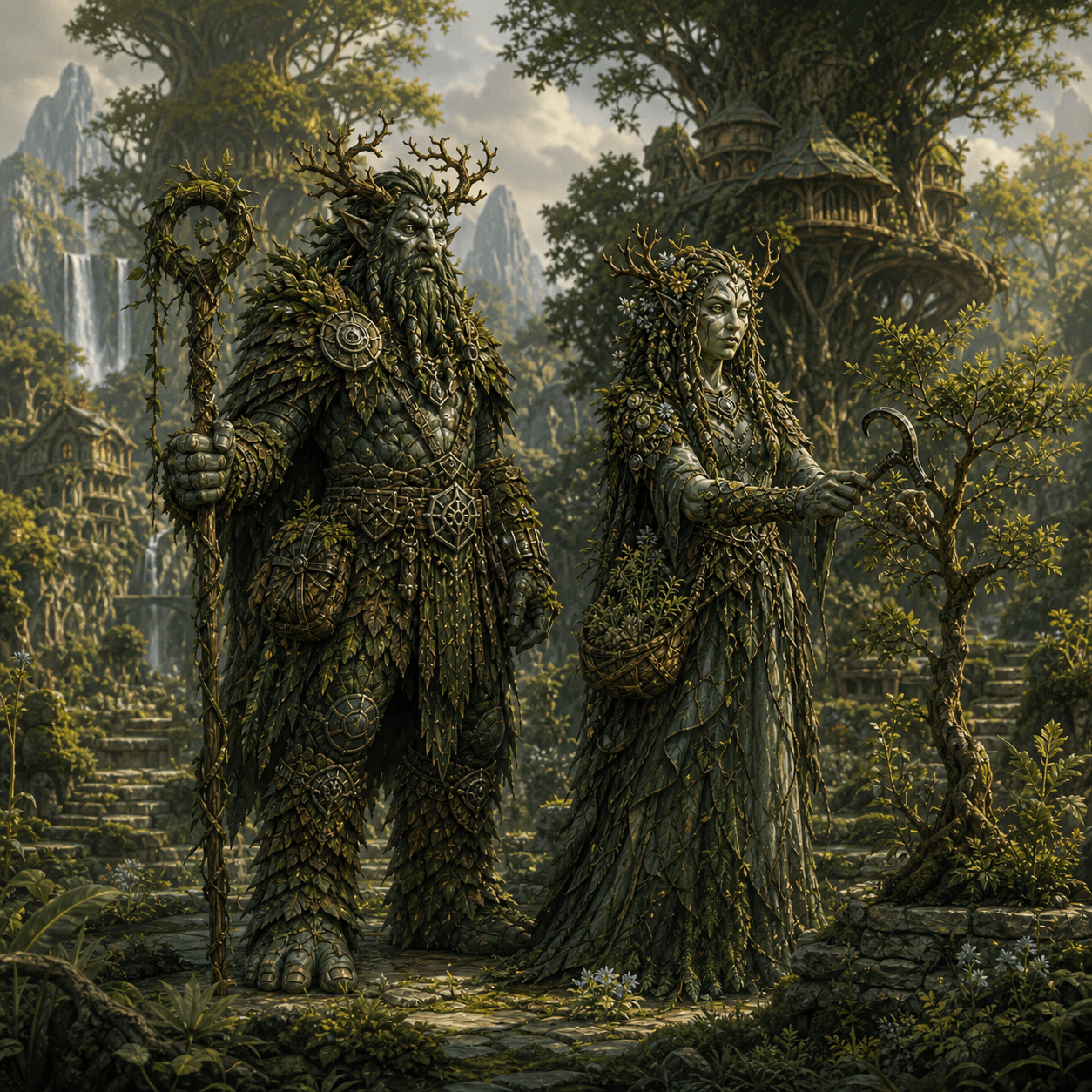
Giantkin
Firbolg
Thuaedor
Background Questions
1. Who raised you in the deep forest?
2. What grove shaped your beliefs?
3. What wound did you heal that changed you?
4. What tree do you dream of still?
Lore
Firbolg keep their strength quiet. Their longhouses are hidden under canopy and ridge-shadow, and their leaders are chosen through ritual consensus - elders, oath-keepers, and grove-speakers weighing what keeps the land healthy. Their pantheon follows the shape of old grove faiths: river-mothers, stag-lords, hearth spirits, and ancestor stones, honored with offerings that leave no scar.
Homeland: Deep glens, mist-valleys, and standing-stone highlands where forest meets mountain.
Government: Grove-Circles led by elder stewards and ritual speakers. Leadership is earned by service - keeping the paths safe, settling disputes, and maintaining the seasonal rites.
Society: Pastoral wardens and boundary-keepers. Firbolg culture is communal, with strong notions of guest-right and land stewardship. They are culturally allied with dwarves (shared borderworks and trade), but their identity is rooted in groves and stones rather than forges.
Buildings: Hillforts, earth-ring commons, standing-stone courts, and timber-and-stone halls. Settlements are designed to blend - roads curve, walls follow old roots, and public spaces are built around a central hearth grove.
Religion: A Firbolg pantheon patterned after old grove-rites. Outsiders often treat these as seasonal faces of familiar gods:
• The Hart-Lord - God of Forest and Safe Hunt
• The River-Mother - God of Waters, Oaths, and Passage
• The Hearth-Flame - God of Fire, Craft, and Shelter
• The Stone-Keeper - God of Hills, Graves, and Memory
Law. Guest-Right and Grove-Boundary. What you take must be replaced; what you swear must be kept; what you shelter must not be betrayed.
Cultural Taboo (Exile Crime). Grove-Breach - spilling blood in a consecrated grove or cutting a sworn-protected tree.
Trade:
Export: timber-haul teams, herbal medicines, rope and resin craft, standing-stone surveying, safe-pass guides
Import: worked metal fittings, salt, preserved grains, paper and dyes
Lore & Background
Firbolg keep their strength quiet. Their longhouses are hidden under canopy and ridge-shadow. They do not announce themselves if they can avoid it. This is not timidity - it is a considered position. The forests they inhabit have their own balance, and every outside presence that enters uninvited is a disruption to it. Firbolg are its guardians. Not by ambition. By the straightforward logic that someone has to be, and they were already there.
They would rather be left alone. When something threatens the groves or the people sheltered inside them, Firbolg act with a thoroughness that surprises anyone who only encountered the quietness first. Both things are genuine. The gentleness and the capability behind it are not in contradiction.
Role in Aldaedro Society
Firbolg hold the green edge of Aldaedro territory - where highland meets old forest and the land requires different attention than stone and pass. Their Grove-Circles maintain the ecological health of regions the other Aldaedro peoples depend on for timber, water, and forage. This service is rarely named directly by the others. Firbolg notice. They do not make an issue of it.
Social Structure & Upbringing
Firbolg society runs through Grove-Circles - consent-based communities built around a specific piece of land that the Circle has sworn to steward. Leadership is earned through service: keeping paths safe, settling disputes, maintaining the seasonal rites. Elder stewards and ritual speakers carry the most weight, but authority is local and no one person rules the whole.
Guest-right is sacred. Offering shelter and food is not hospitality in the casual sense - it is extending the Grove's protection to someone, which carries real obligations for both sides. Violated hospitality is treated as a wound to the grove itself. A Firbolg who breaks guest-right has committed something close to a spiritual desecration. The guest who violates it has done the same.
Firbolg children learn obligation early - what the Circle owes the land, what the land gives back, what a sworn commitment actually means when tested. Coming of age is the Grove Oath: a public declaration of what the young Firbolg commits to giving and protecting, witnessed by the Circle and recorded. Vague promises are not accepted. The Oath must be specific.
Appearance
Firbolg are large - seven to nine feet - and built with a heaviness that reads as solidity rather than bulk. Skin runs through earthy tones: deep green-brown, mossy grey, warm clay-red. Hair is often grown long and carries plant matter worked into it - not decoration, but functional. Carried seeds, medicinal samples, markers of the specific grove they tend.
They move quietly for their size. Not trained quietness - habitual quietness, from a lifetime in forest environments where noise is disruption. Their tools and clothing are built for longevity over appearance. Something that looks old in a Firbolg's hands has almost certainly been maintained for decades.
Religion: & Philosophy
The Firbolg pantheon follows old grove-rites - many named powers, each tied to a specific duty. Outsiders treat them as seasonal faces of familiar gods, and Firbolg priests speak in equivalences rather than exclusivity. Aelmora is Thüosh is the forest living. The name used reflects what aspect of that force is being addressed. The multiplicity is not confusion. It is precision.
Death is ecological. The dead return to the land. Burial practices involve specific plantings over the grave site - the choice of plant reflects what the dead person gave to the grove in life. Firbolg who have died well are buried in places where something needed to grow.
Relationships with Other Ancestries
The Druazer are a genuine partner - Dwarves who work stone without diminishing the forest and deal in materials rather than extraction. The relationship with the Aldaecir (Treefolk) is the deepest bond Firbolg maintain outside their own people: shared forest stewardship, overlapping sacred traditions, the shared experience of being people for whom the land is not background but kin.
Within the Aldaedro, the Giant relationship is the warmest. Both peoples are comfortable with deep time and old things. With Orcs there is practical respect and genuine warmth in specific friendships, even when the cultures pull differently. With Cragborn, little regular contact and no friction.
Blight-makers, illegal loggers, and anyone who burns groves for profit are consistent enemies. Firbolg do not maintain dramatic enmities. They maintain long, specific memories for specific harms, and they act on them when the time is right.
Military Presence
Firbolg do not project force outside their territory. What they have is wardens - Circle members oath-bound to the defense of their grove - and the knowledge of people who have spent their lives in a specific piece of forest. Fighting an entrenched Firbolg defense in old-growth they know better than anyone is one of the worst tactical decisions available. The historical examples are used to teach what not to attempt.
They export trained wardens who work under specific contracts - the Grove Circle must ratify any extended service, and the contracts are explicit about what the warden will and will not be asked to do. Firbolg mercenaries are uncommon. Firbolg wardens protecting something worth protecting are among the most reliable specialized defenders in Reth.
Cultural Traits
What you take must be replaced. What you swear must be kept. What you shelter must not be betrayed. These three rules cover most of what Firbolg culture does and does not permit. The rest is elaboration. Firbolg who have left their Grove-Circles carry those commitments with them and apply them to whatever they find worth protecting next.
Species Name. Thuaedor
Homeland: Metsa and the green borders of Vuori - deep glens, mist-valleys, standing-stone highlands where forest meets mountain
Government: Grove-Circles led by elder stewards and ritual speakers. Authority is local and consent-based.
Law. Guest-Right and Grove-Boundary. What you take must be replaced. What you swear must be kept. What you shelter must not be betrayed.
Exile Crime. Grove-Breach - spilling blood in a consecrated grove or cutting a sworn-protected tree.
Export: Timber-haul teams, herbal medicines, rope and resin craft, standing-stone surveying, safe-pass guides
Import: Worked metal fittings, salt, preserved grains, paper and dyes
Racial Allies: Druazer (Dwarves), Druthal Metsa courts, Aldaecir wardens
Racial Enemies: Blight-makers, illegal loggers, any force that burns groves for profit
Firbolg Pantheon (Grove-Rites)
The Hart-Lord - God of Forest and Safe Hunt
The River-Mother - God of Waters, Oaths, and Passage
The Hearth-Flame - God of Fire, Craft, and Shelter
The Stone-Keeper - God of Hills, Graves, and Memory
Checking your codex…
From the Reth Ancestries (Daggerheart) compendium. Ancestry mechanics unlock when you collect this lineage in Hoard and link your account.