Giantkin
Orc
Druaedor
Background Questions
1. What oath defines your identity?
2. Who forged your first weapon?
3. Which border did you guard in your youth?
4. Who did you disappoint - and why?
Lore
Orcs keep trail-laws older than most charters: rules for safe passage, fair toll, and what must be repaid when blood is spilled on a road. They live in forge-bands - mobile clans that can raise a defensible camp in a night and turn salvaged iron into working gear by morning. Their rites echo the wider pantheon, but in Orc-cast names and stories: the same forces, filtered through war and survival.
Homeland: Badlands and rugged borderlands - broken mesas, basalt flats, scrub hills, and the hard edges of desert and mountain where raiding once flourished and now trade caravans must be protected.
Government: Warclans led by a Chieftain (battle authority) and a Hearth-Elder (law and lineage). Major decisions are made in a Circle of Spears, where sworn witnesses can challenge a claim. The strongest voice is not always the loudest - victory is proved by deed and upheld by oath.
Society: Tribal, mobile, and merit-driven. Orcs measure a person by the burdens they carry and the promises they keep. Many clans hire out as road-guards or stone-haulers alongside dwarven crews; in mixed cities they often serve as masons, wardens, caravan captains, and sworn escorts. Adoption is common: outsiders can be "taken into the clan" through a binding rite and a public oath.
Buildings: Stockade-ring camps that can be raised fast, plus permanent longhalls at key passes and trade junctions. Stonework is practical - low walls, windbreaks, and heavy gates - often built in partnership with Druazer engineers.
Religion: Orcs honor the Circle's gods through clan-epithets and war-prayers. They most often call on Azirosh (Fire/War-Flame), Zorosh (Stone/Earth-Father), Thüosh (Forest/Root-Mother), Zerosh (Desert/Scouring Wind), and Narosh (Coast/Tide-Hunter). Their rites emphasize sacrifice of effort - work, sweat, and vigilance - rather than coin.
Law. The War-Path Code. Hospitality is owed to a declared guest, and blood-debt must be paid or balanced. Victory without witness is suspect; contracts are sealed before the Circle and remembered in scar and story.
Cultural Taboo (Exile Crime). Oath-Cutting - abandoning sworn kin in danger or breaking guest-right after accepting shelter. An oath-cutter is stripped of name and clan-mark and sent out alone.
Trade:
• Export: sworn road-guards, heavy-haul crews, leatherwork, bone-and-stone craft, scouting and escort services
• Import: grain, salt, worked tools, lamp oils, treated lumber for palisades and wagons
Lore & Background
Orcs came out of the frontier and stayed there. The broken mesas, basalt flats, and scrub hills at the hard edge of mountain and desert are where they built their forge-bands and tested their War-Chiefs - and where they still operate today. They keep trail-laws older than most charters: rules for safe passage, fair toll, and what must be repaid when blood is spilled on a road. Other peoples occasionally mistake this for simplicity. It is not simplicity. It is precision applied to the things that matter most.
Strength is currency, conflict is ritual, and the oath is the foundation everything else sits on. An Orc who breaks a sworn contract has not just failed a business arrangement. They have declared themselves unreliable at the level of identity, and the clan treats it exactly that way.
Role in Aldaedro Society
Orcs hold the edges. Their clan-camps sit where Aldaedro territory meets the wider world - the frontier margins where trouble arrives first. They are the early warning and the first response. The other Aldaedro peoples rely on this without always saying so. The Prime Council relied on it too, while they still attended. The Orc Moot stopped sending Speakers a generation ago. The Council's priorities had not matched the frontier's problems for long enough that the journey stopped making sense.
Social Structure & Upbringing
Orc society runs on the clan - a mobile band led by a Chieftain who holds battle authority and a Hearth-Elder who holds law and lineage. Major decisions go to the Circle of Spears, where any sworn witness can challenge a claim. Victory is proved by deed and upheld by oath. The loudest voice is not automatically the strongest one.
Adoption into a clan is common and treated as fully legitimate. An outsider who undergoes the binding rite and speaks the public oath is clan. Not honorary clan. Not probationary clan. Clan. This is taken seriously on all sides.
Orc children grow up inside the full life of the camp. There is no separate children's space. They learn the trail-laws young, watch the Circle, and carry loads long before they are counted as adults. Coming of age is the First Proving - a solo task assigned by the War-Chief, calibrated to push exactly past that person's current limits. The task is not announced ahead of time. Completing it earns a seat in Circle and a voice in clan decisions.
Appearance
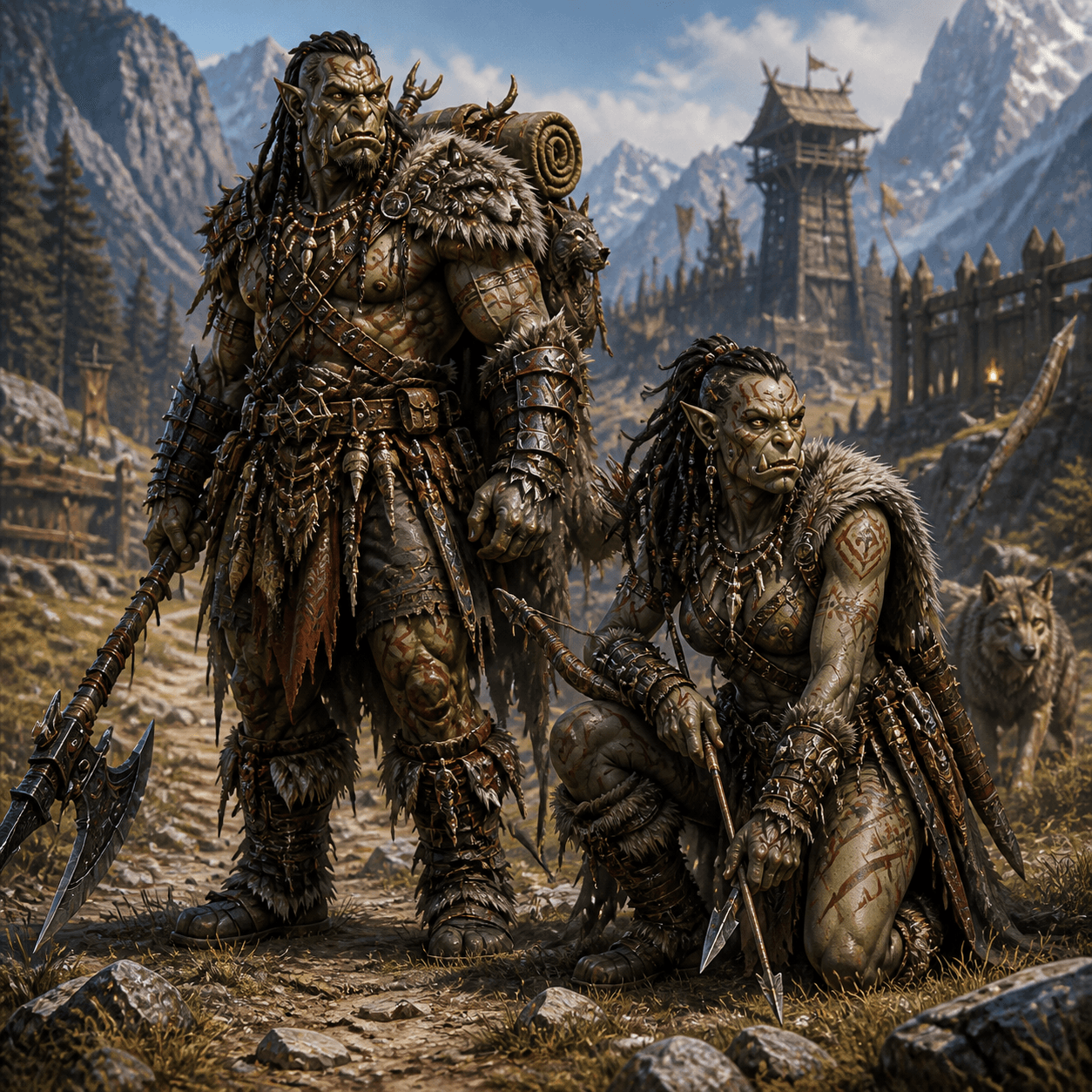
Orcs are large and heavily built - six and a half to seven and a half feet, with the dense musculature of people who work hard terrain every day. Skin ranges from deep grey-green to warm olive-brown to near-black depending on bloodline and region. Tusks are a point of cultural identity, not just biology. Tusk decoration marks clan affiliation, significant victories, and the specific debts a warrior carries. A decorated tusk is readable, if you know the language.
Dress is practical and layered - leather, treated hides, and metalwork from Druazer trade where available. Decoration exists but is earned. Beadwork marks the First Proving. Clan patterns identify territory. None of it is worn casually.
Religion: & Philosophy
Orcs honor the Circle's gods through clan-epithets and war-prayers. The same divine forces the rest of Reth worships, filtered through war and survival and given Orc names that describe what those forces demand of you rather than what they are called by scholars. Rites emphasize sacrifice of effort - work, sweat, vigilance - rather than coin or ceremony.
An Orc who feels poorly served by a deity will say so. The relationship is understood as reciprocal. An oath that only one party is expected to honor is not an oath. That principle extends to the divine.
Relationships with Other Ancestries
The Druazer are the most reliable relationship Orcs maintain - straight dealing, quality metalwork, no performance. Some Niityt human border communities have built practical arrangements with specific clans around shared interests in keeping the steppes stable. Aldaethu caravans that hire Orc escorts get what they paid for, and word travels.
Within the Aldaedro, the Giant relationship is the most friction-laden. Giants deliberate. Orcs move. Both approaches have merit and both peoples know it, which does not stop the arguments. With Firbolg there is genuine warmth in specific inter-people friendships, even where the cultures pull in different directions. With Cragborn the relationship is practical respect without much personal closeness - different terrain, different concerns, rarely in each other's way.
Slavers, oath-breakers, and raiding coalitions that prey on clan-camps are consistent enemies. Not by formal declaration. By the logic that people who do those things have made themselves enemies of everything the clan stands for.
Military Presence
Every adult Orc is a fighter in the sense that every adult Orc has trained, carries weapons, and answers the muster. The distinction the clan makes is between the general force and the proven captains - people who have demonstrated under actual pressure that their judgment is worth following. Captains lead specific actions. The War-Chief commits the clan.
The mercenary market Orcs have built is not desperation. It is a deliberate economic structure. A captain with a clean track record commands higher rates and builds relationships with lowland communities that benefit both sides for years. Orcs at sustained pressure are difficult to dislodge. Their endurance is exceptional, their supply logistics efficient by necessity, and their tolerance for hard terrain is higher than almost any other force in Reth.
Cultural Traits
Orcs measure a person by what they carry and what they keep. Burdens taken without complaint, promises honored without reminder, debts paid without being asked twice. The trail-laws exist because someone worked out the hard way what happens when those things go unobserved. Orcs did not forget the lesson.
Species Name. Druaedor
Homeland: Kukkulat and outer Vuori foothills - broken mesas, basalt flats, scrub hills, hard desert and mountain edges
Government: Warclans. Chieftain (battle authority) and Hearth-Elder (law and lineage). Major decisions in the Circle of Spears.
Law. The War-Path Code. Hospitality is owed to a declared guest. Blood-debt must be paid or balanced. Contracts sealed before the Circle.
Exile Crime. Oath-Cutting - abandoning sworn kin in danger or breaking guest-right after accepting shelter. The offender is stripped of name and clan-mark and sent out alone.
Export: Sworn road-guards, heavy-haul crews, leatherwork, bone-and-stone craft, scouting and escort services
Import: Grain, salt, worked tools, lamp oils, treated lumber for palisades and wagons
Racial Allies: Druazer (Dwarves), select Niityt humans, some Aldaethu caravans
Racial Enemies: Slavers, oath-breakers, raiding coalitions that prey on clan-camps
Pantheon (Orc-Cast)
Azirosh - Fire and War-Flame
Zorosh - Stone and Earth-Father
Thüosh - Forest and Root-Mother
Zerosh - Desert and Scouring Wind
Narosh - Coast and Tide-Hunter
Checking your codex…
From the Reth Ancestries (Daggerheart) compendium. Ancestry mechanics unlock when you collect this lineage in Hoard and link your account.