Goblinkin
Bugbear
Gelaegot
The Patient Bands
Lore
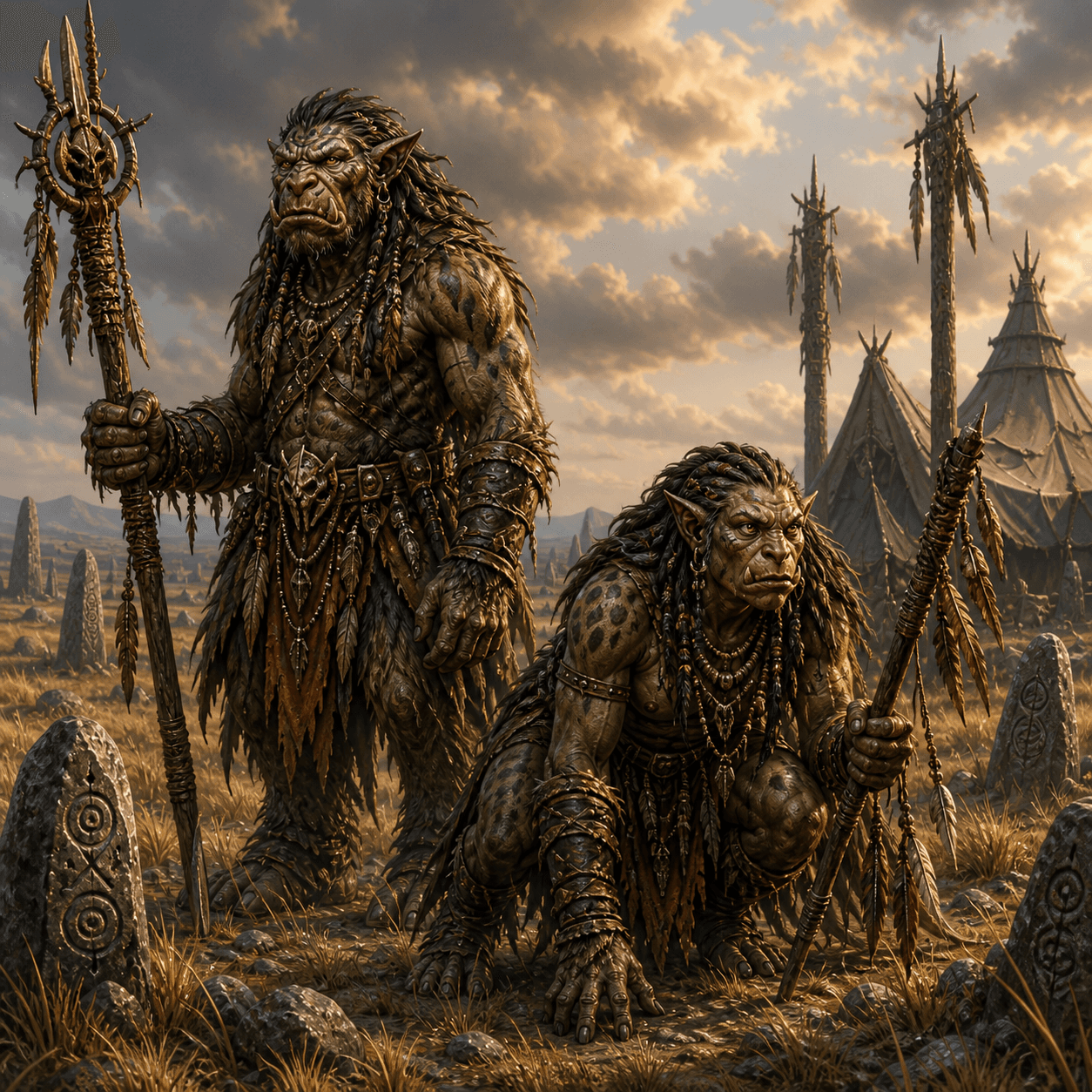
Bugbears are the largest of the Aldaegel peoples - tall and broad in a way that reads immediately as physical force, with dense fur from warm brown to near-black and amber eyes with exceptional night vision. They move quietly for their size, a quiet that is trained, maintained, and culturally valued: a Bugbear who makes unnecessary noise is communicating something specific, and it is worth paying attention to what.
Social Structure. The Band
Bugbear society is organized around the band - a dozen to several hundred individuals bound by oath, kinship, and shared territory, moving semi-nomadically with the seasons. Authority flows through gangs, function-based groups organized around hunting, defense, craft, or ritual. The Speaker is elected by the gang leaders to represent the band's voice to the outside world; the Speaker does not command, and can be replaced when the voice stops representing the band accurately. Children belong to the whole band, and coming of age is a quiet period of solo survival within band territory - watched, from a deliberately maintained distance, but never helped.
Religion: & Philosophy
Bugbear spiritual life is territorial. the band's territory is a living entity they are in active relationship with, one that has its own memory and demands reciprocity. Taking more than the territory can sustain is a spiritual violation, not merely waste. The sacred is mediated by Wardens - not priests, but individuals recognized as having a clear connection to the territory's will, an authority kept carefully distinct from the Speaker's. Among Reth's pantheon they feel the strongest pull toward Thüosh, and toward Zorosh in the domain of the kept oath. The territory itself is their primary sacred text.
Relationships
Bugbears keep the most inward-facing culture of the Aldaegel. Relations with outsiders are transactional by default - not hostile, but clearly boundaried. The toll system is the main interface most peoples have with them: passage through Bugbear land is acknowledged with compensation. Those who pass without it rarely meet violence; they meet the discovery that the path they thought they knew has become difficult in ways very hard to explain afterward.
Lore & Background
The Gelaegot are the Aldaegel people the rest of Reth is most uncertain about - and they consider that uncertainty one of their primary assets. They are the inheritors of something ancient and self-sufficient: a tradition of bands and territories and patient consequence that existed long before the Prime Council developed opinions about it. They have watched institutions rise and fall from the margins of the world for long enough that they have stopped being surprised by either event.
Picture the old warrior-tribes of deep forest and covered ground: fiercely communal within the band, spiritually inseparable from their territory, capable of devastating violence and profound loyalty in equal measure, and completely unmoved by what outsiders think of either quality. The Bugbears are not barbaric in the sense of being without culture. They have culture that runs deep and specific. It is simply not organized in any way that institutions built by other peoples can easily categorize or control - which is precisely how the Bugbears prefer it.
Role in Aldaegel Society
Among the three Aldaegel peoples, Bugbears occupy the role of the anchor. Their territories are the territories that matter most to Aldaegel security - the covered ground, the hidden passes, the marginal zones between biomes that armies need to cross and that Bugbears have made legible on their own terms. No Aldaegel community is comfortably established in a region where the local Bugbear bands have not been accounted for.
They are the least formally integrated of the three peoples and the most resistant to integration on terms they did not set. Their contribution to Aldaegel existence is territorial: they hold the ground that makes other Aldaegel communities viable, and they do so without asking for recognition they have already established they do not need.
Social Structure & Upbringing
Bugbear society is organized around the band - a group of anywhere from a dozen to several hundred individuals bound by oath, kinship, shared territory, and the dense web of mutual obligation that emerges from depending on the same people for survival across seasons and years. Bands are semi-nomadic, moving with seasonal patterns across defined territories and maintaining semi-permanent encampments at significant points: watering sites, cache locations, sacred ground, and the intersections of toll routes.
Leadership flows through the gang structure. A band contains multiple gangs - groups of adult Bugbears organized around shared function: hunting gangs, defense gangs, craft gangs, ritual practitioners. The Speaker is elected by the gang leaders collectively: the person chosen to represent the band's voice to the outside world and to adjudicate conflict between gangs when it arises. The Speaker does not command. The Speaker speaks - and can be replaced if the voice stops representing the band accurately.
Children are raised by the entire band. The concept of a child belonging exclusively to its parents is foreign to Bugbear thinking. A child belongs to the band, is protected by the band, and owes the band the adult they become. Young Bugbears spend their upbringing learning the band's territory in granular detail: every trail, every seasonal water source, every place where the ground can be trusted and every place where it cannot. They learn craft - primarily leatherwork, which is civic skill before it is personal skill - and they learn patience, the most valued quality in Bugbear culture and the hardest to teach deliberately.
Coming of age involves a period of solo survival within band territory. Not a dramatic exile - a quiet withdrawal. The band knows where the young Bugbear is. They are watching from a distance maintained deliberately. They do not help. The young Bugbear sustains themselves using only what they have been taught, for a period that varies by tradition but is never so short as to be easy. When they return, the change in how they are treated is immediate and permanent.
Appearance
Bugbears are the largest of the Aldaegel peoples - tall and broad in a way that reads immediately as physical force, with dense fur that ranges from warm brown to grey to near-black depending on biome heritage and individual bloodline. Their faces have a blunter cast than the other Goblinkin, and their eyes are typically amber or pale gold with exceptional night vision that extends significantly further than either Goblins or Hobgoblins.
They move quietly for their size in a way that surprises people who encounter them for the first time, and this quietness is not accidental - it is trained, maintained, and culturally valued. A Bugbear who makes unnecessary noise is not being careless. They are communicating something specific, and it is worth paying attention to what.
Bugbear dress is practical and layered. furs, treated leather, straps and wraps designed for movement in covered terrain. Ritual scarification and braided decoration mark band affiliation and significant life events in patterns readable to those who know how to read them and opaque to those who do not. This opacity is not accidental either.
Religion: & Philosophy
Bugbear spiritual life is territorial in a way that does not translate cleanly into other peoples' frameworks. The band's territory is not simply where they live - it is a living entity that they are in active relationship with, that has its own memory and its own requirements, and that demands reciprocity. Taking more than the territory can sustain is not simply wasteful. It is a spiritual violation of a relationship the band depends on continuing.
Their relationship to the sacred is mediated by Wardens: not priests in any institutional sense, but individuals recognized by the band as having a particularly clear connection to the territory's will. Wardens read sign - the behavior of animals, the health of water sources, the way the land responds to seasonal change - and interpret what the territory requires of the band. Their authority is spiritual and advisory rather than political, and it is carefully maintained as distinct from the Speaker's authority. The two roles are never held by the same person.
Among Reth's pantheon, Bugbears feel the strongest pull toward Thüosh - the god of wild places and animal truth - and toward Zorosh specifically in the domain of oaths and the kept promise. Their relationship to Culosh, the god of storms and difficult passage, is respectful and practical: storms happen, difficult passages happen, and Culosh is acknowledged as the force behind both rather than petitioned to prevent them.
The Warden tradition holds that the territory itself is the primary sacred text - it is older than any account of it, contains more information than any record of it, and requires direct relationship rather than mediated study. This makes Bugbear spirituality fundamentally empirical in a way that surprises scholars who expect something more mystical.
Relationships with Other Ancestries
Bugbears maintain the most inward-facing culture of the Aldaegel peoples. Relationships with outsiders are transactional by default - not hostile, but clearly boundaried, and those boundaries are maintained with a consistency that outside peoples learn to respect or discover the consequences of ignoring.
The toll system is the primary interface most peoples have with Bugbear communities, and it works because both parties understand what it is: an acknowledgment that the territory belongs to the Bugbears, expressed in the concrete form of compensation for passage. Peoples who try to pass through without this acknowledgment do not necessarily encounter violence. They encounter the discovery that the path they thought they knew has become difficult in ways that are very hard to explain afterward.
Their warmest external relationship is with Goblins - complementary peoples who occupy adjacent spaces, share enough history to have established genuine trust in specific communities, and understand each other's approach to the world in ways that require no translation. With Hobgoblins the relationship is acknowledged kinship held at respectful distance. With Orcs, Bugbears maintain an alliance built on the shared experience of occupying the world's margins and being underestimated by its centers.
The Prime Council's attache - the Council of Peace - is watched with specific attention. Bugbear Speakers know what it is. They behave accordingly: giving the delegation nothing to report as alarming, while making the nature of the observation mutually legible. The watching goes in both directions. Everyone present understands this.
Gender & Roles
Bugbear society assigns responsibility based on demonstrated capacity and band need. The gang structure that underlies political authority is entirely function-based. Any Bugbear who demonstrates the necessary skill and earns the necessary trust moves toward the role that suits them. Gender is not a mechanism the band uses to sort this.
Some bands carry traditional gender associations for Warden roles that run through specific bloodlines - communities where the position has been held by women across as many generations as oral history records, or the reverse. These are understood as the territory's preference expressing itself through pattern over time, not as a rule applicable to other bands or other territories.
Military Presence
Bugbears do not have armies and have no interest in developing them. What they have are bands who are extremely effective in the terrain they know and extremely motivated to defend it. The distinction matters enormously: an army requires logistics, supply chains, and the ability to project force far from home. None of these are things Bugbears are organized to provide. What they provide instead is the ability to make a defined territory catastrophically costly to move through without permission.
When Bugbears have been drawn into larger conflicts historically, they have functioned as irregular forces: guides and ambushers who appear from covered terrain, complete an engagement, and disappear back into it. The concept of a pitched battle in open ground strikes most Bugbears as a peculiar way to organize violence that primarily advantages whoever has more people willing to stand in a field.
Their relationship with violence is more intimate than either of the other Aldaegel peoples. Hobgoblins organize violence. Goblins avoid it. Bugbears simply live alongside it as one of the things the territory sometimes requires. This produces fighters who are calm in ways other peoples find deeply unsettling - not aggressive, not performing confidence, simply present and prepared and entirely comfortable with what is about to happen.
Cultural Traits
The band, the territory, and the kept oath define Bugbear culture. Everything else is elaboration. They are not the people who were forgotten by the world - they are the people the world forgot to account for, which is different. What matters is the land under your feet, the people at your back, the seasons the territory has taught you to read, and whether your word means what you said it meant when you said it. Everything else is noise from people who do not live here, and the Gelaegot have never been required to care about noise from people who do not live here.
Elemental Variants
Forest Bugbears (Gelaegot Metsa)
The archetypal and most numerous variant - the one behind the reputation, the one that shaped how the wider world understands Bugbears even when it understands them incorrectly. Metsa life-magic has pressed into Forest Bugbear bloodlines across generations until the distinction between the band and the forest they inhabit becomes genuinely philosophical. They are part of their territory in a way that goes beyond familiarity.
Social Structure & Upbringing
Forest Bugbear bands are the largest of the variants, because Metsa territory supports the population density. Bands in rich old-growth can sustain several hundred members across a defined range, with the gang structure correspondingly elaborate: multiple hunting gangs with specific territorial assignments, craft gangs organized by material type, defense gangs functioning as a distributed intelligence network across the band's range. The coming-of-age withdrawal is most formalized here - the period, the parameters, and the return assessment are all well-established by tradition.
Appearance
Fur develops subtle patterns across established bloodlines that echo local bark and shadow in ways that function as genuine camouflage rather than coincidental resemblance. Movement through old-growth forest is functionally silent - trained, maintained, and biome-enhanced until it becomes automatic. Coloring runs brown, grey-brown, and dark green-black in the deepest forest bloodlines. The largest individual Bugbears in Reth tend to come from Forest variant stock.
Religion: & Philosophy
Forest Bugbear Wardens have the most developed practice of any variant - old-growth forest provides the richest sign-reading environment, and bands that have held the same territory across multiple generations have accumulated interpretive traditions going back centuries. Specific trees are recognized as territory-markers with spiritual significance. Water sources are read for health in specific seasonal sequences. The oral tradition of Warden knowledge in an established Forest band is extraordinarily detailed and entirely non-transferable to a different territory: it is about here, specifically.
Cultural Traits
The most communally-minded variant - the forest requires it. You cannot maintain a canopy encampment, a distributed cache system, and a multi-gang territorial defense with anything less than deep mutual trust and constant communication. Forest Bugbear bands develop internal communication systems - sound signals, track markers, leave signs - that amount to a secondary language operating within their territory. Outsiders who wander into band range describe the feeling of being watched from every direction simultaneously. They are correct.
Mountain Bugbears (Gelaegot Vuori)
The largest-built variant and the coldest-adapted. Mountain Bugbears occupy the high passes and rocky margins where Vuori stone-magic has worked into their bloodlines as cold tolerance, physical density, and the most developed night vision of all Gelaegot variants - calibrated to the absolute dark of deep mountain cave systems that serve as both shelter and strategic resource.
Social Structure & Upbringing
Mountain Bugbear bands run smaller than Forest variants by necessity - the terrain supports less, and a smaller band is a more mobile one on rocky high-altitude ground. The gang structure is correspondingly leaner: fewer gangs with broader function assignments. Speakers in mountain communities tend to be individuals who have demonstrated both territorial knowledge and the specific diplomatic skill required to negotiate passage rights with adjacent peoples - Hobgoblins primarily - whose fortresses occupy the same ground. The relationship is functional. It is not warm.
Appearance
Fur runs grey and stone-brown, with some bloodlines showing a faint silver in old age that blends remarkably well with mountain scree at distance. The largest bone structure of the Gelaegot variants - Mountain Bugbears are built for carrying weight across difficult terrain, and it shows. Their night vision is the most developed of all variants: calibrated for the absolute dark of deep mountain cave systems, they can navigate cave interiors that would require a torch for any other people.
Religion: & Philosophy
Mountain Bugbear Wardens read sign in rock - crack patterns, water seepage behavior, the way sound moves through stone in different weather - with the same depth that Forest Wardens read sign in the living forest. Their sacred ground tends toward specific geological features: particular cave entrances, unusual formations, places where the mountain does something unexpected. The territory here speaks in stone rather than in growth, and the Warden tradition has adapted accordingly.
Cultural Traits
Lean in all senses. lean bands, lean material culture, lean speech. Mountain Bugbears do not maintain anything they do not use, do not say anything they do not mean, and do not negotiate anything they are not prepared to enforce. Their toll arrangements are among the most straightforward of the Bugbear variants - the pass exists, the cost of passage is established, and the conversation is brief. They are respected across the high regions as people whose word is exactly as reliable as stated and no more.
Ocean Bugbears (Gelaegot Ranta)
The variant that surprises people most, because the Bugbear reputation is so thoroughly terrestrial that the existence of a large, fur-covered predator who swims with genuine ease and claims tidal zones as band territory tends to reframe people's assumptions entirely. Ranta salt-magic has worked into Ocean Bugbear bloodlines as water-resistance, swimming capacity, and the specific weather-sensitivity of people who have needed to read incoming storms for survival across generations.
Social Structure & Upbringing
Ocean Bugbear bands occupy coastal and estuarine territory that interfaces constantly with fishing communities, trading routes, and the traffic of coastal peoples who need to move through Bugbear-claimed waters. This necessity has produced Speakers who are the most outward-facing of all Gelaegot variants - their role requires negotiation with outside peoples as a daily function rather than an occasional necessity, and the bands select accordingly. Young Ocean Bugbears learn to swim as their primary coming-of-age physical skill. The first solo ocean crossing carries the weight that the inland survival withdrawal carries for other variants.
Appearance
Fur is coarser and more water-resistant than inland variants, lying flat when wet and shedding water efficiently. Coloring runs toward the grey-browns and blue-greys of coastal rock and breaking water. Established bloodlines develop slight webbing between the fingers - functional for swimming rather than remarkable at a glance. Their sensitivity to atmospheric pressure changes is the most refined of the Gelaegot variants: an Ocean Bugbear Warden's weather predictions are treated as reliable intelligence by every coastal community that has worked with them long enough to test the track record.
Religion: & Philosophy
Ocean Bugbear Wardens read the sea itself - wave patterns, current behavior, the behavior of fish and coastal birds as indicators of deeper ocean conditions. Culosh is honored more directly here than in other Bugbear communities: the god of storms and difficult passage is not abstract when the storms are real and the passages are literal. The Warden tradition has developed a specific practice around storm reading that is valued by coastal peoples of many ancestries and offered, rarely and at significant cost, as a service.
Cultural Traits
More outward-facing than any other Bugbear variant without being more open. Ocean Bugbears have learned to negotiate with outside peoples from necessity and have become good at it without particularly enjoying it. Their toll arrangements cover both coastal passage and fishing rights in their tidal zones, enforced with the same quiet consistency that inland bands apply to forest passes. The fact that enforcement at sea looks different than enforcement in a forest does not make it less reliable. Peoples who have tested this discover it quickly.
Sky Bugbears (Gelaegot Taivas)
The rarest variant and the most spiritually distinctive. Sky Bugbears occupy exposed high plateaus and ridge territories where Taivas wind-magic concentrates most intensely, and the long-term effect on their bloodlines is unlike any other Gelaegot development: they are the lightest-built of all Bugbear variants, with a faint silver-grey sheen in their fur at altitude, and Wardens who practice the most intense territorial-connection traditions in the Gelaegot world.
Social Structure & Upbringing
Sky Bugbear bands are the smallest of all variants - their territory supports limited population, and the isolation of high-plateau ground means that every member of the band is known to every other in a depth that even Forest Bugbears do not quite achieve. The gang structure is at its most minimal: the functions remain, but the gangs overlap and individuals carry multiple responsibilities. Speakers in sky communities are almost always Wardens as well - the spiritual and diplomatic roles converge because the territory demands it and the band size makes formal separation impractical.
Appearance
The lightest-built Bugbear variant - still substantial, but with a leanness that distinguishes them immediately from Mountain or Forest stock. Fur develops the silver-grey altitude sheen in established bloodlines, and in direct high-altitude sunlight this creates a quality of near-invisibility against bright sky that has surprised more than one person trying to locate a Sky Bugbear band from a distance. Their senses are calibrated for open exposed terrain: long-range sight, extreme sensitivity to air movement, and the ability to read wind behavior that experienced sky-farers have compared to weather-precognition.
Religion: & Philosophy
Sky Bugbear Warden practice is the most intensive of all variants. The territory here is exposed in ways that forest or cave territory is not - no shelter from above, constant wind, minimal ground-level complexity to read. Wardens have compensated by developing extraordinary depth in reading what is available: wind behavior, cloud formation, the movement of birds at altitude, the behavior of the few plants that survive at height. Their connection to the territory is described by other Bugbear communities as the deepest among the variants, which the Sky Bugbears accept without comment. The territory here demands more. They give more.
Cultural Traits
The most internally self-sufficient and the most difficult to find. Sky Bugbear bands are not hiding, exactly - they simply live in places that require significant effort to reach, and they do not go out of their way to make that effort easier for outsiders. Outsiders who find their encampments describe the experience consistently: the sense of having arrived somewhere that existed entirely on its own terms and was mildly surprised an outsider had managed to complete the journey. The Sky Bugbears are not surprised. They knew the visitor was coming. They were simply waiting to see if the journey would be finished.
Homeland: Suo edges, Varjo mouths
Cities: Bramble-Den, Shadow-Latch, Mire-Gate
Exports: Trappers, hides, stealth hunters
Imports: Iron, lamp-oil
Allies: Goblins, Orcs
Enemies: Halfling sheriffs, Satyr bands
History: Bugbear toll-pacts stabilized Suo's mire trails after the swamp bridges were built.
Cultural Profile
Homeland: & Settlement: Bugbears favor open ground with cover - grassland enclaves at the edge of scrub, or swamp borders where reeds and brush break sightlines. Their camps move with hunting and trade seasons, but their toll routes remain consistent and defended.
Government: Warlords and Lodge-Bands. A warlord leads by proven capability, supported by lodge elders who control provisioning, hides, and camp discipline. Challenges are allowed, but failure carries real consequences.
Society: Bugbears are craftsmen first and predators second. Leatherwork is civic craft: tents, tack, armor panels, straps, waterproof wraps, and pack harnesses. Hunting is regulated; taking more than is needed is treated as bad practice and bad luck.
Buildings: Mobile long-tents, hide-halls, smoke racks, bone-frame watch towers, and semi-permanent enclaves at well-known watering points.
Trade. Exports - leather goods, cured hides, pack gear, field scouts, and trappers. Imports - iron, lamp oil, salt, and grains they cannot reliably produce on the move.
Aldaedro - Giantkin
The Aldaedro are not a single nation. Giants (Droaedor), Orcs (Druaedor), Firbolg (Thuaedor), and Cragborn (Zuraedor) are four distinct peoples with their own laws, rites, and traditions. What binds them is ancestry - Giants are the eldest, and the others diverged from that root across generations of different terrain and different choices. The rest of Reth groups them as Giantkin. The Aldaedro accept the label without much interest in it.
They cooperate through trade pacts, border oaths, and mutual defense. The Druazer - Dwarves - are their longest-standing allies, bound by shared highland territory and centuries of craft-exchange and road-work. Formal unity has never taken root. That has not stopped the pacts from holding.
Council
The Aldaedro hold a recognized seat on the Prime Council, most often filled by an oath-speaker chosen through inter-people bargaining rather than a single inherited position. In the current era, Giants still attend when a matter concerns the Holds directly. The others have largely stopped sending representatives. The Council stopped being worth the journey.
Shared Trade
Across all four peoples, the pattern is consistent. They build, guard, and move things through difficult terrain that other peoples cannot manage without them. Their imports are the things that highland life cannot easily produce - grain, cloth, oils, and record materials. Their exports are the things that only they have the knowledge and the endurance to provide.
Religion
Each people keeps its own rites, but shared oaths allow pantheons to be honored together at borders and council tables. Giants keep a Jotun-style storm and hearth pantheon. Firbolg keep an old grove and ancestor tradition. Cragborn follow the Earth Father's Song. Orcs keep tribal war-rites that mirror the great deities in Orc-cast names and stories. The specific names differ. The underlying forces are recognized across all four.
Languages: Common, Aldaedro
Creature Type. Humanoid
Council Seat: The Aldaedro hold a recognized seat on the Prime Council, most often filled by an oath-speaker chosen through inter-people bargaining rather than a single inherited crown.
Allies: Dwarven clanholds (deep alliance by craft and border-work); practical trade ties with humans and gnomes where roads and fortifications matter.
Signature Trade:
• Export: Stone infrastructure (bridges, gatehouses, road-cuts), lift-and-rigging engineering, heavy guard companies, and quarry metals.
• Import: Grain, oils, cloth, and record materials (paper, ink, vellum) needed to keep long-term projects supplied and accounted for.
Religion: (high level): The Aldaedro are syncretic - each people keeps its own rites, but shared oaths allow pantheons to be honored together at borders and council tables. Giants keep a Jotun-style storm and hearth pantheon; Firbolg keep a Celtic-flavored grove and ancestor tradition; Cragborn follow the Earth Father's Song; Orcs keep tribal war-rites that mirror the great deities in an Orc-cast form.
Checking your codex…
From the Reth Ancestries (Daggerheart) compendium. Ancestry mechanics unlock when you collect this lineage in Hoard and link your account.