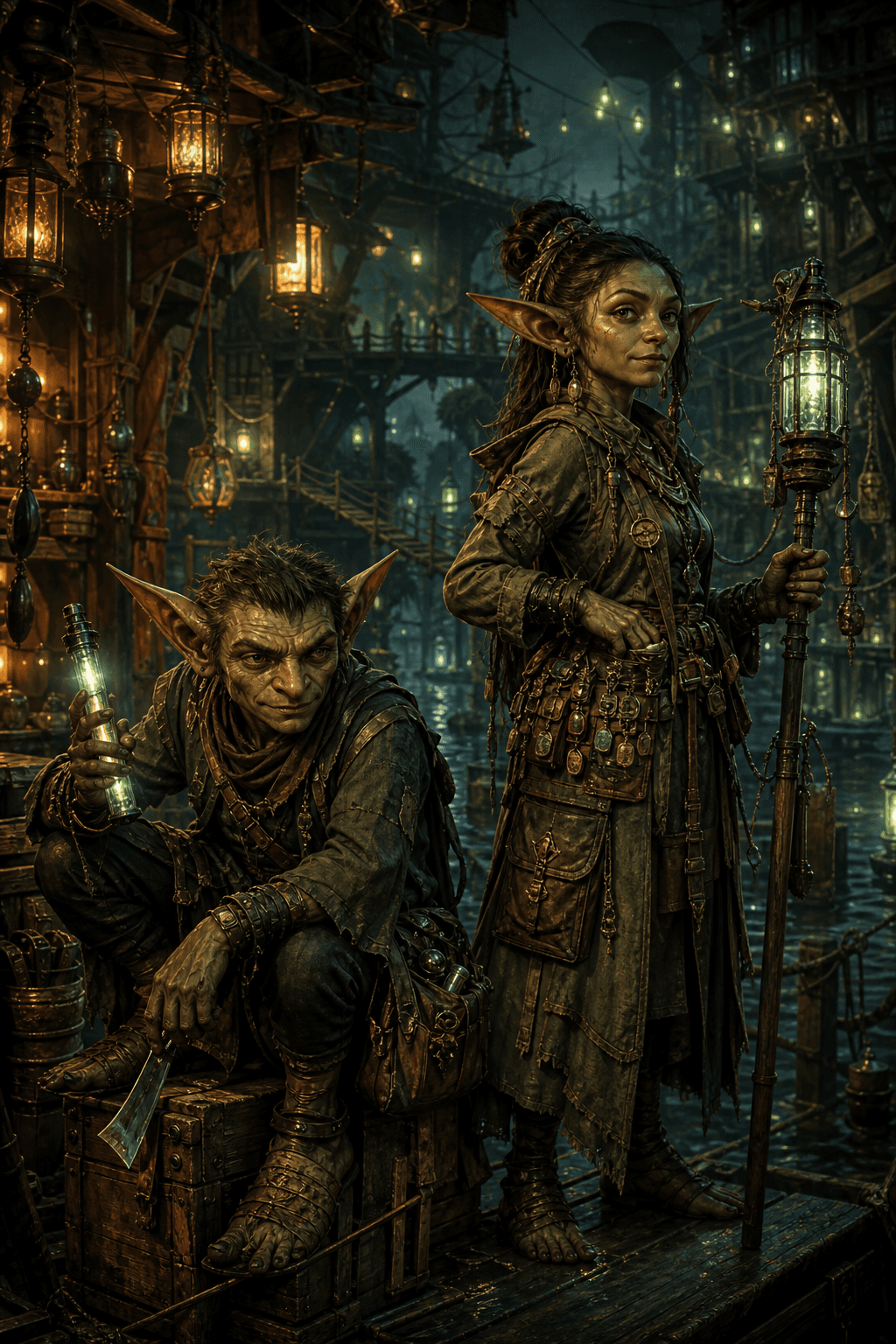
Goblinkin
Goblin
Gelaenal
Background Questions
Who taught you the rules of the night markets?
What scrap item do you keep as a charm or tool?
Who do you owe a dangerous favor?
What rule do you break every day?
Overview
The Gelaenal are the most widespread and most generalist of the Aldaegel peoples and the hardest to pin down. They thrive in cramped markets, torchlit warrens, and waterlogged swamp-islets. They are clever opportunists who see angles others miss - not cunning in the sense of deception, though they can manage that when needed - but in the sense of perception. A Goblin walks into a room and immediately understands the flow of it: where the money is, where the exit is, who owes whom, and what everyone wants but has not said aloud. Their clever hands and scavenger instincts make them expert fixers, runners, and lanternwrights. The glow-rods they invented still light the swamp trails of Suo.
They are generalists in a world that rewards specialization, adaptable in a world that prefers legibility, and at home almost everywhere - which means some people never think of them as being at home anywhere at all. This misread has followed the Gelaenal across centuries. They have built their entire culture around the advantages of being perpetually underestimated.
Role in Aldaegel Society
Among the three Aldaegel peoples, Goblins occupy the role that no one formally assigned and everyone quietly depends on: the connective tissue. They move between Hobgoblin forts and Bugbear territories and the wider world with a fluency the other two peoples do not share. They run the markets. They know who to talk to and what to offer. When an Aldaegel community needs something from the outside world without drawing attention to that need, it is usually a Goblin who handles it.
This role was not designed. It emerged from the Goblin habit of living everywhere and building relationships wherever they land. Hobgoblins occasionally find this exhausting. Bugbears find it useful. The Goblins themselves find it simply normal.
Social Structure & Upbringing
Goblin communities are formally organized around Elder Councils - governing bodies that operate by consensus and precedent, where the eldest hold authority earned through demonstrated judgment under scarcity rather than through age alone. Day-to-day enforcement flows through appointed Wardens who oversee specific functions: market Wardens, tunnel Wardens, watch Wardens, ropeway Wardens. The Elder Council sets direction and precedent. The Wardens execute it.
Below the formal structure sits the street-level reality: the Whim-Bosses. These are the leaders of market gangs - extended networks of kin, debt, oath-friendship, and shared territory that form the actual living texture of Goblin community life. A Whim-Boss is not elected by the Elder Council. They earn their position through the gangs: through relationship, through favors given and collected, through being the person the gang turns to when something needs handling. The Elder Council governs by precedent; the Whim-Bosses govern by presence. Both are real. Both are necessary. A Goblin community without Elder Councils has no memory. A Goblin community without Whim-Bosses has no pulse.
Children are raised communally. There is always someone watching, always someone teaching - not formally, but in the ambient instruction of a busy community. Young Goblins learn to read situations before they learn to read text. They learn what a safe exit looks like, which adults can be trusted with what kind of secret, and what the difference between a favor and a debt is, and why it matters. They are taught that a favor given is never forgotten and a favor owed is currency.
Rites of passage are informal but deeply felt. The first successful solo trade - something negotiated and completed without adult intervention - is celebrated by the community. The first time a young Goblin navigates a genuine crisis and comes out the other side is remembered by the Elders. Not with ceremony, but with recognition: a shift in how they are spoken to, a different quality of attention. Goblins notice these shifts. They are always paying attention.
Appearance
Goblins are small - the shortest of the Aldaegel peoples - with large ears, wide-set eyes that catch light easily in the dark, and quick dexterous hands that are their most immediately recognized feature. Their skin ranges from pale grey-green to deep moss, with some lines showing ochre, warm brown, or near-black tones depending on biome heritage. Their eyes are typically amber, yellow, or vivid green, with some variants showing silver-grey irises adapted to specific lighting conditions.
They dress practically, with a strong preference for many pockets, adjustable layers, and clothing that does not snag. In wealthier communities Goblin fashion leans toward bold color and clever construction - garments that appear simple but contain hidden panels, reversible sections, or concealed carrying capacity. The glow-rod technology they invented is frequently incorporated as personal decoration as well as utility: small lights worked into belts, collars, and tool-kits that serve both function and quiet statement.
Religion: & Philosophy
Goblin spiritual life centers on the concept of the Turning Eye - the idea that the world reveals itself differently depending on where you stand and when you look. No single viewpoint is complete. No moment of understanding is final. The sacred act is not revelation but noticing: catching the angle others missed, seeing the seam in what seemed solid. This philosophy maps neatly onto how Goblins approach trade, navigation, and survival - which is not coincidental. Their cosmology grew from their practice, not the other way around.
They do not maintain formal temples. What they maintain are shrines: small personal collections of objects that carry meaning, kept in homes and market stalls and workshop corners. Each shrine is specific to its keeper. The dead are remembered through what they left behind and what they were still owed when they went.
Among Reth's broader pantheon, Goblins feel the strongest pull toward Narosh, the god of routes and passage, and Thüosh, the god of the wild and adaptive. Their relationship to these deities is characteristically personal and practical. A Goblin does not pray to Narosh through a priest. They acknowledge Narosh by knowing where the exits are.
Relationships with Other Ancestries
Goblins have working relationships with almost everyone, which is genuinely different from being trusted by almost everyone. The distinction is one they are aware of and have strong feelings about - usually expressed obliquely, in context-heavy Aldaegel idiom, to people who don't understand it.
Their warmest external relationships are with Kobolds, who share a talent for underground construction, tunnel navigation, and the particular cleverness that emerges from being consistently underestimated. With Bugbears, Goblins share complementary skills and enough history to have established genuine working trust in specific communities - warmer than either people usually advertises.
Their relationship with Hobgoblins is respectful and friction-filled in equal measure. Hobgoblins find Goblin improvisation wasteful and difficult to trust. Goblins find Hobgoblin rigidity brittle under pressure. They cooperate when interests align, which is more often than either people openly admits.
Town watches, tax collectors, and any institution whose power depends on controlling movement tend to have friction with Goblin communities. The Goblin response is characteristically not direct confrontation. It is rerouting. The night markets that authorities attempt to shut down simply appear in a different location, run by different apparent organizers, selling the same things.
Gender & Roles
Goblin society places almost no formal weight on gender in the assignment of roles or authority. What matters is competence and relationship: who you know, what you can do, and whether you can be relied upon when the situation changes. Elder Councils include whoever has earned the community's trust across time, regardless of gender. Whim-Boss authority follows the same logic - the gangs follow whoever can deliver, full stop.
Some Goblin communities carry naming traditions that mark gender; others do not. The variation is wide enough that outsiders attempting to apply a single rule will always be wrong about somebody. Goblins find this confusion faintly amusing and do not rush to correct it.
Military Presence
Goblins do not maintain standing armies and have no interest in doing so. Their approach to conflict is asymmetric by nature - they prefer knowing the terrain better than the opponent, moving faster, and making a fight costly enough that it stops being worthwhile. They are exceptional skirmishers, scouts, and irregular fighters who function best when they choose the terms of engagement.
In larger conflicts they serve as force multipliers: intelligence gatherers, supply line disruption specialists, guides through terrain that regular armies cannot navigate. Several major campaigns in Reth's history succeeded or failed based on whether Goblin cooperation was secured on the ground. The Goblins who participated in those campaigns were not celebrated in the histories written afterward. This is typical. They noticed.
Cultural Traits
Opportunity, adaptability, and the long memory of a people who have been underestimated define Goblin culture. They do not forget a slight, but they are not primarily driven by grievance. They are driven by possibility. The world is full of angles others have not noticed yet. A Goblin's first instinct on entering any new situation is not threat assessment - it is inventory. What is here? What does it connect to? What could it become?
To be called clever by a Goblin is a genuine compliment. To be called obvious is the worst thing they know how to say.
Homeland: Varjo tunnels, Suo islets
Cities: Wick-Nest, Tallow-Run, Grin-Market
Exports: Lanternwork, tinkered tools, scrapfix crews, game and preserved meat, trapwork, rope-and-rigging, small repairs
Imports: Grain, cloth, oil, lamp oil, metals they cannot easily smelt in-tree
Allies: Bugbears, Kobolds
Enemies: Town watches that ban night markets; any institution whose power depends on controlling who moves where
History: Goblins maintained vital travel routes during blackout years with their glow-rod lines.
Elemental Variants
Mountain Goblins (Gelaenal Vuori)
Overview
Mountain Goblins have adapted to high-altitude environments where the Vuori biome's resonant stone magic presses into everything that lives there across generations. They build into cliff faces, hidden shafts, and weight-triggered passages - communities that are nearly impossible to find and functionally impossible to assault without their cooperation. Their warrens are carved deep into the mountain itself, with layers that descend far below the original entrance point.
Social Structure & Upbringing
Elder Councils here are more formal than lowland counterparts, shaped by isolation that makes every outside contact a considered decision requiring council approval. Whim-Bosses in mountain communities control the few trade access points into the warren - positions simultaneously more constrained and more powerful than their urban counterparts, because there are fewer angles to work, but the ones that exist are everything. Young Goblins learn engineering before trade: how weight moves through stone, how a shaft must be angled to carry sound, how to read the way a tunnel breathes to know if it is safe.
Appearance
Skin runs cooler - greys, slate blues, pale greens - with silver-cast eyes suited to the sharp reflected light of elevation and the absolute dark of deep shafts. They are smaller even than lowland Goblins, built compact and low-centered for scrambling across unstable terrain. Older mountain bloodlines develop a faint luminescence in low light, a side effect of the Vuori stone magic absorbed across generations.
Religion: & Philosophy
Mountain Goblins extend the Turning Eye philosophy into the vertical: truth is not just about angle but about depth. What appears one way from the surface reveals something different from below. Their shrines tend toward geological specimens - crystals, unusual stones, small formations - kept in precise positions relative to light sources so they catch and refract at specific times of day. This is not decoration. It is practice.
Cultural Traits
Patient, precise, and deeply territorial about knowledge as much as land. Mountain Goblins share what they know selectively and remember everything they learn. A community that has held a particular pass for two centuries knows things about it that no map can record - and they have no intention of giving that knowledge away for free.
Forest Goblins (Gelaenal Mets?)
Overview
Forest Goblins are the tree-fortress builders - the variant most associated with the canopy communities that define one image of Goblin civilization. The Metsa biome's life-magic runs rich through old-growth wood, and Forest Goblins have cultivated a relationship with living construction across generations: platforms grown rather than cut, rope networks treated with sap compounds to last decades, concealed walkways that the forest itself seems to close around after passage. Below the canopy they maintain shingled warrens and supervised markets - the forest floor is workspace and trade space, not home.
Social Structure & Upbringing
Elder Councils in forest communities include formal representatives from each layer of the canopy settlement. Whim-Bosses here control the market floors below the canopy - the busiest and most cosmopolitan space in any forest Goblin community - and their authority is built on knowing every trader, runner, and contact who passes through. Young Forest Goblins learn to read the canopy: wind direction from leaf behavior, incoming weather from bird movement, the difference between a safe branch and one that will hold your weight for exactly three steps.
Appearance
Skin runs deep green and brown, with established bloodlines showing subtle seasonal color shift that serves as genuine camouflage in their specific forest. Their eyes tend toward green with excellent low-light vision calibrated for filtered canopy light. They move with a particular ease in vertical space that ground-dwellers find unsettling: comfortable at height, calm when the path is a rope rather than solid ground.
Religion: & Philosophy
The glow-rod tradition began in Metsa Goblin communities, born from the need to navigate a dark forest floor without giving position away from the canopy above. This origin is remembered as spiritual as much as practical: the glow-rod is not just a light source but a declaration that you choose to be seen, in the place and moment you choose, on your terms. Forest Goblin shrines tend toward living components - growing moss, maintained seedlings, small branches kept alive in water. The dead are sometimes remembered by planting something in their name.
Cultural Traits
Communal in a way the other Goblin variants are not quite - the canopy community requires trust in ways that warren or cave communities can avoid. A rope bridge only works if the person who built it built it correctly. Forest Goblins know their neighbors in a structural way. Their Elder Councils are consequently the most genuinely democratic of the Goblin variants: everyone's voice matters because everyone's weight is on the same infrastructure.
Ocean Goblins (Gelaenal Ranta)
Overview
Ocean Goblins are the surprise of the Goblin peoples - small folk who took to the water with the same adaptability they bring to everything else and never looked back. The Ranta biome's salt-and-storm magic has worked into coastal Goblin bloodlines across generations, producing swimmers, weather-readers, and harbor pilots invaluable to anyone moving goods or people along a coast. Their warrens run through harbor districts, seaside cliffs, and the dense understructure of port cities - always close to water's edge.
Social Structure & Upbringing
Gang structures in Ocean Goblin communities operate almost entirely as trade guilds - formally organized, with recognized leadership, managed territories across harbor districts, and internal codes functioning as maritime law where official maritime law does not reach. Whim-Bosses here are often indistinguishable from guild masters; the gangs and the trade networks are one and the same. Young Ocean Goblins learn to swim before anything else. The first time a young Goblin pilots a vessel alone is the milestone that other variants mark with the first solo trade.
Appearance
Skin runs sea-grey and blue-green, with established coastal bloodlines developing subtle bioluminescent patches visible in darkness - a Ranta magic adaptation that functions as communication between swimmers at night. Their eyes are darker than inland variants, adapted to reading water surface and horizon simultaneously. They develop webbed fingers and stronger swimmer's lungs across generations in coastal communities, and their sensitivity to atmospheric pressure changes makes them invaluable weather-readers aboard vessels.
Religion: & Philosophy
Ocean Goblins feel the pull of Narosh most intensely of all the variants - the god of routes and passage becomes, at sea, the god of the one thing between you and drowning. Their shrines tend toward nautical: knotwork, salvaged navigation instruments, small stones from specific coastlines kept as anchors to known places. The Turning Eye philosophy takes on additional resonance at sea, where the same water looks entirely different from deck level, crow's nest height, or beneath the surface, and all three perspectives are simultaneously true.
Cultural Traits
Outward-facing without being open. Ocean Goblins know how to talk to outsiders, how to read them, how to give them what they need without giving them more than was agreed. This fluency can be mistaken for warmth. It is professional skill, maintained carefully. The information networks that form naturally when you know everyone passing through a major harbor are among the most valuable assets an Ocean Goblin community holds - and the most carefully protected.
Sky Goblins (Gelaenal Taivas)
Overview
Sky Goblins are the rarest and least understood variant. Communities that have lived on high plateaus, cliff-city rooftops, and exposed ridgelines under the Taivas wind-magic for generations develop a lightness of build and an ease at heights that lowland peoples find genuinely unsettling. Their warrens run through the upper levels of cliff settlements and the hidden spaces beneath rooftop structures - always elevated, always with clear sightlines in multiple directions.
Social Structure & Upbringing
Sky Goblin Elder Councils meet in open air whenever weather permits, which Sky Goblins consider simply correct and others consider baffling. Whim-Bosses in sky communities control the rooftop markets and elevated trade routes between cliff settlements - positions that require both physical comfort at height and intimate knowledge of who travels the upper lanes. Young Sky Goblins learn to read weather with the same depth that Forest Goblins learn to read canopy and Ocean Goblins learn to read water. The first time a young Sky Goblin successfully tracks a weather system across a full day - predicting correctly what it will do and when - is their milestone.
Appearance
Slimmest of the Goblin variants, built light with large ears that function as additional pressure sensors in high wind. Their eyes are sharp and adapted for distance vision in bright outdoor light. Skin tends toward lighter grey-green and pale ochre tones, with some established high-altitude bloodlines showing a very faint silver sheen that catches direct sunlight distinctively. Their hair, where present, grows dense and close to the head - an adaptation to constant wind.
Religion: & Philosophy
The Turning Eye takes on literal verticality for Sky Goblins: the world seen from above is genuinely different from the world seen from below, and both are genuinely real. Sky Goblin shrines are characteristically minimal - a few objects, carefully weighted so they do not blow away, positioned to catch light at specific times of day. They have a particular relationship with impermanence that other Goblin variants do not share: things that cannot survive wind and exposure should not be kept.
Cultural Traits
Quiet, observational, and possessed of the particular patience of people who spend a great deal of time watching large things happen slowly from a distance. Sky Goblin scouts are prized across Reth for their weather-reading, terrain-mapping, and rooftop navigation skills. They are also among the most difficult of the Goblin variants to find and speak with, which they regard as a feature of their lifestyle rather than an obstacle.
Lore
Goblins thrive in cramped markets, torchlit warrens, and waterlogged swamp-islets. Their clever hands and scavenger instincts make them expert fixers, runners, and lanternwrights. The glow-rods they invented still light the swamp trails of Suo.
Homeland: Varjo tunnels, Suo islets
Cities: Wick-Nest, Tallow-Run, Grin-Market
Exports: Lanternwork, tinkered tools, scrapfix crews
Imports: Grain, cloth, oil
Allies: Bugbears, Kobolds
Enemies: Town watches that ban night markets
History: Goblins maintained vital travel routes during blackout years with their glow-rod lines.
Cultural Profile
Homeland: & Settlement: Goblins build upward. Their most secure communities are tree-fortresses - layered platforms, rope bridges, and concealed walkways woven through thick canopies. Below the trees sit supervised markets and storage burrows, not homes.
Government: Elder Councils. A council governs by consensus and precedent; the eldest do not rule by age alone, but by proven judgment under scarcity. Day-to-day enforcement is handled by appointed Wardens (market, ropeway, watch, and tunnel).
Society: Goblins prize competent motion - fast hands, quick repair, clean exits. Hunting is both foodwork and training: scouts learn to read canopy sign, wind shifts, and spoor the way other cultures teach letters.
Buildings: Canopy keeps, ladder-towers, ropeway gates, sap-collection sheds, and concealed ground vaults. Firebreak lanes and rain-screens are treated as civic infrastructure.
Trade. Exports - game and preserved meat, trapwork, rope-and-rigging, lantern goods, small repairs. Imports - grain, cloth, lamp oil, and metals they cannot easily smelt in-tree.
Lore & Background
The Gelaenal are the most widespread and most generalist of the Aldaegel peoples and the hardest to pin down. They thrive in cramped markets, torchlit warrens, and waterlogged swamp-islets. They are clever opportunists who see angles others miss - not cunning in the sense of deception, though they can manage that when needed - but in the sense of perception. A Goblin walks into a room and immediately understands the flow of it: where the money is, where the exit is, who owes whom, and what everyone wants but has not said aloud. Their clever hands and scavenger instincts make them expert fixers, runners, and lanternwrights. The glow-rods they invented still light the swamp trails of Suo.
They are generalists in a world that rewards specialization, adaptable in a world that prefers legibility, and at home almost everywhere - which means some people never think of them as being at home anywhere at all. This misread has followed the Gelaenal across centuries. They have built their entire culture around the advantages of being perpetually underestimated.
Role in Aldaegel Society
Among the three Aldaegel peoples, Goblins occupy the role that no one formally assigned and everyone quietly depends on: the connective tissue. They move between Hobgoblin forts and Bugbear territories and the wider world with a fluency the other two peoples do not share. They run the markets. They know who to talk to and what to offer. When an Aldaegel community needs something from the outside world without drawing attention to that need, it is usually a Goblin who handles it.
This role was not designed. It emerged from the Goblin habit of living everywhere and building relationships wherever they land. Hobgoblins occasionally find this exhausting. Bugbears find it useful. The Goblins themselves find it simply normal.
Social Structure & Upbringing
Goblin communities are formally organized around Elder Councils - governing bodies that operate by consensus and precedent, where the eldest hold authority earned through demonstrated judgment under scarcity rather than through age alone. Day-to-day enforcement flows through appointed Wardens who oversee specific functions: market Wardens, tunnel Wardens, watch Wardens, ropeway Wardens. The Elder Council sets direction and precedent. The Wardens execute it.
Below the formal structure sits the street-level reality: the Whim-Bosses. These are the leaders of market gangs - extended networks of kin, debt, oath-friendship, and shared territory that form the actual living texture of Goblin community life. A Whim-Boss is not elected by the Elder Council. They earn their position through the gangs: through relationship, through favors given and collected, through being the person the gang turns to when something needs handling. The Elder Council governs by precedent; the Whim-Bosses govern by presence. Both are real. Both are necessary. A Goblin community without Elder Councils has no memory. A Goblin community without Whim-Bosses has no pulse.
Children are raised communally. There is always someone watching, always someone teaching - not formally, but in the ambient instruction of a busy community. Young Goblins learn to read situations before they learn to read text. They learn what a safe exit looks like, which adults can be trusted with what kind of secret, and what the difference between a favor and a debt is, and why it matters. They are taught that a favor given is never forgotten and a favor owed is currency.
Rites of passage are informal but deeply felt. The first successful solo trade - something negotiated and completed without adult intervention - is celebrated by the community. The first time a young Goblin navigates a genuine crisis and comes out the other side is remembered by the Elders. Not with ceremony, but with recognition: a shift in how they are spoken to, a different quality of attention. Goblins notice these shifts. They are always paying attention.
Appearance
Goblins are small - the shortest of the Aldaegel peoples - with large ears, wide-set eyes that catch light easily in the dark, and quick dexterous hands that are their most immediately recognized feature. Their skin ranges from pale grey-green to deep moss, with some lines showing ochre, warm brown, or near-black tones depending on biome heritage. Their eyes are typically amber, yellow, or vivid green, with some variants showing silver-grey irises adapted to specific lighting conditions.
They dress practically, with a strong preference for many pockets, adjustable layers, and clothing that does not snag. In wealthier communities Goblin fashion leans toward bold color and clever construction - garments that appear simple but contain hidden panels, reversible sections, or concealed carrying capacity. The glow-rod technology they invented is frequently incorporated as personal decoration as well as utility: small lights worked into belts, collars, and tool-kits that serve both function and quiet statement.
Religion: & Philosophy
Goblin spiritual life centers on the concept of the Turning Eye - the idea that the world reveals itself differently depending on where you stand and when you look. No single viewpoint is complete. No moment of understanding is final. The sacred act is not revelation but noticing: catching the angle others missed, seeing the seam in what seemed solid. This philosophy maps neatly onto how Goblins approach trade, navigation, and survival - which is not coincidental. Their cosmology grew from their practice, not the other way around.
They do not maintain formal temples. What they maintain are shrines: small personal collections of objects that carry meaning, kept in homes and market stalls and workshop corners. Each shrine is specific to its keeper. The dead are remembered through what they left behind and what they were still owed when they went.
Among Reth's broader pantheon, Goblins feel the strongest pull toward Narosh, the god of routes and passage, and Thüosh, the god of the wild and adaptive. Their relationship to these deities is characteristically personal and practical. A Goblin does not pray to Narosh through a priest. They acknowledge Narosh by knowing where the exits are.
Relationships with Other Ancestries
Goblins have working relationships with almost everyone, which is genuinely different from being trusted by almost everyone. The distinction is one they are aware of and have strong feelings about - usually expressed obliquely, in context-heavy Aldaegel idiom, to people who don't understand it.
Their warmest external relationships are with Kobolds, who share a talent for underground construction, tunnel navigation, and the particular cleverness that emerges from being consistently underestimated. With Bugbears, Goblins share complementary skills and enough history to have established genuine working trust in specific communities - warmer than either people usually advertises.
Their relationship with Hobgoblins is respectful and friction-filled in equal measure. Hobgoblins find Goblin improvisation wasteful and difficult to trust. Goblins find Hobgoblin rigidity brittle under pressure. They cooperate when interests align, which is more often than either people openly admits.
Town watches, tax collectors, and any institution whose power depends on controlling movement tend to have friction with Goblin communities. The Goblin response is characteristically not direct confrontation. It is rerouting. The night markets that authorities attempt to shut down simply appear in a different location, run by different apparent organizers, selling the same things.
Gender & Roles
Goblin society places almost no formal weight on gender in the assignment of roles or authority. What matters is competence and relationship: who you know, what you can do, and whether you can be relied upon when the situation changes. Elder Councils include whoever has earned the community's trust across time, regardless of gender. Whim-Boss authority follows the same logic - the gangs follow whoever can deliver, full stop.
Some Goblin communities carry naming traditions that mark gender; others do not. The variation is wide enough that outsiders attempting to apply a single rule will always be wrong about somebody. Goblins find this confusion faintly amusing and do not rush to correct it.
Military Presence
Goblins do not maintain standing armies and have no interest in doing so. Their approach to conflict is asymmetric by nature - they prefer knowing the terrain better than the opponent, moving faster, and making a fight costly enough that it stops being worthwhile. They are exceptional skirmishers, scouts, and irregular fighters who function best when they choose the terms of engagement.
In larger conflicts they serve as force multipliers: intelligence gatherers, supply line disruption specialists, guides through terrain that regular armies cannot navigate. Several major campaigns in Reth's history succeeded or failed based on whether Goblin cooperation was secured on the ground. The Goblins who participated in those campaigns were not celebrated in the histories written afterward. This is typical. They noticed.
Cultural Traits
Opportunity, adaptability, and the long memory of a people who have been underestimated define Goblin culture. They do not forget a slight, but they are not primarily driven by grievance. They are driven by possibility. The world is full of angles others have not noticed yet. A Goblin's first instinct on entering any new situation is not threat assessment - it is inventory. What is here? What does it connect to? What could it become?
To be called clever by a Goblin is a genuine compliment. To be called obvious is the worst thing they know how to say.
Homeland: Varjo tunnels, Suo islets
Cities: Wick-Nest, Tallow-Run, Grin-Market
Exports: Lanternwork, tinkered tools, scrapfix crews, game and preserved meat, trapwork, rope-and-rigging, small repairs
Imports: Grain, cloth, oil, lamp oil, metals they cannot easily smelt in-tree
Allies: Bugbears, Kobolds
Enemies: Town watches that ban night markets; any institution whose power depends on controlling who moves where
History: Goblins maintained vital travel routes during blackout years with their glow-rod lines.
Elemental Variants
Mountain Goblins (Gelaenal Vuori)
Mountain Goblins have adapted to high-altitude environments where the Vuori biome's resonant stone magic presses into everything that lives there across generations. They build into cliff faces, hidden shafts, and weight-triggered passages - communities that are nearly impossible to find and functionally impossible to assault without their cooperation. Their warrens are carved deep into the mountain itself, with layers that descend far below the original entrance point.
Social Structure & Upbringing
Elder Councils here are more formal than lowland counterparts, shaped by isolation that makes every outside contact a considered decision requiring council approval. Whim-Bosses in mountain communities control the few trade access points into the warren - positions simultaneously more constrained and more powerful than their urban counterparts, because there are fewer angles to work, but the ones that exist are everything. Young Goblins learn engineering before trade: how weight moves through stone, how a shaft must be angled to carry sound, how to read the way a tunnel breathes to know if it is safe.
Appearance
Skin runs cooler - greys, slate blues, pale greens - with silver-cast eyes suited to the sharp reflected light of elevation and the absolute dark of deep shafts. They are smaller even than lowland Goblins, built compact and low-centered for scrambling across unstable terrain. Older mountain bloodlines develop a faint luminescence in low light, a side effect of the Vuori stone magic absorbed across generations.
Religion: & Philosophy
Mountain Goblins extend the Turning Eye philosophy into the vertical: truth is not just about angle but about depth. What appears one way from the surface reveals something different from below. Their shrines tend toward geological specimens - crystals, unusual stones, small formations - kept in precise positions relative to light sources so they catch and refract at specific times of day. This is not decoration. It is practice.
Cultural Traits
Patient, precise, and deeply territorial about knowledge as much as land. Mountain Goblins share what they know selectively and remember everything they learn. A community that has held a particular pass for two centuries knows things about it that no map can record - and they have no intention of giving that knowledge away for free.
Forest Goblins (Gelaenal Metsa)
Forest Goblins are the tree-fortress builders - the variant most associated with the canopy communities that define one image of Goblin civilization. The Metsa biome's life-magic runs rich through old-growth wood, and Forest Goblins have cultivated a relationship with living construction across generations: platforms grown rather than cut, rope networks treated with sap compounds to last decades, concealed walkways that the forest itself seems to close around after passage. Below the canopy they maintain shingled warrens and supervised markets - the forest floor is workspace and trade space, not home.
Social Structure & Upbringing
Elder Councils in forest communities include formal representatives from each layer of the canopy settlement. Whim-Bosses here control the market floors below the canopy - the busiest and most cosmopolitan space in any forest Goblin community - and their authority is built on knowing every trader, runner, and contact who passes through. Young Forest Goblins learn to read the canopy: wind direction from leaf behavior, incoming weather from bird movement, the difference between a safe branch and one that will hold your weight for exactly three steps.
Appearance
Skin runs deep green and brown, with established bloodlines showing subtle seasonal color shift that serves as genuine camouflage in their specific forest. Their eyes tend toward green with excellent low-light vision calibrated for filtered canopy light. They move with a particular ease in vertical space that ground-dwellers find unsettling: comfortable at height, calm when the path is a rope rather than solid ground.
Religion: & Philosophy
The glow-rod tradition began in Metsa Goblin communities, born from the need to navigate a dark forest floor without giving position away from the canopy above. This origin is remembered as spiritual as much as practical: the glow-rod is not just a light source but a declaration that you choose to be seen, in the place and moment you choose, on your terms. Forest Goblin shrines tend toward living components - growing moss, maintained seedlings, small branches kept alive in water. The dead are sometimes remembered by planting something in their name.
Cultural Traits
Communal in a way the other Goblin variants are not quite - the canopy community requires trust in ways that warren or cave communities can avoid. A rope bridge only works if the person who built it built it correctly. Forest Goblins know their neighbors in a structural way. Their Elder Councils are consequently the most genuinely democratic of the Goblin variants: everyone's voice matters because everyone's weight is on the same infrastructure.
Ocean Goblins (Gelaenal Ranta)
Ocean Goblins are the surprise of the Goblin peoples - small folk who took to the water with the same adaptability they bring to everything else and never looked back. The Ranta biome's salt-and-storm magic has worked into coastal Goblin bloodlines across generations, producing swimmers, weather-readers, and harbor pilots invaluable to anyone moving goods or people along a coast. Their warrens run through harbor districts, seaside cliffs, and the dense understructure of port cities - always close to water's edge.
Social Structure & Upbringing
Gang structures in Ocean Goblin communities operate almost entirely as trade guilds - formally organized, with recognized leadership, managed territories across harbor districts, and internal codes functioning as maritime law where official maritime law does not reach. Whim-Bosses here are often indistinguishable from guild masters; the gangs and the trade networks are one and the same. Young Ocean Goblins learn to swim before anything else. The first time a young Goblin pilots a vessel alone is the milestone that other variants mark with the first solo trade.
Appearance
Skin runs sea-grey and blue-green, with established coastal bloodlines developing subtle bioluminescent patches visible in darkness - a Ranta magic adaptation that functions as communication between swimmers at night. Their eyes are darker than inland variants, adapted to reading water surface and horizon simultaneously. They develop webbed fingers and stronger swimmer's lungs across generations in coastal communities, and their sensitivity to atmospheric pressure changes makes them invaluable weather-readers aboard vessels.
Religion: & Philosophy
Ocean Goblins feel the pull of Narosh most intensely of all the variants - the god of routes and passage becomes, at sea, the god of the one thing between you and drowning. Their shrines tend toward nautical: knotwork, salvaged navigation instruments, small stones from specific coastlines kept as anchors to known places. The Turning Eye philosophy takes on additional resonance at sea, where the same water looks entirely different from deck level, crow's nest height, or beneath the surface, and all three perspectives are simultaneously true.
Cultural Traits
Outward-facing without being open. Ocean Goblins know how to talk to outsiders, how to read them, how to give them what they need without giving them more than was agreed. This fluency can be mistaken for warmth. It is professional skill, maintained carefully. The information networks that form naturally when you know everyone passing through a major harbor are among the most valuable assets an Ocean Goblin community holds - and the most carefully protected.
Sky Goblins (Gelaenal Taivas)
Sky Goblins are the rarest and least understood variant. Communities that have lived on high plateaus, cliff-city rooftops, and exposed ridgelines under the Taivas wind-magic for generations develop a lightness of build and an ease at heights that lowland peoples find genuinely unsettling. Their warrens run through the upper levels of cliff settlements and the hidden spaces beneath rooftop structures - always elevated, always with clear sightlines in multiple directions.
Social Structure & Upbringing
Sky Goblin Elder Councils meet in open air whenever weather permits, which Sky Goblins consider simply correct and others consider baffling. Whim-Bosses in sky communities control the rooftop markets and elevated trade routes between cliff settlements - positions that require both physical comfort at height and intimate knowledge of who travels the upper lanes. Young Sky Goblins learn to read weather with the same depth that Forest Goblins learn to read canopy and Ocean Goblins learn to read water. The first time a young Sky Goblin successfully tracks a weather system across a full day - predicting correctly what it will do and when - is their milestone.
Appearance
Slimmest of the Goblin variants, built light with large ears that function as additional pressure sensors in high wind. Their eyes are sharp and adapted for distance vision in bright outdoor light. Skin tends toward lighter grey-green and pale ochre tones, with some established high-altitude bloodlines showing a very faint silver sheen that catches direct sunlight distinctively. Their hair, where present, grows dense and close to the head - an adaptation to constant wind.
Religion: & Philosophy
The Turning Eye takes on literal verticality for Sky Goblins: the world seen from above is genuinely different from the world seen from below, and both are genuinely real. Sky Goblin shrines are characteristically minimal - a few objects, carefully weighted so they do not blow away, positioned to catch light at specific times of day. They have a particular relationship with impermanence that other Goblin variants do not share: things that cannot survive wind and exposure should not be kept.
Cultural Traits
Quiet, observational, and possessed of the particular patience of people who spend a great deal of time watching large things happen slowly from a distance. Sky Goblin scouts are prized across Reth for their weather-reading, terrain-mapping, and rooftop navigation skills. They are also among the most difficult of the Goblin variants to find and speak with, which they regard as a feature of their lifestyle rather than an obstacle.
Lore
Goblins thrive in cramped markets, torchlit warrens, and waterlogged swamp-islets. Their clever hands and scavenger instincts make them expert fixers, runners, and lanternwrights. The glow-rods they invented still light the swamp trails of Suo.
Homeland: Varjo tunnels, Suo islets
Cities: Wick-Nest, Tallow-Run, Grin-Market
Exports: Lanternwork, tinkered tools, scrapfix crews
Imports: Grain, cloth, oil
Allies: Bugbears, Kobolds
Enemies: Town watches that ban night markets
History: Goblins maintained vital travel routes during blackout years with their glow-rod lines.
Cultural Profile
Homeland: & Settlement: Goblins build upward. Their most secure communities are tree-fortresses - layered platforms, rope bridges, and concealed walkways woven through thick canopies. Below the trees sit supervised markets and storage burrows, not homes.
Government: Elder Councils. A council governs by consensus and precedent; the eldest do not rule by age alone, but by proven judgment under scarcity. Day-to-day enforcement is handled by appointed Wardens (market, ropeway, watch, and tunnel).
Society: Goblins prize competent motion - fast hands, quick repair, clean exits. Hunting is both foodwork and training: scouts learn to read canopy sign, wind shifts, and spoor the way other cultures teach letters.
Buildings: Canopy keeps, ladder-towers, ropeway gates, sap-collection sheds, and concealed ground vaults. Firebreak lanes and rain-screens are treated as civic infrastructure.
Trade. Exports - game and preserved meat, trapwork, rope-and-rigging, lantern goods, small repairs. Imports - grain, cloth, lamp oil, and metals they cannot easily smelt in-tree.
Checking your codex…
From the Reth Ancestries (Daggerheart) compendium. Ancestry mechanics unlock when you collect this lineage in Hoard and link your account.