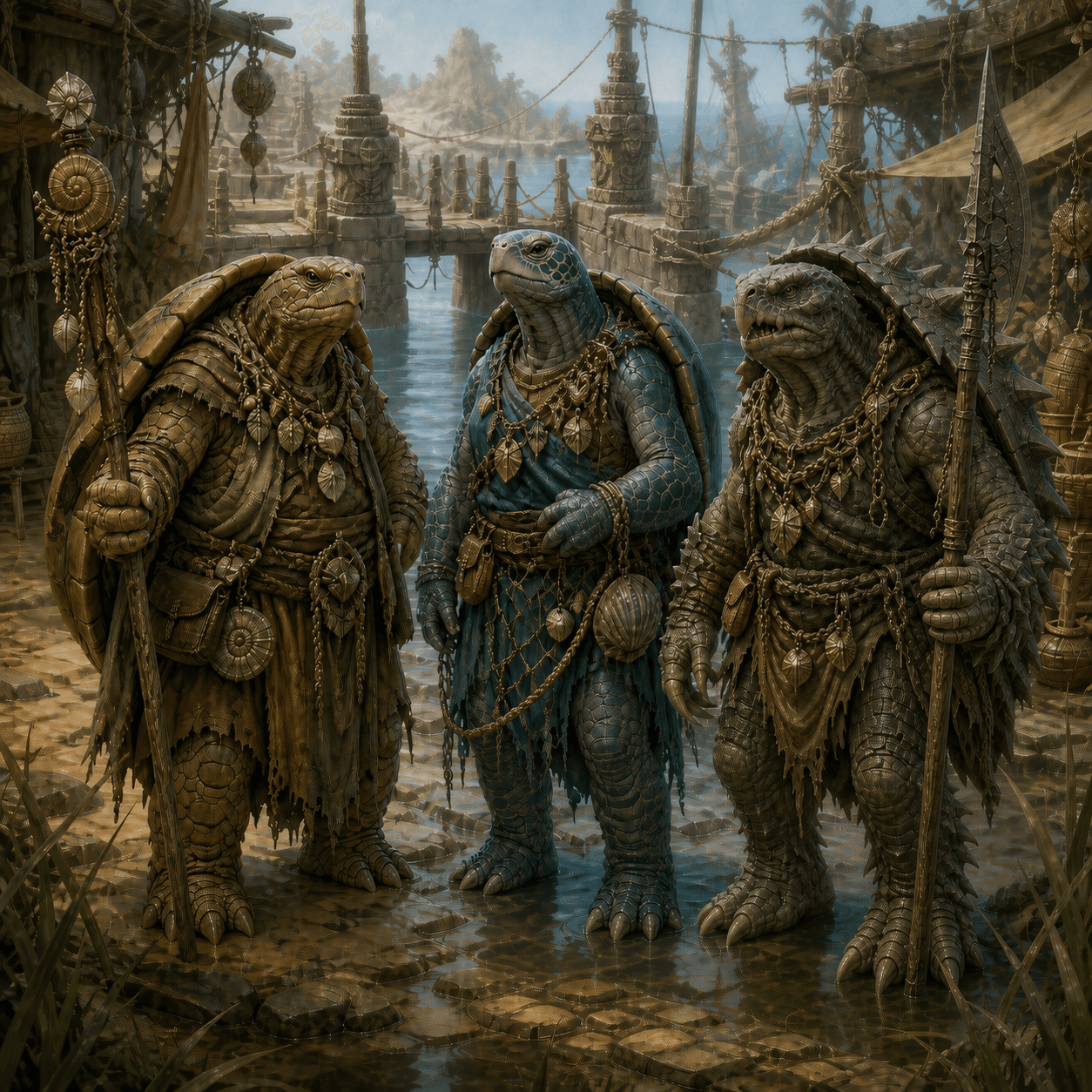
Reptile-Folk
Tortle Folk
Miréss
Subtypes. Swamp • Land • Ocean
Background Questions
Which Shellsage taught you your role?
What waterway or road did you first help maintain?
What toll or right do you guard fiercely?
What storm or flood shaped your people?
Lore
Tortles are ferry-builders, lock-keepers, and water-engineers. Their Shell-Code governs fair passage, tolls, and canal maintenance from Eastgate to Westgate.
Homeland: Suo fens, Hiekka oases, Ranta reefs
Cities: Carapace Quay, Mire-Cairn, Sun-Shell Terrace
Exports: Ferry pilots, shell-laminate armor, coral blocks
Imports: Tar, iron, cloth
Allies: Lizard Folk, Tritons, Armadillo & Badger Folk
Enemies: Shark raiders, Snake Folk press-gangs, Kobold trap-guilds
History: Their engineering reopened drowned trade routes after the Flooded Spring, redefining water travel across Reth.
Lore & Background
Tortles are ferry-builders, lock-keepers, and water-engineers. Their Shell-Code governs fair passage, tolls, and canal maintenance from Eastgate to Westgate.
Homeland: Suo fens, Hiekka oases, Ranta reefs
Cities: Carapace Quay, Mire-Cairn, Sun-Shell Terrace
Exports: Ferry pilots, shell-laminate armor, coral blocks
Imports: Tar, iron, cloth
Allies: Lizard Folk, Tritons, Armadillo & Badger Folk
Enemies: Shark raiders, Snake Folk press-gangs, Kobold trap-guilds
History: Their engineering reopened drowned trade routes after the Flooded Spring, redefining water travel across Reth.
Aldaethu - Animal-folk of the Land
Aldaethu - Land Animal-Folk
Cultural Compendium
PART I - HISTORICAL OVERVIEW
THE GRAND DESIGN
The Aldaethu believe they were created by the Celestial Dragon, who shaped each of their peoples with a distinct nature and purpose.
The Celestial Dragon's identity is intentionally unresolved. Some Aldaethu describe a literal creator who formed them beyond Reth. Others speak of a guide who gathered already-living peoples and taught them how their differences could function together. A few philosophers argue that the Celestial Dragon is the name given to the ordering principle behind their civilization rather than a single being.
No interpretation has become absolute doctrine.
What nearly all Aldaethu accept is the principle called the Grand Design:
No people was made complete alone.
Each Aldaethu lineage possesses strengths suited to a necessary role. Leadership requires law. Law requires memory. Defense requires food. Food requires land and water. Roads require builders. Builders require plans. Plans require communication. Hospitality holds all of them together.
The Grand Design does not teach that every individual must follow one profession. It teaches that gifts create obligations and that no Pillar may place itself above the whole.
THE ALDAETHU ARRIVAL
The Aldaethu arrived in Reth during the First War.
Their own histories describe the arrival as sudden and disorienting. Entire communities, caravans, households, and traveling groups found themselves in an unfamiliar world already divided by conflict. Dwarves, elves, giants, humans, forest peoples, mountain peoples, and other powers watched the newcomers closely, each expecting the Aldaethu to become allies, enemies, or resources to be claimed.
The Aldaethu refused to become another army.
Their first actions were practical:
establish protected camps
identify safe water and grazing
build neutral roads between displaced communities
protect refugees
open food exchanges
observe the existing factions
prevent their own peoples from being divided and recruited separately
The Chiaegen Lionfolk emerged as public mediators, but they did not act alone. Elephantfolk recorded terms. Bearfolk secured neutral ground. Cowfolk and Rabbitfolk fed those who came. Horsefolk carried messages. Caninefolk and Felinefolk watched the borders. Monkeyfolk studied the conflict. Goatfolk tended the dead and counseled frightened communities.
The Aldaethu did not end the First War by conquest.
They created the practical conditions in which peace could be attempted.
THE FIRST CONVOCATION
As more Aldaethu communities found one another, their leaders gathered in what later histories call the First Convocation.
The central dispute was whether the Aldaethu should remain separate peoples or form a permanent union.
Those who favored separation argued that each lineage already possessed its own customs, leaders, and survival methods. A central authority might allow Lionfolk or another powerful people to dominate the rest.
Those who favored union argued that Reth's existing powers would divide the Aldaethu if they did not speak together.
The compromise became the foundation of Aldaethu government:
every people retains its own local customs and leadership
no lineage rules the others by birthright
shared responsibilities are organized through Pillars
the Confederation governs only what must be held in common
major decisions require multiple Pillars
every recognized people may challenge a Pillar that neglects its duty
This agreement created the Aldaethu Confederation.
THE GREAT PEACE
The Aldaethu played a central role in the peace settlement that followed the First War.
They helped establish:
neutral roads
shared markets
protected messenger routes
border witness stations
refugee resettlement
common standards for guest-right
food and water agreements between hostile regions
Their reputation as mediators grew, and the Aldaethu became natural supporters of the wider peace established under the new order.
The Aldaethu were granted territory in which to establish their own civilization. They built Zal'Aldaethu, a capital designed as a physical expression of the Grand Design.
The city was not divided into isolated ancestry quarters. Instead, its districts were arranged by interdependence. Courts stood near archives. Markets opened toward roads and waterways. Granaries connected to kitchens and garrisons. Workshops stood near planning halls. Temples overlooked public gathering places.
The city's design declared that no Pillar could operate alone.
THE PRIME COUNCIL
The Aldaethu were recognized as one of the major peoples represented in the political settlement of Reth.
This recognition brought influence but also created internal strain.
Other peoples frequently wanted a single Aldaethu representative who could speak for every lineage. The Confederation resisted this simplification. Lionfolk often served as the public voice, but Elephantfolk, Bearfolk, Cowfolk, Goatfolk, Monkeyfolk, and the agricultural and infrastructure peoples retained authority over matters belonging to their Pillars.
This produced a constant tension:
The Aldaethu must speak together without pretending they are one culture.
THE SECOND WAR
The Second War did not begin within Aldaethu territory, but its consequences reached them.
Trade routes closed. Refugees arrived. Food prices increased. Public fear turned against Batfolk, insectoid peoples, and anyone associated with the conflict. Some Aldaethu leaders called for neutrality. Others argued that the Grand Design required intervention whenever one people was being collectively punished for the actions of particular factions.
The Confederation never reached full agreement.
Bearfolk garrisons protected Aldaethu territory. Horsefolk and Caninefolk kept relief routes open. Cowfolk halls received displaced families. Elephantfolk documented abuses. Goatfolk condemned collective punishment. Felinefolk and Monkeyfolk gathered information from the borderlands.
The Confederation survived the war, but unity became harder to maintain.
THE LONG SHADOW
During the Long Shadow, Aldaethu institutions remain functional but strained.
The Pillars still meet. Roads still carry messages. Granaries still open during crisis. Treaties are still witnessed. Yet confidence in the Confederation has weakened.
The greatest danger is not open civil war.
It is slow separation.
Lionfolk prides increasingly prioritize local influence.
Bearfolk lodges answer first to nearby communities.
Rabbitfolk resist surrendering food stores to distant regions.
Horsefolk travel routes that the central government no longer maintains.
Ratfolk supply systems operate through unofficial networks.
Goatfolk disagree over whether the Long Shadow reflects political failure or a deeper disruption in the Grand Design.
Monkeyfolk call for rapid innovation that older authorities consider dangerous.
Elephantfolk warn that emergency exceptions are becoming permanent law.
The Aldaethu remain one people because each part still depends upon the others.
Whether that dependence remains honorable - or becomes resentment - is one of the defining questions of the present age.
PART II - SHARED CULTURAL THEMES
THE GRAND DESIGN
The Grand Design is the central idea of Aldaethu civilization.
Each Aldaethu people is believed to embody gifts suited to a necessary social purpose. These roles are called Pillars, though not every lineage carries a formal Pillar alone.
The Grand Design is not meant to restrict individuals.
A Rabbitfolk may become a warrior. A Bearfolk may become a cook. A Lionfolk may reject leadership. A Monkeyfolk may become a priest.
The Design describes collective responsibilities, not compulsory professions.
Its central lesson is:
A gift becomes sacred only when it serves beyond itself.
PURPOSE AS OBLIGATION
Aldaethu do not treat talent as proof of superiority.
A people recognized for strength is expected to protect.
A people recognized for memory is expected to preserve truth.
A people recognized for speed is expected to carry urgent warning.
A people recognized for leadership is expected to accept blame.
The greater the ability, the greater the obligation.
INTERDEPENDENCE OVER SAMENESS
Aldaethu unity does not require cultural uniformity.
Prides, packs, lodges, warrens, burrows, temples, workshops, and route-camps maintain distinct customs. The Confederation is meant to protect those differences while ensuring that they serve a shared civilization.
An Aldaethu does not prove unity by becoming like everyone else.
They prove unity by carrying their part without dismissing the parts carried by others.
OATH-MEAL
Binding agreements are confirmed through an Oath-Meal.
The parties share food or drink while the terms are spoken before witnesses. The meal represents mutual vulnerability: everyone eats from the same stores and accepts the same hospitality.
Refusing the meal after agreeing to terms is considered a declaration that trust does not exist.
Breaking an Oath-Meal agreement does more than damage personal reputation. It may close roads, halls, markets, and protection agreements throughout Aldaethu territory.
ROAD-RIGHT
Messengers, relief caravans, lawful travelers, and recognized envoys are protected under Road-Right.
Someone traveling under Road-Right must:
declare their purpose honestly
obey route law
respect local stores and water
avoid carrying hostile forces under false protection
assist others in immediate danger when able
Those who violate Road-Right may lose access to Aldaethu roads, inns, ferries, courier stations, and protected camps.
NAME-WORK
Aldaethu status is earned through witnessed work.
A title or family name may open a door, but reputation is built by what someone has done:
whom they protected
what they built
what they preserved
what they carried
what they fed
what they repaired
what responsibility they accepted
This is known as Name-Work.
The question asked of a respected Aldaethu is not merely, "Who were your ancestors?"
It is:
"What stands because you did your part?"
THE SHARED TABLE
During disaster, Aldaethu custom requires immediate stabilization before blame.
Food, water, shelter, safety, and medical care are secured first. Judgment follows once the vulnerable are protected.
This practice is known as Opening the Shared Table.
Refusing aid during an immediate crisis because of lineage, politics, or debt is treated as a rejection of the Grand Design.
PART III - THE ALDAETHU CONFEDERATION
The Aldaethu Confederation governs shared responsibilities between its peoples.
It does not replace local government.
A pride still governs its internal affairs. A pack chooses its own leaders. A Rabbitfolk burrow manages its fields. A Bearfolk lodge controls its training. A Monkeyfolk guild regulates its apprentices.
The Confederation intervenes when a matter affects multiple peoples or threatens shared survival.
Its responsibilities include:
foreign diplomacy
major roads
shared waterways
inter-lineage law
common defense
emergency food reserves
public infrastructure
Confederation-wide rites
disputes between Pillars
representation before wider Reth
THE PILLAR CONCLAVE
The Confederation is governed through the Pillar Conclave at Zal'Aldaethu.
Each recognized Pillar sends delegates according to its own traditions.
Lionfolk convene the Conclave but do not possess absolute authority.
Elephantfolk certify procedure and preserve the official record.
No declaration of war, permanent territorial concession, or treaty binding all Aldaethu may be enacted by one Pillar alone.
Major decisions require agreement from multiple Pillars, including those that will bear the practical cost.
A military expansion cannot be approved without consulting agriculture, logistics, law, and infrastructure.
A grand road cannot be ordered without consulting those whose land and water it crosses.
THE GREAT PILLARS
Leadership
Carried principally by the Chiaegen Lionfolk.
Leadership coordinates the Confederation, mediates disputes, speaks outward, and accepts visible responsibility.
Law
Carried principally by the Elephantfolk.
Law preserves precedent, witnesses treaties, records judgment, and prevents temporary power from becoming permanent authority.
Military Defense
Carried principally by Bearfolk and Pandafolk.
Defense protects borders, trains militias, responds to crisis, and limits the lawful use of force.
Hospitality and Hearth
Carried principally by Cowfolk.
Hospitality protects guest-right, public food, rest halls, emergency shelter, celebrations, and communal morale.
Religion: and Mysticism
Carried principally by Goatfolk.
Religion: maintains rites, spiritual counsel, funerals, vows, omens, and interpretation of the Grand Design.
Science and Strategy
Carried principally by Monkeyfolk.
Science and Strategy oversee planning, engineering, forecasting, experimentation, and coordinated problem-solving.
Agriculture
Shared principally by Rabbitfolk and Armadillofolk.
Agriculture protects seed, crops, soil, terraces, rural defense, and long-term food security.
Infrastructure and Waterways
Carried principally by Hippofolk, with support from Armadillofolk, Badgerfolk, Ratfolk, and Monkeyfolk.
Infrastructure maintains roads, canals, bridges, ports, levees, foundations, and public works.
Roads and Couriers
Carried principally by Horsefolk, with support from Chiaegen runners, Caninefolk patrols, and Ratfolk logistics.
Logistics and Foundations
Shared principally by Ratfolk and Badgerfolk.
They maintain stores, under-streets, tunnels, supply systems, foundations, and emergency routes.
PART IV - THE ALDAETHU PEOPLES
I. CHIAEGEN - FELINE FOLK
Major Lineages
Lionfolk, Cheetahfolk, Tigerfolk, Pantherfolk, Leopardfolk, Lynxfolk, and other feline peoples.
Role
Chiaegen serve as leaders, scouts, couriers, hunters, investigators, and border guides.
Lionfolk traditionally carry the Leadership Pillar, but they do not represent every Chiaegen lineage automatically.
Government
Chiaegen govern through:
pride councils
path councils
running bands
hunting clans
Leadership Pillar delegates
Lionfolk Pride-Speakers coordinate large councils, while other feline lineages select their own route, clan, or territorial representatives.
Culture
Chiaegen culture values perception, precision, memory, restraint, and decisive action.
Their history is preserved through sand-thread rituals - temporary patterns made from sand, cord, stone, beads, ash, or petals while a story is recited. The pattern is erased after completion and must later be recreated from memory.
Economy and Trade
Couriers, scouts, wilderness guides, gems, route maps, investigators, diplomatic service, predator control, and sand-thread historians.
Warfare
Lionfolk. commanders and rallying figures
Cheetahfolk. rapid messengers and pursuit scouts
Tigerfolk. solitary guardians and heavy skirmishers
Pantherfolk. night scouts and infiltrators
Leopardfolk. climbers and high-ground ambushers
Lynxfolk. sentries and counter-infiltration trackers
Principal Settlements
Sun-Shade
Pride-Cairn
Whisper-Step
II. ELEPHANTFOLK - LAW AND MEMORY KEEPERS
Role
Elephantfolk carry the Law Pillar and serve as archivists, judges, treaty witnesses, teachers, and guardians of precedent.
Government
Extended family houses select Record-Keepers and Archivist-Judges.
No major Aldaethu treaty is considered complete until its terms have been spoken aloud, recorded, and formally witnessed.
Culture
Memory is treated as civic responsibility.
Young Elephantfolk learn:
lineage histories
legal precedents
treaty language
testimony
parables concerning unintended consequences
They are taught to repeat an opponent's position fairly before arguing against it.
Economy and Trade
Legal services, archives, teaching, treaty certification, historical consultation, translation, and stewardship of public trusts.
Warfare
Elephantfolk rarely form frontline units. Magistrates accompany armies to:
establish rules of engagement
record surrender
oversee prisoner treatment
investigate misconduct
preserve evidence
Principal Settlements
Memory-Gate
Tuskwitness Hall
The Spoken Archive
III. BEARFOLK AND PANDAFOLK - THE MILITARY PILLAR
Role
Bearfolk and Pandafolk carry the Military Defense Pillar.
They maintain garrisons, train mixed militias, guard borders, protect public stores, and respond to large-scale emergencies.
Government
Bearfolk live in lodge communities governed by Lodge-Keepers and veteran councils.
Military command does not grant ownership of the land, stores, or people being protected.
Culture
Their central philosophy is the Quiet Paw:
Strength is most sacred when it is not used.
Cubs learn wrestling, endurance, emotional regulation, rescue, restraint, and protection before they are taught lethal combat.
Pandafolk traditions place particular emphasis on balance, meditation, medicine, and discipline.
Economy and Trade
Guard services, rescue crews, forestry, winter stores, heavy labor, training, and frontier protection.
Warfare
Shield defense, chokepoint control, rescue under pressure, formation breaking, defensive retreats, and civilian protection.
Principal Settlements
Ironclaw Lodge
Quiet-Paw Bastion
Winter-Guard Ring
IV. CANINEFOLK - PACK WARDENS
Role
Caninefolk serve as border wardens, patrol leaders, communal hunters, search-and-rescue teams, and road guardians.
Government
Caninefolk organize into packs.
A leader must accept the Last Bowl:
eat after the pack
take the hardest watch
protect the weakest
accept responsibility for failure
Packs gather seasonally in Warden Moots.
Culture
Loyalty is proven through action.
Pups are raised communally and learn formation, pursuit, scent work, rescue, and shared watch from early childhood.
Economy and Trade
Patrol contracts, caravan protection, hunting, animal management, tracking, frontier law, and escort service.
Warfare
Coordinated pursuit, flanking, encirclement, road defense, extended patrol, and rescue.
Principal Settlements
Howl-Step
Bone-Gate
Dust-Den
V. COWFOLK - HOSPITALITY AND HEARTH
Role
Cowfolk carry the Hospitality and Hearth Pillar.
They oversee guest-right, inns, feast halls, public kitchens, emergency food distribution, caravansaries, and public celebrations.
Government
Hearth Councils are composed of hosts, brewers, cooks, quartermasters, merchants, and storekeepers.
A Hearth-Speaker may deny entry to anyone who has violated guest-right.
Culture
Feeding others is a sacred civic act.
Calves are raised around kitchens, markets, public tables, and storehouses. They learn mood-reading, conflict de-escalation, preservation, brewing, cooking, and hospitality.
Economy and Trade
Food, brewing, preserved goods, dairy, caravan provisioning, hospitality, public markets, and quartermaster services.
Warfare
Supply coordination, field kitchens, refugee care, camp organization, morale, and emergency shelter.
Principal Settlements
Hearth-Horn
Broadtable
Amber-Milk Hall
VI. GOATFOLK - RELIGION AND MYSTICISM
Role
Goatfolk carry the Religion and Mysticism Pillar.
They maintain temples, shrines, rites, funerals, marriages, naming ceremonies, spiritual counseling, and interpretation of planar signs.
Government
Temple communities are guided by Circles of Horns.
Authority is earned through insight, service, and the ability to guide without claiming certainty.
Culture
Goatfolk teach that the planes are living patterns.
They value questions, paradox, resilience, and humility before the unknown.
Children learn to climb, debate, read symbols, and recover after failure.
Economy and Trade
Ritual services, herbs, education, counseling, pilgrimage lodging, calendars, and magical interpretation.
Warfare
Chaplains, healers, battle-chanters, morale keepers, and negotiators.
Principal Settlements
Thistle-Lyre
Redhorn
Glen-Kith
VII. HORSEFOLK - ROADS AND COURIERS
Role
Horsefolk carry messages, medicine, warning, trade, and emergency orders across Aldaethu territory.
They maintain relay stations and rapid-response routes.
Government
Routes are governed by Route Circles led by elected Way-Speakers.
Authority belongs to the route being maintained rather than to a permanent territorial ruler.
Culture
Journeys and promises are sacred.
Young Horsefolk complete a First Circuit, traveling an established route and returning with witnessed proof that they fulfilled every obligation along it.
Economy and Trade
Courier work, transport, road maintenance, route mapping, patrols, and rapid trade.
Warfare
Outriders, screening forces, pursuit troops, rapid reinforcement, and message delivery.
Principal Settlements
Mare's-Crown
Wind-Hearth
Trail-Star
VIII. MONKEYFOLK - SCIENCE AND STRATEGY
Role
Monkeyfolk carry the Science and Strategy Pillar.
They serve as engineers, planners, observers, inventors, scribes, logisticians, and tactical advisors.
Government
Guilds and workshop neighborhoods select Bench-Speakers.
Dangerous experiments must be reviewed by a Consequence Circle representing both experts and affected communities.
Culture
Curiosity is sacred, but knowledge without empathy is dangerous.
Young Monkeyfolk learn through puzzles, construction, climbing, games, and collaborative experiments.
Economy and Trade
Engineering, instruments, maps, planning, repairs, logistics systems, education, and experimental devices.
Warfare
Siege engineering, signals, logistics, mapping, countermeasures, sharpshooting, and strategy.
Principal Settlements
Vine-Spire
Joggle-Bay
Canopy-Market
IX. RABBITFOLK - AGRICULTURE AND SEED KEEPERS
Role
Rabbitfolk form the core of the Agriculture Pillar.
They manage fields, seeds, crop rotation, population needs, small livestock, harvest, and emergency food reserves.
Government
Burrow Commons govern through direct participation.
Seasonal Stewards coordinate planting and distribution but hold authority only for one agricultural cycle.
Culture
Rabbitfolk value cooperation, foresight, preparation, communal childcare, and quiet courage.
Their greatest cultural fear is famine.
Economy and Trade
Grain, vegetables, herbs, seed stock, fibers, small livestock, preserved food, and agricultural expertise.
Warfare
Emergency runners, scouts, evacuation coordinators, and supply organizers.
Principal Settlements
Warren-Cross
Clover-Ring
Lantern-Fen
X. ARMADILLOFOLK - SOIL AND DEFENSIVE AGRICULTURE
Role
Armadillofolk maintain soil health, terraces, berms, drainage systems, dikes, rural tunnels, and defensive earthworks.
Government
Work crews elect Foreclaws.
Regional Soil Moots coordinate watersheds and prevent one community's construction from damaging another.
Culture
Stability, modesty, persistence, and unseen labor define Armadillofolk identity.
They are taught to read the pressure, moisture, and integrity of the earth.
Economy and Trade
Terracing, drainage, soil restoration, tunneling, defensive works, quarry support, and construction.
Warfare
Sappers, trench builders, tunnel fighters, fortification specialists, and movement denial.
Principal Settlements
Scale-Wheel
Stone-Scroll
Pale-Barrow
XI. HIPPOFOLK - INFRASTRUCTURE AND WATERWAYS
Role
Hippofolk carry the Infrastructure and Waterways Pillar.
They construct and maintain canals, locks, levees, bridges, ports, roads, and large civic works.
Government
Major projects are governed through Project Councils containing:
engineers
workers
legal witnesses
local representatives
affected downstream communities
Culture
Crossings are sacred.
A bridge, road, canal, or port transforms separation into relationship.
Major works open with a First Crossing rite.
Economy and Trade
Construction, dredging, ports, stonework, water control, transport infrastructure, and flood response.
Warfare
River defense, bridge control, port security, urban chokepoints, and structural defense.
Principal Settlements
Broad-Ford
Lock-Gate
Brass-Quay
XII. RATFOLK - LOGISTICS AND UNDER-STREETS
Role
Ratfolk maintain granaries, warehouses, inventories, emergency caches, under-streets, and hidden supply routes.
Government
Warrens are governed by Ledger Circles.
Stores and routes are audited by rival teams to prevent quiet corruption.
Culture
Ratfolk believe every object and path belongs to a wider web.
Their sacred work is to keep that web moving without waste.
Economy and Trade
Warehousing, salvage, shipping, courier work, recycling, hidden transport, and inventory systems.
Warfare
Evacuation, sabotage, supply disruption, intelligence movement, and smuggling allies to safety.
Principal Settlements
Ledger-Warren
Underthread
Quickstore
XIII. BADGERFOLK - FOUNDATIONS AND THE UNDERCITY
Role
Badgerfolk maintain tunnels, supports, foundations, basements, deep stores, and collapse rescue.
They also mediate neighborhood disputes in underground districts.
Government
Deep Homes are guided by Foundation Councils of builders, rescuers, elders, and trusted mediators.
Culture
Badgerfolk revere the Rooted Home:
Security is the foundation from which others may grow.
They celebrate disasters prevented and lives saved rather than visible glory.
Economy and Trade
Foundation work, tunneling, rescue, inspections, storage, structural repair, and mediation.
Warfare
Tunnel defense, chokepoint holding, collapse control, underground rescue, and denial of enemy movement.
Principal Settlements
Iron-Set
Root-Run
Claw-Hold
PART V - ZAL'ALDAETHU
Zal'Aldaethu is the capital of the Aldaethu Confederation and the clearest architectural expression of the Grand Design.
It is arranged so that no Pillar can function in isolation.
The city contains:
Lionfolk council courts
Elephantfolk record halls
Bearfolk Guard Rings
Cowfolk feast halls and public kitchens
Goatfolk temples
Monkeyfolk planning towers
Rabbitfolk granaries and garden districts
Armadillofolk earthworks
Hippofolk canals and locks
Horsefolk relay stations
Ratfolk under-streets
Badgerfolk foundations
Roads and canals deliberately cross Pillar districts.
A court cannot operate without passing the stores that feed it.
A garrison stands near public kitchens and legal halls.
A planning tower overlooks the neighborhoods affected by its designs.
The city itself teaches:
Every purpose touches another.
THE PILLAR CONCLAVE
The Pillar Conclave meets at the civic center of Zal'Aldaethu.
The chamber is arranged as a ring rather than a throne room.
Lionfolk convene proceedings.
Elephantfolk preserve the record.
Every Pillar speaks from an equal floor.
The central space remains empty, symbolizing the Grand Design itself - something no single people may occupy.
THE GUARD RINGS
Bearfolk maintain defensive rings throughout the capital.
These are not merely barracks. Each includes:
refuge halls
emergency food
medical rooms
public wells
evacuation routes
communication posts
The Guard Rings are built to protect neighborhoods, not control them.
THE SHARED TABLES
Cowfolk maintain permanent public tables near major gates and markets.
Travelers may receive water and a simple meal before being questioned about payment, ancestry, or purpose.
During crisis, these tables become distribution centers.
THE UNDERCITY
Ratfolk and Badgerfolk maintain a second city beneath the visible one.
It contains:
supply routes
cisterns
storage chambers
foundations
emergency shelters
archive copies
evacuation passages
Access is controlled, but the undercity is not considered shameful or criminal.
It is one of the systems that allows the Grand Design to function.
PART VI - EXTERNAL RELATIONSHIPS
Druazir
Relations: with humans are varied.
The Aldaethu remember both the violence they encountered upon arrival and the human communities that accepted their mediation and trade.
They respect human adaptability but distrust political systems that change terms whenever rulers change.
Druazer
Dwarves are valued for metalwork, stonecraft, and structural knowledge.
Armadillofolk, Hippofolk, Badgerfolk, and Monkeyfolk maintain particularly strong working relationships with them.
Disputes arise where roads, mines, or waterworks threaten Aldaethu territory.
Druthal
Aldaethu generally respect the long memory and treaty traditions of the Druthal Courts.
Chiaegen, Goatfolk, and Elephantfolk often work with Druthal diplomats and wardens.
Druis
Halflings are trusted as couriers, hosts, farmers, and neutral messengers.
Rabbitfolk, Cowfolk, Horsefolk, and Chiaegen maintain especially close ties with them.
Aldaemir
Relations: improved during the Great Peace through ferry law, water agreements, food trade, and neutral road work.
Hippofolk and Aldaemir water-keepers sometimes clash over engineering projects, but both recognize the need for negotiated water rights.
Aldaener
Aldaener messengers complement Horsefolk and Chiaegen courier networks.
Conflicts arise over nesting rights, aerial surveillance, hunting territory, and who has authority over high routes.
Aldaedro
The Aldaethu respect the strength and craft of the earth-forged peoples but remain wary of territorial claims backed by size and ancient inheritance.
Bearfolk, Armadillofolk, Hippofolk, and Badgerfolk often find common ground with them through work.
Aldaedre
Relations: with dragonkin vary widely.
The Aldaethu are fascinated by dragon-linked peoples because of their own belief in the Celestial Dragon, but they do not automatically treat dragon blood as proof of divine authority.
PART VII - RELIGION AND PHILOSOPHY
THE CELESTIAL DRAGON
The Celestial Dragon is believed to have created, gathered, guided, or ordered the Aldaethu.
No single interpretation is mandatory.
The Dragon may be understood as:
a literal creator
an ancient celestial being
a guide who brought the Aldaethu together
an ancestor of impossible age
the divine expression of the Grand Design
a symbol created to preserve unity
Goatfolk theologians debate these possibilities openly.
The mystery is intentional.
What matters is the belief that Aldaethu differences possess purpose when placed in relationship.
COMMON INTERPRETATIONS
Chiaegen
The Grand Design as perception, pursuit, leadership, and decisive action.
Elephantfolk
The Grand Design as law, memory, witness, and continuity.
Bearfolk and Pandafolk
The Grand Design as strength held in protection.
Caninefolk
The Grand Design as loyalty, shared burden, and mutual defense.
Cowfolk
The Grand Design as nourishment, hospitality, and belonging.
Goatfolk
The Grand Design as spiritual pattern, mystery, and conscience.
Horsefolk
The Grand Design as connection through movement and fulfilled obligation.
Monkeyfolk
The Grand Design as knowledge disciplined by consequence.
Rabbitfolk
The Grand Design as renewal, preparation, and future survival.
Armadillofolk
The Grand Design as stable ground and patient labor.
Hippofolk
The Grand Design as crossings, infrastructure, and connection made physical.
Ratfolk
The Grand Design as flow, efficiency, and the prevention of waste.
Badgerfolk
The Grand Design as secure foundations and the hidden work that allows others to flourish.
PART VIII - CULTURE SNAPSHOT
Name. Aldaethu
Common Name. Land Animal-Folk
Government: Confederation of distinct peoples governed through the Pillar Conclave
Capital. Zal'Aldaethu
Primary Lionfolk City. Mane-Arch
Shared Belief. The Celestial Dragon created or gathered the Aldaethu and gave each people a purpose within the Grand Design
Shared Customs:
Oath-Meal
Road-Right
Name-Work
Opening the Shared Table
Pillar service
Public witness
Chief Exports:
Couriers
Agricultural goods
Livestock and preserved food
Guards and scouts
Engineering
Legal and diplomatic services
Hospitality
Transport
Public-works expertise
Chief Imports:
Fine steel
Precision tools
Glass
Rare magical reagents
Luxury textiles
Foreign books and maps
Specialized stone and timber
Diet: Varies by lineage; meat, grain, vegetables, milk, cheese, fruit, roots, tea, stews, and preserved travel foods are common
Society: Prides, packs, lodges, burrows, warrens, temples, route camps, guilds, work crews, and extended households joined through the Confederation
Buildings: Pride compounds, lodges, burrow-villages, public kitchens, route stations, canals, bridges, workshops, archives, temples, granaries, under-streets, and Guard Rings
Traditional Allies. Druis couriers, lawful trade partners, neutral mediators, road communities, and peoples who respect Oath-Meal and Road-Right
Common Enemies. Slavers, raiders, oath-breakers, corrupt officials, food hoarders, route-poachers, and powers that attempt to divide one Aldaethu people against another
Core Values:
Purpose
Interdependence
Duty
Hospitality
Witness
Shared survival
Responsibility
Service before privilege
Greatest Taboos:
Breaking Road-Right
Falsifying a witnessed oath
Hoarding public stores during crisis
Abandoning another Aldaethu people after securing one's own safety
Using a Pillar to seize permanent supremacy
Treating another lineage as a servant caste
Claiming that one people alone embodies the Grand Design
Checking your codex…
From the Reth Ancestries (Daggerheart) compendium. Ancestry mechanics unlock when you collect this lineage in Hoard and link your account.