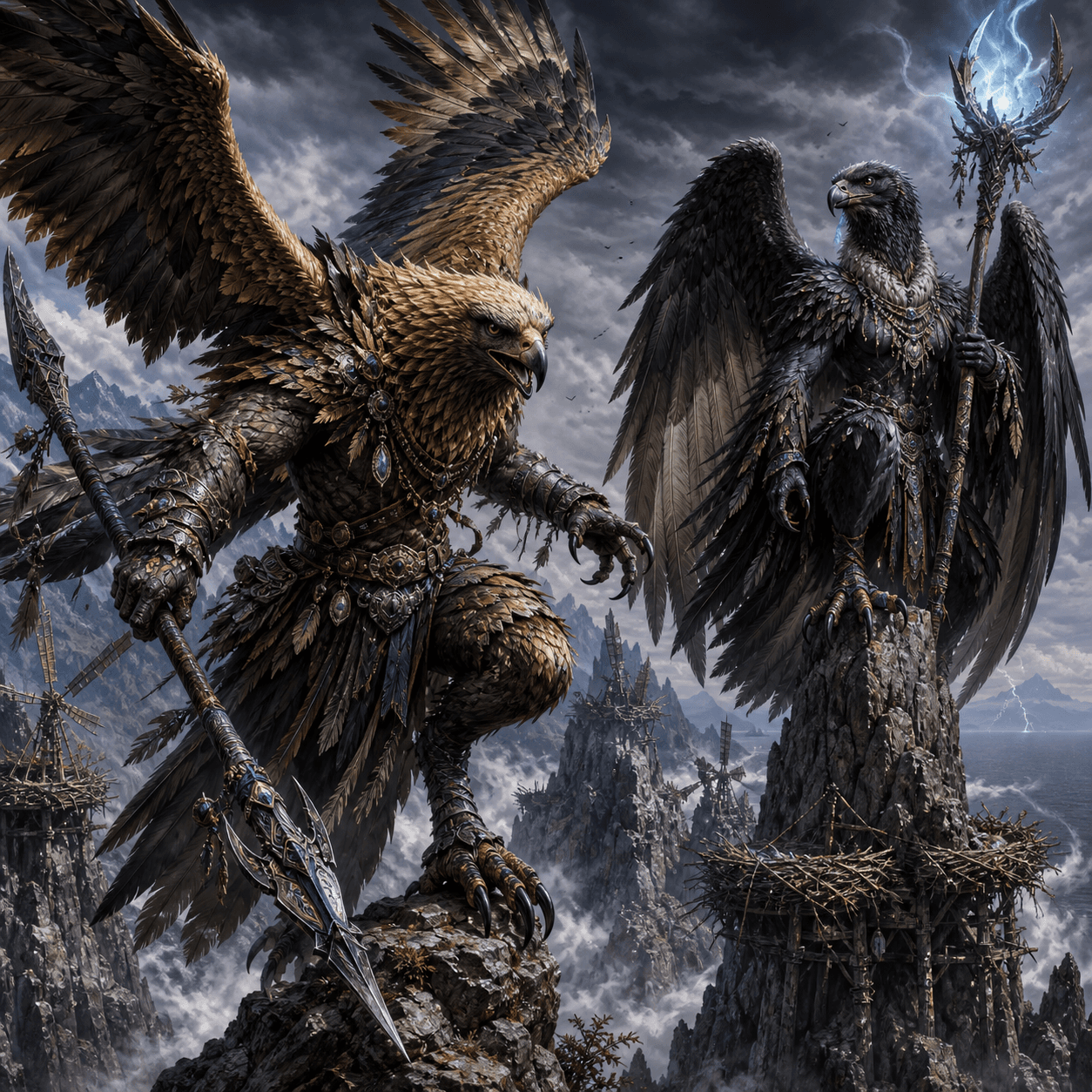
Sky Animal-Folk
Large Avian
Ner'Kor
Background Questions
1. What peak, storm, or sky-shelter is sacred to your people?
2. When did you first take to the air alone?
3. What omen did you once witness in the clouds?
4. Which stormspeaker shaped your path?
Lore
Large Avians are wind-tribe hunters and sentinels, whose storm beacons once saved entire regions. They act as scouts, weather wardens, and high-cliff defenders.
Homeland: Vuori updraft peaks, coastal cliffs
Cities: Rime-Thera (Kylmä peak), Storm-Gate (Ranta), Sun-Perch (Vuori)
Exports: Aerial scouting, storm warnings
Imports: Worked leather
Diet: Fish, mountain goat, citrus
Society: Wind-tribes led by stormspeakers
Buildings: Spire nests, windmills
Allies: Pterasaur, Owlin
Enemies: Sky-shark cults
History: Their storm beacons saved Westgate during the Flooded Spring.
Lore & Background
Large Avians are wind-tribe hunters and sentinels, whose storm beacons once saved entire regions. They act as scouts, weather wardens, and high-cliff defenders.
Homeland: Vuori updraft peaks, coastal cliffs
Cities: Rime-Thera (Kylmä peak), Storm-Gate (Ranta), Sun-Perch (Vuori)
Exports: Aerial scouting, storm warnings
Imports: Worked leather
Diet: Fish, mountain goat, citrus
Society: Wind-tribes led by stormspeakers
Buildings: Spire nests, windmills
Allies: Pterasaur, Owlin
Enemies: Sky-shark cults
History: Their storm beacons saved Westgate during the Flooded Spring.
Aldaemir (Reptile-folk)
Cultural Compendium
PART I - HISTORICAL OVERVIEW
THE OLD WATER PACT
The Aldaemir peoples once lived across Reth's wetlands - marshes, swamps, river deltas, wetwood forests, lake systems, and the shallow cave-springs that feed them. They were never one nation, but they recognized one another as kin-of-water: different scales, different rites, the same hard lessons. Their earliest treaties and trade norms are remembered as the Old Water Pact.
THE FIRST WAR - UNITED MARSH HOLDS
As human frontier charters spread, surveyors and guild crews pushed into the wetlands to cut channels, drain bogs, and claim crossings. The Aldaemir answered the same way the marsh answers fire: quickly, quietly, and everywhere at once. For the only time in their recorded history, the five peoples formed a coalition - the United Marsh Holds - to deny flanking routes and protect the great rivers feeding the Circle.
Roles in the coalition:
• Niráss (Lizardfolk): scouts, ambushers, and chokepoint defenders along reed-cuts and river bends.
• Crocodilian Clans (within Niráss): heavy shock fighters in deep water and mud-sink ground.
• Niríss (Snakefolk): diplomats, healers, venomcrafters, and oath-binders who kept the coalition intact.
• Nirüss (Frogfolk): fog-callers, shallow-water guides, and growers who fed holds when roads failed.
• Niross (Newt & Salamander Folk): river-wardens and wetwood druids who kept escape paths open and land healthy.
• Niréss (Turtlefolk): sanctuary keepers, record-tenders, and mediators who prevented vendettas from becoming civil war.
THE GREAT PEACE & COUNCIL SEAT
After the ceasefire and the Great Peace that followed, the Prime Council offered the Aldaemir a single seat meant to represent all five peoples. The intent was "unity." The result was resentment. Each nation maintained its own laws, borders, and water-rights, and none enjoyed speaking for the others. Still, trade boomed: marsh-iron, resins, medicines, ferry rights, and river maps flowed outward; worked tools, grain, and salt flowed in.
THE SECOND WAR - BORDER FIRES AND WITHDRAWAL
When the Second War flared between the Batfolk and the Scorpion Folk, the fighting splashed outward into borderlands and trade routes. Raids and counter-raids disrupted fisheries and reed-fields. Patrols cut across protected channels. Shrines were damaged in the confusion, and old crossing-treaties were broken by outsiders who believed the marsh would simply "take it." The Aldaemir petitioned for enforcement and reparations. The Council responded slowly and unevenly.
By the war's end, the Aldaemir withdrew their unified voice from Prime Council proceedings. They did not declare open hostility. They simply stopped pretending one seat could carry five nations.
THE LONG SHADOW - FIVE NATIONS
In the Long Shadow era, the Aldaemir are five independent wetland civilizations. They cooperate when the water demands it, but they negotiate as peers, not as a single people. Their shared convocation - the Circle of Reeds - remains the only place where all five will sit without an outside mediator.
PART II - SHARED CULTURAL THEMES
WATER AS RECORD
Among the Aldaemir, water is treated as a witness. Still water shows what is placed before it. Moving water carries news and warnings between settlements, because most travel and trade follow the rivers. After a flood, waterlines on trees and stone markers are used as the official record of what happened and where damage began. Many rites are practical: a speaker states an oath or a dispute claim over a basin or calm pool so witnesses can hear it in full, and the community remembers the words as part of the record. Breaking such a vow does not "anger" the water - it marks the speaker as unreliable in future councils, trade, and marriage ties.
STILLNESS AS DISCIPLINE
Aldaemir communities value quiet observation and deliberate movement. Children are trained to watch first - wind, insects, ripples, and footfalls - before they act. In councils, long pauses are normal; speaking quickly is taken as carelessness, a sign someone has not checked the situation. In war and travel, this same habit shows as patience: they wait for the right angle, the right tide, and the right cover, instead of forcing a rushed approach.
TERRITORY AS BODY
Wetlands are not interchangeable ground to the Aldaemir. Each channel, reedbed, and floodplain has a job: it feeds fish and waterfowl, moves boats, filters water, and protects settlements from storms and drought. When outsiders dredge, dam, or drain marshland, it breaks those systems and removes food, safe routes, and natural defenses. As a result, Aldaemir diplomacy is built around water-rights: who may cross, fish, cut reeds, build levees, or divert flow - and what repairs and compensation are required when damage is done.
CYCLES OVER CERTAINTY
Aldaemir law assumes the map changes. Flood season, dry season, and storm years all change what routes are safe, what crops can be planted, and what ground can be defended. Their agreements often include seasonal terms: different rules for ferry tolls, reed cutting, fishing limits, and travel rights depending on water level. Outsiders sometimes call this inconsistent. The Aldaemir treat it as basic competence.
SUBTLETY OVER FORCE
In conflict, Aldaemir prefer methods that match the terrain: false paths, hidden berms, reed screens, night crossings, and ambush at chokepoints. They avoid open-field battles where heavier troops can form lines. Instead, they disrupt supply, isolate scouting parties, and force enemies to move slowly and loudly. If a fight cannot be won cleanly, they withdraw, let water and weather do the work, and strike again when the enemy is tired, wet, and short on food.
PART III - THE CIRCLE OF REEDS
The Circle of Reeds is a generational convocation where all five Aldaemir nations:
• resolve boundary and water-right disputes
• share ecological warnings (disease blooms, salt intrusion, river collapse, predators on the move)
• establish trade norms and ferry law
• decide whether to send a united envoy to the Prime Council for a single matter
No ruler presides. Each Circle names a Speaker of the Waters for that session only - an elder chosen for clarity of speech and the ability to keep five tempers from becoming five wars.
PART IV - THE FIVE ALDAEMIR NATIONS
I. NIRÁSS - LIZARDFOLK MARSH-CLANS
Government: Clan chieftains send teeth-and-kin to a Marsh Council. In wartime, the council may raise a temporary High-Scale, a war-leader who holds command only until the threat passes.
Culture. Honor is practical. Strength matters, but so does restraint. A Niráss hunter is judged by what they bring home, what they protect, and what they refuse to waste.
Economy & Trade. fish, hides, marsh-iron, amber resin, reed-wood weapons, river tolls and escort rights through dangerous cuts.
Warfare. ambush and chokepoints. Crocodilian clans serve as deep-water shock troops; reed-hunters turn banks into killing lanes.
II. NIRÍSS - SNAKEFOLK COVENS
Government: Covens gather into a Circle of Scales. A Serpent-Mother or Serpent-Father may be recognized to settle disputes and carry treaty authority, but no single voice overrides the covens on matters of home-water.
Culture. Speech is craft. Oaths are measured like medicine - carefully, with consequences understood. Honor is tied to precision, fulfilled promises, and the refusal to waste life without cause.
Economy & Trade. venoms, antidotes, ritual dyes, incense, medical training, and treaty-brokering when other peoples cannot sit in the same room.
Warfare. toxins, coils, and controlled strikes. Killing must be justified; careless slaughter is treated as spiritual rot.
III. NIRÜSS - FROGFOLK REED-COLLECTIVES
Government: Direct vote within the collective. Reed Speakers are appointed to speak for the group; a ceremonial Tidemother may bless plantings, marriages, and peace talks, but does not rule.
Culture. Communal and rhythmic. History is carried in song cycles and work-chants - because people remember what they can sing together.
Economy & Trade. ferries, wetland agriculture, fungus farming, herbal medicine, and reed-craft.
Warfare. fog, misdirection, and hit-and-run strikes in shallow water. They win by never being where the enemy swings.
IV. NIROSS - NEWT & SALAMANDER WETWOOD TRIUMVIRATE
Government: Three arch-druids - Wetwood, River, and Spring-Cave - share authority. They argue constantly and cooperate the moment the ecosystem is threatened.
Culture. Renewal and transition. Regrowth is not a metaphor to Niross - it is a civic duty. They police pollution, over-harvest, and reckless burning with the same seriousness others reserve for murder.
Economy & Trade. glowmoss, tonics, soil-works, fungus alchemy, wetwood carvings, and restoration services for damaged marshland.
Warfare. terrain control and endurance. They make the ground change under your feet, then outlast you.
V. NIRÉSS - TURTLEFOLK LAKE MONASTERIES
Government: Slow councils of monastic elders. Shell-Tenders oversee archives and rites; a High Shell carries diplomatic authority when the monasteries must speak outward.
Culture. Patience and long consequence. A Niréss decision is rarely fast, but it is rarely wrong for the long view. They keep records others would rather forget.
Economy & Trade. glyph-tablets, scrollwork, ceramics, water-engineering, and mediation contracts between wetland nations and outsiders.
Warfare. fortified causeways, shield-lines, and defensive waterworks. They build the battlefield before they fight on it.
PART V - EXTERNAL RELATIONSHIPS
Humans. wary cooperation and deep distrust in equal measure - drained marshes and broken crossing-treaties are not forgotten quickly.
Dwarves. respect for craft and stonework, tempered by resentment where engineered diversions harmed wetlands.
Elves. generally respectful, especially where courts uphold water-rights; frustration follows when outsiders treat marshland as "empty."
Aldaethu (Land Animal Folk). relations improved during the Great Peace, especially through trade and neutral courier work. The Aldaemir do not forget that the Aldaethu were not present for the earliest wetland fighting of the First War, but they judge allies by what they do now.
Aldaener (Avian Folk). tense in contested skies and fishing waters; stable where flight routes and nesting rights are clearly negotiated.
Aldaedre (Dragonkin). natural kinship with reptile-touched peoples and a shared respect for old bloodlines and hard places.
PART VI - RELIGION & PHILOSOPHY
Unifying themes:
• water as witness and record
• stillness as discipline
• territory as spirit and body
• cycles as the only honest law
Common interpretations:
• Niráss: water as survival - what keeps you fed, hidden, and alive.
• Niríss: water as renewal - what cleans, heals, and binds oaths.
• Nirüss: water as transformation - what changes shape and makes new land.
• Niross: water as balance - what must be tended so the world does not sour.
• Niréss: water as time - what outlasts anger and carries history forward.
Proficiency. Choose one skill: Medicine, Nature, Stealth, or Survival.
Homeland: Suo swamps, river deltas, bayous, and misted marsh-rings - especially the borders where roads fail and boats matter more than walls.
3 Principal Cities: Reedspire Moot (floating council city), Mossgate Basin (river-marsh trade hub), Shellbarrow Enclave (raised causeway settlement).
Chief Export: Reeds, resins, medicines, river guides, bog-iron, smoked fish, and swamp-brew reagents.
Chief Import: Salt, worked metal, lamp oils, cloth, and glass.
Diet: Fish, frogs, roots, swamp rice, pickled vegetables, and tea-blackened broths.
Society: Kin-clans bound by river oaths. Local moots handle law, but hospitality becomes absolute once formally granted.
Buildings: Stilt homes, woven-reed halls, root-lashed bridges, floating platforms, and raised stone cairns used as flood marks and meeting points.
Racial Allies: Druis couriers, Ranta riverfolk, forest wardens, and pragmatic Druazir outposts that honor marsh oaths.
Racial Enemies: Poachers, slavers, and any power that drains the marsh. During border conflicts, raiders target Mireborn guides first.
History: The Mireborn became a shared identity after repeated expulsions and border wars. They learned to survive without walls by making the swamp itself their fortress, and their moots became neutral ground for disputes when the Great Peace opened trade.
Checking your codex…
From the Reth Ancestries (Daggerheart) compendium. Ancestry mechanics unlock when you collect this lineage in Hoard and link your account.