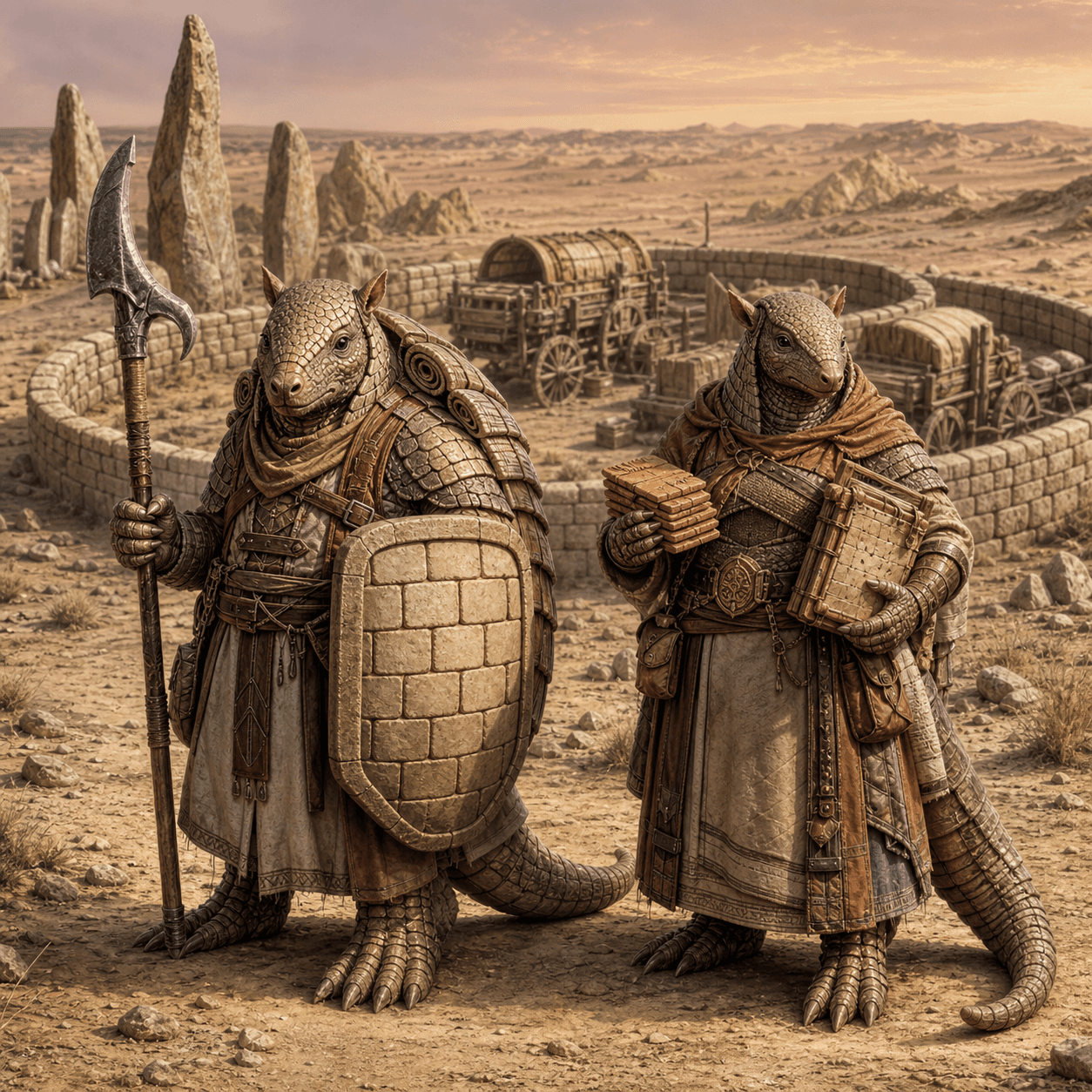
Land Animal-Folk
Armadillo Folk
Chiaenol
Background Questions
What caravan taught you the Wheelmaster's routes?
When did you first learn to curl so tightly your shell rang like bronze?
What desert or foothill shaped your early steps?
Who trusted you with your first caravan duty, and why?
Lore & Background
The Chiaenol are the Armadillo Folk of the Aldaethu: compact, plated, earthwise people whose labor supports the fields, roads, foundations, fortifications, and settlements of the Confederation.
They are most strongly associated with soil stewardship and defensive agriculture. Rabbitfolk may decide what should be planted and when. Hippofolk may design the waterworks that feed a region. Monkeyfolk may calculate the ideal grade of a canal or retaining wall.
The Chiaenol make those plans hold.
They shape terraces into unstable slopes. They build drainage beneath fields. They reinforce caravan roads against seasonal flooding. They create berms and dikes that protect crops from stormwater and raiders alike. They inspect tunnels, read fractures in dry earth, and recognize when a foundation has begun to shift before the damage becomes visible.
Much of their work disappears when performed correctly.
A stable terrace simply remains standing.
A drainage channel carries water away without notice.
A reinforced road survives the rainy season.
A settlement does not collapse.
This has shaped a culture in which value is not measured by applause. Chiaenol honor the things that continue working after the builders have gone home.
Their place within the Grand Design is commonly described as stability through preparation.
The earth bears every foot placed upon it.
The Chiaenol ensure it does not break beneath the weight.
The Chiaenol and the Grand Design
Chiaenol tradition teaches that the Celestial Dragon gave their people strong backs, digging claws, protective shells, and the patience to understand what lies beneath the surface.
Their purpose was not merely to dig.
It was to prepare the ground upon which the work of every other Aldaethu people could stand.
Lionfolk cannot gather a council in a hall whose foundation is failing.
Rabbitfolk cannot feed the Confederation from soil stripped by erosion.
Horsefolk cannot carry warning over roads washed away by seasonal floods.
Bearfolk cannot hold a defensive line if the trench beneath them collapses.
Hippofolk cannot redirect a river safely without understanding the land that must contain it.
The Chiaenol understand themselves as the part of the Grand Design that asks:
What must bear this weight?
What pressure has not been accounted for?
Where will the water go?
Who will maintain this after the builders leave?
What happens when the conditions change?
Ground Is Not Empty
To the Chiaenol, land is never simply open space.
Every piece of ground has:
weight
history
drainage
compaction
buried roots
stone layers
old construction
forgotten graves
previous claims
future consequences
Building without understanding those things is regarded as arrogance.
Preparation Is Protection
Chiaenol rarely distinguish sharply between agricultural work, civic engineering, and defense.
A terrace wall protects crops.
A drainage ditch prevents disease.
A berm slows raiders.
A tunnel moves food during siege.
A reinforced cellar becomes a storm refuge.
The same work can sustain peace and preserve life during war.
The Strongest Wall Is Maintained
Chiaenol teachings reject the idea that completion ends responsibility.
Every earthwork changes with time.
Rain erodes it. Roots push through it. Water changes course. New weight is added. Soil settles.
A structure that was once safe may become dangerous if nobody continues watching it.
Maintenance is therefore considered part of creation, not lesser work performed afterward.
Appearance
Chiaenol are compact, broad-framed humanoids with powerful limbs, digging claws, and segmented natural armor covering much of the back, shoulders, hips, and outer limbs.
Their shells differ considerably between family lines and regions.
Common shell forms include:
broad overlapping bands
high rounded plates
flatter shells suited to narrow tunnels
heavy shoulder plating
pale desert-colored armor
dark stone-grey ridges
reddish clay tones
patterned bands of brown, black, tan, or ochre
Their softer skin and fur may appear along the face, underside, joints, and inner limbs.
Shell Markings
A Chiaenol shell often serves as a record of labor and identity.
Shells may be:
etched with crew symbols
painted with soil-region colors
marked with completed public works
fitted with protective metal caps
wrapped with measuring cords
polished for ceremony
left deliberately scarred after a collapse or disaster
A work crew may add one small mark to each member's shell when a major project is completed and inspected successfully.
These marks do not signify ownership of the structure.
They signify continued accountability for it.
Clothing and Equipment
Chiaenol clothing is fitted closely to the body to avoid catching on narrow passages, roots, scaffold supports, or excavation tools.
Common equipment includes:
soil probes
compact shovels
measuring cord
chalk
plumb weights
collapsible braces
sealing clay
water levels
shell-mounted lanterns
dust wraps
close-fitting tool harnesses
Ceremonial clothing often leaves the shell visible.
Hiding one's work markings during formal testimony may be interpreted as unwillingness to stand behind one's record.
Social Structure
Chiaenol organize primarily through crews, extended households, and regional Soil Moots.
A crew may begin as a family group, but it frequently expands through apprenticeship, adoption, marriage, sworn service, or long cooperation.
Crew membership means more than sharing employment.
A crew accepts collective responsibility for:
training
safety
tools
public reputation
completed work
emergency response
care for injured members
support for the families of those lost
A Chiaenol may leave a crew, but they cannot simply leave behind obligations connected to unsafe or unfinished work.
Crew Kinship
Chiaenol often distinguish between several forms of relationship:
Shell-Kin. biological or adopted family
Work-Kin. those trained and trusted within the same crew
Ground-Kin. people tied to the same territory or watershed
Burden-Kin. those connected by a disaster, rescue, or long-term public obligation
A member of another Aldaethu people may become Work-Kin through sustained service.
A Rabbitfolk irrigation planner, Hippofolk engineer, Monkeyfolk surveyor, or Badgerfolk shoring specialist may be accepted into a Chiaenol crew without becoming Chiaenol.
Upbringing
Young Chiaenol are taught that digging is not merely an instinct.
It is a responsibility requiring judgment.
Children begin with small garden channels, model berms, and shallow practice pits. They learn how water behaves, how soil compacts, and how careless excavation can undermine nearby ground.
Early lessons include:
never enter an unsupported excavation
never dig beneath weight without calculating where it will move
never assume dry ground is stable
never hide a crack
never remove a brace without warning
always account for those working below
always leave a clear route out
The First Brace
The First Brace is a coming-of-age task in which a young Chiaenol must stabilize a small but genuine structure under supervision.
It might be:
a field terrace
a drainage wall
a cellar support
a roadside embankment
a flood berm
a shallow tunnel entrance
The structure must remain stable through an agreed test period before the rite is complete.
The lesson is patience.
A brace is not proven when it is placed.
It is proven when it continues holding.
The Burden Walk
Before receiving full crew status, a Chiaenol carries tools, braces, water, and supplies through a completed worksite while an elder explains every hidden contribution that made the project possible.
The initiate must name not only the planners and foreclaws, but also:
laborers
cooks
water carriers
scouts
material haulers
healers
inspectors
nearby communities affected by the work
The rite teaches that no structure is the work of one celebrated builder.
Government
Work Crews
The work crew is the basic civic unit of Chiaenol society.
Each crew elects or recognizes a Foreclaw, responsible for:
assigning work
enforcing safety
negotiating contracts
maintaining tools and records
stopping a project when conditions become unsafe
answering publicly for crew failures
Foreclaws are not permanent rulers.
A crew may remove one who ignores warnings, conceals flaws, or places schedule above safety.
Soil Moots
Regional matters are handled through Soil Moots.
These gatherings include representatives from:
work crews
farmers
water engineers
landholders
nearby settlements
Rabbitfolk agricultural councils
Hippofolk project councils
Badgerfolk foundation crews
Monkeyfolk surveyors
Elephantfolk legal witnesses
Soil Moots decide:
watershed use
terracing boundaries
major excavation rights
drainage agreements
road grades
erosion response
quarry access
maintenance obligations
compensation for downstream harm
No settlement may improve its own ground by knowingly destroying another's.
The Agriculture Pillar
Chiaenol share the broader Agriculture Pillar with Rabbitfolk.
Rabbitfolk are most closely associated with planting cycles, seed, crop planning, and food distribution.
Chiaenol are associated with:
soil structure
erosion control
terraces
dikes
rural tunnels
field fortification
drainage
long-term ground stability
Their partnership is necessary but frequently tense.
Rabbitfolk may push for rapid planting.
Chiaenol may insist the ground is not ready.
When they disagree, the weather rarely waits for either side.
Settlements and Architecture
Chiaenol settlements are often built into low hills, ridges, desert margins, stabilized dunes, and the firm ground surrounding agricultural regions.
They favor layered construction that combines surface and subterranean space.
Common features include:
reinforced burrow homes
cool underground storehouses
terraced public courts
drainage channels
retaining walls
broad work yards
soil-testing gardens
emergency refuge chambers
sloped roads that shed water safely
shell-shaped roofs
tool halls
public brace stores
flood markers
multiple tunnel exits
Their settlements rarely appear grand from a distance.
Much of their sophistication lies below ground or inside the slope.
Scale-Wheel
Scale-Wheel is a major Chiaenol caravan and agricultural city near the Hiekka margins.
It grew around a ring of reinforced roads and water-control works that allowed caravans to cross a region once considered too unstable for permanent travel.
The settlement is known for:
heavy caravan wheels
rugged carts
road reinforcement
lime brick
clay shingles
shell-plate laminar armor
field walls
mobile repair crews
Its streets curve gradually rather than forming sharp intersections, allowing heavy wagons to turn without damaging retaining walls.
At the city's center stands the Wheel Moot, where route crews, caravan masters, and Soil Moot representatives settle maintenance responsibility.
Stone-Scroll
Stone-Scroll is the principal Chiaenol center of survey records, soil law, and engineering education.
Its name comes from the long bands of carved stone and fired clay that record:
soil layers
flood history
road failures
terrace designs
repair obligations
major collapses
successful restoration methods
The city's archive is not treated as a monument to perfect engineering.
It is a record of what failed and why.
Stone-Scroll trains:
Foreclaws
surveyors
brace inspectors
drainage planners
collapse investigators
tunnel rescue leaders
Elephantfolk archivists and Monkeyfolk engineers maintain permanent halls there.
Pale-Barrow
Pale-Barrow is a fortified agricultural settlement built into a chain of chalk-colored rises.
Its terraces feed surrounding communities, while its buried storehouses protect seed and grain from heat, raiders, and storm.
Pale-Barrow is known for:
layered defensive fields
hidden evacuation tunnels
pale lime walls
deep communal granaries
storm shelters
military earthworks
siege-resistant farms
Bearfolk officers study Pale-Barrow's defenses because the settlement can withdraw behind successive agricultural barriers without abandoning its food supply.
Economy and Trade
Chiaenol wealth is measured through reliable infrastructure, maintained land, trained crews, and long-term contracts.
They rarely dominate luxury markets, but their work appears beneath nearly every stable Aldaethu settlement.
Exports
soil-restoration services
terracing
berms and dikes
drainage systems
reinforced roads
rugged carts
clay shingles
lime brick
shell-plate laminar armor
excavation crews
tunnel reinforcement
siege earthworks
quarry support
erosion-control plans
rural fortification
trained inspectors
Imports
fine steel tools
timber braces
rope
glass measuring instruments
precision hardware
oils
grain during major projects
cloth
alchemical sealants
Monkeyfolk instruments
Dwarven fasteners
Elephantfolk record materials
Contracts
Chiaenol contracts define more than the initial construction.
A proper agreement establishes:
who inspects the work
who maintains it
how often it must be reviewed
what conditions void the design
who pays for repair
what downstream communities must be consulted
who bears responsibility if warnings are ignored
A client who asks only, "How quickly can it be built?" is regarded with suspicion.
Religion: and Philosophy
Chiaenol faith centers on the Celestial Dragon, the Grand Design, and the sacred responsibility of stable ground.
They commonly teach that when the Celestial Dragon gave each Aldaethu people a purpose, the Chiaenol were charged with ensuring that purpose had somewhere firm to stand.
The Memory of Earth
Chiaenol believe earth remembers pressure.
This may be understood spiritually or practically.
A slope reveals where water has passed.
Compacted ground reveals old roads.
A buried wall changes how roots grow.
A crack shows where weight has shifted.
The land carries evidence even when people lie.
For this reason, Chiaenol often say:
Ask the ground what happened.
Work-Site Altars
Many projects begin with a simple earth altar made from local soil and one object contributed by each participating people.
A terrace shared by Rabbitfolk and Chiaenol might include:
a seed
a shell chip
a measuring cord
a stone
a cup of water
The altar is buried beneath or beside the work.
It does not empower the structure magically in most cases.
It records that the project belongs to more than one hand.
The Last Inspection
When a Chiaenol dies, their crew performs a symbolic inspection of one of their completed works.
They do not praise the deceased without qualification.
They note:
what remains sound
what needs repair
what the deceased taught correctly
what later workers improved
what responsibility now passes onward
The rite reflects their belief that honest continuation honors the dead more than perfect praise.
Warfare and Defense
Chiaenol are not primarily frontline soldiers, but few Aldaethu military campaigns succeed without their work.
They specialize in shaping the ground before and during conflict.
Defensive Doctrine
Chiaenol military engineers prepare:
trenches
berms
hidden approach routes
protected supply channels
reinforced camps
anti-cavalry cuts
concealed shelters
fallback terraces
drainage around fortifications
controlled collapse points
Their preferred defense forces enemies to fight the land itself.
Sappers
Some Chiaenol serve as sappers, undermining walls, disabling roads, collapsing hostile tunnels, or opening protected routes beneath fortifications.
Sapping is tightly regulated.
Destroying a structure without accounting for civilians, water flow, or neighboring foundations is treated as reckless even during war.
Tunnel Fighters
Chiaenol tunnel fighters use compact armor, short weapons, shields, and intimate knowledge of confined terrain.
They excel at:
holding narrow passages
rescuing trapped soldiers
identifying false walls
surviving partial collapses
advancing beneath enemy defenses
Field Agriculture
Chiaenol also protect armies from hunger.
They establish fortified camp fields, drainage, storage pits, and temporary soil works that allow military forces to remain supplied without destroying nearby farmland.
The best Chiaenol victory is one in which the fields can be planted again after the army leaves.
Relationships with Other Aldaethu
Rabbitfolk
Rabbitfolk are the Chiaenol's closest partners within the Agriculture Pillar.
Rabbitfolk think in seasons, yields, seed, and population needs.
Chiaenol think in soil, drainage, pressure, and stability.
They argue frequently because both understand that delay can cause famine - but unsafe haste can destroy a field for generations.
Hippofolk
Hippofolk coordinate major waterworks, canals, bridges, and levees.
Chiaenol ensure that those structures meet the ground correctly.
Their partnership is essential to large civic projects.
Their disputes often concern scale. Hippofolk may favor monumental works, while Chiaenol warn that the land beneath them cannot bear endless expansion.
Badgerfolk
Badgerfolk specialize in foundations, deep tunnels, and undercity stability.
Chiaenol tend to work closer to agricultural soil, roads, slopes, and surface earthworks.
The two peoples share tools, rescue methods, and a respect for unseen labor.
Ratfolk
Ratfolk use Chiaenol tunnels and storehouses to move goods safely.
Chiaenol sometimes criticize Ratfolk for modifying passages without filing updated plans.
Ratfolk counter that Chiaenol records are too slow to reflect how cities actually change.
Monkeyfolk
Monkeyfolk design instruments, models, and new construction systems.
Chiaenol test whether those ideas survive real soil, real water, and real neglect.
Their relationship is productive when both sides respect the other.
It becomes dangerous when invention is treated as more prestigious than maintenance.
Bearfolk and Pandafolk
Bearfolk rely on Chiaenol fortifications and defensive earthworks.
Chiaenol respect Bearfolk who understand that a trench is part of a larger plan, not merely a hole to occupy.
Horsefolk
Horsefolk depend upon reinforced roads, stable slopes, drainage, and safe relay stations.
Their greatest disagreements concern speed. Horsefolk want routes reopened quickly. Chiaenol refuse to certify a road they believe will fail.
Cowfolk
Cowfolk feed work crews and manage the halls where contracts are negotiated.
Chiaenol regard a dependable Cowfolk quartermaster as essential to any large project.
Elephantfolk
Elephantfolk preserve land agreements, maintenance obligations, and liability.
Chiaenol rely on them when powerful clients attempt to deny responsibility for ignored warnings.
Chiaegen
Chiaegen scouts help identify terrain, hidden routes, and incoming threats.
Lionfolk leaders sometimes frustrate Chiaenol by announcing projects before Soil Moot approval.
Caninefolk
Caninefolk patrol worksites, protect remote crews, and assist in collapse searches.
Their scent and hearing make them valuable when locating buried survivors.
Goatfolk
Goatfolk bless major earthworks and counsel crews after fatal accidents.
Chiaenol appreciate their spiritual care but distrust any priest who treats prayer as a replacement for proper reinforcement.
External Relationships
Druazer
Chiaenol respect Dwarven masonry, mining, and metalwork.
The two peoples cooperate on tunnels, roads, retaining walls, and foundations. Conflict arises where Dwarven excavation redirects water or destabilizes agricultural ground.
Druaezur
Gnomes provide precision instruments, compact tools, pumps, surveying devices, and mechanical braces.
Chiaenol value their ingenuity but insist every device have a manual alternative.
Druis
Halflings are close agricultural and road partners.
Druis food production and village organization work well with Chiaenol soil engineering.
Aldaemir
Relations: center on drainage, levees, floodplains, and water rights.
Aldaemir often distrust permanent earthworks that attempt to force changing wetlands into fixed channels. Chiaenol who work in these regions must negotiate carefully and accept that not every landscape should be stabilized.
Aldaedro
Chiaenol respect earth-forged peoples and Giantkin builders, but remain wary of projects designed at a scale that ignores smaller communities.
Customs and Rites
The First Soil
Before beginning a major project, the crew gathers soil from each affected part of the site.
The samples are compared for:
moisture
grain
smell
roots
color
compaction
hidden contamination
The rite is both practical inspection and ceremonial acknowledgment that the crew must understand the whole site before changing it.
Brace-Sharing
When a crew faces dangerous work, each member contributes one brace, tool, or safety line to a common pool.
No one is expected to enter danger supported only by personal equipment.
The Open Crack
A visible crack in a public structure must be marked openly until inspected.
Covering it for appearance is a serious offense.
The symbol used to mark such flaws has become a broader Chiaenol sign for any danger that must not be hidden.
The Crew Table
After completing a project, the crew eats together with representatives of the community that will inherit it.
The builders explain maintenance requirements before celebration begins.
A structure is not considered properly delivered until those who must care for it understand what it needs.
Taboos
Hiding a Flaw
Concealing a crack, unstable brace, contaminated soil, failed drainage channel, or structural weakness is among the gravest Chiaenol offenses.
Downstream Harm
No project may knowingly protect one community by flooding, starving, or destabilizing another without negotiated consent and compensation.
The Sealed Exit
Every excavation, tunnel, cellar, or defensive work must retain a safe route out whenever possible.
Blocking an exit without accounting for those inside is treated as attempted killing.
Building Without Maintenance
A public project cannot be approved without identifying who will inspect and maintain it.
False Credit
Claiming a crew's collective work as the achievement of one celebrated builder rejects Name-Work and the Grand Design.
The Decorative Wall
A structure must not be made to appear sound when it is not.
Beauty may accompany strength.
It may never impersonate it.
Current Tensions
Fortification Versus Agriculture
The Long Shadow has increased demand for walls, trenches, bunkers, and defensive tunnels.
Many Chiaenol crews have been redirected from soil restoration and agricultural maintenance into military work.
Some warn that the Confederation is protecting itself from invasion while quietly undermining its future harvests.
Central Projects and Local Ground
Leaders in Zal'Aldaethu increasingly announce major works intended to symbolize unity.
Regional Soil Moots argue that several projects ignore local drainage, maintenance capacity, and community consent.
The conflict is not opposition to the Confederation.
It is opposition to design imposed from above.
Aging Infrastructure
Older terraces, roads, dikes, and tunnels built during the Great Peace are reaching the end of their safe lives.
Repair requires materials and labor the Confederation no longer distributes reliably.
Chiaenol inspectors are increasingly forced to decide which communities receive protection and which works must be abandoned.
The Unmarked Failures
Some crews suspect political officials and wealthy landholders are pressuring Foreclaws to certify unsafe construction.
A growing movement called the Open Crack demands public disclosure of every known structural danger, regardless of political consequence.
Purpose and Expectation
Young Chiaenol increasingly question whether the Grand Design honors their work or traps them within it.
They ask why their people must always repair, reinforce, and clean up the ambitions of others.
Traditionalists answer that purpose is not servitude - but concede that other Pillars have often failed to treat Chiaenol as equal partners.
Chiaenol Adventurers
Chiaenol leave their crews and settlements for many reasons.
The Open Crack
They discovered a hidden structural danger and were silenced by those responsible.
Collapse Survivor
They survived a disaster that killed their crew and now seek the cause.
Lost Foreclaw
Their crew leader vanished while investigating an unsafe project.
Grand Design Pilgrimage
They travel to understand how other Aldaethu peoples fulfill their roles and whether the Confederation still reflects the Celestial Dragon's purpose.
Restoration Contract
They have been sent to repair land, roads, or settlements damaged by war, blight, flood, or magical corruption.
Unfinished Work
A structure they helped build has begun failing far from home.
Crew Exile
They were expelled after refusing an order, exposing a flaw, or being blamed for another's negligence.
Buried History
An excavation uncovered something that contradicts accepted history.
The Moving Earth
They have sensed unnatural pressure, vibration, or movement beneath the land that no local authority believes.
Culture Snapshot
Name. Chiaenol
Common Name. Armadillo Folk
Aldaethu Classification. Land Animal-Folk
Traditional Aldaethu Role. Soil stewardship and defensive agriculture
Associated Pillar. Agriculture, with major responsibilities in infrastructure and defense
Creature Type. Humanoid
Typical Size. Medium
Languages: Common and Aldaethu
Homeland: Hiekka desert margins, Vuori scree fields, Niityt agricultural terraces, Suo dry rises, and Aldaethu civic regions
Principal Settlements:
Scale-Wheel
Stone-Scroll
Pale-Barrow
Government: Work crews led by Foreclaws; regional Soil Moots for watershed, land, and public-works decisions
Society: Crew-based extended households organized around shared work, safety, apprenticeship, and collective responsibility
Buildings: Reinforced burrow homes, terraced courts, drainage systems, retaining walls, cool storehouses, refuge chambers, and layered field defenses
Exports:
Lime brick
Clay shingles
Rugged carts
Shell-plate laminar armor
Terracing
Drainage
Soil restoration
Tunneling
Defensive earthworks
Trained inspection crews
Imports:
Fine steel
Timber braces
Rope
Glass instruments
Precision hardware
Grain
Cloth
Sealants
Surveying devices
Diet: Roots, insects, cactus fruit, grains, vegetables, smoked fish or meat, and dense work stews
Faith. The Celestial Dragon and the Grand Design; Chiaenol purpose understood as preparing and protecting the ground upon which others depend
Military Role. Sappers, trench builders, tunnel fighters, fortification specialists, rescue crews, and defensive engineers
Allies: Rabbitfolk, Hippofolk, Badgerfolk, Ratfolk, Monkeyfolk, Bearfolk, Druazer, Druaezur, and Druis agricultural communities
Common Enemies. Saboteurs, negligent builders, raiders targeting public works, corrupt officials, and powers that destroy land for short-term gain
Core Values:
Stability
Preparation
Maintenance
Honesty
Collective labor
Public safety
Long consequence
Responsibility beneath the surface
Greatest Taboos:
Hiding structural danger
Causing unacknowledged downstream harm
Blocking safe exits
Building without maintenance plans
Claiming collective work as personal glory
Certifying unsafe work for political or financial reward
History
Before Reth
Chiaenol tradition teaches that the Celestial Dragon gave their people shells so they could bear pressure, claws so they could shape the earth, and patience so they would understand that every great work depends upon what lies beneath it.
They interpret their purpose within the Grand Design as the creation of stable ground - literal and social - upon which the other Aldaethu peoples can fulfill their own roles.
Arrival in Reth
When the Aldaethu arrived during the First War, the Chiaenol immediately began stabilizing camps, digging drainage channels, reinforcing shelters, and constructing protected food stores.
They helped transform temporary refugee encampments into defensible communities.
Their early work was rarely recorded in foreign histories because it did not resemble conquest or diplomacy.
Yet without their roads, berms, shelters, and stores, the Aldaethu could not have remained independent long enough to act as mediators.
The First Convocation
Chiaenol representatives supported Confederation on the condition that local land and watershed decisions remain with those who understood them.
This principle later became Soil Moot law:
No distant council may command the earth to bear a weight it has not examined.
The Great Peace
During the Great Peace, Chiaenol crews expanded roads, terraces, agricultural districts, and protective earthworks throughout Aldaethu territory.
Scale-Wheel became a major caravan center. Stone-Scroll developed into an engineering and inspection school. Pale-Barrow demonstrated how agriculture and defense could be designed together.
Their methods spread beyond Aldaethu lands.
The Second War
Chiaenol crews maintained relief roads, refugee camps, temporary fortifications, and hidden supply routes.
Some were also ordered to build border defenses that redirected water or damaged neighboring communities.
These decisions remain controversial.
Several current Soil Moot disputes trace their origins to emergency works built during the war and never properly removed.
The Long Shadow
The Chiaenol now face more work than their crews can safely perform.
Roads fail faster than they can be repaired. Old terraces erode. Military demands consume materials intended for farms. Political leaders announce monumental projects while ordinary drainage and foundations are neglected.
The Chiaenol have not abandoned the Confederation.
They are asking whether the other Pillars still understand that the Grand Design cannot stand indefinitely on ground no one is willing to maintain.
Checking your codex…
From the Reth Ancestries (Daggerheart) compendium. Ancestry mechanics unlock when you collect this lineage in Hoard and link your account.