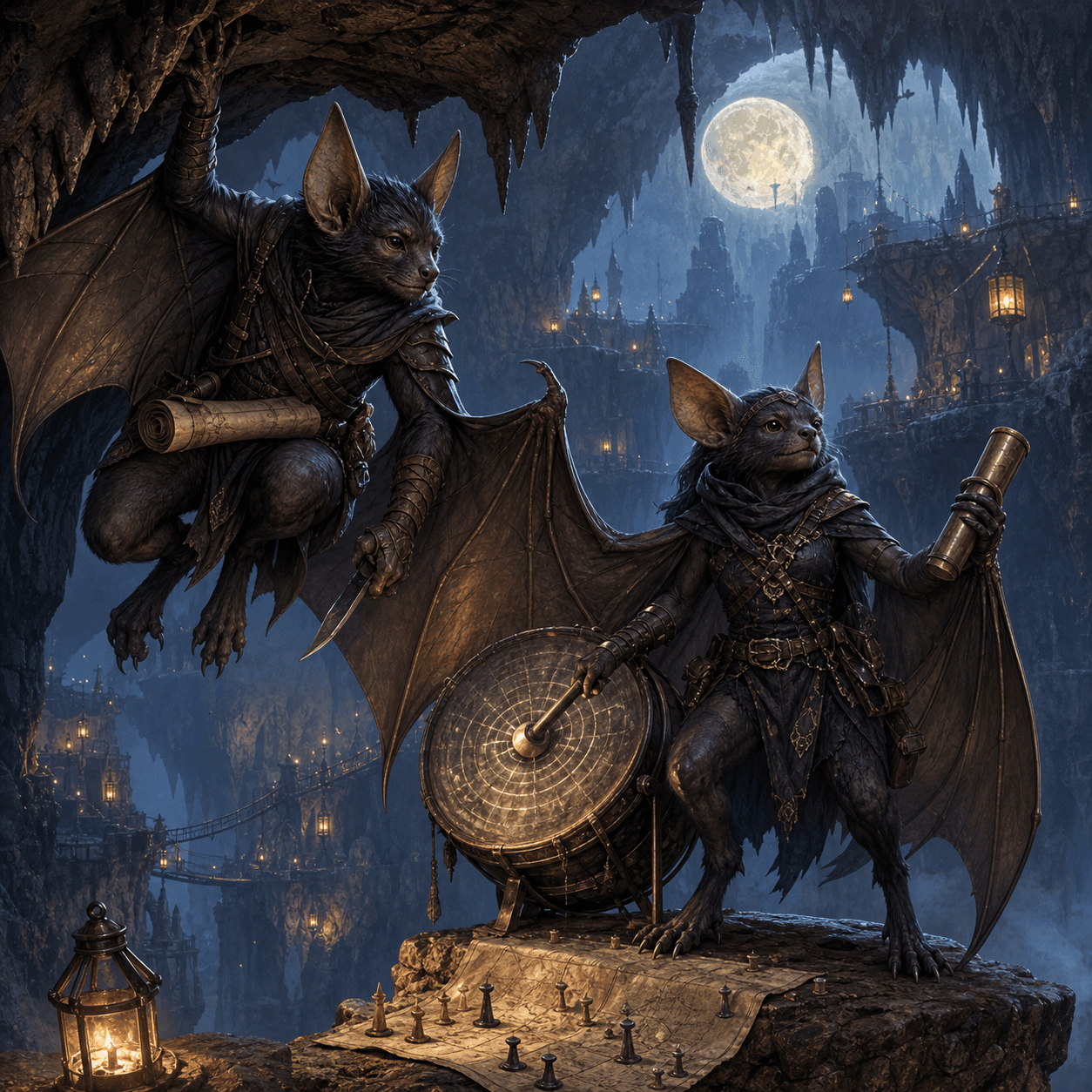
Land Animal-Folk
Bat Folk
Chiaeget
Background Questions
1. What cavern or cliffside roost raised you?
2. What echo pattern is sacred to your kin?
3. What night-time secret do you carry?
4. What surface-dweller do you trust - or mistrust?
Lore & Background
The Chiaeget are the Bat Folk of the Aldaethu.
They are a nocturnal, cavern-dwelling people whose communities developed around darkness, vertical space, sound, and long-distance movement through routes that many other peoples find difficult or impossible to navigate.
Their major homelands lie in:
the caverns of Varjo
the night-cliffs of Vuori
the sinkholes and deep hollows of Metsä
Chiaeget settlements are commonly built into cliff faces, cavern ceilings, vertical shafts, and deep chambers where sound carries farther than light.
Their civilization is shaped by one obvious fact:
A Chiaeget does not need to see a place to understand its shape.
Through echolocation, memory, and practiced sound patterns, they can read enclosed spaces with extraordinary precision.
This ability became one of their greatest contributions to the Aldaethu Grand Design.
The Chiaeget are associated with night routes, subterranean navigation, courier work, cave mapping, and intelligence gathering.
Their established lore describes them as valued night couriers and cave guides, while later Prime Council material shows the Chiaeget maintaining informal information networks through nocturnal routes and subterranean passages.
The Chiaeget and the Grand Design
Like the other Aldaethu, the Chiaeget believe the Celestial Dragon created each people with a purpose within the Grand Design.
For the Chiaeget, that purpose is most naturally understood through what their established culture already does:
to find the path where others cannot see it, and to carry knowledge through darkness.
They occupy a place between the Horsefolk courier tradition, the Ratfolk route networks, the Chiaegen scouts, and the intelligence functions that eventually became associated with prominent Chiaeget such as Vesk'Thaal.
Their role is not simply "secrecy."
It is access.
They reach:
dark roads
vertical caverns
night routes
sinkholes
underpasses
cliff trails
subterranean passages
that are difficult for many other Aldaethu peoples to use safely.
A road that exists only in daylight is only half a road.
The Chiaeget keep the other half open.
Echo-Halls
Chiaeget preserve history in echo-halls.
This is explicit in their surviving ancestry lore: chambers are shaped so that particular calls and patterns can be preserved and repeated.
Rather than treating this as magical sound-storage unless we establish that later, the safest canon interpretation is architectural and cultural.
An echo-hall is deliberately shaped around:
resonance
repeating tones
recognizable call patterns
controlled reverberation
oral instruction
Important stories, route warnings, family calls, and historical patterns can be taught in a room designed to reproduce them clearly.
A skilled Chiaeget knows how a particular pattern should return from the walls.
If the echo changes, either the caller performed it incorrectly or the chamber itself has changed.
That makes echo-halls useful not just for memory, but for teaching precision.
Echo-Cartography
One of the clearest established Chiaeget accomplishments is echo-cartography.
Their Culture Snapshot specifically says their echo-cartography opened two major messenger routes.
Chiaeget cave mapping combines:
echolocation
repeated sound measurements
remembered route calls
physical cave maps
vertical orientation
distinctive acoustic landmarks
A Chiaeget route may therefore be remembered not only by visual markers, but by how a place sounds.
A wide chamber, narrow fissure, underground river, broken shaft, or deep drop each returns sound differently.
This lets trained couriers travel through places where painted markers or lanterns are unreliable.
The resulting cave maps became valuable trade goods.
Night Couriers
Night courier work is one of the Chiaeget's confirmed primary exports.
Their greatest advantages are straightforward:
they operate comfortably in darkness
they can navigate caves without light
they can climb vertical stone
they can use cliff and cavern routes unavailable to carts
they are difficult to observe when moving at night
Their courier traditions made them useful throughout the Great Peace and gave them access to information moving between regions.
That later connection to information is important.
A courier sees:
which roads have closed
which garrisons are moving
which merchants suddenly stop traveling
which gate is being watched
which tunnel has been sealed
which official is quietly sending messages at night
The Chiaeget intelligence reputation grows naturally from their courier network rather than needing a separate invented spy caste.
Information Networks
By the Long Shadow, the Chiaeget are associated strongly enough with intelligence that Vesk'Thaal, a Chiaeget councilor, holds the Night Operations / Intelligence seat.
His profile establishes that Chiaeget operate through night networks and subterranean passages and maintain one of Reth's most complete informal intelligence webs.
Their strength is described as information asymmetry:
knowing what others do not realize they have revealed.
That should shape Chiaeget culture without turning every Bat Folk into a spy.
Most are not.
But their civilization naturally produces people skilled at:
observing movement
recognizing unusual traffic
comparing route reports
hearing changes in normal patterns
communicating across hidden routes
noticing when something does not belong
For Chiaeget, information often begins as route knowledge.
Roost Communities
The Chiaeget live in roost-cities on night-cliffs and within deep caverns.
Their architecture should therefore remain grounded in that geography.
Common features likely include:
high entrances
ceiling platforms
cliff ledges
vertical shafts
narrow suspended paths
low-light gathering chambers
echo-halls
courier ledges
map chambers
sheltered sleeping spaces
I would not lock a specific government title or civic hierarchy yet, because the surviving Bat Folk profile does not establish one.
The only safe structural term already present is roost-clan customs, from their Night-Chime Lore talent.
So for now:
Society: organized around roosts and roost-clans, with customs adapted to shared cavern space, courier routes, and echo traditions.
We can build the exact government once you decide whether their leadership is clan-based, route-based, intelligence-based, or something else.
The Three Principal Cities
Khels'varr
Khels'varr is one of the three established Chiaeget cities.
What is canon:
It is a Chiaeget principal city.
It lies within their wider Varjo/Vuori/Metsä homeland range.
We have not yet established a specific governmental or economic specialty for it.
Noctelune
Noctelune is a principal Chiaeget city.
Again, its name and status are established, but not yet a detailed specialty.
Vesk-Torin
Vesk-Torin is the third established principal Chiaeget city.
Its name may connect well with later Chiaeget naming such as Vesk'Thaal, but I would not declare a familial or political connection without canon support.
Trade
Exports
Confirmed Chiaeget exports are:
Night couriers
Cave maps
Sonar drums
The sonar drums fit naturally with their acoustic culture, but the existing document does not yet define exactly how they work.
We should leave them as a known Chiaeget craft until we deliberately establish whether they are:
signaling instruments
mapping tools
ritual drums
long-distance communication devices
or some combination
Imports
Confirmed imports:
Lantern glass
Treated leathers
Dyes
Their need for lantern glass does not contradict being Light-Shy. Chiaeget still interact with surface travelers and mixed communities, and controlled illumination is very different from direct sunlight.
Diet
Confirmed common foods:
fruit
insects
cave fish
That is enough for the Culture Snapshot.
We do not need to invent elaborate cuisine unless we specifically decide to later.
Allies
Established allies include:
Owlin
Gnomes
Newt Folk
These make sense within existing geography and services:
Owlin share nocturnal activity.
Gnomes are common engineering and route partners.
Newt Folk operate in cave-springs, wetlands, and environments that can intersect Chiaeget underground routes.
But I would leave those explanations as interpretation unless we find an older document establishing the precise reason for each alliance.
The Second War - Bat and Arachnid War
This is the most important piece of Chiaeget history and should not be softened or overwritten.
The Second War began as Bat Folk and Scorpion Folk border violence and raids along desert edges and cliff routes.
It escalated into:
night attacks
tunnel ambushes
reprisals
attacks on supply lines
fighting through canyon passes
The Chiaeget used their aerial and night advantages to strike supply routes and settlements, then disappear through canyon terrain before counterattack.
The Scorpion Folk responded with:
false burrows
layered ambushes
hidden desert routes
As the war escalated:
Spider Folk joined the Scorpion Folk.
Their webcraft and bows were specifically used to counter Bat Folk flyers and secure cavern corridors.
Beetle Folk fought as frontline troops for the Scorpion Folk.
The war culminated in the attack on Khar-Duo, which devastated the Scorpion Folk homeland.
Afterward, the Bat Folk withdrew.
The reason remains intentionally unresolved.
Existing histories offer competing explanations, including vengeance being satisfied or the Chiaeget recognizing that continued occupation of the desert would become unsustainable.
There is no canon answer.
That ambiguity should remain.
Spider Folk Relations
Spider Folk are established Chiaeget enemies.
The surviving Spider Folk material confirms that they allied with the Scorpion Folk during the Second War and developed web engineering and bows used against Bat Folk flyers.
Spider Folk still remember this alliance in old patterns and heirloom designs.
Their own Culture Snapshot explicitly lists Batfolk as enemies.
The Chiaeget Culture Snapshot likewise identifies Spider Folk toll-webs among their enemies.
So this is a genuine historical hostility, not something we need to manufacture.
The Long Shadow
The consequences of the Second War are also clearly established.
After the war:
the Great Peace ended
discrimination against Bat Folk became widespread
discrimination also spread toward insectoid peoples
trade contracted
old hatreds resurfaced
the Prime Council increasingly failed to address these divisions
The Second War ended approximately a century before the campaign's starting era, meaning current Chiaeget society lives with inherited stigma from a conflict most living people did not personally fight.
This should be one of the defining tensions of their current culture.
Chiaeget reputation has two competing faces:
To their allies. couriers, navigators, intelligence gatherers, and people capable of traveling where others cannot.
To those who remember the Second War primarily through fear: night raiders who struck without warning and helped devastate Khar-Duo.
Both reputations exist in Reth.
The Chiaeget in the Grand Design After the War
The Second War creates a particularly strong philosophical problem for an Aldaethu people.
The Aldaethu worldview says every people has a role within the Grand Design.
The Chiaeget possess gifts suited to:
darkness
movement
information
rapid strikes
hidden routes
Those same gifts can serve as:
courier work
rescue
navigation
intelligence
or:
surveillance
raiding
ambush
terror
The war therefore leaves the Chiaeget with a question that fits their established culture without requiring a new doctrine:
What does it mean to fulfill your purpose when the same gift can connect people or destroy them?
That is a much stronger current-era tension than simply making them "the spy race."
Warfare
What is established from the Second War and their ancestry mechanics:
Chiaeget are exceptionally suited to:
night operations
aerial attacks
cavern fighting
canyon movement
ambush
route disruption
withdrawal through difficult terrain
Their Shadow-Glide Ambush mechanically supports this fighting style.
The war history also establishes that Chiaeget forces specifically targeted supply lines and used canyon routes to escape counterattack.
We do not yet have canon support for named military orders, ranks, weapons, or formations, so I would leave those open.
Current Tensions
These are directly rooted in established canon rather than creating new organizations:
The Legacy of Khar-Duo
The Scorpion Folk homeland was devastated.
The Chiaeget withdrew afterward.
No accepted explanation exists for why.
The unanswered question affects how every side remembers the war.
Spider Folk Hostility
The Bat-Spider conflict did not disappear when formal war ended.
Old defenses, toll-webs, wartime memories, and inherited grievances keep the hostility alive.
Discrimination
Bat Folk remain targets of prejudice because of the Second War.
Individual Chiaeget may be judged for a war fought generations earlier.
Intelligence and Trust
Their route networks and information gathering make Chiaeget valuable.
They also make outsiders suspicious.
Vesk'Thaal embodies this contradiction at the Prime Council: not fully trusted, but listened to because his information is useful.
The Grand Design
Chiaeget must reconcile their ancestral purpose with the history of what their gifts were used to do during the Second War.
Chiaeget Adventurers
Keeping these closely tied to established lore, good reasons for a Chiaeget adventurer include:
Night Courier. Carrying messages or goods along routes others cannot safely use.
Echo-Cartographer. Mapping caverns, ruins, sinkholes, or newly opened underground passages.
War-History Seeker. Trying to discover what actually caused the Second War or why the Bat Folk withdrew after Khar-Duo.
Route Guide. Working as a cave guide between otherwise disconnected regions.
Outcast by Reputation. Leaving a community where Second War prejudice makes ordinary life difficult.
Intelligence Runner. Gathering immediate information for a roost, employer, or political figure.
Spider War Grudge. Pursuing a dispute rooted in the old Bat-Spider conflict.
Grand Design Pilgrim. Trying to understand what role the Chiaeget are supposed to occupy after the way their gifts were used in the war.
Culture Snapshot
Name. Chiaeget
Common Name. Bat Folk
Aldaethu Classification. Land Animal-Folk
Homeland: Varjo caverns, Vuori night-cliffs, Metsä sinkholes
Cities: Khels'varr, Noctelune, Vesk-Torin
Exports: Night couriers, cave maps, sonar drums
Imports: Lantern glass, treated leathers, dyes
Diet: Fruit, insects, cave fish
Allies: Owlin, Gnomes, Newt Folk
Enemies: Spider Folk toll-webs; devil-blood sound guilds
History: Their echo-cartography opened two major messenger routes. Later, the Chiaeget became one of the principal sides in the Second War against the Scorpion Folk; Spider Folk and Beetle Folk entered the conflict against them, and the attack on Khar-Duo became its defining catastrophe. The Chiaeget withdrawal afterward remains unexplained.
Checking your codex…
From the Reth Ancestries (Daggerheart) compendium. Ancestry mechanics unlock when you collect this lineage in Hoard and link your account.