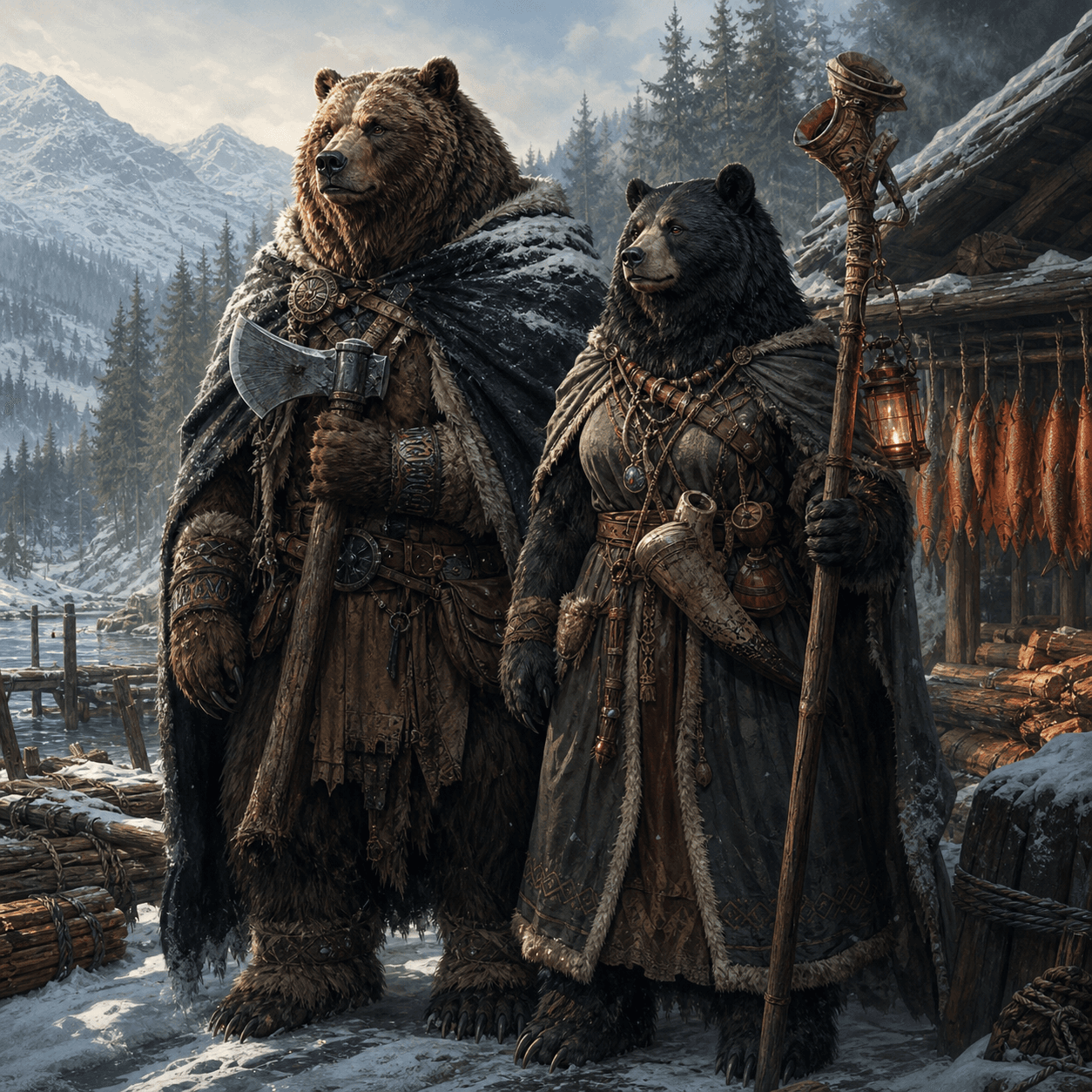
Land Animal-Folk
Bear Folk
Chiaegot
Background Questions
1. Which lodge taught you to hunt or gather?
2. What winter hardship shaped your endurance?
3. What cubhood friend or rival still drives you?
4. What vow do you uphold for your lodge or family?
Lore & Background
The Bearfolk and Pandafolk are the Aldaethu people most strongly associated with military defense, protection, garrison service, crisis response, and the disciplined use of force.
They carry the Military Defense Pillar of the Aldaethu Confederation.
Their role is frequently misunderstood by outsiders.
Bearfolk are not the Aldaethu people "made for war."
Their culture rejects that interpretation.
They believe the Celestial Dragon gave them strength so that someone capable of causing great harm could instead choose to stand between harm and everyone else.
That distinction forms the foundation of their society.
Their military tradition does not glorify conquest, bloodshed, or personal combat prowess.
It glorifies:
the gate that held,
the civilians who escaped,
the patrol that found the missing child,
the soldier who refused an unlawful order,
the commander who withdrew before pride turned defeat into slaughter,
the veteran who returned home without bringing the war back with them.
Their most important teaching is known as the Quiet Paw:
Strength is most sacred when it is under control.
Pandafolk belong to the same broader Aldaethu people and military tradition, but their cultural schools place greater emphasis on meditation, discipline, healing, instruction, and emotional regulation.
Bearfolk often become the visible wall.
Pandafolk often teach the wall when to lower itself.
Both are considered expressions of the same purpose within the Grand Design:
Protection through disciplined strength.
The Bearfolk and the Grand Design
Bearfolk tradition teaches that the Celestial Dragon created their people with powerful bodies because the Grand Design required someone capable of bearing danger that would crush others.
But physical strength alone does not fulfill their purpose.
A Bearfolk who uses strength only to dominate is considered to have misunderstood the gift.
Their place in the Design is described through three responsibilities:
Stand Where Others Cannot
A defender must be willing to occupy the dangerous place.
That may mean:
a city gate,
a collapsing bridge,
a plague checkpoint,
the rear guard of a retreat,
the entrance to a refuge,
or simply the space between an angry person and someone who cannot defend themselves.
Use No More Force Than Necessary
Bearfolk military law strongly distinguishes between stopping a threat and punishing an enemy.
Once the threat is ended, further violence requires separate justification.
This belief shapes their handling of:
surrender,
prisoners,
rioters,
duels,
border incidents,
and defeated enemies.
Strength Must Answer to Purpose
Military power is not its own Pillar.
It exists to protect the rest of the Grand Design.
A garrison that begins governing the people it was meant to defend is treated as dangerously out of pattern.
Appearance
Bearfolk are broad, heavily built humanoids with ursine heads, dense fur, powerful limbs, and large hands.
Common appearances include:
brown,
black,
grey,
cinnamon,
cream,
pale,
or mixed coats.
Some lineages are massive and towering.
Others are shorter and heavily muscled.
Pandafolk
Pandafolk share the same general body plan but possess distinctive black-and-white markings and often somewhat rounder facial features.
Their differences are cultural as much as physical.
Pandafolk lodges are especially associated with:
meditation,
training,
battlefield medicine,
veteran care,
discipline instruction,
and de-escalation.
They are not considered a separate ancestry.
They are a major lineage within the wider Bearfolk people.
Scars and Service Marks
Bearfolk generally do not hide scars.
A scar is not automatically treated as heroic.
The important question is:
What happened, and what did you learn?
Service marks may be worn on:
shoulder wraps,
belts,
armor clasps,
bracers,
or lodge cords.
These can indicate:
garrison service,
rescue work,
border patrol,
medical training,
command,
veteran status,
or an oath of protection.
Social Structure
Bearfolk society is organized around lodges.
A lodge may be:
an extended family,
a military community,
a training hall,
a border settlement,
or some combination of all four.
Membership is not restricted by blood.
Adopted children, veterans, foreign spouses, healers, craftsmen, and longtime allies may all become full lodge members.
Lodge Houses
A lodge house usually contains:
communal kitchens,
sleeping halls,
training rooms,
bathhouses,
equipment stores,
medical rooms,
memorial walls,
refuge chambers,
and public meeting space.
The building is both home and civic institution.
Lodge-Keepers
A Lodge-Keeper is an elder or trusted adult responsible for the moral and social health of the lodge.
They are not necessarily military commanders.
Their responsibilities include:
settling internal disputes,
caring for veterans,
supervising youth training,
preserving lodge tradition,
and ensuring that service does not consume the people who perform it.
A celebrated general may still answer to a Lodge-Keeper upon returning home.
Watch-Kin
Bearfolk recognize deep relationships formed through shared protection duty.
Those who have kept dangerous watches together may become Watch-Kin.
Watch-Kin may come from any Aldaethu people.
The bond carries expectations of mutual aid and honesty.
Upbringing
Young Bearfolk are taught physical control early.
Children wrestle, climb, carry, swim, and perform endurance games, but every exercise includes rules about stopping.
A child who wins because they ignored a surrender signal is not praised.
They are corrected.
The Open Paw
One of the earliest lessons is the Open Paw.
A cub is taught to demonstrate physical strength without using it to harm.
Exercises may include:
carrying another child,
holding a heavy door,
stopping a rolling cart,
bracing a shifting beam,
restraining without striking,
catching instead of pushing.
The lesson is that capability should create options.
The First Watch
The First Watch is a common coming-of-age rite.
A young Bearfolk spends a full watch period protecting something or someone entrusted to them.
This might be:
a lodge gate,
a herd,
a public store,
a refugee shelter,
a sleeping caravan,
or a sacred site.
The rite is deliberately uneventful when possible.
A successful watch is often one in which nothing happens.
The Weight of Command
Those seeking command undergo a separate rite.
They are given responsibility for a training exercise where every possible solution carries cost.
Afterward, elders ask:
Who bore the most risk?
Who did you protect?
Who did you expose?
What did you fail to see?
What would you change?
The purpose is to teach that command is not the power to choose for others.
It is responsibility for the consequences.
Government
Lodge Councils
Most Bearfolk communities are governed by Lodge Councils.
These typically include:
Lodge-Keepers,
veteran representatives,
quartermasters,
healers,
militia officers,
civilian members,
and sometimes representatives from nearby communities.
The council governs the lodge.
Military officers govern military actions.
The distinction is deliberate.
Captains
A Captain commands a garrison, patrol, or military formation.
Captains are expected to:
protect civilians,
maintain discipline,
record orders,
preserve retreat options,
and challenge unlawful commands.
Wardens
Wardens oversee specific protective responsibilities such as:
city gates,
roads,
public stores,
border regions,
or disaster response.
A Warden may have military authority but is not automatically a battlefield commander.
The Military Defense Pillar
Bearfolk and Pandafolk principally carry the Military Defense Pillar.
Its responsibilities include:
Confederation defense,
militia standards,
garrison law,
emergency response,
border coordination,
rescue under hostile conditions,
and the lawful use of force.
The Pillar does not possess authority to declare war on its own.
The Guard Rings
One of the most visible Bearfolk institutions in Zal'Aldaethu is the Guard Ring system.
Rather than concentrating military power in one enormous fortress, Bearfolk maintain defensive rings distributed throughout the capital.
Each Guard Ring includes:
barracks,
wells,
public refuge halls,
medical rooms,
signal stations,
supply stores,
evacuation routes,
and civilian gathering areas.
They are designed to protect neighborhoods, not dominate them.
During festivals, Guard Rings may function as public kitchens, training spaces, and first-aid stations.
During disaster, they become refuge centers.
The design reflects Bearfolk philosophy:
A fortress that protects only soldiers is badly placed.
Settlements and Architecture
Bearfolk settlements favor:
broad halls,
thick walls,
low centers of gravity,
large doors,
communal sleeping spaces,
courtyards,
training yards,
bathhouses,
and protected stores.
Common features include:
heavy timber,
stone foundations,
broad roofs,
covered walkways,
winter stores,
refuge chambers,
public kitchens,
and signal towers.
Ironclaw Lodge
Ironclaw Lodge is one of the oldest Bearfolk military communities.
It began as a defensive camp during the early Aldaethu settlement period and eventually grew into a permanent town.
It is known for:
officer training,
mixed-ancestry militia instruction,
defensive doctrine,
veteran rehabilitation,
and formal debates over lawful force.
Its central hall contains no throne.
Instead, the largest seat is reserved for whoever carries responsibility for the people currently under protection.
Quiet-Paw Bastion
Quiet-Paw Bastion is strongly associated with Pandafolk traditions.
It is part monastery, part military academy, part hospital.
Training there includes:
meditation,
grappling,
medicine,
breathing control,
conflict de-escalation,
trauma care,
and battlefield ethics.
Many of the Confederation's most respected instructors train there.
Winter-Guard Ring
Winter-Guard Ring is a fortified settlement built around a major northern route.
It protects travelers during dangerous cold and maintains enormous emergency stores.
The settlement is famous for:
snow rescue,
long-range patrols,
winter logistics,
fortified caravan shelter,
and survival training.
Economy and Trade
Bearfolk communities are economically tied to defense, heavy labor, rescue, forestry, and provisioning.
Exports
trained guards,
militia instructors,
defensive planning,
rescue crews,
heavy labor,
timber,
leatherwork,
winter equipment,
armor maintenance,
wilderness escort,
medical training,
and border patrol services.
Imports
grain,
preserved vegetables,
cloth,
steel,
armor fittings,
medicines,
salt,
tools,
lamp oil,
and specialized weapons.
Garrison Economy
Bearfolk strongly oppose garrisons becoming extractive.
A garrison is expected to contribute to the community by:
maintaining roads,
assisting during fires,
supporting harvest,
helping with rescue,
training local militia,
and purchasing supplies fairly.
A military force that consumes more than it protects is considered unhealthy.
Religion: and Philosophy
Bearfolk faith centers on the Celestial Dragon, the Grand Design, and the Quiet Paw.
They believe the Celestial Dragon gave their people strength with the expectation that it would be restrained.
The Quiet Paw
The Quiet Paw teaches:
The strongest paw is the one that knows when not to strike.
This does not mean pacifism.
Bearfolk recognize violence as sometimes necessary.
The philosophy asks whether violence remains necessary once it has begun.
The Sleeping Guard
A common religious image depicts a Bearfolk sleeping beside an open door.
The meaning is that safety exists when a protector can rest without abandoning responsibility.
Shrines of Defense
Bearfolk shrines often contain:
broken shields,
repaired armor,
rescue ropes,
names of civilians saved,
surrender tokens,
and fragments of gates that held.
Weapons associated only with killing are less commonly displayed than tools associated with protection.
The Returning Vigil
After surviving battle, Bearfolk often keep a period of quiet watch before returning fully to civilian life.
The vigil allows them to reflect on:
what they did,
what they witnessed,
whom they lost,
and what parts of the battlefield must not follow them home.
Pandafolk counselors frequently oversee these vigils.
Warfare and Defense
Bearfolk are the backbone of organized Aldaethu military defense.
Defensive Doctrine
Their preferred doctrine emphasizes:
protected civilians,
stable lines,
controlled withdrawal,
reserve forces,
medical support,
clear surrender terms,
and disciplined pursuit.
They are skeptical of commanders who confuse aggression with initiative.
Shield Lines
Bearfolk excel in heavy defensive formations.
They use:
shields,
polearms,
heavy armor,
body positioning,
and coordinated bracing.
Their goal is often to create enough time for others to escape or reposition.
Rescue Under Fire
Bearfolk units train specifically to recover:
wounded allies,
trapped civilians,
isolated scouts,
and fallen officers.
A formation may break its offensive rhythm to preserve life.
Pandafolk Field Role
Pandafolk commonly serve as:
sergeants,
battlefield medics,
instructors,
discipline officers,
counselors,
and restraint specialists.
They are especially valued in situations where anger or fear could cause atrocities.
Pursuit Limits
A defeated enemy is not automatically lawful prey.
Bearfolk commanders are expected to define:
when pursuit begins,
when it ends,
and what circumstances justify continued force.
Uncontrolled pursuit is treated as a common path from victory into massacre.
Military Law
Bearfolk military law works closely with Elephantfolk jurists.
The Refusal Duty
A soldier has a duty to refuse an obviously unlawful order.
This principle is explicitly taught.
"Following orders" is not accepted as a complete defense for:
killing surrendered enemies,
harming protected civilians,
torture,
deliberate starvation,
or attacking those under Road-Right.
The Protected Hand
A combatant who clearly surrenders and ceases resistance becomes protected.
Striking them afterward is a grave offense.
The Burden of Command
Higher rank increases responsibility.
A commander may be judged for harm caused by orders they should reasonably have known would produce abuse.
The Open Report
Serious incidents must be recorded even when they embarrass the unit.
Attempting to preserve a lodge's honor by concealing misconduct is considered a deeper dishonor.
Relationships with Other Aldaethu
Chiaegen
Lionfolk often command mixed Aldaethu formations.
Bearfolk respect leadership when Lionfolk accept the same risk and accountability they expect from troops.
Other Chiaegen provide scouting, reconnaissance, and intelligence essential to Bearfolk operations.
Elephantfolk
Elephantfolk provide legal oversight.
Bearfolk deeply value clear rules because ambiguous authority creates dangerous situations for soldiers.
Caninefolk
Caninefolk frequently patrol alongside Bearfolk.
Caninefolk excel at pursuit, tracking, and coordinated movement.
Bearfolk provide heavier support when patrols encounter major threats.
Cowfolk
Cowfolk maintain the food, shelter, and morale systems that allow garrisons to function.
Bearfolk generally treat quartermasters with unusual respect.
Goatfolk
Goatfolk chaplains help soldiers deal with fear, grief, guilt, and spiritual conflict.
Horsefolk
Horsefolk provide rapid communication, screening, and reinforcement.
Bearfolk commanders depend on them to keep scattered forces coordinated.
Monkeyfolk
Monkeyfolk supply strategic planning, logistics models, fortification design, and siege expertise.
Bearfolk frequently challenge plans that appear elegant but expose too many people to unnecessary risk.
Rabbitfolk
Rabbitfolk feed garrisons and civilian populations.
Bearfolk doctrine strongly condemns military requisition that destroys a community's future harvest.
Chiaenol
Chiaenol prepare fortifications, trenches, berms, and defensive terrain.
Bearfolk treat experienced earthwork crews as part of the defensive line.
Hippofolk
Hippofolk maintain bridges, roads, ports, and river defenses essential to military mobility.
Ratfolk
Ratfolk keep supplies moving and maintain evacuation routes.
Bearfolk often credit them with victories outsiders attribute only to soldiers.
Badgerfolk
Badgerfolk work closely with Bearfolk in:
tunnels,
fortifications,
collapse rescue,
countermining,
and deep shelters.
External Relationships
Druazer
Bearfolk and Dwarves often respect one another's discipline, durability, and defensive skill.
Joint garrison and fortification work is common.
Druazir
Relations: with human militaries vary by kingdom.
Bearfolk respect professional soldiers but distrust political systems that reward conquest for prestige.
Druthal
Forest and other Druthal wardens frequently cooperate with Bearfolk on border defense and monster threats.
Aldaemir
Bearfolk generally avoid pursuing enemies deep into Aldaemir wetlands without local guides.
They have learned that heavy troops can become liabilities in marsh terrain.
Aldaecül
Bearfolk cooperate with Shark Folk and other Aldaecül defenders when land and sea threats overlap.
Their military cultures share a strong protective streak but differ sharply in tactics.
Aldaedro
Bearfolk respect the strength of Giantkin and other Aldaedro peoples.
Friendly contests of endurance and wrestling are common where relations are good.
Customs and Rites
The First Watch
A young Bearfolk keeps their first true protective watch.
The Open Paw
Strength is demonstrated through control rather than harm.
The Shared Shield
Before dangerous defense, members of a unit touch shields, hands, weapons, or shoulders and state whom they are protecting.
The focus is deliberately placed on the protected rather than the enemy.
The Empty Barracks
When a unit suffers major loss, unused sleeping spaces may remain empty until the formal remembrance is complete.
The Returned Weapon
After a campaign, weapons are cleaned and inspected before being stored.
The ritual marks the transition from war back into civilian life.
The Last Meal Before Watch
The person taking the most dangerous watch is served first at the final meal before deployment.
This reverses normal command privilege.
Taboos
Violence for Pride
Using force merely because someone challenged status or reputation is disgraceful.
Harm to the Surrendered
An enemy who has genuinely surrendered becomes protected.
Abandoning Civilians
Preserving soldiers while knowingly leaving civilians to preventable harm violates the Military Pillar.
Unlawful Obedience
Following an obviously unlawful order does not erase responsibility.
The Hidden Atrocity
Concealing misconduct to protect lodge reputation is a severe offense.
Glory Pursuit
Continuing combat after the objective is achieved merely to win personal fame is condemned.
The Shield Turned Inward
Using military authority to intimidate the civilians one is sworn to protect is considered one of the clearest betrayals of the Grand Design.
Current Tensions
Militarization of the Confederation
The Long Shadow has increased fear throughout Aldaethu territory.
More resources are being directed toward:
garrisons,
walls,
patrols,
emergency powers,
and armed escorts.
Some Bearfolk believe this is necessary.
Others fear the Military Pillar is becoming too central to civilian life.
Lodge Autonomy
Remote lodges increasingly answer first to local communities rather than Zal'Aldaethu.
This has saved settlements abandoned by central authorities.
It has also created armed organizations operating with limited oversight.
Veteran Strain
Years of repeated emergencies have produced a generation of veterans who have never truly left crisis conditions.
Pandafolk healers warn of:
exhaustion,
aggression,
isolation,
guilt,
and emotional numbness.
The Confederation needs experienced soldiers too badly to let many of them rest.
Unlawful Orders
Several recent conflicts have produced disputes over whether Lionfolk political leaders or local governors exceeded their authority.
Bearfolk units have begun refusing orders more frequently.
This strengthens accountability but also creates fears of military fragmentation.
Protection Versus Control
Some communities have requested permanent garrisons.
Others believe soldiers invited for protection have remained too long and accumulated too much influence.
The Quiet Paw Debate
Younger Bearfolk increasingly ask whether the philosophy of restraint has sometimes been used to justify inaction.
They point to situations where decisive force might have prevented greater suffering.
Traditionalists answer that everyone believes violence was obviously necessary after the danger has already arrived.
The Grand Design Question
Bearfolk increasingly ask:
Were we given strength to protect the Confederation as it is - or the people even when the Confederation fails them?
Bearfolk & Pandafolk Adventurers
Broken Oath
They were ordered to do something that violated their understanding of the Military Pillar.
Lost Patrol
Members of their lodge disappeared beyond the border.
Veteran's Road
They travel because returning directly to ordinary life proved impossible.
Protection Charge
They have sworn to protect a specific person, community, relic, or route.
Lodge Exile
Their refusal to obey command divided their lodge.
Failed Defense
Someone died while under their protection.
Quiet Paw Pilgrimage
They seek teachers outside Bearfolk society who understand restraint, discipline, or peace differently.
War-Crime Witness
They possess evidence of misconduct committed by respected officers.
Abandoned Hold
A settlement the Confederation declared indefensible refuses to evacuate.
Grand Design Doubt
They wonder whether being created to protect others means they are ever allowed to live for themselves.
Culture Snapshot
Name. Bearfolk & Pandafolk
Common Name. Bear Folk
Aldaethu Classification. Land Animal-Folk
Major Lineages. Bearfolk, Pandafolk, and related ursine peoples
Traditional Aldaethu Role. Defense, garrisons, militia training, rescue, and disciplined force
Associated Pillar. Military Defense
Creature Type. Humanoid
Typical Size. Medium to Large
Languages: Common and Aldaethu
Homeland: Aldaethu borderlands, forest margins, northern routes, mountain approaches, Guard Rings, and garrison settlements
Principal Settlements:
Ironclaw Lodge
Quiet-Paw Bastion
Winter-Guard Ring
Government: Lodge Councils, Lodge-Keepers, Captains, Wardens, and Military Defense Pillar delegates
Society: Extended lodges, garrison communities, training halls, rescue guilds, veteran households, and Watch-Kin networks
Buildings: Broad lodge halls, training yards, refuge chambers, public kitchens, bathhouses, armories, medical rooms, winter stores, Guard Rings, and defensive courtyards
Exports:
Guards
Militia training
Rescue services
Defensive planning
Heavy labor
Timber
Wilderness escort
Winter equipment
Armor maintenance
Medical and discipline instruction
Imports:
Grain
Preserved vegetables
Steel
Armor fittings
Medicines
Cloth
Salt
Tools
Lamp oil
Diet: Fish, meat, roots, berries, vegetables, grains, honey, dense breads, winter stews, tea, and preserved foods
Faith. The Celestial Dragon and the Grand Design; Bearfolk purpose understood as disciplined strength placed between danger and those who cannot safely bear it
Military Role. Heavy defenders, garrison troops, rescue fighters, officers, restraint specialists, battlefield medics, border patrols, and civilian-protection units
Allies: Chiaegen, Elephantfolk, Caninefolk, Cowfolk, Goatfolk, Horsefolk, Monkeyfolk, Rabbitfolk, Chiaenol, Hippofolk, Ratfolk, Badgerfolk, Druazer, and communities relying upon Aldaethu protection
Common Enemies. Raiders, slavers, warlords, oath-breaking commanders, those who target civilians, and authorities that turn protective forces against their own people
Core Values:
Restraint
Protection
Endurance
Reliability
Discipline
Courage
Accountability
Mercy
Service
Greatest Taboos:
Violence for pride
Harming surrendered enemies
Abandoning civilians
Following obviously unlawful orders
Concealing atrocities
Pursuing glory after the threat is ended
Using military authority to dominate those under protection
History
Before Reth
Bearfolk tradition teaches that the Celestial Dragon gave their people great strength not so they could rule, but so someone would always be capable of standing where danger was greatest.
Their place in the Grand Design was protection.
Arrival in Reth
During the Aldaethu arrival, Bearfolk formed protective rings around refugee camps, guarded water and food stores, escorted separated communities, and prevented outside powers from forcibly dividing the newcomers.
Pandafolk tended injuries, calmed frightened families, and helped establish early discipline among hastily formed militias.
The First Convocation
Bearfolk strongly supported Confederation but rejected any system in which military command could become political rule.
They insisted that:
civilian government remain separate from garrison command,
lawful orders be recorded,
soldiers retain a duty to refuse atrocities,
and military power exist only to protect the wider Grand Design.
These principles formed the Military Defense Pillar.
The Great Peace
The Great Peace allowed Bearfolk military culture to shift away from emergency survival.
They established:
formal garrisons,
mixed militias,
Guard Rings,
officer schools,
rescue guilds,
veteran houses,
and standardized defensive law.
Quiet-Paw philosophy became especially influential during this period.
The Second War
Bearfolk defended trade routes, refugee camps, border settlements, and public stores.
They also faced some of the Confederation's hardest questions about neutrality and intervention.
Some commanders acted without full Conclave approval to protect threatened communities.
Others refused orders they believed would escalate the war.
Both actions later became subjects of Elephantfolk legal debate.
The Long Shadow
Bearfolk now carry a heavier burden than at any time since the First War.
Every failing route needs guards.
Every frightened settlement wants a garrison.
Every political faction wants military backing.
Every border commander claims their situation is exceptional.
The Bearfolk remain deeply committed to the Grand Design.
But they increasingly understand that protecting a society may sometimes require protecting its people from the very institutions claiming to act in their name.
Checking your codex…
From the Reth Ancestries (Daggerheart) compendium. Ancestry mechanics unlock when you collect this lineage in Hoard and link your account.