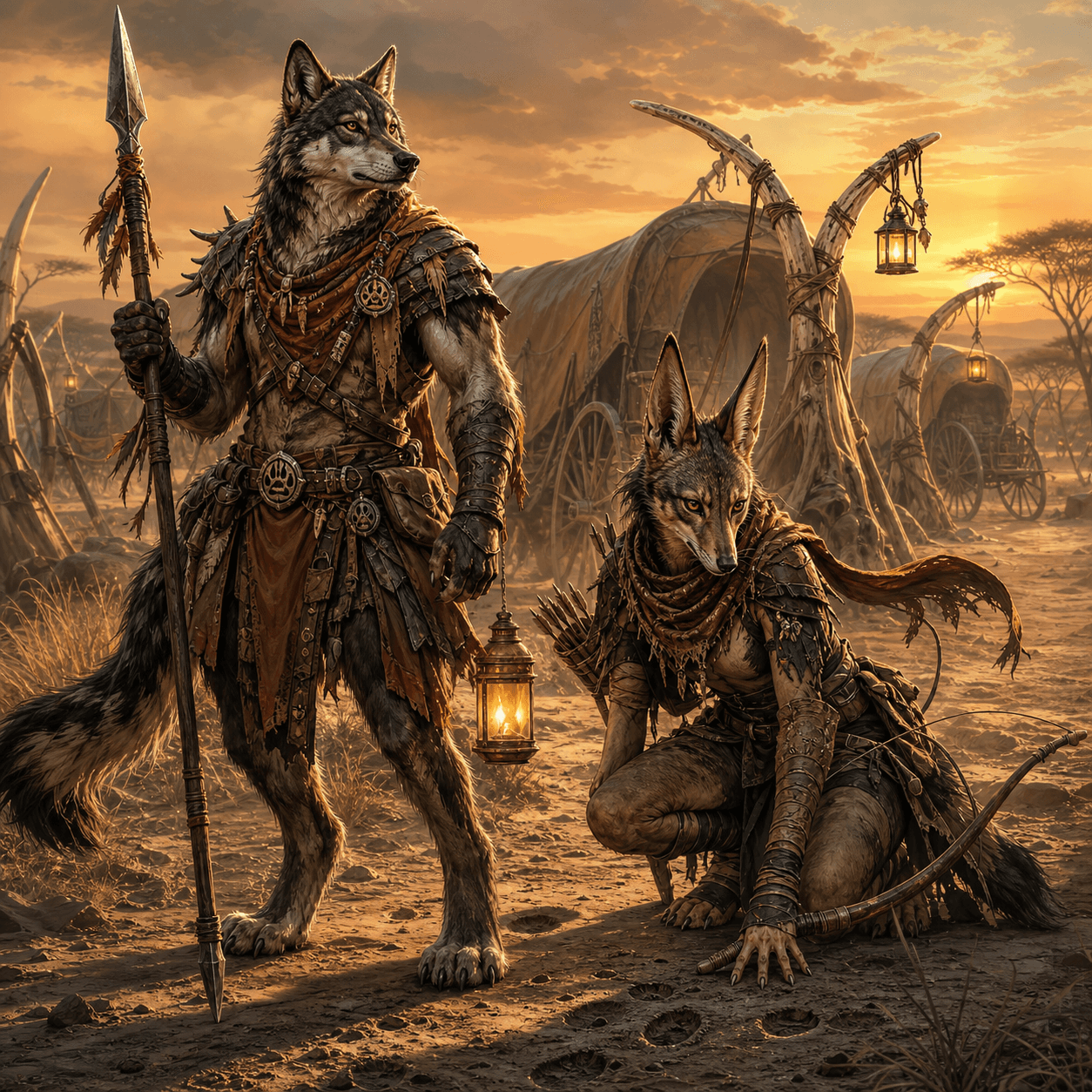
Land Animal-Folk
Canine Folk
Chiaegan
Background Questions
1. What pack raised you, and what did you inherit from them?
2. What scent do you remember most vividly from childhood?
3. Who have you sworn to protect under your Lantern Oath?
4. What prey or enemy taught you the meaning of danger?
Lore & Background
The Canine Folk are the Aldaethu people most strongly associated with border patrols, communal hunting, tracking, pursuit, and the protection of roads and shared territory.
Their established culture is pack-oriented rather than solitary. Pups are commonly raised by the broader pack rather than only by their biological parents, and cooperation is taught early through games that mimic hunting, patrol movement, rescue, and group defense.
Canine Folk are not defined simply by wolves.
Their broader people may include lineages resembling:
wolves
wild dogs
jackals
fox-like hunting canids
mastiff-like working lines
other canine forms
Different packs may emphasize different strengths, but the underlying cultural principle remains the same:
One set of eyes misses what the pack sees together.
Their role within the Grand Design is most naturally expressed as shared vigilance.
They are the Aldaethu who keep watch on the spaces between settlements.
The Canine Folk and the Grand Design
Canine Folk believe the Celestial Dragon created each Aldaethu people with a purpose.
Their own gifts - scent, endurance, coordination, alertness, and social instinct - are understood as tools for protecting the paths between communities and finding danger before it reaches the vulnerable.
This places them naturally beside several other Aldaethu peoples.
Bearfolk provide heavy defense.
Chiaegen scouts move quietly and independently.
Horsefolk move messages across great distance.
Canine Folk hold the road, follow the trail, and stay with the pursuit.
Where Chiaegen are often associated with precision and stealth, Canine Folk emphasize cooperation and persistence.
That distinction drives both rivalry and mutual respect between the two peoples. The older cultural profile explicitly describes a friendly competition between feline and canine scouts.
Pack Society
The pack is the core unit of Canine Folk social life.
A pack may be:
one extended family
several related households
a patrol community
a hunting group
a border settlement
or a mixed household built around shared obligation
Pack membership is not restricted entirely by blood.
Someone who consistently keeps watch, shares food, protects the young, and answers when called may become pack in every meaningful sense.
Shared Upbringing
Pups are raised communally.
Adults teach:
scent recognition
tracking
group movement
call signals
restraint during pursuit
shared meals
watch rotation
road law
basic rescue
protection of younger packmates
Children learn very early that group survival depends on reliability.
A pup who is the fastest runner but abandons the group is not praised as the best hunter.
Leadership
The established Canine Folk profile gives us one especially strong piece of canon:
Anyone who leads must be willing to eat last and watch over the others.
That should remain the heart of Canine leadership.
A pack leader is expected to take responsibility for:
assigning watches
ensuring food is shared fairly
deciding when pursuit should stop
negotiating with neighboring packs
responding to missing members
protecting pups and elders
maintaining relationships with nearby settlements
Leadership is therefore practical rather than ceremonial.
A leader who consistently takes the safest place, eats first, or leaves difficult work to others quickly loses credibility.
I would leave exact formal titles open unless we find them elsewhere in the ancestry material.
Communal Hunting
Canine Folk hunting is built around coordination rather than individual glory.
A hunt may involve:
trackers
flankers
drivers
watchers
finishers
carriers
young trainees observing from safety
A successful hunt is judged by:
whether the pack returned safely
whether the kill was necessary
whether food was distributed fairly
whether unnecessary suffering was avoided
whether territory agreements were respected
This fits the established cultural focus on shared resources such as game reserves.
Border Wardens
One of the clearest Canine Folk roles is border protection.
They commonly act as:
patrol leaders
trackers
road wardens
communal hunters
pursuit teams
scouts
escorts
Their patrols monitor:
raiders
dangerous predators
missing travelers
damaged roads
illegal hunting
changing migration patterns
suspicious troop movements
Because their work often takes them far from home, Canine Folk rely heavily on other Aldaethu communities along their routes.
The surviving profile specifically notes dependence on Rabbitfolk farmers and Cowfolk hosts during travel.
Relationship with Bearfolk
Canine Folk work especially closely with Bearfolk garrisons.
Their roles complement one another.
Canine Folk:
find the threat
pursue it
patrol the wider territory
track movement
maintain warning routes
Bearfolk:
hold the defended point
provide heavier force
protect settlements
reinforce patrols when danger escalates
The original profile explicitly establishes this cooperation.
Relationship with Chiaegen
Canine Folk and Chiaegen maintain a long-running friendly rivalry.
Chiaegen scouts often pride themselves on:
silence
patience
independent stalking
precise observation
Canine Folk tend to emphasize:
shared pursuit
communication
endurance
coordinated tracking
Neither approach is inherently superior.
Which works best depends on the terrain and the quarry.
Joint border posts often turn this competition into strong trust over time, which is also established in the older cultural profile.
Territory and Shared Resources
Canine Folk often take responsibility for communal resources that cross household boundaries.
These may include:
hunting grounds
game reserves
forest routes
wells along patrol roads
shared pasture edges
highway shelters
warning posts
Their territorial philosophy is not necessarily about absolute ownership.
It is about knowing who depends on a place and who is responsible for watching it.
A hunting ground that is overused harms every pack that relies upon it.
A road left unguarded endangers every community along it.
Pack Loyalty
Pack loyalty is the defining ethical principle of Canine Folk culture.
The old cultural profile describes betrayal of the pack as their worst imaginable crime.
This does not mean unquestioning obedience.
The deeper principle is that a pack is built on mutual responsibility.
Someone who lies to the pack, abandons others to save themselves, withholds critical danger, or knowingly leads companions into a trap attacks the structure holding the group together.
Warfare
Canine Folk are well suited to:
pursuit
patrol
flanking
coordinated strikes
reconnaissance
border defense
locating fugitives or raiders
finding missing people
Their original profile specifically emphasizes patrol duty, pursuit of raiders, coordinated strikes, and flanking maneuvers.
They are generally more useful as mobile forces than as heavy shield-line troops.
A Canine Folk unit works best when it can communicate and maneuver as a group.
Relations: with Other Aldaethu
Bearfolk
Their strongest military partners.
Bearfolk hold what Canine Folk patrol.
Chiaegen
Friendly rivals in scouting, hunting, and tracking.
Rabbitfolk
Important providers of food and rest along rural patrol routes.
Cowfolk
Their inns, feast halls, and caravansaries provide safe stopping points for long patrols.
Horsefolk
Natural partners along road systems.
Horsefolk cover distance quickly; Canine Folk protect and inspect the route itself.
Elephantfolk
Useful partners in border agreements, hunting rights, and disputes between packs.
Goatfolk
Often involved when territorial disputes require ritual settlement or reconciliation.
Current Tensions
Keeping this grounded in their existing function, the most natural present-day pressures are:
Longer Frontiers
The Long Shadow has made travel and trade less safe.
That means more road, more border, and more isolated settlement must be watched by the same number of patrols.
Pack Versus Confederation
A Canine Folk warden may be ordered to protect a distant route while their own home is under threat.
That creates a real Grand Design question:
Does duty begin with the pack or with the wider Aldaethu people?
Pursuit and Restraint
Canine Folk are excellent pursuers.
That creates the danger of continuing after the original purpose has ended.
Tracking a raider is protection.
Hunting their family for vengeance is not.
Rivalry with Chiaegen
Usually healthy, but pressure can turn rivalry into competition over authority, funding, or prestige.
Canine Folk Adventurers
Good reasons for Canine Folk to travel remain close to their established roles:
Missing Packmate. Someone disappeared on patrol.
Long Pursuit. A raider, criminal, or dangerous creature crossed beyond the pack's jurisdiction.
Road Warden. They have been sent to inspect or reopen a failing route.
Escort Duty. They are responsible for protecting someone traveling through dangerous territory.
Pack Exile. They violated a pack obligation or were blamed for doing so.
Grand Design Pilgrimage. They want to understand how loyalty to one pack fits within loyalty to the wider Aldaethu.
Broken Border. A treaty or hunting boundary is failing.
Lost Traveler. They promised to bring someone home.
Culture Snapshot
Name. Canine Folk
Aldaethu Classification. Land Animal-Folk
Homeland: Borderlands, forest roads, open hunting country, trade routes, and Aldaethu frontier settlements
Role. Border wardens, patrol leaders, communal hunters, trackers
Society: Packs with shared upbringing, labor, food, patrol responsibility, and mutual defense
Exports: Tracking, patrol services, hunting, road protection, escort work
Imports: Food, leather goods, metal tools, medicines
Diet: Meat, grains, roots, preserved foods, and whatever is practical during long patrols
Allies: Bearfolk, Chiaegen, Rabbitfolk, Cowfolk
Enemies: Raiders, poachers, road bandits, and threats to pack or protected territory
History: Canine Folk became trusted wardens of shared roads and border territories, working alongside Bearfolk garrisons and Chiaegen scouts. Their pack tactics made them especially effective at pursuit and long-frontier patrol.
Checking your codex…
From the Reth Ancestries (Daggerheart) compendium. Ancestry mechanics unlock when you collect this lineage in Hoard and link your account.