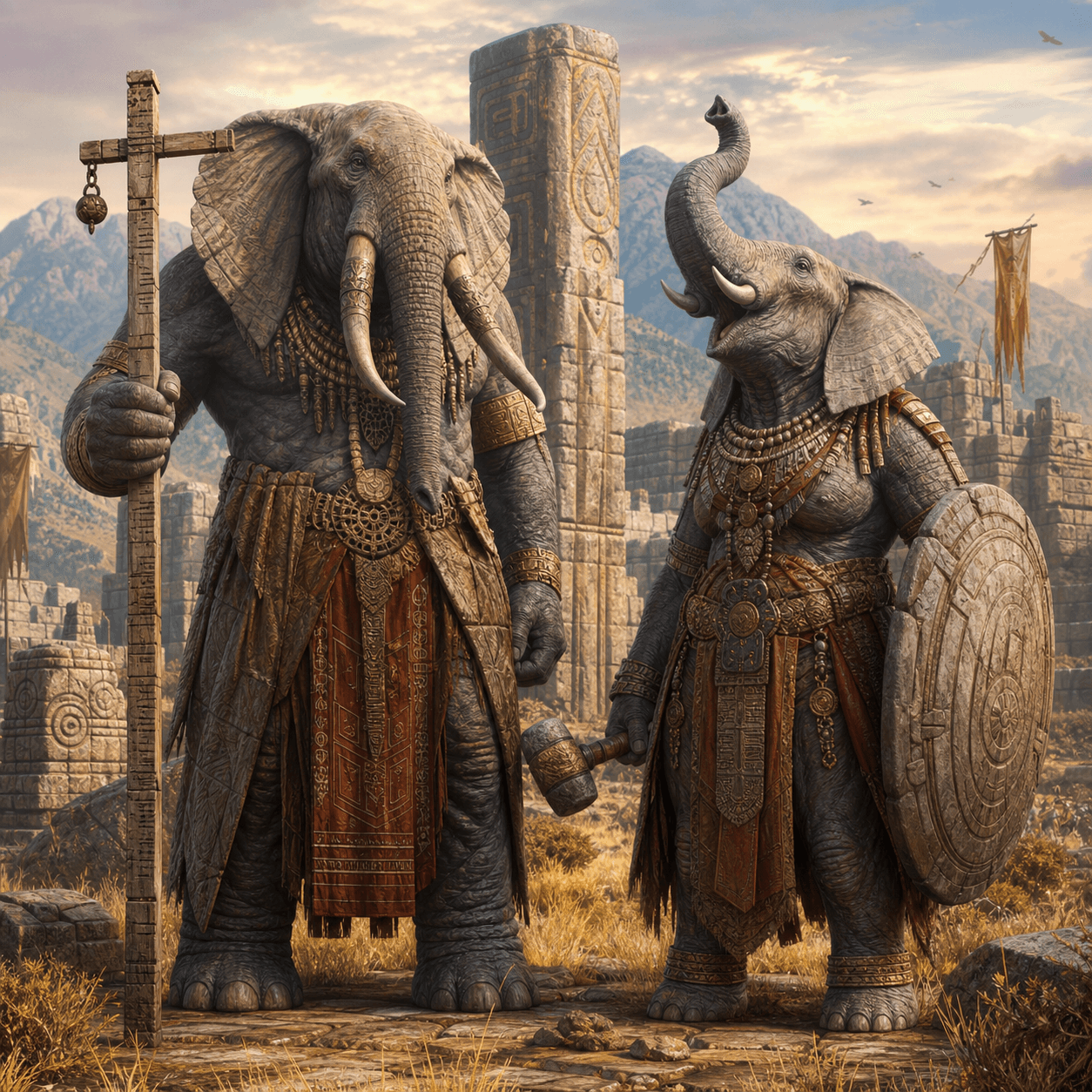
Land Animal-Folk
Elephant Folk
Chiaerol
Background Questions
1. What migration route shaped your childhood?
2. Which Elder Resonant taught you your first chants?
3. What ancient ruin or path left a lasting mark on you?
4. Who did you guide - or fail to guide - along the old roads?
Lore & Background
Elephantfolk are the Aldaethu people most closely associated with law, memory, witness, precedent, diplomacy, and the preservation of collective history.
They carry the Law Pillar of the Aldaethu Confederation.
Their responsibility is larger than maintaining courts.
Elephantfolk preserve the agreements that allow the Grand Design to function across generations.
Lionfolk can negotiate a settlement.
Horsefolk can carry its terms across the Confederation.
Ratfolk can ensure the agreed supplies move.
Bearfolk can protect the border established by it.
But someone must remember exactly what was promised when everyone who made the agreement is dead.
That responsibility belongs principally to the Elephantfolk.
Their oldest teaching is simple:
A people without memory renegotiates every mistake.
Elephantfolk culture developed around the belief that civilization depends upon continuity. A law means little if it changes whenever the powerful become inconvenienced. An oath means little if the person who benefited from it can later pretend it was never spoken.
Memory therefore carries moral weight.
Yet Elephantfolk are taught from childhood that memory alone is insufficient.
A perfectly remembered injustice remains unjust.
A faithfully preserved bad law remains a bad law.
The proper role of the Law Pillar is not merely to preserve the past.
It is to ensure the present must answer to it.
Elephantfolk and the Grand Design
Elephantfolk tradition teaches that the Celestial Dragon gave their people long memory, patience, strength, and voices capable of carrying across a gathering because the Grand Design required continuity.
Every Pillar performs work that reaches beyond a single lifetime.
Someone must preserve why that work began.
Someone must remember:
who agreed
who objected
what conditions were attached
what price was paid
which promises remain
which exceptions were temporary
which boundaries existed before later generations redrew them
which people were harmed by decisions later celebrated as victories
Elephantfolk commonly describe their place within the Grand Design as:
Memory made accountable through law.
Law Is Not Command
Elephantfolk distinguish law from orders.
An order comes from authority.
Law establishes the limits within which authority may act.
A Lionfolk leader may issue an order.
An Elephantfolk jurist asks whether that leader had the right to issue it.
A Bearfolk commander may act during an emergency.
An Elephantfolk magistrate later asks whether the emergency justified what was done.
Memory Belongs to Everyone
Elephantfolk reject the idea that history belongs only to rulers, scholars, or victors.
Their archives preserve:
treaties
marriages
land grants
births
deaths
migrations
crimes
reparations
public works
military orders
testimony
complaints
minority opinions
failed proposals
appeals
pardons
An objection that lost a vote may be preserved as carefully as the decision that passed.
The reason is practical.
A minority warning ignored today may become tomorrow's precedent.
Witness Creates Obligation
To witness an agreement is not passive.
An Elephantfolk who formally witnesses an oath becomes responsible for preserving its meaning.
They must speak if either party later misrepresents it.
Remaining silent while knowing the truth is itself considered a failure of witness.
Appearance
Elephantfolk are large, powerful humanoids with elephantine heads, trunks, broad ears, thick limbs, and heavy bodies.
Common traits include:
grey, slate, brown-grey, pale ash, or reddish skin
long or short tusks depending on lineage and individual
broad ears
strong trunks capable of delicate manipulation
heavy feet
expressive eyes
powerful shoulders
sparse hair or short bristles
Some lineages possess larger ears suited to warmer climates, while others are more compact.
Tusks vary widely.
They are not treated as an automatic mark of gender, authority, or maturity.
Tusks as Record
Many Elephantfolk carve or decorate their tusks with significant marks.
These can signify:
major cases witnessed
public offices held
family history
treaty service
marriages
mourning
pilgrimage
military witness
academic achievement
reparations fulfilled
The practice is voluntary.
Some Elephantfolk refuse all permanent tusk markings because they believe law should exist in public archives rather than on the body.
Others consider their tusks a visible statement:
Ask what I have witnessed.
Ear Script
Temporary legal and ceremonial markings may be painted along the ears.
These can communicate:
court role
neutrality
mourning
active arbitration
archive membership
diplomatic immunity
prohibition against private contact during a trial
Clothing
Elephantfolk formal clothing favors:
broad layered robes
heavy sashes
archive cords
engraved clasps
durable belts
document tubes
seal cases
writing boards
ink kits
Judges and witnesses often wear clothing with few pockets during important proceedings to demonstrate that no hidden documents or gifts are being carried.
Social Structure
Elephantfolk society is organized through Archive Houses, extended families, court communities, schools of law, and witness lineages.
Archive Houses
An Archive House may be:
an extended family
a legal school
a physical archive
a professional lineage
some combination of all four
Members share responsibility for maintaining a body of records.
One house might specialize in:
land law
treaties
genealogy
criminal judgment
trade
water rights
military conduct
public works
Confederation precedent
Archive Houses frequently contain non-Elephantfolk apprentices and clerks.
The records belong to the Confederation.
The House merely carries responsibility for preserving them.
Extended Families
Elephantfolk commonly live in multigenerational households.
Grandparents, cousins, siblings, adopted children, apprentices, and elders may share one large residence.
Children grow surrounded by stories.
Even ordinary meals may include someone saying:
Do you remember why we do it this way?
Family memory is treated as both comfort and education.
Memory Kin
Elephantfolk recognize relationships created by shared witness.
Two people who survive and testify about the same major event may become Memory-Kin.
The bond does not replace family.
It acknowledges that they carry part of the same history and may be called upon to support one another when that memory is challenged.
Upbringing
Elephantfolk children are encouraged to ask questions, but they are expected to listen fully before responding.
Interrupting is not automatically rude among children, but failing to understand before objecting is strongly discouraged.
Their education emphasizes:
memory
listening
precise speech
fairness
context
consequence
distinguishing observation from assumption
separating what was heard from what was inferred
The Three Tellings
Young Elephantfolk often learn important stories through the Three Tellings.
First, the story is told normally.
Second, it is retold from the perspective of another participant.
Third, the student must identify what neither version can prove.
The exercise teaches that memory can be honest without being complete.
The First Witness
A coming-of-age rite places a young Elephantfolk beside an experienced witness during a real but modest agreement.
It may involve:
a trade contract
apprenticeship
property boundary
repayment
marriage agreement
route-sharing arrangement
The young witness records the terms independently.
Afterward, their version is compared against the official account.
Precision matters.
So does recognizing ambiguity.
The Quiet Interval
Before issuing important judgments, Elephantfolk traditionally maintain a period of silence.
This may last minutes, hours, or longer depending on the case.
The silence is not theatrical.
It prevents the pressure to answer quickly from becoming part of the judgment.
Government
Law-Speakers
A Law-Speaker is an Elephantfolk legal authority trusted to interpret precedent and publicly explain how it applies.
They do not create law alone.
Their responsibility is interpretation.
Archivist-Judges
Archivist-Judges preside over serious disputes.
They must:
hear testimony
identify applicable precedent
permit relevant challenge
disclose conflicts of interest
explain their reasoning
preserve dissenting opinions
record the final judgment
Witnesses
Formal Witnesses certify:
treaties
contracts
military surrender
major transfers of property
diplomatic guarantees
Pillar agreements
reparations
succession decisions
A witness does not necessarily approve of the agreement.
They certify what was agreed.
The Law Pillar
Elephantfolk principally carry the Law Pillar at Zal'Aldaethu.
Its responsibilities include:
Confederation law
constitutional procedure
treaty preservation
inter-Pillar disputes
appeals
official archives
foreign agreements
emergency authority
rights of accused persons
public accountability
Law and the Pillar Conclave
Elephantfolk do not possess a veto simply because they carry the Law Pillar.
They may, however, formally declare a decision Out of Pattern.
This means the proposed action contradicts established Confederation law or procedure.
The Conclave may still attempt to proceed, but doing so requires openly acknowledging the conflict and establishing legal justification.
This prevents powerful leaders from quietly treating exceptions as normal.
Courts and Legal Procedure
Elephantfolk courts emphasize explanation rather than performance.
There are few theatrical gestures.
Witnesses speak from equal ground.
The Spoken Record
Important testimony is spoken aloud even when submitted in writing.
This ensures that:
witnesses hear their own claims
contradictions can be challenged
observers understand the issue
the record exists both orally and in writing
Restatement
Before challenging another person's testimony, a speaker may be required to restate it accurately.
If the original speaker says:
That is not what I meant,
the challenge pauses until both agree on what claim is actually being disputed.
Dissenting Record
Minority opinions are preserved.
An Archivist-Judge who disagrees with the majority may record why.
This practice has repeatedly allowed later generations to recognize flaws in older judgments.
Appeals
Appeal is permitted when:
new evidence appears
procedure was violated
relevant precedent was ignored
a conflict of interest emerges
the law itself has changed
Simply disliking the judgment is not sufficient.
Settlements and Architecture
Elephantfolk architecture emphasizes:
permanence
accessibility
acoustics
fire resistance
public visibility
archival redundancy
Common structures include:
archive halls
circular courts
testimony chambers
stone record vaults
open plazas
memory gardens
family compounds
public reading halls
legal schools
fireproof document chambers
Memory-Gate
Memory-Gate is a major Elephantfolk city and legal center.
Its oldest district grew around an arch beneath which early Aldaethu agreements were formally witnessed after their arrival in Reth.
The city is known for:
legal academies
treaty archives
genealogical houses
public courts
historical debate
The gate itself bears no single inscription.
Instead, tablets beside it record how its meaning changed through different periods.
Tuskwitness Hall
Tuskwitness Hall is the Confederation's principal center for treaty witnessing and diplomatic law.
Foreign diplomats often arrive there before proceeding to Zal'Aldaethu.
Its central chamber is designed so even whispered speech carries clearly.
The hall maintains records of:
foreign treaties
border agreements
reparations
prisoner exchanges
major trade accords
The Spoken Archive
The Spoken Archive is both an archive and an institution.
Some of Reth's most important records are preserved in multiple forms:
written
etched
memorized
recited ceremonially
Selected Elephantfolk called Living Volumes memorize critical documents so they cannot be erased through the destruction of one building.
They are not expected to interpret those records without consultation.
Their duty is preservation.
Economy and Trade
Elephantfolk economic activity centers on:
law
teaching
archival preservation
mediation
diplomacy
certification
historical research
public administration
Exports
legal services
trained witnesses
archivists
judges
diplomatic advisors
treaty certification
historical consultation
genealogical research
public-record systems
educational texts
contract arbitration
Imports
paper
vellum
metal plates
stone tablets
ink
glass
fireproof storage materials
fine tools
cloth
food
preservation reagents
Legal Fees
Elephantfolk accept payment for professional legal work.
However, basic access to Confederation law cannot be denied because someone is poor.
Public courts maintain advocates for those unable to pay.
Charging someone simply to learn what law applies to them is considered abusive.
Religion: and Philosophy
Elephantfolk faith centers on the Celestial Dragon and the idea that memory gives the Grand Design continuity.
They commonly teach:
Purpose remembered becomes tradition.
Tradition examined becomes wisdom.
Tradition obeyed without examination becomes habit.
The First Memory
Some Elephantfolk theologians believe the Celestial Dragon did not merely create the Aldaethu.
It remembered what each people was meant to become before they themselves understood it.
Others reject this interpretation.
The mystery remains intentional.
Memory and Truth
Elephantfolk distinguish:
memory
record
testimony
truth
These are related but not identical.
Someone may remember honestly and still be wrong.
A record may be accurate but incomplete.
Testimony may be sincere but shaped by fear.
Law must therefore compare sources rather than worship memory itself.
Archive Shrines
Sacred spaces are often integrated into archives.
Offerings may include:
copies of fulfilled contracts
repaired family records
names restored after wrongful erasure
broken seals from completed obligations
testimony from reconciled enemies
The Reading of Names
At funerals, the deceased's name is read alongside:
those they taught
agreements they witnessed
errors they corrected
judgments later overturned
promises they fulfilled
An overturned decision is not necessarily hidden.
Acknowledging error is part of accurate remembrance.
Warfare and Defense
Elephantfolk are physically formidable but traditionally avoid becoming the principal military caste.
Their most distinct military role is law in war.
Field Magistrates
Elephantfolk Field Magistrates accompany major Aldaethu forces.
Their responsibilities include:
recording military orders
establishing rules of engagement
witnessing surrender
protecting prisoners
documenting casualties
investigating misconduct
preserving enemy testimony
recording destruction of civilian property
Peace Standards
Some military units carry Elephantfolk-inscribed standards listing terms under which surrender may be accepted.
Destroying such a standard to prevent surrender is considered a serious crime.
Frontline Elephantfolk
When Elephantfolk fight directly, their size and strength make them capable of:
holding formations
protecting wounded allies
breaking barriers
shielding witnesses
defending command posts
Their martial philosophy favors deliberate force.
After-Battle Courts
Serious accusations arising during conflict may be heard immediately after battle.
Victory does not suspend accountability.
A commander may win a battle and still face judgment for how it was fought.
Relationships with Other Aldaethu
Chiaegen
Lionfolk and Elephantfolk form one of the central political relationships of the Confederation.
Lionfolk coordinate.
Elephantfolk constrain.
At their best, Lionfolk prevent law from becoming paralysis, while Elephantfolk prevent leadership from becoming personal rule.
Other Chiaegen also work closely with Elephantfolk through sand-thread history and investigation.
Bearfolk and Pandafolk
Bearfolk seek clear legal authority for major uses of force.
Elephantfolk respect Bearfolk traditions of restraint.
Both fear being manipulated by political leaders seeking legitimacy for unnecessary violence.
Caninefolk
Caninefolk rely heavily on oath, pack loyalty, and protection agreements.
Elephantfolk often formalize agreements between packs and settlements.
Cowfolk
Cowfolk guest-right and Elephantfolk contract law overlap frequently.
A Cowfolk hall may provide the neutral location for an Elephantfolk-mediated settlement.
Goatfolk
Goatfolk and Elephantfolk often debate morality versus legality.
Goatfolk may ask:
Is it right?
Elephantfolk answer:
What has been promised?
Neither considers the other question sufficient alone.
Horsefolk
Horsefolk carry official documents and witnessed agreements between communities.
Elephantfolk maintain strict standards for sealed messages and chain of custody.
Monkeyfolk
Monkeyfolk help index, copy, preserve, and analyze vast collections of records.
Their tools have transformed Elephantfolk archives.
Some traditionalists worry that easier searching encourages people to find precedent supporting what they already wanted.
Rabbitfolk
Rabbitfolk rely heavily on Elephantfolk land law, inheritance, water agreements, and public store obligations.
Chiaenol
Chiaenol require accurate maintenance contracts and liability records.
Elephantfolk provide legal force to technical warnings.
Hippofolk
Nearly every major Hippofolk project requires Elephantfolk witness because infrastructure creates shared rights and obligations.
Ratfolk
Ratfolk provide practical inventory and movement records.
Elephantfolk provide formal legal records.
The difference between what was authorized and what actually happened often emerges only when both records are compared.
Badgerfolk
Badgerfolk structural inspections frequently become legal evidence.
Elephantfolk courts prosecute false certification and ignored warnings.
External Relationships
Druazir
Human kingdoms frequently employ Elephantfolk diplomats and arbiters, although some rulers dislike their insistence on written and witnessed limits to authority.
Druazer
Dwarves respect long records, contracts, craft obligations, and hereditary archives.
Disputes tend to concern whether tradition alone justifies current ownership.
Druthal
Elephantfolk maintain deep respect for Druthal long memory.
The two cultures differ in method.
Druthal may preserve tradition through Courts and living practice.
Elephantfolk insist on explicit precedent and record.
Aldaemir
Water-right disputes frequently require Elephantfolk witnesses.
The Aldaemir expectation that law change with seasonal water levels has significantly influenced Elephantfolk environmental law.
Aldaecül
Whale Folk genealogy keepers and Dolphinfolk lawmakers are particularly respected by Elephantfolk.
Their traditions provide alternative approaches to collective memory and legal authority.
Aldaener
Long-distance treaties involving migration paths, nesting grounds, and aerial boundaries often involve Elephantfolk arbitration.
Customs and Rites
The First Witness
A young Elephantfolk formally witnesses their first agreement.
The Open Record
Public law must be available for public review.
Rules that bind people but cannot be examined are treated with suspicion.
The Spoken Name
Before serious testimony begins, every participant states their own name rather than being introduced solely by title.
This reinforces personal responsibility.
The Broken Seal
When a contract is completely fulfilled, the parties may ceremonially break its seal together.
The fragments are archived or returned to them.
The Empty Chair
When a judgment affects an absent or dead community, an empty chair may be placed in the court.
It reminds everyone that those without a voice still bear consequences.
The Second Reading
Major new laws are traditionally read publicly on two separate occasions before taking permanent effect.
The time between readings permits challenge and reflection.
Taboos
False Witness
Knowingly giving false formal testimony is among the gravest Elephantfolk offenses.
Altering the Record
Changing or destroying public records to manipulate history or law is treated as an attack upon the Confederation itself.
Selective Memory
Intentionally preserving only evidence favorable to one side violates the duty of witness.
Secret Law
A person cannot reasonably be punished under a rule they were forbidden from knowing.
Judgment for Sale
Accepting payment, favors, or political advantage in exchange for a legal outcome is profound disgrace.
Silence Before Falsehood
A formal witness who hears an agreement deliberately misrepresented has an obligation to correct the record.
Emergency Forever
Temporary emergency powers must not quietly become permanent.
This has become one of the most politically significant Elephantfolk principles during the Long Shadow.
Current Tensions
Emergency Law
Years of crisis have created exceptions throughout the Confederation.
Temporary border closures remain.
Emergency requisitions continue.
Military authorities retain powers originally granted for specific threats.
Elephantfolk jurists increasingly ask:
When does emergency become government?
The Weight of Old Law
Some younger Elephantfolk argue that too much precedent dates from conditions that no longer exist.
They believe reverence for continuity is preventing necessary reform.
Traditionalists answer that abandoning precedent whenever it becomes inconvenient destroys the entire purpose of law.
Missing Records
Several important records from the First War and early Great Peace appear incomplete, contradictory, or deliberately altered.
Whether this reflects chaos, later editing, or intentional concealment remains disputed.
The Living Volumes
Some of the most sensitive historical records survive partly through memorization.
Questions have arisen over what happens when Living Volumes disagree.
If memory itself becomes contested, what constitutes the record?
Political Pressure
Lionfolk leaders increasingly demand rapid decisions.
Bearfolk commanders demand clear authority.
Rabbitfolk regions demand food exceptions.
Ratfolk expose missing stores.
Hippofolk close unsafe infrastructure.
Nearly every crisis arrives at Elephantfolk courts.
The Law Pillar is becoming overwhelmed.
Mercy and Precedent
The Long Shadow has created situations older law never anticipated.
Refugees cross borders illegally because legal roads are closed.
Communities seize food because official distribution fails.
Local militias violate procedure while defending abandoned settlements.
Elephantfolk judges increasingly disagree over whether survival justifies breaking established law.
The Grand Design Question
Some Elephantfolk ask whether their people were given memory to preserve the Grand Design - or to recognize when the Design itself must change.
Elephantfolk Adventurers
Lost Treaty
A foundational agreement has disappeared from the archives.
False Witness
Someone important built their authority on testimony the Elephantfolk knows was untrue.
Living Volume
They carry a memorized record too dangerous to leave in one archive.
Judicial Exile
They issued a lawful judgment that powerful people refused to accept.
Memory-Kin
Someone who shares a critical memory has disappeared.
Broken Precedent
A case has emerged that no existing law can resolve.
First War Investigation
They seek surviving evidence of what actually happened during the Aldaethu arrival.
The Unremembered Name
A person or community appears to have been systematically removed from public history.
Grand Design Pilgrimage
They travel Reth studying how other cultures preserve law, memory, and obligation.
The Impossible Contradiction
Two records both appear authentic and cannot both be true.
Culture Snapshot
Name. Elephantfolk
Common Name. Elephant Folk
Aldaethu Classification. Land Animal-Folk
Traditional Aldaethu Role. Law, memory, witness, precedent, and treaty preservation
Associated Pillar. Law
Creature Type. Humanoid
Typical Size. Medium to Large
Languages: Common and Aldaethu
Homeland: Zal'Aldaethu civic districts, archive cities, treaty centers, and established Aldaethu settlements throughout the Confederation
Principal Settlements:
Memory-Gate
Tuskwitness Hall
The Spoken Archive
Government: Archive Houses, Law-Speakers, Archivist-Judges, formal Witnesses, and Law Pillar delegates
Society: Multigenerational households, Archive Houses, legal schools, witness communities, and Memory-Kin networks
Buildings: Stone archives, circular courts, testimony halls, memory gardens, public reading chambers, fireproof vaults, legal schools, and broad family compounds
Exports:
Legal services
Arbitration
Diplomacy
Treaty certification
Archival preservation
Education
Genealogical research
Historical consultation
Judges
Trained witnesses
Imports:
Paper
Vellum
Ink
Stone tablets
Metal record plates
Glass
Preservation reagents
Fine tools
Cloth
Food
Diet: Grains, vegetables, fruits, roots, legumes, tea, dense breads, stews, and large communal meals; regional traditions vary substantially
Faith. The Celestial Dragon and the Grand Design; Elephantfolk purpose understood as preserving the memory and law that allow obligations to survive beyond the lives of those who made them
Military Role. Field Magistrates, treaty witnesses, prisoner advocates, defensive heavy troops, command-post guards, and investigators of wartime misconduct
Allies: Lionfolk, Bearfolk, Goatfolk, Ratfolk, Hippofolk, Rabbitfolk, Chiaenol, Whale Folk historians, Dolphinfolk lawmakers, Druthal archivists, and peoples who value witnessed agreements
Common Enemies. Record destroyers, corrupt judges, oath-breakers, false witnesses, authoritarian officials, historical revisionists, and powers that use emergency law to evade accountability
Core Values:
Memory
Truth
Witness
Continuity
Fairness
Patience
Accountability
Context
Precedent with reflection
Greatest Taboos:
False witness
Altering public records
Secret law
Judgment for sale
Selective preservation of evidence
Remaining silent while a witnessed agreement is deliberately falsified
Allowing emergency authority to become permanent without review
History
Before Reth
Elephantfolk tradition teaches that the Celestial Dragon gave their people long memory so the Grand Design would not need to begin again with every generation.
Their purpose was to preserve the promises connecting one people to another.
Arrival in Reth
During the Aldaethu arrival, Elephantfolk began recording almost immediately.
They documented:
where communities appeared
who was missing
which resources were available
early encounters with Reth's peoples
violence against Aldaethu camps
offers of alliance
territorial negotiations
internal Aldaethu disagreements
Their records became essential when different Aldaethu groups finally found one another.
The First Convocation
Elephantfolk strongly supported Confederation but opposed any arrangement that simply transformed Lionfolk coordination into permanent rule.
They helped establish the principle that shared government required:
witnessed procedure
preserved dissent
defined authority
appeal
record
limits on emergency power
These principles became the foundation of the Law Pillar.
The Great Peace
The Great Peace became the great archival age of Elephantfolk civilization.
Treaties multiplied.
Borders were established.
Trade law expanded.
Zal'Aldaethu required complex civic law.
Memory-Gate and Tuskwitness Hall became major institutions.
Elephantfolk also began exchanging legal traditions with the other peoples of Reth.
The Second War
Elephantfolk served as witnesses, diplomats, prisoner advocates, investigators, and Field Magistrates.
The war created some of their most difficult precedents.
Emergency law permitted actions that would otherwise have been forbidden.
Many of those exceptions were never completely removed afterward.
The Long Shadow
The Elephantfolk now face the exact danger their ancestors feared:
A society overwhelmed by crisis may stop distinguishing between temporary necessity and permanent authority.
Their archives are full.
Their courts are crowded.
Their precedents conflict.
Their memories reach backward.
But the Confederation is asking questions for which the past may not contain answers.
The Elephantfolk continue carrying the Law Pillar because they believe the Grand Design requires continuity.
Their present struggle is determining when continuity means preserving an old rule - and when it means preserving the deeper principle strongly enough to let the rule change.
Aldaecas - Blood-Changed
Note Aldecas appear completely Human unless you choose to tap into their latent element, often it can lie dormant and unknown.
Most Blood-Changed do not form separate nations. They live as Druazir citizens, clustering in guilds, neighborhoods, enclaves, and professional circles tied to the bloodline's strengths.
Where Aldaecas culture differs from ordinary Druazir life, it is usually in three places: secrecy, reputation, and safety. Families that know their line teach when to speak, when to hide, and who can be trusted with the truth.
Genasi
Checking your codex…
From the Reth Ancestries (Daggerheart) compendium. Ancestry mechanics unlock when you collect this lineage in Hoard and link your account.