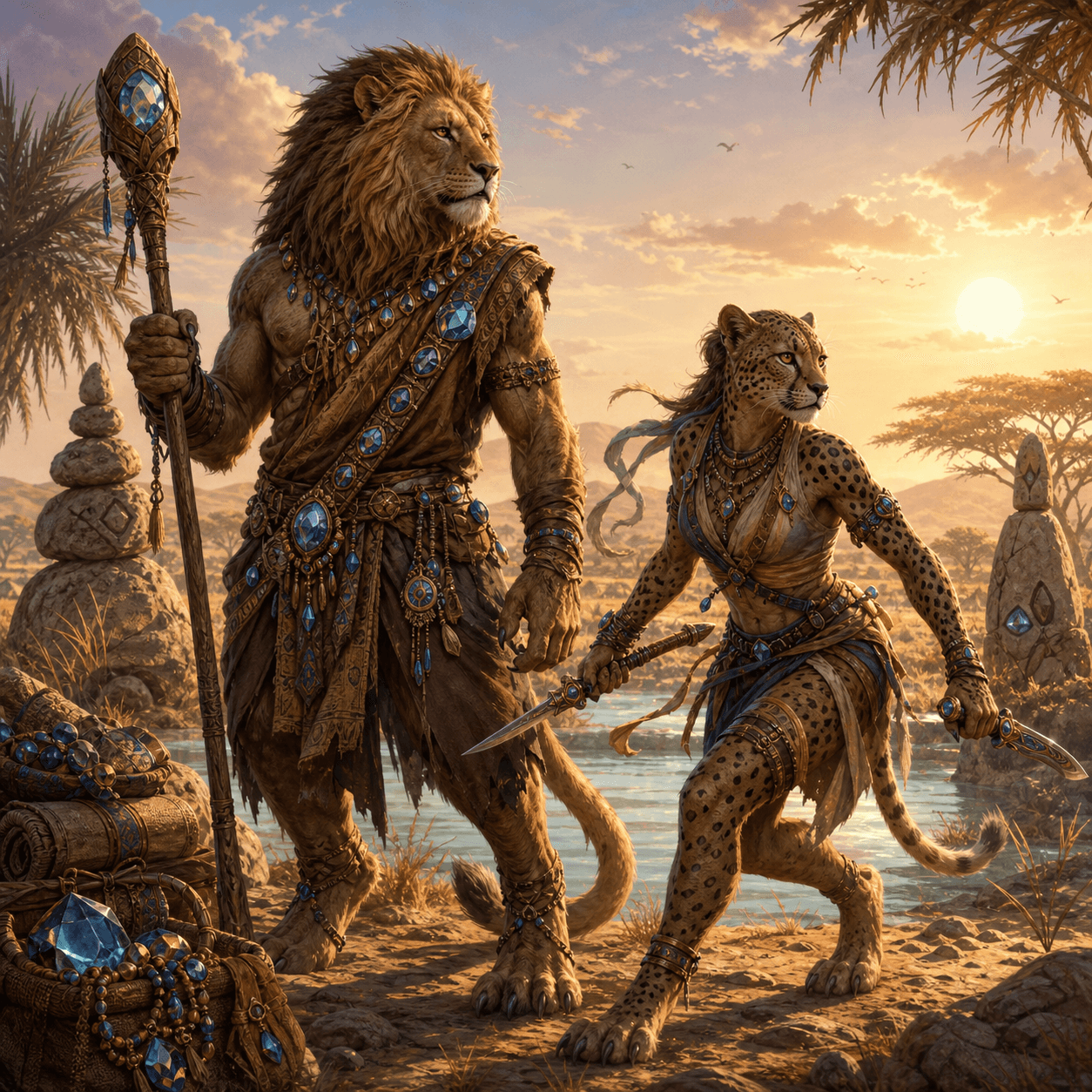
Land Animal-Folk
Feline Folk
Chiaegen
Background Questions
1. Which pride or oasis shaped your first steps?
2. What desert or forest path do you know by heart?
3. What story-keeper taught you your earliest tales?
4. What enemy made your claws first draw blood?
Lore & Background
The Chiaegen are the Feline Folk of the Aldaethu: lion, cheetah, tiger, panther, leopard, lynx, and many other feline lineages bound by shared ancestry, memory traditions, and an instinctive awareness of movement, territory, and social position.
Outsiders often reduce the Chiaegen to two stereotypes.
The first is the commanding Lionfolk leader.
The second is the silent feline hunter.
Both contain some truth. Neither describes the whole people.
Chiaegen cultures stretch across the Niityt savannas, the edges of Metsä forests, Hiekka oasis routes, rocky uplands, trade cities, and the civic districts of Zal'Aldaethu. Some live in large prides. Others travel in small hunting families, solitary households, courier bands, or urban networks.
What binds them is not a single way of living.
It is the belief that attention carries responsibility.
A Chiaegen notices who is frightened, who is lying, which path has changed, where the prey is running, and who in a room expects to be obeyed. To recognize those things and then pretend not to have seen them is considered a failure of instinct.
The Chiaegen and the Grand Design
Like all Aldaethu, the Chiaegen believe the Celestial Dragon created their peoples as parts of a greater whole.
Each lineage was given traits suited to a purpose within the Grand Design.
The Chiaegen interpretation emphasizes perception, pursuit, judgment, and decisive action.
They are the part of the Design that notices movement before danger arrives.
Within that broad purpose, different feline lineages developed distinct traditions.
Lionfolk - The Pride That Gathers
Lionfolk traditionally carry the Leadership Pillar.
Their purpose is not to dominate the other Aldaethu. It is to gather different peoples around a shared decision, bear public responsibility, and prevent the Confederation's many roles from becoming isolated powers.
Lionfolk lead through visible presence, mediation, and accountability.
Cheetahfolk - The Word in Motion
Cheetahfolk are closely associated with couriers, warning runners, rapid scouts, and open-country messengers.
They excel when speed matters more than endurance over many days. Their communities maintain relay points across savannas and oasis roads.
Their purpose is often interpreted as carrying the necessary word before it arrives too late.
Tigerfolk - The Boundary Held Alone
Tigerfolk are commonly associated with solitary guardianship, difficult hunts, and defense of remote places.
They are often entrusted with locations that cannot support a full garrison: shrines, mountain roads, forest boundaries, or isolated settlements.
Their role in the Grand Design is interpreted as the strength to stand where a crowd cannot.
Pantherfolk - The Unseen Watch
Pantherfolk traditions emphasize concealment, night movement, intelligence gathering, and the protection of routes hidden from enemies.
They are frequently associated with covert scouts and investigators, though not all Pantherfolk serve secretive roles.
Their purpose is to see without being seen and to act before danger realizes it has been discovered.
Leopardfolk - The High Path
Leopardfolk often inhabit broken uplands, forest canopies, escarpments, ruins, and territories where vertical movement matters.
They are climbers, ambushers, high-route guides, and wardens of difficult terrain.
Their place in the Grand Design is the ability to reach what others cannot.
Lynxfolk - The Distant Warning
Lynxfolk are known for exceptional hearing, patient observation, and cold-region or woodland tracking traditions.
They frequently serve as sentries, investigators, and quiet judges of uncertain evidence.
Their purpose is to hear the danger hidden beneath ordinary noise.
These roles are traditions, not biological laws.
A Lionfolk may become a solitary scout. A Cheetahfolk may become a judge. A Pantherfolk may run a public inn. The Grand Design is understood as an arrangement of gifts, not a prison built from expectations.
Social Structure
Chiaegen social organization varies more than that of many Aldaethu peoples.
Prides
Prides are large extended households most strongly associated with Lionfolk, though mixed-lineage prides are common.
A pride may include:
Several bonded adults
Cubs from multiple family lines
Elders
Adopted Aldaethu
Sworn companions
Long-term guests
Retainers who have become family
A pride's reputation belongs to everyone within it.
One member's honor may strengthen the whole pride. One member's betrayal may force every adult to answer publicly.
Hunting Clans
Tigerfolk, Pantherfolk, Leopardfolk, and Lynxfolk more commonly organize into small clans connected by territory, apprenticeship, or shared hunting obligations.
These clans may separate for much of the year and gather only for:
Seasonal hunts
Courtship
Story exchange
Territorial negotiations
Funeral rites
Training the young
Running Bands
Cheetahfolk frequently form running bands built around courier routes, migration, or shared service.
A running band may include non-Cheetah Chiaegen and even members of other Aldaethu peoples.
Membership is determined by whether someone can be trusted to keep the route.
Solitary Chiaegen
Living alone is not considered shameful.
A solitary Chiaegen is still expected to maintain relationships, honor territorial agreements, and answer calls for aid. Solitude is accepted.
Isolation from all obligation is not.
Sand-Thread Memory
The Chiaegen preserve history through sand-thread rituals.
A sand-thread is a temporary pattern made from colored sand, cord, beads, claw marks, stones, crushed shell, ash, or flower petals.
Each element represents part of a story:
A route
A family line
A battle
A promise
A migration
A betrayal
A birth
A death
A debt
A shared victory
The pattern is created while the story is recited.
When the telling is complete, the pattern is deliberately erased.
The story must then be recreated by the next keeper from memory.
This practice prevents written records from becoming detached from living understanding. A story that cannot be retold accurately has not truly been preserved.
Pridekeepers
Pridekeepers are Chiaegen historians, genealogists, treaty-remembrancers, and teachers.
They do not simply memorize words.
They preserve:
Why a route mattered
What each participant believed
Which debts remain unpaid
Which details are disputed
What later generations misunderstood
Pridekeepers often work with Elephantfolk archivists.
Elephantfolk preserve the fixed record.
Chiaegen preserve how the event was lived and remembered.
Neither method is considered complete alone.
Government
The Chiaegen do not possess one universal government.
They participate in Aldaethu government through several overlapping institutions.
Pride Councils
Large prides select Pride-Speakers to represent them.
A Pride-Speaker does not rule the household. They carry its position outward and accept responsibility for representing it accurately.
Path Councils
Smaller clans and running bands gather in Path Councils to settle:
Territory
Hunting rights
Courier routes
Oasis access
Border disputes
Dangerous predators
Shared obligations
Leadership Pillar
Lionfolk traditionally occupy much of the Leadership Pillar, but they do not represent all Chiaegen automatically.
Other feline lineages maintain their own delegates, especially on issues involving:
Scout law
Territorial boundaries
Hunting
Courier access
Intelligence gathering
Forest and savanna routes
A Lionfolk who claims to speak for every Chiaegen without consultation risks losing legitimacy.
Settlements and Architecture
Chiaegen settlements are built around sightlines, movement, shade, and defensible access.
Their structures rarely block every route. A Chiaegen prefers to know several ways in and out.
Common features include:
Shaded terraces
Rooftop paths
Elevated sleeping platforms
Open courtyards
Hidden observation galleries
Narrow hunting trails
Low walls that preserve sightlines
Deep cool chambers
Multiple exits
Sand-thread courts
Scent gardens used for navigation and memory
Sun-Shade
Sun-Shade is a major Chiaegen settlement in the Niityt savannas.
It is built around broad shade structures, water courts, running lanes, and elevated watch platforms.
Lionfolk pride compounds and Cheetahfolk relay houses stand beside markets used by many Aldaethu peoples.
Sun-Shade is known for:
Leadership training
Courier relays
Savanna diplomacy
Public sand-thread ceremonies
Large mixed-pride councils
Pride-Cairn
Pride-Cairn is a settlement built around generations of memorial stones.
Each cairn marks:
A pride
A treaty
A migration
A fallen leader
A public failure that must not be forgotten
Lionfolk and Tigerfolk traditions are especially prominent there.
Pride-Cairn is a place of judgment, remembrance, and contested inheritance.
Whisper-Step
Whisper-Step lies near the Metsä forest edge.
It is less a single dense city than a network of hidden paths, canopy platforms, shaded dwellings, and concealed meeting courts.
Pantherfolk, Leopardfolk, Lynxfolk, and other scouting lineages are common there.
Whisper-Step is known for:
Scout training
Forest routes
Intelligence exchange
Predator tracking
Hidden courier paths
Economy and Trade
Chiaegen economic life varies by lineage and region.
Exports
Couriers
Scouts
Wilderness guides
Gems and worked stones
Rare hides taken under regulated hunts
Route maps
Predator control
Diplomatic service
Investigators
Sand-thread historians
Caravan protection
Forest and savanna medicines
Imports
Steel
Finished weapons
Armor fittings
Grain
Milk
Tea and spices
Paper for foreign correspondence
Rope
Fine cloth
Preserved food for long routes
Chiaegen communities often possess wealth in the form of obligations rather than stored coin.
A pride may be considered rich because ten settlements owe it safe passage, military aid, or hospitality.
Diet
Chiaegen diets vary, but commonly include:
Meat
Fish
Milk
Cheese
Broths
Spiced tea
Roasted roots
Savanna grains
Fruit
Dried travel rations
Hunting is treated as both practical work and moral obligation.
The kill should be:
Necessary
Clean
Used fully
Shared appropriately
Remembered when significant
Wasteful hunting is condemned.
Religion: and Philosophy
Chiaegen faith centers on the Celestial Dragon and the Grand Design.
They believe their instincts were given purpose.
Instinct alone, however, is not considered virtue.
A predator who acts only because they hunger has not fulfilled the Design. Purpose requires judgment.
Common teachings include:
See Before Acting
Attention precedes responsibility.
Pursue What Matters
Not every moving thing deserves to be chased.
The Claw Must Release
Strength that cannot stop becomes cruelty.
Pride Is Relationship
Pride is not self-importance. It is the web of people whose names are affected by your actions.
Chiaegen shrines often remain open to sky and wind. Offerings include claw-shed fragments, route stones, braided thread, milk, incense, and sand-thread patterns erased after prayer.
Warfare
Chiaegen serve throughout Aldaethu military forces but rarely as one uniform formation.
Lionfolk
Commanders
Champions
Standard-bearers
Negotiators
Rallying figures
Cheetahfolk
Rapid messengers
Flank runners
Emergency responders
Pursuit scouts
Tigerfolk
Heavy skirmishers
Solitary guardians
Monster hunters
Chokepoint defenders
Pantherfolk
Night scouts
Infiltrators
Ambushers
Intelligence agents
Leopardfolk
High-ground scouts
Climbers
Ruin fighters
Canopy ambushers
Lynxfolk
Sentries
Trackers
Counter-infiltration scouts
Cold-weather hunters
Chiaegen doctrine emphasizes information, positioning, and decisive engagement.
They prefer to know:
Where the enemy is
What the enemy wants
Which path they will take
Where the battle can be ended quickly
Relationships
Other Aldaethu
The Chiaegen see themselves as one necessary part of the Grand Design, not the whole of it.
Lionfolk work closely with every Pillar, while other Chiaegen often interact most with Horsefolk, Caninefolk, Bearfolk, Monkeyfolk, and Elephantfolk.
Caninefolk
Their rivalry is old and usually affectionate.
Caninefolk emphasize coordinated pursuit and pack endurance.
Chiaegen emphasize silence, positioning, and individual precision.
Each believes the other makes tracking unnecessarily complicated.
Elephantfolk
Elephantfolk preserve formal records. Chiaegen preserve lived memory.
Their cooperation keeps law from losing context and oral history from becoming untestable.
Horsefolk
Cheetahfolk and Horsefolk cooperate across courier networks but disagree over methods.
Horsefolk trust endurance and relay discipline.
Cheetahfolk trust speed and direct delivery.
Forest Peoples
Chiaegen maintain strong relationships with forest elves, some Druaecir, Satyr communities, and other peoples who respect hunting boundaries.
Snake Folk
Some Chiaegen communities maintain bitter conflict with Snake Folk poachers and slaving groups.
This should not be treated as universal hatred toward every Snake Folk community. The enmity is strongest where specific broods have raided prides, stolen cubs, or violated hunting territories.
Taboos
Wasting the Kill
Taking life without using or honoring what was taken is disgraceful.
False Pride
Claiming another Chiaegen's deed, history, territory, or lineage is a grave offense.
Breaking the Thread
Deliberately altering a sand-thread story to erase debt, shame, or responsibility is treated as an attack on collective memory.
Hunting the Protected
Children, guests under protection, surrendered enemies, and recognized messengers are not lawful prey.
The Endless Pursuit
Continuing a hunt after necessity has ended is considered surrender to instinct without purpose.
Speaking for Every Claw
No Lionfolk, Pride-Speaker, or elder may claim to represent all Chiaegen without consultation.
Current Tensions
Leadership and Representation
Lionfolk remain central to the Aldaethu Leadership Pillar, but other Chiaegen increasingly resist being treated as subordinate branches of Lionfolk culture.
The disagreement is not necessarily separatist.
It is a demand that leadership represent the whole feline people.
Failing Routes
Trade decline and regional conflict have made old courier and migration routes increasingly dangerous.
Cheetahfolk running bands and Pantherfolk scouts accuse central authorities of relying on routes they no longer fund or protect.
Sand-Thread Disputes
Different prides preserve conflicting versions of important historical events.
Elephantfolk records do not always resolve those disputes because the official record may omit motive, emotion, or unwitnessed promises.
Predator and Person
Some outsiders continue to treat Chiaegen instinct as evidence that they are less civilized or more violent than other peoples.
This prejudice has made Chiaegen communities defensive about natural behavior that they consider disciplined and sacred.
Culture Snapshot
Name. Chiaegen
Common Name. Feline Folk
Aldaethu Classification. Land Animal-Folk
Major Lineages. Lion, cheetah, tiger, panther, leopard, lynx, and other feline peoples
Creature Type. Humanoid
Typical Size. Medium
Languages: Common and Aldaethu
Homeland: Niityt savannas, Metsä forest edges, Hiekka oases, rocky uplands, and Aldaethu cities
Principal Settlements:
Sun-Shade
Pride-Cairn
Whisper-Step
Government: Pride Councils, Path Councils, running bands, and representation through the Aldaethu Pillars
Traditional Aldaethu Role. Leadership, scouting, couriers, hunting, intelligence, and border guidance
Exports:
Gems
Couriers
Scouts
Guides
Route knowledge
Diplomatic service
Predator control
Sand-thread histories
Imports:
Steel
Finished weapons
Grain
Milk
Spices
Tea
Rope
Fine cloth
Diet: Meat, fish, milk, cheese, broth, grain, fruit, and spiced tea
Society: Prides, hunting clans, running bands, mobile households, and solitary wardens connected through shared obligation
Buildings: Shaded courts, elevated platforms, rooftop paths, hidden galleries, running lanes, scent gardens, and multiple-exit dwellings
Faith. The Celestial Dragon and the Grand Design; instinct given meaning through purpose and judgment
Allies: Other Aldaethu, Halflings, Satyrs, forest peoples, and lawful trade partners
Common Enemies. Poachers, slavers, route-raiders, and those who violate protected hunting territories
Core Values:
Perception
Precision
Pride
Memory
Purpose
Restraint
Decisive action
Greatest Taboos:
Wasting a kill
Altering sand-thread history
Hunting protected people
Claiming another's deed
Pursuing after necessity has ended
Lionfolk claiming authority over all Chiaegen without consultation
Checking your codex…
From the Reth Ancestries (Daggerheart) compendium. Ancestry mechanics unlock when you collect this lineage in Hoard and link your account.