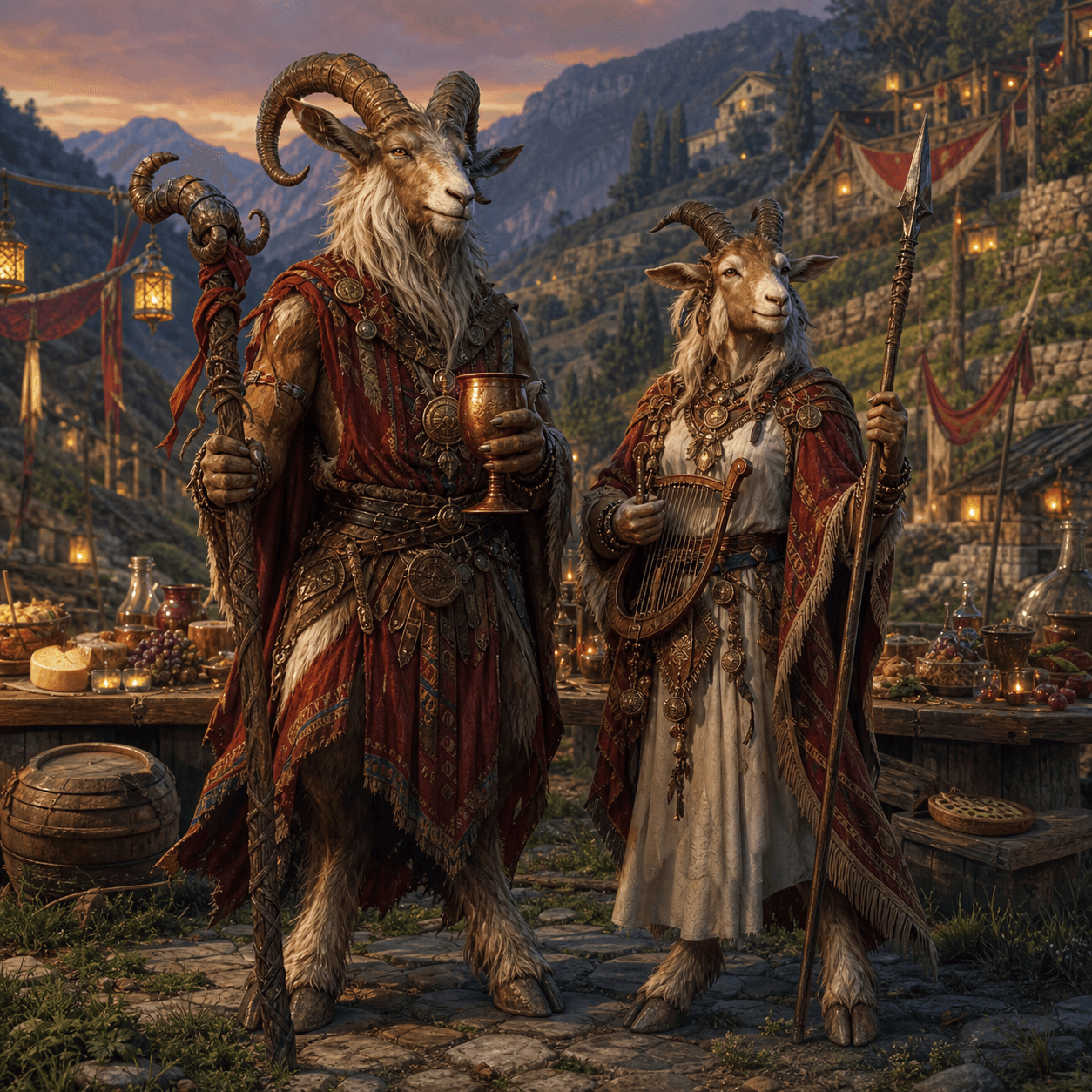
Land Animal-Folk
Goat Folk
Chiaegon
Background Questions
1. What festival shaped your childhood?
2. What cliff or hill is sacred to your people?
3. What guest-right oath did you once break - or uphold?
4. What instrument or dance is yours by tradition?
Lore & Background
The Goatfolk are the Aldaethu people most strongly associated with religion, mysticism, spiritual counsel, ritual practice, and interpretation of the Grand Design.
They carry the Religion & Mysticism Pillar.
Their existing cultural profile describes them as the primary spiritual guides of the Aldaethu: sharp-minded, resilient, and willing to challenge simple answers.
They maintain:
temples
shrines
ritual calendars
birth rites
marriages
funerals
oaths
spiritual counseling
interpretation of omens, dreams, and planar shifts
Their role is not to tell the other Aldaethu what to believe.
It is to help them understand what their beliefs demand of them.
That distinction is central.
The Elephantfolk preserve law.
The Lionfolk coordinate leadership.
The Bearfolk protect.
The Rabbitfolk sustain.
The Monkeyfolk plan.
The Goatfolk ask:
What does our purpose require of us now?
Their place within the Grand Design is therefore usually understood as conscience, interpretation, and spiritual orientation.
The Goatfolk and the Grand Design
Like all Aldaethu, Goatfolk believe the Celestial Dragon created their peoples with distinct purposes that together form the Grand Design.
The exact identity and nature of the Celestial Dragon remain intentionally open to interpretation.
Goatfolk are among the people most comfortable with that uncertainty.
Some describe the Celestial Dragon as a literal creator.
Some describe it as a guide.
Some see it as the force that arranged the Aldaethu peoples into complementary purposes.
Others insist that trying to define it too narrowly defeats the point.
Their own purpose within the Grand Design is not to settle every question.
It is to help the Aldaethu remain aligned with the meaning behind their roles.
Purpose Requires Reflection
A Pillar can fulfill its literal duty and still betray the Grand Design.
A Bearfolk can defend a border but become cruel.
A Lionfolk can maintain order but become controlling.
An Elephantfolk can preserve law that has ceased to be just.
A Monkeyfolk can invent something brilliant that causes harm.
Goatfolk exist to ask whether purpose is being fulfilled in spirit as well as function.
Mystery Is Not Ignorance
Goatfolk do not treat uncertainty as failure.
Their philosophy accepts that:
dreams may have several meanings
omens may be misunderstood
the planes may shift for reasons no one knows
spiritual experiences can be sincere without being universal
The proper response is not always certainty.
Sometimes it is patience.
Falling Is Part of Climbing
The original profile gives Goatfolk one of their strongest cultural ideas:
They believe falling is acceptable so long as one learns how to land.
This applies physically and philosophically.
Mistakes are expected.
Refusing to learn from them is not.
Appearance
Goatfolk are slender to stocky humanoids with caprine features.
Common traits include:
curved, straight, spiral, or swept-back horns
cloven hooves
short tails
expressive eyes
strong legs
narrow or broad muzzles
coats ranging from white and cream to brown, black, grey, reddish, or mixed patterns
Some lineages are lightly furred.
Others possess thick coats suited to colder or higher elevations.
Horns
Horns are an important visual feature, but the existing profile does not establish a rigid rank system based on horn shape.
That should stay open.
Goatfolk may decorate horns with:
prayer beads
cloth ties
simple metal rings
painted markings
memorial tokens
festival decorations
The original profile specifically establishes braided prayer beads in facial hair for some Goatfolk, so beadwork is definitely part of their visual culture.
Clothing
Goatfolk clothing is practical for climbing and steep terrain.
Common features include:
wrapped leggings
fitted robes
layered tunics
shoulder shawls
prayer cords
small herb pouches
light packs
sturdy belts
Temple dress may be more formal, but exact vestments are not established yet.
Social Structure
Goatfolk communities commonly exist in:
steep hillside villages
cliff settlements
temple complexes
That is directly established in the surviving cultural profile.
Their communities tend toward egalitarian social roles.
The existing profile specifically says Goatfolk gender roles are generally egalitarian, though individual temples may preserve matriarchal or patriarchal traditions.
Spiritual authority ultimately depends upon:
insight
service
trust
experience
rather than gender.
Temple Communities
Temples are more than places of worship.
They can also serve as:
counseling centers
places of teaching
ritual spaces
centers for calendar keeping
shelters
meeting places
The current canon does not establish a universal Goatfolk priestly government, so we should avoid locking in a central hierarchy.
Different temple communities may organize themselves differently.
Village Life
Goatfolk children grow up surrounded by:
steep paths
climbing
ritual gatherings
debate
observation
communal work
Their physical environment and philosophical culture reinforce one another.
A difficult path is not considered unusual.
It is part of daily life.
Upbringing
The existing profile explicitly establishes that Goatfolk children are taught to:
climb
question
contemplate
from an early age.
This is one of the clearest foundations of their culture.
Questioning as Education
A Goatfolk child is not necessarily rewarded for accepting the first answer offered.
Teachers may ask:
Why?
How do you know?
What if the opposite is true?
Who benefits from that interpretation?
What would change your mind?
The point is not endless argument.
It is resistance to shallow certainty.
Physical Confidence
Climbing is practical, cultural, and symbolic.
Young Goatfolk learn:
balance
footing
controlled falling
route choice
how to recover after a slip
Their physical abilities reinforce the philosophy that mistakes are survivable when handled with awareness.
Ritual Education
Children also learn the meaning of:
seasonal rites
funerary customs
naming traditions
marriage rites
oath witnessing
signs associated with planar changes
The exact forms may differ by community.
The Religion & Mysticism Pillar
Goatfolk carry the Religion & Mysticism Pillar of the Aldaethu.
Their responsibilities include:
maintaining temples and shrines
tending ritual calendars
officiating births
officiating marriages
conducting funerals
witnessing spiritually significant oaths
interpreting dreams and omens
advising on planar disturbances
counseling individuals and communities
Their role is advisory and spiritual.
It does not automatically override:
law
leadership
military authority
agriculture
infrastructure
The Grand Design depends on balance between the Pillars.
A Goatfolk priest cannot simply declare that a legal ruling, military action, or public project is invalid because of an omen.
They can challenge it.
They can warn.
They can argue that it violates the spirit of the Design.
But the other Pillars remain part of the decision.
Omens, Dreams, and Planar Shifts
The established profile specifically says Goatfolk priests interpret:
omens
dreams
planar shifts
This should be treated as an important part of their culture without assuming every interpretation is objectively correct.
Omens
An omen may be:
a strange animal behavior
unusual weather
repeated symbols
unexpected celestial events
a meaningful coincidence
an unexplained magical reaction
Different Goatfolk may interpret the same omen differently.
Dreams
Dreams may be treated as:
personal symbols
warnings
emotional reflections
spiritual experiences
possible messages
Goatfolk generally do not assume every vivid dream is prophecy.
Planar Shifts
Changes in magical, spiritual, or planar conditions are taken more seriously.
Goatfolk are often among the first called when:
a shrine behaves strangely
magic changes in an area
dreams spread among many people
a region feels spiritually altered
unusual manifestations appear
This connects directly to their established role.
Religion: and the Celestial Dragon
Goatfolk are not the sole keepers of belief in the Celestial Dragon.
All Aldaethu share that broader cultural belief.
Goatfolk are the people most responsible for interpreting what that belief means.
Their central theological tension is simple:
If each Aldaethu people was given a purpose, how rigid is that purpose?
Some Goatfolk emphasize tradition.
Others emphasize interpretation.
The important canon point is that the Dragon remains intentionally ambiguous.
Goatfolk preserve that ambiguity rather than eliminate it.
Shrines and Temples
The established material confirms temples and shrines as important Goatfolk institutions.
Their exact architecture varies, but their cliffside and hillside homelands suggest practical adaptations such as:
terraces
stone stairs
narrow paths
ledges
open gathering spaces
sheltered chambers
We should avoid inventing named temple orders or universal architectural symbolism unless we establish it later.
Small Shrines
Not every sacred place is a temple.
Goatfolk may maintain smaller shrines along:
mountain paths
roads
cliffs
crossings
remote settlements
These can serve as places for:
reflection
offerings
prayer
remembrance
travel rest
Ritual Life
The current source explicitly establishes several areas of Goatfolk ritual responsibility.
Births
Goatfolk preside over or assist with birth-related rites.
Exact naming ceremonies can vary among the other Aldaethu peoples.
Marriage
Goatfolk may oversee the spiritual side of marriage.
Elephantfolk or local authorities may handle legal obligations.
That separation fits the Pillar system.
Funerals
Goatfolk help communities interpret grief, memory, and continuation after death.
They frequently work beside Elephantfolk record keepers and the deceased person's own people.
Oaths
Some oaths are more than contracts.
Goatfolk may participate where the oath carries:
sacred
communal
ancestral
Grand Design significance
Legal certification still belongs principally to Elephantfolk.
Counseling
One of the most important details in the established Goatfolk profile is that their priests also counsel people about ordinary worries.
That prevents them from becoming purely mystical figures.
Goatfolk spiritual care may concern:
grief
doubt
family conflict
guilt
fear
responsibility
uncertainty
questions of purpose
This is arguably just as important to their culture as interpreting omens.
Economy and Trade
The original cultural profile does not establish a large commodity-based Goatfolk trade economy.
Their most clearly supported services revolve around:
temples
rites
spiritual counsel
herbs
ceremonial work
So we should keep this section modest.
Common Roles
priests
shrine keepers
counselors
ritual specialists
teachers
herbalists
pilgrimage guides
interpreters of unusual spiritual activity
Imports: and Exports
The specific Culture Snapshot exports and imports have not yet been clearly established in the source we are using.
I would leave them open rather than inventing an economy that might conflict with older Reth material.
Warfare
Goatfolk are not primarily a military people.
The established profile gives them specific wartime roles:
chaplains
battle-chanters
ritual support
use of song
use of herbs
emotional stabilization
Their function is to steady people under pressure.
Chaplains
Goatfolk chaplains may accompany:
Bearfolk units
mixed militias
refugee groups
medical camps
Their responsibility can include:
counseling
funerary rites
morale
spiritual support
Battle-Chanters
Battle-chanters are explicitly established in the old profile.
We should preserve the term without overdefining their magical capabilities.
At minimum, they use:
ritual
song
voice
to steady allies.
Whether some chants possess actual supernatural effects can depend on character class or later canon.
Herbs
The profile also explicitly references herbs.
Goatfolk may use them for:
calming
medicine
ritual incense
battlefield care
Again, we do not need to invent a full pharmacology.
Relationships with Other Aldaethu
Chiaegen
Goatfolk advise Lionfolk leaders on matters of conscience and spiritual meaning.
A Lionfolk leader may ask:
"What can we do?"
The Goatfolk may answer:
"What should we do?"
Elephantfolk
This is one of their most important relationships.
Elephantfolk preserve law.
Goatfolk examine moral meaning.
The two frequently disagree without necessarily being enemies.
Law and conscience are supposed to challenge each other.
Bearfolk & Pandafolk
The existing profile specifically establishes Goatfolk comforting Bearfolk veterans.
This is an important canon relationship.
Goatfolk provide:
counseling
funerary support
moral guidance
spiritual care
Canine Folk
Pack loyalty and oath traditions make Canine Folk natural participants in Goatfolk rites involving responsibility and loss.
Cowfolk
The established profile specifically says Cowfolk coordinate with Goatfolk priests during festivals.
Cowfolk handle:
food
hospitality
public space
Goatfolk handle:
ritual
meaning
spiritual observance
Horsefolk
Goatfolk may tend roadside shrines associated with journeys and vows, though Horsefolk retain their own traditions.
Monkey Folk
The established profile explicitly says Goatfolk often debate Monkey Folk scholars with good-natured sharpness.
This is a strong canon relationship.
Monkey Folk ask:
How does it work?
What happens next?
Goatfolk ask:
What does it mean?
Should we do it?
Rabbitfolk
Goatfolk bless fields and participate in planting and harvest observances.
Rabbitfolk retain their own local seasonal traditions.
Chiaenol
The established profile specifically includes Goatfolk blessing the fields of Armadillofolk as well.
Chiaenol work closely with land and soil, giving their spiritual relationship with Goatfolk a natural agricultural dimension.
Hippofolk
Goatfolk may participate in rites surrounding major crossings, public works, or community displacement.
The engineering itself remains Hippofolk responsibility.
Ratfolk
Ratfolk logistics and emergency distribution often intersect with Goatfolk charity, funerary work, and relief efforts.
Badgerfolk
Goatfolk are especially valuable after:
collapses
rescue failures
disasters
Badgerfolk rescue culture deals heavily with grief and survivor guilt.
External Relationships
The original Goatfolk profile does not provide a clear list of specific foreign allies and enemies.
So I would not assign any yet.
Their religious role likely puts them into contact with:
foreign priests
druids
mystics
philosophers
healers
but those relationships should be established individually rather than assumed.
Customs and Values
The source gives us strong cultural values even where it does not name specific rites.
Curiosity
Questions are not disrespectful merely because they are difficult.
Resilience
Falling is part of learning.
Paradox
Two ideas may both contain truth even when they appear opposed.
Service
Spiritual authority is earned through service.
Humility
Interpretation is not certainty.
A Goatfolk who claims perfect understanding of the Celestial Dragon would be treated with suspicion by many of their own people.
Taboos
The original source does not list formal Goatfolk taboos, so these should stay directly tied to their established role rather than becoming elaborate invented law.
False Certainty
Presenting personal interpretation as unquestionable divine truth is deeply suspect.
Exploiting Grief
Using funerals, fear, or spiritual vulnerability for personal power violates their role.
Manufactured Omens
Knowingly creating false signs to manipulate others is a serious betrayal.
Refusing the Troubled
A spiritual guide who refuses ordinary people because their concerns are not "important enough" is failing their duty.
Ritual Without Meaning
Performing rites carelessly or only for status is considered hollow practice.
Current Tensions
These follow naturally from established Aldaethu canon and Goatfolk responsibilities.
The Long Shadow
The Long Shadow has created growing demand for:
explanation
reassurance
prophecy
certainty
Goatfolk cannot always provide those things.
That makes people vulnerable to anyone willing to claim certainty.
Grand Design Interpretation
Different Goatfolk disagree over whether the current crises mean:
the Aldaethu have abandoned their proper purposes
the Grand Design is being misunderstood
circumstances simply change
something deeper is disrupting the world
No single interpretation has been established as canon.
Spiritual Authority
As governments struggle, some communities may rely more heavily on religious figures.
Goatfolk must decide how much political influence their Pillar should carry.
Omen Versus Evidence
Goatfolk mystics may interpret signs that conflict with:
Monkey Folk analysis
Elephantfolk records
practical needs
Their culture must constantly balance spiritual interpretation against evidence.
Doubt
The most serious tension may simply be that some Goatfolk themselves no longer know what the Grand Design means in the present age.
For a people whose role is helping others find meaning, that uncertainty carries considerable weight.
Goatfolk Adventurers
Omen Seeker
They experienced a sign they cannot interpret within their own community.
Pilgrim
They travel to sacred places, shrines, or communities throughout Reth.
Counselor
They accompany others through dangerous circumstances as spiritual support.
Temple Disagreement
They left after a serious theological or philosophical dispute.
Planar Disturbance
They are investigating unusual magical or spiritual changes.
Broken Oath
They witnessed a spiritually significant promise that has been violated.
Grand Design Pilgrim
They seek to understand how other peoples interpret their purpose.
Failed Guidance
Someone suffered because of advice they gave, and they are trying to understand why.
Culture Snapshot
Name. Goatfolk
Common Name. Goat Folk
Aldaethu Classification. Land Animal-Folk
Role. Religion & Mysticism Pillar; spiritual guides, priests, counselors, ritual specialists, and interpreters of omens and planar shifts
Homeland: Steep hillside villages, cliff settlements, and temple communities within Aldaethu territory
Cities: No specific principal Goatfolk cities are confirmed in the current profile source
Exports: Spiritual counsel, ritual services, herbal knowledge, teaching; more specific trade goods remain to be established
Imports: Not specifically established in the current source
Diet: Not specifically established in the current source
Allies: Strong internal ties with Lionfolk, Elephantfolk, Bearfolk, Cowfolk, Monkey Folk, Rabbitfolk, and Chiaenol
Enemies: No specific racial enemies established in the current cultural profile
History: Goatfolk became the primary spiritual guides of the Aldaethu, maintaining temples, shrines, ritual calendars, births, marriages, funerals, and sacred oaths. Their priests interpret omens, dreams, and planar shifts while also counseling ordinary people through everyday fears and difficult decisions.
Core Values. Curiosity, resilience, service, humility, and comfort with paradox.
Cultural Principle. Falling is acceptable so long as you learn how to land.
Faith. The Celestial Dragon and the Grand Design; Goatfolk purpose understood as helping the Aldaethu interpret meaning, conscience, and spiritual responsibility within that Design.
Checking your codex…
From the Reth Ancestries (Daggerheart) compendium. Ancestry mechanics unlock when you collect this lineage in Hoard and link your account.