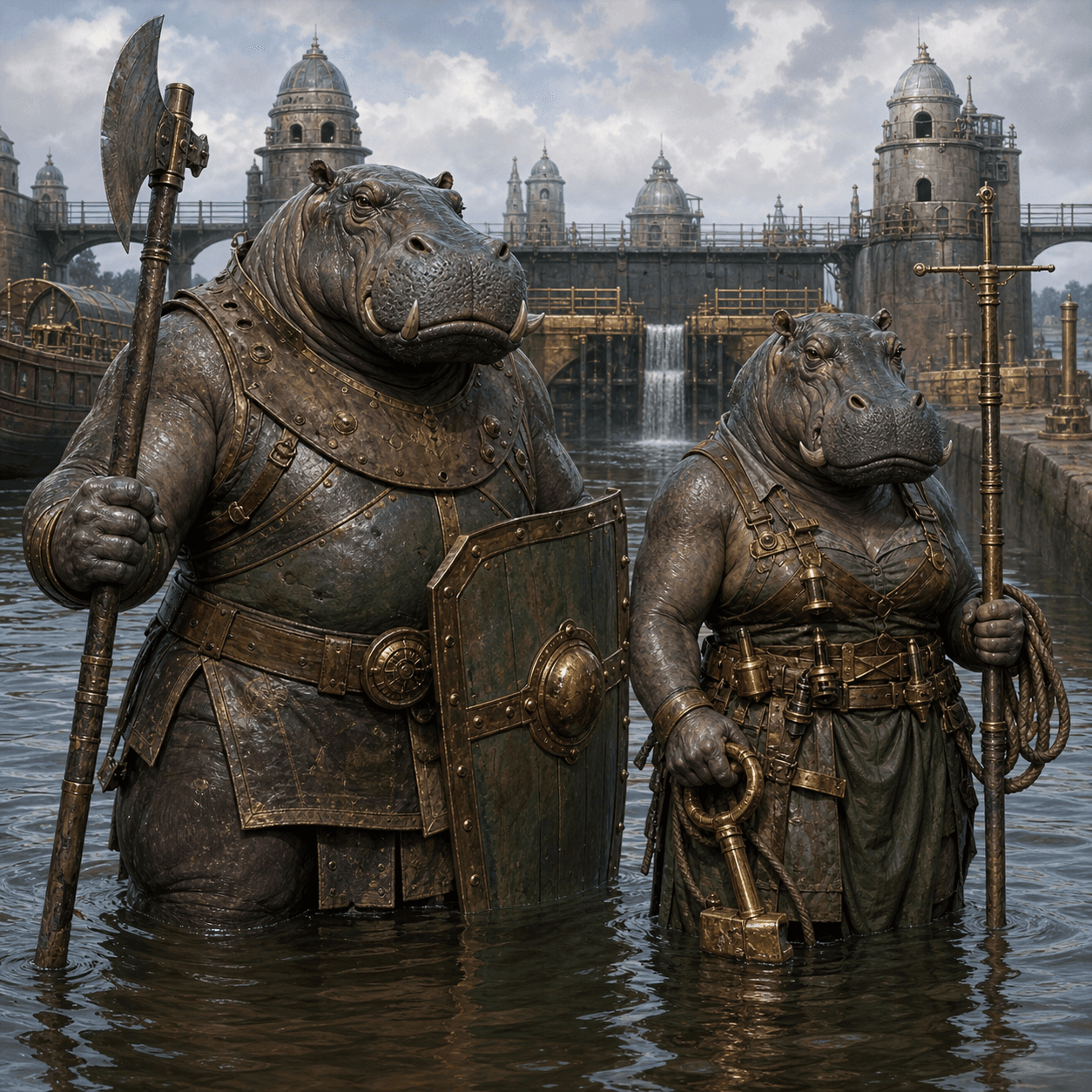
Land Animal-Folk
Hippo Folk
Chiaecel
Background Questions
1. What river shaped your earliest memories?
2. Who taught you the oaths of the ferry-guards?
3. What bandit attack or river disaster hardened your resolve?
4. Which port or quay feels like home?
Lore & Background
The Hippofolk are the Aldaethu people most closely associated with infrastructure, waterways, crossings, and large public works.
They build and maintain the physical connections that allow the Aldaethu Confederation to function as more than a collection of isolated settlements.
Their work includes:
canals
bridges
ports
locks
levees
docks
reservoirs
roads
public cisterns
flood channels
ferry stations
retaining walls
civic stoneworks
river defenses
Where the Chiaenol prepare and stabilize the ground, Hippofolk coordinate the larger structures that carry people, water, goods, and responsibility across it.
They are known for immense strength, long patience, excellent spatial memory, and a practical understanding of moving water.
Outsiders sometimes imagine Hippofolk engineering as an exercise in brute force.
Hippofolk find this insulting.
Any fool can push a stone.
A true builder must understand where the stone's weight goes, how water will move around it, who lives upstream, who depends upon the crossing below, and who will still be maintaining it generations later.
Their purpose within the Grand Design is understood as connection made physical.
A promise may join two peoples.
A bridge allows them to reach one another.
The Hippofolk and the Grand Design
Hippofolk tradition teaches that the Celestial Dragon gave their people strength enough to move great weight, lungs suited to deep water, and minds capable of seeing how distant places could be joined.
Their purpose was not merely to construct.
It was to create the crossings through which every other Aldaethu purpose could reach the others.
A Rabbitfolk harvest cannot feed a distant city without a road.
A Horsefolk messenger cannot carry warning across a river without a ford or bridge.
A Cowfolk caravansary cannot serve travelers if no safe route reaches it.
An Elephantfolk treaty cannot bind distant communities if no one can meet.
A Bearfolk garrison cannot protect a border if supplies cannot reach it.
The Hippofolk therefore understand public works as moral structures.
A bridge declares that those on the far side matter.
A canal declares that water must be shared.
A port declares that strangers may arrive.
A levee declares which homes will be protected - and which lands may receive the displaced water.
Every structure makes a social decision.
A Crossing Is a Relationship
Hippofolk do not consider a bridge, road, or canal finished simply because it functions mechanically.
It must also fit the communities it joins.
A technically perfect road that destroys a village's fields is a failed road.
A strong bridge that excludes the poor through tolls is an incomplete crossing.
A canal that enriches one district while drying another violates the Grand Design.
Water Must Be Negotiated With
Hippofolk do not speak of conquering rivers.
They speak of guiding, dividing, slowing, deepening, redirecting, or making room for them.
Water always seeks movement.
A builder who believes a river has been permanently defeated will eventually be corrected.
Public Work Creates Public Duty
Once a structure becomes essential to the lives of multiple communities, its maintenance cannot remain solely a private concern.
Hippofolk law treats neglected public works as a form of civic abandonment.
Appearance
Hippofolk are massive humanoids with broad torsos, thick limbs, dense bones, and hippopotamus-like heads.
Their bodies are adapted to both land and water.
Common physical traits include:
thick grey, brown, blue-grey, violet-grey, or reddish skin
small rounded ears
wide nostrils capable of closing underwater
powerful jaws
heavy teeth or short tusks
short tails
webbing between fingers or toes in some lineages
dense musculature
broad, weight-bearing feet
Their eyes and ears sit high on the head, allowing them to observe their surroundings while mostly submerged.
Despite their size, Hippofolk can move quietly in water and are often more graceful while submerged than outsiders expect.
Skin Markings
Hippofolk commonly mark their skin with:
mineral pigments
project emblems
waterline tattoos
bridge symbols
crew bands
lock patterns
flood-year notations
civic seals
A completed major project may be commemorated with a painted or tattooed line representing the structure's span or route.
Clothing and Equipment
Hippofolk clothing must withstand water, stone dust, rope friction, and heavy labor.
Common items include:
broad work belts
waterproof wraps
reinforced aprons
heavy gloves
measuring cords
stone chalk
surveying poles
float markers
rope harnesses
diving weights
compact breathing reeds
shell or leather shoulder guards
Formal attire often includes layered sashes showing projects completed, councils served, and waterways protected.
Social Structure
Hippofolk society is organized through project households, construction crews, river communities, and civic guilds.
A household may include biological family, apprentices, laborers, engineers, cooks, divers, and workers from other Aldaethu peoples.
Large public works often create communities that remain together for decades.
A canal crew may become a permanent neighborhood.
A bridge camp may grow into a town.
A port-building expedition may become a hereditary civic guild.
Project Kinship
Hippofolk recognize several forms of social bond.
Blood-Kin
Biological and adopted family.
Crew-Kin
Those who have labored together under shared risk.
Crossing-Kin
Communities joined by the same bridge, road, canal, or port.
Flood-Kin
Those who survived the same flood, levee failure, or river disaster.
First-Crossing Kin
Those who formally crossed a completed structure together during its opening rite.
These relationships can carry legal and ceremonial obligations.
Shared Child-Rearing
Calves are raised within broad communal households.
Children spend time in:
work yards
shallow canals
drafting halls
stone yards
kitchens
repair docks
ferry stations
They learn early that no project is completed by engineers alone.
A celebrated bridge also depends upon:
quarry workers
haulers
cooks
rope makers
scouts
divers
carpenters
legal witnesses
farmers who surrendered land
communities that agreed to its placement
Upbringing
Hippofolk calves are introduced to water almost immediately.
They learn to float, hold their breath, feel currents, and recognize changes in depth and pressure.
Their education combines physical work, mathematics, history, law, and community negotiation.
Early lessons include:
never underestimate moving water
never stand beneath suspended stone
never open a gate without confirming what lies downstream
never close a crossing without warning both sides
never call a project complete before testing it under strain
never treat laborers as replaceable
never ignore those displaced by construction
The First Stone
The First Stone is a childhood rite.
A young Hippofolk chooses, prepares, and places one stone in a small public work under supervision.
The stone might belong to:
a footbridge
a dock
a retaining wall
a well
a culvert
a public stair
a canal edge
The child's name is not carved into the visible face.
Instead, it is placed on the concealed side or entered into the project ledger.
The lesson is that necessary work does not require public recognition to possess meaning.
The First Crossing
The First Crossing is a coming-of-age rite tied to service.
The young Hippofolk must guide others safely across a route for which they hold responsibility.
This might involve:
ferrying travelers
guiding a flood crossing
escorting a caravan across a bridge
operating a canal lock
directing people through a construction zone
leading an evacuation
The rite is not complete until everyone entrusted to them reaches the far side.
The Measured Breath
Apprentices training for underwater construction undergo the Measured Breath.
They learn to remain calm while submerged, communicate through line pulls and hand signals, and abandon a task before exhaustion turns into panic.
The rite teaches that endurance is not the same as recklessness.
Government
Project Councils
Major Hippofolk works are governed through Project Councils.
A Project Council usually includes:
senior engineers
labor representatives
community delegates
Chiaenol ground specialists
Monkeyfolk planners
Elephantfolk legal witnesses
Ratfolk logistics coordinators
affected upstream and downstream communities
representatives of those whose land will be altered
No single engineer owns the project.
The council determines:
purpose
route
funding
labor obligations
safety standards
maintenance
compensation
emergency procedures
responsibility for failure
Spanmasters
A Spanmaster is the chief coordinator of a major bridge, road, or structural crossing.
The title refers to responsibility, not unrestricted authority.
A Spanmaster may halt construction, revise plans, or dismiss unsafe workers, but cannot ignore Project Council conditions.
Lockwardens
Lockwardens operate and regulate canals, gates, reservoirs, and controlled waterways.
They are trained in engineering, water law, trade regulation, and emergency response.
Opening or closing a major gate without proper confirmation is one of the gravest professional offenses in Hippofolk society.
Harbor Speakers
Ports and large ferry districts are represented by Harbor Speakers.
They coordinate:
docking rights
trade schedules
customs
safety
rescue crews
foreign vessels
quarantine
public access
The Infrastructure Pillar
Hippofolk traditionally carry the Infrastructure and Waterways Pillar of the Aldaethu Confederation.
They do not possess exclusive authority over every bridge, road, or canal.
Their responsibility is to ensure that shared infrastructure is:
safe
maintained
accessible
coordinated
legally witnessed
designed with long consequences in mind
Settlements and Architecture
Hippofolk settlements are often located along rivers, canals, lakes, reservoirs, estuaries, and major crossroads.
Their cities commonly combine land and water districts.
Typical features include:
broad stone quays
stepped waterfronts
deep canals
lock towers
heavy bridges
low flood-resistant halls
submerged work chambers
public baths
reservoir courts
ferry basins
elevated refuge platforms
wide roads
stone ramps
flood plazas
civic cisterns
open maintenance yards
Hippofolk construction favors durability, accessibility, and repair.
Stairs are usually paired with ramps.
Bridges include maintenance ledges.
Canals include rescue points.
Public halls are built with broad entrances and load-bearing floors.
Broad-Ford
Broad-Ford is one of the oldest major Hippofolk settlements in Aldaethu territory.
It developed around a river crossing used during the Aldaethu arrival.
The original ford was gradually expanded into a network of:
stone causeways
ferries
bridges
market islands
water stairs
caravan yards
Broad-Ford is now a major trade and negotiation center.
Its most famous feature is the Hundred-Step Quay, a waterfront designed to remain usable across widely changing river levels.
The city is known for:
ferry law
bridge design
public markets
emergency river rescue
foreign trade
large Oath-Meals held between traveling peoples
Lock-Gate
Lock-Gate is the central city of Aldaethu canal engineering.
It surrounds a massive sequence of locks, gates, and reservoirs that connect higher agricultural districts to lower trade waterways.
The city trains:
Lockwardens
hydraulic engineers
divers
gate crews
flood planners
canal judges
emergency repair workers
Its districts are arranged vertically along the changing water levels.
At the city's center stands the Gate of Seven Measures, a monumental lock whose opening requires confirmation from seven separate stations.
The design exists to prevent one official from controlling the water alone.
Brass-Quay
Brass-Quay is a major port and industrial waterfront.
Its name comes from the brass fittings, bells, gauges, chains, and maritime instruments produced there.
The city is known for:
ship repair
heavy cranes
stone docks
customs halls
warehouses
canal barges
foreign merchants
navigational instruments
flood-resistant architecture
Ratfolk warehouses and Cowfolk caravansaries occupy large portions of the city.
Brass-Quay is cosmopolitan, prosperous, crowded, and politically contentious.
Economy and Trade
Hippofolk are among the most economically influential Aldaethu peoples because nearly every major trade route depends upon their work.
Their wealth comes from infrastructure, construction, transport, and maintenance rather than private control of all goods that pass through their territory.
Exports
bridge engineering
canal design
stonework
port construction
dredging
levees
locks and gates
road building
quarrying
ferry operations
flood control
public cisterns
heavy cranes
waterproof mortar
surveying
harbor administration
rescue training
transport coordination
Imports
fine steel
brass
timber
rope
pitch
glass
precision tools
magical reagents
cloth
preserved food
drafting materials
Dwarven hardware
Monkeyfolk instruments
Chiaenol soil surveys
Elephantfolk legal tablets
Tolls and Public Access
Hippofolk accept tolls as necessary for maintenance.
However, they distinguish between a maintenance toll and an exclusion toll.
A maintenance toll funds:
repair
staffing
rescue
inspection
lighting
public access
An exclusion toll exists primarily to keep certain people away or enrich a private holder.
Such tolls are considered violations of the crossing's purpose.
Contract Law
Hippofolk construction contracts require clear answers to five questions:
Who benefits?
Who bears the risk?
Who is displaced?
Who maintains the work?
Who answers when it fails?
A project that cannot answer all five is considered politically and structurally incomplete.
Religion: and Philosophy
Hippofolk faith centers on the Celestial Dragon, the Grand Design, and the sacred nature of crossings.
They believe the Celestial Dragon gave each Aldaethu people a purpose, and that the Hippofolk were entrusted with joining what distance, terrain, and water would otherwise keep apart.
The Sacred Crossing
A crossing is more than a structure.
It changes relationships.
Before a bridge, the far shore is distant.
After a bridge, it becomes reachable.
Before a canal, two waters are separate.
Afterward, they exchange trade, fish, silt, people, and danger.
Hippofolk therefore consider every crossing spiritually significant.
The First Crossing Rite
When a major bridge, road, port, lock, or canal opens, representatives from all affected communities gather.
The first crossing is made by a mixed group rather than the project's rulers.
Common participants include:
a child
an elder
a worker
a traveler
a legal witness
someone from each side
someone displaced or compensated by the work
The structure is not formally open until all reach the other side.
The Weight and the Flow
Hippofolk teachings describe two forces present in every work.
Weight is what must be supported.
Flow is what must be allowed to move.
Too much weight without support causes collapse.
Too much control over flow causes pressure, flooding, or rupture.
This philosophy is applied not only to engineering, but to government and relationships.
Shrines of Passage
Small shrines are common near:
bridges
docks
ferries
locks
gates
roads
city entrances
Offerings include:
river stones
rope knots
small model bridges
cups of water
coins used for first toll
names of those who crossed safely
names of those lost in the water
Warfare and Defense
Hippofolk are formidable combatants, but their principal military value lies in control of terrain, movement, and infrastructure.
Riverine Defense
Hippofolk excel at defending:
bridges
docks
ferries
canals
river gates
ports
flooded streets
shoreline fortifications
They understand how current, depth, footing, and structure affect battle.
Bridge Control
A bridge is both route and chokepoint.
Hippofolk bridge defenders use:
heavy shields
long polearms
barriers
controlled gates
counterweights
retractable spans
concealed maintenance routes
water access beneath the bridge
Their doctrine emphasizes preserving the crossing whenever possible.
Destroying a bridge may deny an enemy passage, but it also isolates allies and civilians.
Combat Engineers
Hippofolk engineers build and repair:
field bridges
temporary roads
river defenses
siege ramps
reinforced camps
mobile docks
water barriers
supply crossings
Flood Warfare
Using water as a weapon is heavily regulated.
Opening levees or gates can destroy entire communities far from the battlefield.
Any commander ordering such action must account for:
civilians
farmland
downstream settlements
future water access
contamination
long-term ecological effects
Unlawful flood warfare is considered a crime against the Grand Design.
Urban Defense
In cities, Hippofolk use infrastructure knowledge to:
close routes
redirect crowds
secure bridges
protect cisterns
isolate fires
open evacuation corridors
prevent structural collapse
deny enemies control of gates and docks
Relationships with Other Aldaethu
Chiaenol
Chiaenol prepare the soil and foundations upon which Hippofolk works depend.
Hippofolk think in spans, routes, systems, and flow.
Chiaenol think in pressure, ground, erosion, and stability.
Their partnership is essential.
Their greatest disputes occur when Hippofolk ambition exceeds what Chiaenol believe the ground can support.
Rabbitfolk
Rabbitfolk depend upon canals, irrigation, roads, and levees.
Hippofolk rely on Rabbitfolk knowledge of seasonal food needs.
Conflict arises when irrigation for one region threatens another's crops.
Ratfolk
Ratfolk manage much of the movement beneath and through Hippofolk infrastructure.
They operate:
warehouses
tunnel routes
inventory systems
dock logistics
hidden supply lines
Hippofolk admire their efficiency but often demand more formal route records than Ratfolk prefer.
Badgerfolk
Badgerfolk maintain deep foundations, tunnels, and undercity supports.
Hippofolk involve them in major bridge footings, quay foundations, and underground waterworks.
Monkeyfolk
Monkeyfolk provide calculations, instruments, designs, forecasting, and experimental systems.
Hippofolk frequently turn Monkeyfolk concepts into full-scale civic works.
They insist that every innovation be repairable by ordinary crews.
Horsefolk
Horsefolk roads and relay routes depend on Hippofolk bridges and crossings.
Horsefolk often demand speed.
Hippofolk insist on inspection.
Both believe the other underestimates the cost of delay.
Cowfolk
Cowfolk halls cluster around ports, bridges, and caravan routes.
They provide food, lodging, and public gathering spaces for workers and travelers.
Hippofolk often consult Cowfolk hosts when measuring how infrastructure affects daily life.
Elephantfolk
Elephantfolk witness contracts, preserve water law, and record maintenance obligations.
Hippofolk rely on them when rulers attempt to change project terms after construction has begun.
Bearfolk and Pandafolk
Bearfolk protect worksites, bridges, ports, and repair crews.
Hippofolk build the fortifications and routes that allow Bearfolk forces to respond.
Chiaegen
Chiaegen scouts map routes, monitor riverbanks, investigate sabotage, and guide surveys through difficult terrain.
Cheetahfolk and other fast couriers use Hippofolk crossings constantly.
Caninefolk
Caninefolk patrol roads, docks, and construction camps.
Their senses make them excellent search-and-rescue partners after collapses or floods.
Goatfolk
Goatfolk oversee First Crossing rites and counsel communities affected by displacement.
Hippofolk respect their role but reject spiritual approval that attempts to bypass engineering review.
External Relationships
Druazer
Hippofolk respect Dwarven masonry, metalwork, tunneling, and structural engineering.
They frequently collaborate on:
bridge anchors
port walls
lock mechanisms
cranes
heavy gates
mountain roads
Conflict arises when Dwarven projects prioritize mineral access over downstream water stability.
Druaezur
Gnomes supply:
pumps
gauges
valves
mechanical locks
surveying instruments
compact cranes
pressure systems
Hippofolk value their ingenuity but demand redundant safety systems.
Druis
Halfling settlements are frequent beneficiaries of Hippofolk roads, irrigation, bridges, and market routes.
Hippofolk appreciate Druis practicality and community-centered planning.
Aldaemir
Relations: with the Aldaemir are complex.
Hippofolk build canals, levees, ports, and locks.
Aldaemir peoples understand wetlands as living systems that change with season and flood.
Aldaemir often accuse Hippofolk engineers of attempting to fix water into permanent channels.
Hippofolk increasingly acknowledge that some landscapes must be allowed to move.
The best projects are negotiated with Aldaemir water-keepers from the beginning.
Aldaecül
Ocean and aquatic peoples interact with Hippofolk through ports, estuaries, locks, and river mouths.
Triton envoys, Dolphinfolk lawmakers, Whale Folk historians, Shark Folk soldiers, and other Aldaecül peoples may all use Hippofolk-built harbor systems.
Conflicts concern who controls the boundary between river and sea.
Aldaedro
Hippofolk share a respect for great public works with Giantkin and other earth-forged peoples.
The challenge is scale.
Aldaedro works may be monumental.
Hippofolk insist that monumental work still serve ordinary people.
Customs and Rites
The First Crossing
The formal opening of a completed bridge, road, port, lock, or canal.
Those most affected cross first.
The Waterline Mark
After a major flood, the highest water level is permanently marked on public structures.
Covering or removing a waterline mark is forbidden.
It preserves memory of what the water has already done.
The Closed Gate Warning
Before closing a bridge, canal gate, dock, or public route, warnings must be sent to every affected side whenever possible.
Sudden closure without emergency cause is treated as civic betrayal.
The Shared Rope
During dangerous water or construction work, all crew members connect through a shared safety line.
The rope represents both practical rescue and collective responsibility.
The Last Stone
When a major project is completed, the final stone or fitting is placed by someone who will maintain the structure rather than the lead designer.
This signifies that maintenance, not construction, determines whether the work survives.
The Empty Dock
When a worker, sailor, ferryman, or traveler is lost to the water and cannot be recovered, an empty section of dock is left unused during the mourning rite.
Taboos
The False Opening
A public structure must not be opened before it is safe merely to satisfy ceremony, politics, or deadlines.
Unwitnessed Diversion
Water may not be redirected without informing and consulting those downstream.
The Profit Gate
Essential crossings must not be deliberately priced beyond the reach of ordinary people for private enrichment.
Abandoning Maintenance
A builder or authority cannot claim the honor of construction while refusing responsibility for upkeep.
Hidden Flood Risk
Known risks must be marked, recorded, and communicated.
Destruction Without Accounting
A bridge, levee, port, or canal must not be destroyed in war without considering civilians, food, water, evacuation, and long-term survival.
The Stranded Side
A crossing may not be closed after one community has come to depend upon it without providing warning, aid, or an alternative whenever possible.
Current Tensions
Aging Public Works
Many structures built during the Great Peace are approaching the end of their safe service.
Bridges crack.
Levees settle.
Canal gates corrode.
Ports silt.
Roads shift.
The Confederation does not possess enough labor or material to repair everything.
Hippofolk Project Councils must decide which connections remain open and which communities become isolated.
Monument Versus Maintenance
Political leaders favor impressive new projects that demonstrate strength and unity.
Hippofolk workers argue that existing bridges, wells, sewers, and locks are being neglected.
A growing civic movement declares:
Repair is a greater monument than replacement.
Water Disputes
Drought, changing rivers, magical disruption, and expanding agriculture have intensified conflicts over water.
Communities that once shared canals now accuse one another of theft.
Lockwardens face increasing pressure to favor powerful districts.
Militarization
Bearfolk commanders and Lionfolk leaders seek stronger bridges, fortified ports, flood barriers, and defensive canals.
Hippofolk fear that public infrastructure is being redesigned primarily for war.
A bridge built only to move soldiers may cease to serve the people whose taxes and labor built it.
Foreign Trade
Brass-Quay and other ports rely heavily on foreign trade.
Some Aldaethu believe this makes the Confederation vulnerable to outside pressure.
Others argue that isolation would cause economic collapse.
Displacement
Major works have displaced villages, farms, shrines, and older communities.
Even when compensation was legally provided, some Hippofolk question whether the Grand Design permits sacrificing one community for the convenience of many.
The Celestial Interpretation
Some Hippofolk theologians argue that the Grand Design demands expansion: more roads, more canals, more crossings, and greater connection.
Others believe endless connection can become domination and that some distances should remain.
Hippofolk Adventurers
Hippofolk leave their homes and Project Councils for many reasons.
The Broken Crossing
A bridge, lock, port, or levee they helped build has failed under impossible conditions.
Sabotage Inquiry
Evidence suggests a public disaster was deliberate.
The Lost River
A waterway has changed course, vanished, or begun flowing where no river should exist.
Project Exile
They halted a politically important project and were removed from authority.
First Crossing Pilgrimage
They seek to cross the great roads, rivers, gates, and borders of Reth to understand how other peoples connect.
Repair Mandate
They have been sent to restore infrastructure destroyed by war, shadow, blight, or neglect.
Downstream Debt
A project benefited their home while harming another community, and they seek restitution.
The Unfinished Span
A legendary bridge, road, or canal was abandoned before completion.
Grand Design Question
They are trying to determine whether every connection is sacred - or whether some should never be made.
Drowned Evidence
A submerged ruin or collapsed canal contains records that could expose a historic crime.
Culture Snapshot
Name. Hippofolk
Common Name. Hippo Folk
Aldaethu Classification. Land Animal-Folk
Traditional Aldaethu Role. Infrastructure, waterways, crossings, and major public works
Associated Pillar. Infrastructure and Waterways
Creature Type. Humanoid
Typical Size. Medium to Large
Languages: Common and Aldaethu
Homeland: Major rivers, canal districts, lake shores, reservoirs, ports, estuaries, and Aldaethu trade corridors
Principal Settlements:
Broad-Ford
Lock-Gate
Brass-Quay
Government: Project Councils, Spanmasters, Lockwardens, Harbor Speakers, and Infrastructure Pillar delegates
Society: Project households, river communities, civic guilds, work crews, and Crossing-Kin networks
Buildings: Broad quays, stepped waterfronts, canals, lock towers, heavy bridges, flood plazas, submerged work chambers, cisterns, ports, ramps, and public maintenance yards
Exports:
Bridge engineering
Stonework
Canals
Locks
Levees
Ports
Roads
Dredging
Flood control
Ferry operations
Surveying
Rescue training
Waterproof mortar
Heavy cranes
Imports:
Steel
Brass
Timber
Rope
Pitch
Glass
Precision tools
Cloth
Preserved food
Magical reagents
Surveying instruments
Legal record materials
Diet: River fish, aquatic plants, grains, roots, fruit, vegetables, dense stews, fermented drinks, and large communal meals
Faith. The Celestial Dragon and the Grand Design; Hippofolk purpose understood as creating and maintaining the crossings through which the other Aldaethu peoples remain connected
Military Role. River defenders, combat engineers, bridge guards, port security, urban defenders, heavy infantry, rescue crews, and flood-control specialists
Allies: Chiaenol, Rabbitfolk, Ratfolk, Badgerfolk, Monkeyfolk, Horsefolk, Cowfolk, Elephantfolk, Bearfolk, Druazer, Druaezur, and communities dependent upon shared waterways
Common Enemies. Saboteurs, negligent builders, illegal toll holders, water thieves, corrupt port authorities, raiders targeting bridges, and powers that weaponize floods without regard for civilians
Core Values:
Connection
Public access
Durability
Maintenance
Shared responsibility
Practical strength
Water stewardship
Long-term consequence
Greatest Taboos:
Opening unsafe structures
Diverting water without witness
Abandoning essential maintenance
Creating exclusionary tolls
Hiding flood risk
Destroying infrastructure without accounting for civilians
Stranding a dependent community without warning or alternative
History
Before Reth
Hippofolk tradition teaches that the Celestial Dragon gave their people strength to move weight, patience to understand water, and vision to see how distant places might be joined.
Their role in the Grand Design was to create crossings between the purposes of the other Aldaethu peoples.
Arrival in Reth
During the Aldaethu arrival, Hippofolk built the first reliable river crossings, wells, drainage systems, docks, and water stores used by the displaced communities.
They worked closely with Chiaenol crews to stabilize the ground and Rabbitfolk communities to secure food.
Their first works were temporary.
Many became permanent because the Aldaethu remained in the places those structures made survivable.
The First Convocation
Hippofolk supported Confederation because the Aldaethu settlements were already becoming physically interdependent.
They argued that roads, water, and public works could not be governed by isolated local law alone.
Their condition was that affected communities must receive representation in every major project.
This principle became the foundation of Project Council government.
The Great Peace
The Great Peace was the great expansion age of Hippofolk engineering.
They built:
roads
canals
bridges
ports
irrigation systems
levees
reservoirs
public cisterns
Broad-Ford became a major crossing city.
Lock-Gate connected agricultural and trade regions.
Brass-Quay opened the Confederation to foreign merchants and sea routes.
The Second War
During the Second War, Hippofolk maintained refugee roads, repaired bridges under attack, built temporary defenses, and kept ports open.
They also participated in controversial projects:
emergency levee breaches
military canal closures
bridge demolitions
forced relocations
fortified trade routes
Many present legal disputes concern wartime works that were never restored or compensated properly.
The Long Shadow
Hippofolk now inherit a network larger than the Confederation can afford to maintain.
Every failing bridge isolates someone.
Every closed canal changes food prices.
Every abandoned port weakens a community.
Their crisis is not a lack of skill.
It is the impossibility of preserving every connection at once.
The Hippofolk continue to carry the Infrastructure Pillar, but increasingly ask whether the Grand Design requires them to keep every crossing open - or to decide, honestly and publicly, which ones can no longer be saved.
Checking your codex…
From the Reth Ancestries (Daggerheart) compendium. Ancestry mechanics unlock when you collect this lineage in Hoard and link your account.