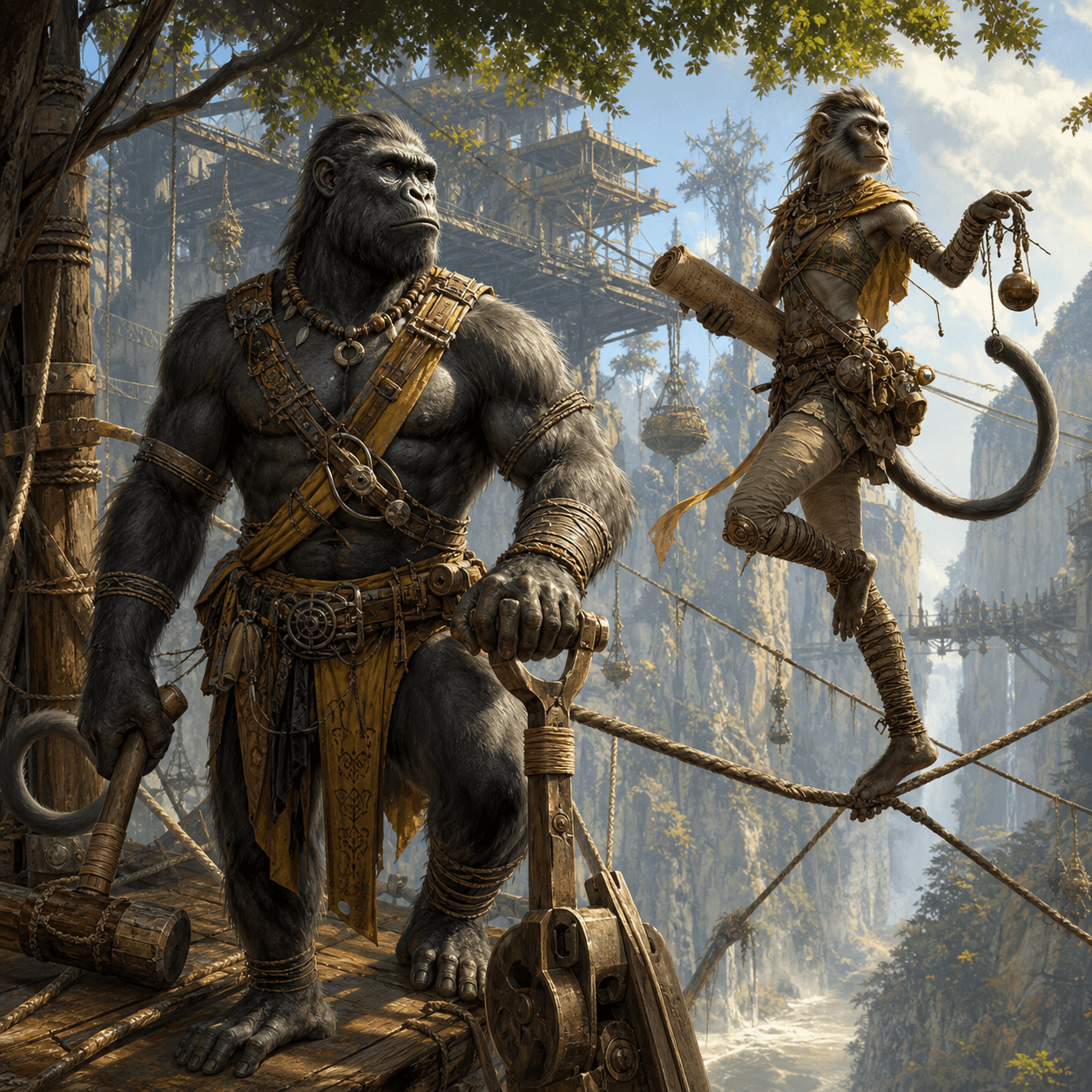
Land Animal-Folk
Monkey Folk
Chiaegit
Background Questions
1. Which canopy, mangrove, or cliffside shaped your earliest leaps?
2. What acrobatic feat first gave you pride or trouble?
3. Which troupe or Ring-Leader taught you the stories you still carry?
4. Whose trust or betrayal drove you to leave your home?
5. Which Chiaegit lineage are you, and how much did your upbringing follow the role others expected from it?
Lore & Background
The Chiaegit are the Monkey Folk of the Aldaethu.
They include a broad range of simian peoples, from small branch-climbing monkeys to medium apes and massive mountain or gorilla-like lineages.
Their culture is built around movement, memory, observation, craft, and adaptation.
The current ancestry text establishes one of their defining ideas very clearly:
Chiaegit live by movement and memory. Their troupes encode history in highline dances and echo-calls, and they treat bridges as sacred work.
That gives us the core of the people.
They are not simply "inventors."
They remember through movement.
They build connections through movement.
They study behavior through movement.
And they are very good at seeing patterns other people miss.
The Chiaegit and the Grand Design
The wider cultural profile establishes Monkey Folk as the Science & Strategy Pillar of the Aldaethu.
They are described as thinkers, tinkerers, planners, advisors, scribes, and problem-solvers who staff observatories, planning halls, and experimental workshops. Their philosophy holds that knowledge is sacred but dangerous when separated from empathy.
That fits very cleanly with the Grand Design.
The Chiaegit believe the Celestial Dragon gave them:
dexterity
curiosity
adaptability
pattern recognition
the ability to move through complicated spaces
the urge to examine how things fit together
Their purpose is not simply to create new things.
It is to understand systems and improve how the other parts of the Grand Design work together.
That includes:
engineering
strategy
observation
planning
logistics
behavior
architecture
communication
Their role is often expressed as:
See the pattern before it becomes the problem.
Chiaegit Lineages
The current ancestry document already distinguishes three broad body traditions.
Small Monkeys
Small Chiaegit are often associated with:
scouting
quick hands
canopy movement
messenger work
detailed repair
observation
Their small size and dexterity allow them to move through places larger Chiaegit cannot.
Medium Apes
Medium apes tend toward:
climbing
building
troupe leadership
physical problem-solving
guarding elevated communities
teaching
Their combination of strength and dexterity makes them versatile.
Large Apes
The largest Chiaegit are often associated with:
ridge guarding
heavy construction
hauling
bridge support work
difficult rescue
moving large materials
The ancestry text explicitly describes the largest as ridge wardens capable of hauling what others cannot.
These are cultural tendencies, not castes.
A small Monkey Folk can become a structural engineer.
A large ape can become a scholar.
The Grand Design provides purpose at the people level, not a compulsory occupation for every individual.
Movement and Memory
One of the strongest Chiaegit traditions is the preservation of history through highline dance and echo-call.
This is already canon and should remain central.
A Chiaegit historical performance may encode:
migrations
alliances
disasters
battles
bridge construction
trade agreements
family histories
warnings
important deaths
The movement itself carries meaning.
A specific turn, leap, hanging posture, or route across a highline can correspond to part of the remembered event.
Echo-calls add another layer.
The audience does not simply hear history.
They watch it move.
Troupes
The existing ancestry text explicitly references troupes and a Ring-Leader.
So those should remain the safest core social terms.
A troupe can function as:
an extended family
a performance group
a work crew
a traveling household
a bridge crew
a teaching community
Different troupes likely specialize differently, but we do not need to invent rigid universal categories.
Ring-Leaders
A Ring-Leader is already established as someone involved in teaching or troupe hierarchy.
We should keep the title without overdefining it until the canon says more.
At minimum, Ring-Leaders appear to carry responsibility for:
teaching
coordination
troupe memory
performance tradition
group organization
Science and Strategy
The expanded Aldaethu profile places Chiaegit strongly in the Science & Strategy Pillar.
Their established roles include:
observatories
planning halls
experimental workshops
advising Lionfolk
assisting Elephantfolk
designing for Hippofolk engineers
logistics planning
siege engineering
battlefield signaling
This should be treated as a later development of the same cultural instincts already visible in their bridge work and performance traditions.
The Chiaegit study systems.
That includes mechanical systems, but also social ones.
A Prime Council Chiaegit, Elder Git-Ka-Rul, is explicitly described as a behavioral scholar who studies hypocrisy, political behavior, and the difference between what leaders say and what they physically do.
That gives us a useful canon extension:
Chiaegit scholarship is not limited to machines.
It can include:
behavior
politics
social systems
trade
strategy
group dynamics
Knowledge and Consequence
The cultural profile gives us a strong Chiaegit philosophical principle:
Knowledge is sacred but dangerous when divorced from empathy.
That should probably be their defining philosophical line.
The question is not merely:
"Can this be done?"
It is also:
"What happens if we do it?"
This explains why Monkey Folk can work closely with both Elephantfolk and Goatfolk.
Elephantfolk ask whether something is lawful.
Goatfolk ask whether something is right.
Chiaegit ask what is likely to happen next.
Settlements
The current ancestry document establishes three principal Chiaegit cities:
Vine-Spire
Joggle-Bay
Canopy-Market
Their broader homeland is also explicit:
Metsä canopy towns
Suo mangrove lattices
Ranta cliff-villages
We should not invent detailed city governments or specialties unless another source establishes them.
Architecture
What is canon-safe from their existing culture:
Chiaegit communities favor vertical construction involving:
canopy bridges
ropes
platforms
cliff paths
vines
elevated routes
The cultural profile also says their neighborhoods are dense and vertical, filled with ropes, platforms, and improvised devices.
That is enough to give them a visually distinct built environment without inventing unnecessary named institutions.
Bridges as Sacred Work
This is one of the most interesting confirmed Chiaegit ideas.
The ancestry text explicitly says they treat bridges as sacred work.
That fits perfectly with the Aldaethu Grand Design.
A bridge is a physical expression of interdependence.
It connects:
one tree to another
one cliff to another
one district to another
one people to another
This also makes their relationship with Hippofolk and Chiaenol particularly important.
Chiaegit can design or rig elevated connections.
Chiaenol ensure the ground supports them.
Hippofolk integrate them into larger infrastructure systems.
Economy and Trade
The ancestry document gives us exact exports and imports, so we should keep them concise.
Exports
Bridge riggers
Spice lacquerers
Highline couriers
Imports
Metal fasteners
Rope
Parchment
This is already enough to tell us a lot.
Their bridge-rigging work fits their architecture.
Highline courier work fits their movement culture.
Spice lacquer suggests a craft tradition we should preserve without inventing the chemistry unless another source explains it.
Diet
Established diet:
fruit
insects
nuts
fish
larger apes often favor root stews and smoked meats
No need to elaborate beyond that yet.
Warfare
The Aldaethu cultural profile establishes that Monkey Folk are not primarily frontline fighters.
Their military roles include:
logistics planning
siege engineering
battlefield signaling
sharpshooting
skirmishing
That works well with their ancestry mechanics.
Their mobility makes them excellent in:
elevated terrain
canopy warfare
cliffs
rigging
urban vertical spaces
The existing Sky-Swing Strike reinforces exactly that.
Relationships with Other Aldaethu
Elephantfolk
A confirmed close relationship.
Monkey Folk help index and organize Elephantfolk archives, while Elephantfolk provide stable records for Chiaegit analysis.
Goatfolk
The profile explicitly establishes good-natured debate between Monkey Folk scholars and Goatfolk mystics.
That makes sense:
Chiaegit look for patterns and consequences.
Goatfolk interpret meaning and mystery.
Hippofolk
Another explicit partnership.
Hippofolk engineers frequently rely upon Chiaegit designs.
Lionfolk / Chiaegen
Chiaegit serve as advisors and problem-solvers for leadership councils.
The older Lionfolk profile specifically says Lionfolk rely on Monkey Folk to foresee consequences.
Bearfolk
Monkey Folk tacticians serve in Bearfolk war councils.
Ratfolk
Chiaegit planning and Ratfolk logistics naturally overlap, and the existing material explicitly connects them operationally.
External Relationships
The current ancestry snapshot establishes:
Allies
Owlin - mapping
Lizard Folk - levee engineering
Dragonfly Folk - river runs
Enemies
Snake Folk poachers
Shark raiders at gorge mouths
We should preserve those exactly rather than invent additional political relationships.
History
The ancestry document gives us one clear historical point:
Their skywork rebuilt the Eastgate bridge-lines after the quake; Vine Contracts still govern canopy trade.
That tells us two important canon facts.
Eastgate Bridge-Lines
Chiaegit engineering played a major role in rebuilding elevated transport after a significant earthquake.
That achievement likely helped cement their reputation as bridge riggers and infrastructure specialists.
Vine Contracts
The Vine Contracts remain active legal or trade agreements governing canopy commerce.
We should not invent their exact clauses yet, but they clearly matter enough to still regulate trade.
That also explains why Elephantfolk law and Chiaegit practical trade systems intersect.
Current Tensions
Keeping this strictly close to established canon:
Innovation and Consequence
Their own philosophy warns that knowledge without empathy is dangerous.
The more Chiaegit become responsible for strategy and engineering, the more important that warning becomes.
Canopy Trade
The Vine Contracts still govern canopy trade.
That creates natural tension whenever:
routes shift
new settlements appear
bridges fail
old contracts no longer reflect reality
Infrastructure Dependence
A large amount of canopy and cliff movement depends on Chiaegit bridge work.
If those routes fail, communities can become isolated quickly.
Strategy and Responsibility
Chiaegit planners advise others who actually carry out the plans.
That naturally raises the question:
How responsible is the strategist for the consequences of a plan they did not personally execute?
That tension follows directly from their Science & Strategy role and their existing philosophy rather than requiring new lore.
Chiaegit Adventurers
Bridge Rigger. Traveling to repair or rebuild a damaged route.
Highline Courier. Carrying something across terrain ordinary roads cannot reach.
Story-Keeper. Seeking a lost dance, echo-call, or historical sequence.
Vine Contract Dispute. Trying to settle or investigate a canopy trade conflict.
Behavioral Scholar. Studying another culture, political system, or crisis.
Engineer. Testing a design under real-world conditions.
Eastgate Legacy. Investigating an old bridge-line, earthquake ruin, or forgotten reconstruction project.
Grand Design Pilgrim. Trying to understand why curiosity and consequence were chosen as the Chiaegit role.
Culture Snapshot
Name. Chiaegit
Common Name. Monkey Folk
Aldaethu Classification. Land Animal-Folk
Homeland: Metsä canopy towns, Suo mangrove lattices, Ranta cliff-villages
Cities: Vine-Spire, Joggle-Bay, Canopy-Market
Exports: Bridge riggers, spice lacquerers, highline couriers
Imports: Metal fasteners, rope, parchment
Diet: Fruit, insects, nuts, fish; larger apes favor root stews and smoked meats
Allies: Owlin for mapping, Lizard Folk for levee engineering, Dragonfly Folk for river runs
Enemies: Snake Folk poachers; Shark raiders at gorge mouths
History: Their skywork rebuilt the Eastgate bridge-lines after the quake; the Vine Contracts still govern canopy trade.
Aldaethu Role. Science, strategy, planning, engineering, observation, and problem-solving
Cultural Principle. Knowledge is sacred, but dangerous when divorced from empathy.
Checking your codex…
From the Reth Ancestries (Daggerheart) compendium. Ancestry mechanics unlock when you collect this lineage in Hoard and link your account.