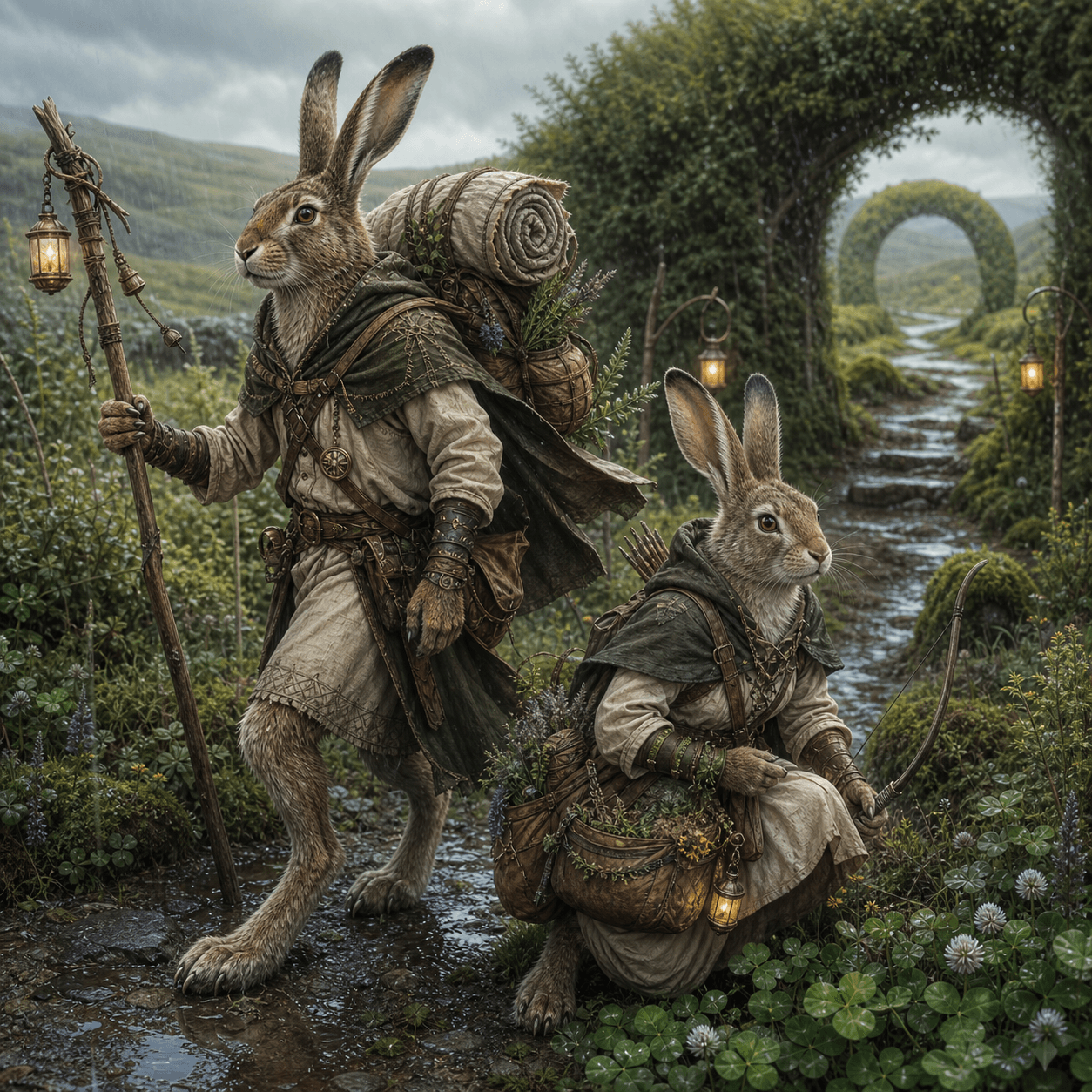
Land Animal-Folk
Rabbit Folk
Chiaegin
Background Questions
1. What warren or fen raised you?
2. What message were you most proud to deliver?
3. What fear did you outrun for the first time?
4. Who relies on your speed even now?
Lore & Background
The Rabbitfolk are the Aldaethu people most strongly associated with agriculture, crop planning, seed preservation, village food security, and seasonal preparation.
They form the core of the Agriculture Pillar.
Their existing cultural profile describes them as the primary cultivators and field-managers of Aldaethu society. Their quick senses and communal mindset make them especially effective at coordinating the seasonal work required to keep large populations fed.
Rabbitfolk do not view farming as simple manual labor.
It is planning.
A seed planted today is a decision about food months from now.
A field left fallow may look unused, but it may protect the harvest three seasons later.
A full granary is not proof of wealth if all of it must be eaten before the next planting.
This long view shapes much of Rabbitfolk culture.
Their place within the Grand Design is continuity through preparation.
You feed the future before it arrives.
The Rabbitfolk and the Grand Design
Rabbitfolk believe the Celestial Dragon created each Aldaethu people with a purpose.
Their own purpose is understood through:
cultivation
preparation
renewal
population care
preservation
seasonal foresight
They do not merely produce food.
They make sure there will still be food later.
That distinction is central.
Cowfolk may prepare and serve meals.
Ratfolk move supplies.
Horsefolk carry them between settlements.
Chiaenol maintain the ground.
Hippofolk manage water and infrastructure.
Rabbitfolk decide what must be grown, how much can be safely consumed, and what must remain untouched for the next cycle.
Agriculture Pillar
The Rabbitfolk carry the core agricultural responsibilities of the Aldaethu.
Their established roles include:
crop rotation
seed stores
village food security
smaller livestock
planting schedules
seasonal work coordination
They share the broader Pillar closely with the Chiaenol.
The division is fairly clear in the surviving lore:
Rabbitfolk. crops, seed, seasonal planning, food needs.
Chiaenol. soil stability, terraces, drainage, defensive earthworks.
Neither part works well alone.
Burrow-Villages
Rabbitfolk communities are traditionally built as burrow-villages with both above- and below-ground spaces.
That is important to keep.
The surface areas support:
farming
livestock
gathering
trade
planting festivals
The underground spaces provide:
homes
storage
protection from heat or cold
secure seed rooms
shelter during storms
Their clothing is practical and often reinforced at knees and elbows because of constant work close to the ground.
Upbringing
Rabbitfolk kits grow up surrounded by seasonal work.
Their existing profile explicitly says they learn to:
read the weather
track population needs
coordinate planting festivals
That should remain the core of their upbringing.
Children gradually learn that food planning is communal mathematics.
You must know:
how many people need feeding
how much seed must remain
which field needs rest
what weather may be coming
what happens if a crop fails
what livestock can safely be supported
Their education is practical because mistakes do not remain theoretical for long.
Shared Childcare
The existing profile specifically establishes shared childcare and communal decision-making as important Rabbitfolk social values.
That fits naturally with burrow-village life.
Children belong to families, but the community shares responsibility for keeping them safe, fed, and educated.
This also means Rabbitfolk elders tend to think in generations rather than individual households.
A planting decision is not judged only by whether one family benefits.
It is judged by what happens to the whole burrow.
Elders and Agricultural Decisions
The profile gives us a very specific canon relationship:
Rabbitfolk elders guide planting choices after consulting:
Elephantfolk records
Monkeyfolk forecasts
That is a really strong expression of the Grand Design.
Rabbitfolk do not pretend agriculture exists separately from the other Pillars.
Elephantfolk contribute historical records:
previous droughts
land agreements
old harvest patterns
Monkeyfolk contribute:
forecasting
planning
analysis
The Rabbitfolk apply that information to the living fields.
Planting Festivals
Planting and harvest festivals are already established as important local traditions.
Their religion and philosophy center strongly around:
seasons
generations
communal resilience
We do not need to create universal named festivals yet.
Different burrow-villages can have their own traditions.
That actually fits their localized agricultural culture better.
Religion: and Philosophy
Rabbitfolk spirituality centers on cycles.
The existing profile explicitly names:
seasons
generations
communal resilience
Many Rabbitfolk attend Goatfolk rites, but they maintain their own local agricultural festivals.
Their Grand Design interpretation is therefore practical.
Everything turns.
Planting becomes harvest.
Harvest becomes seed.
Abundance becomes scarcity.
Scarcity eventually becomes growth again if enough was preserved.
Their deeper fear is not death in battle.
It is failure of the cycle.
Fear of Famine
The existing Rabbitfolk profile gives us one of their strongest cultural lines:
They fear famine more than battle and work tirelessly to prevent it.
That should define them.
For a Bearfolk, an approaching army is an obvious danger.
For a Rabbitfolk, the empty field after the army leaves may be worse.
War ends.
A destroyed seed supply can affect years.
This makes them cautious about:
requisitions
scorched land
wasted food
damaged irrigation
overhunting
livestock loss
emergency consumption of seed grain
Economy and Trade
The established culture supports:
crops
seed stock
food production
smaller livestock
meat
fur
agricultural trade
We should keep that straightforward.
Their major economic role is not luxury production.
It is ensuring the Aldaethu food system functions.
They trade especially frequently with Cowfolk and Horsefolk.
Cowfolk
Cowfolk turn agricultural production into:
meals
hospitality
markets
public distribution
Horsefolk
Horsefolk connect rural production to distant settlements and relay routes.
Relationship with Chiaenol
This is one of the Rabbitfolk's most important relationships.
The profile specifically states that Rabbitfolk rely on Armadillofolk to stabilize terraced fields in difficult terrain.
Rabbitfolk understand:
what needs to be planted
when
and how much
Chiaenol understand:
whether the slope will hold
how water will move
whether erosion will destroy the field
Arguments between the two are likely practical rather than cultural.
The Rabbitfolk may say:
"We need that field this season."
The Chiaenol may answer:
"If you plant it now, you may not have a field next season."
Relationship with Bearfolk
The Rabbitfolk profile explicitly states that they feed Bearfolk garrisons.
That relationship matters greatly during war.
A garrison represents:
protection
mouths to feed
demand on local stores
Rabbitfolk may respect Bearfolk protection while still resisting military requisitions that threaten the next harvest.
Relationship with Elephantfolk
Rabbitfolk rely on Elephantfolk in matters of:
property
land use
records
long-term agreements
That relationship is also explicitly established in the Elephantfolk profile.
Appearance
The established appearance is simple and strong:
Rabbitfolk are Small to Medium humanoids with:
long ears
soft fur
powerful legs
Their clothing is practical and commonly reinforced at the knees and elbows.
Different Rabbitfolk lineages may vary in:
ear length
coat thickness
coloration
body size
leg build
But I would avoid assigning rigid cultural roles to coat or breed types unless the ancestry master already does so.
Warfare
Rabbitfolk are not primarily military.
The existing profile says they may serve as:
scouts
runners
during emergencies, but generally avoid direct fighting.
Their primary contribution to war is feeding everyone else.
That is important enough on its own.
Wartime Agriculture
Rabbitfolk are likely most concerned with:
keeping seed safe
preventing livestock loss
maintaining food stores
moving harvests away from danger
feeding refugees
supporting garrisons
We do not need to turn them into an agricultural warrior culture.
Their role is already strong.
Current Tensions
These are the safest ones derived directly from established canon.
Food Reserves
During the Long Shadow, Rabbitfolk face constant pressure over how much food can safely leave local communities.
The Confederation needs food.
Local burrows also need enough to survive until the next harvest.
Seed Versus Hunger
Eating seed grain solves immediate hunger.
It creates future hunger.
That is exactly the kind of decision Rabbitfolk would take very seriously.
Military Requisition
Bearfolk garrisons need supply.
Rabbitfolk must determine when supplying defense begins threatening agricultural survival.
Changing Weather
Because Rabbitfolk rely heavily on weather-reading and seasonal planning, unusual or unstable seasons directly undermine their traditional expertise.
Population Needs
The established culture already emphasizes tracking population needs.
Refugee movement and displaced communities make that increasingly difficult.
Rabbitfolk Adventurers
Seedkeeper. Carrying rare or vital seed stock to a new settlement.
Crop Scout. Searching for land capable of supporting a displaced community.
Weather Seeker. Investigating why familiar seasonal patterns have changed.
Failed Harvest. Leaving after famine or crop failure devastated home.
Food Convoy. Protecting supplies traveling to a region in need.
Land Dispute. Seeking evidence or arbitration concerning contested agricultural territory.
Agriculture Pillar Envoy. Traveling to understand food conditions beyond their own region.
Grand Design Pilgrim. Trying to understand why their people were given responsibility for feeding others.
Culture Snapshot
Name. Rabbitfolk
Common Name. Rabbit Folk
Aldaethu Classification. Land Animal-Folk
Role. Agriculture Pillar; cultivators, field-managers, seed keepers, and food planners
Homeland: Agricultural Aldaethu settlements, burrow-villages, grasslands, valleys, and terraced farming regions
Cities: No specific principal Rabbitfolk cities are established in the current cultural source
Exports: Crops, seed stock, smaller livestock, foodstuffs, agricultural knowledge
Imports: Tools, metalwork, infrastructure materials, transported goods
Diet: Primarily agricultural foods produced within local regions; exact regional cuisine is not established in this source
Allies: Cowfolk, Horsefolk, Chiaenol, Bearfolk, Elephantfolk, Monkeyfolk
Enemies: No specific racial enemy is established in the current cultural source
History: Rabbitfolk became the core cultivators of Aldaethu society, organizing crop rotations, seed stores, and village-scale food security. Their burrow communities developed around communal planning, weather-reading, and the preservation of enough food and seed to survive future scarcity.
Core Values. Cooperation, foresight, communal resilience, preparation, and quiet courage.
Checking your codex…
From the Reth Ancestries (Daggerheart) compendium. Ancestry mechanics unlock when you collect this lineage in Hoard and link your account.