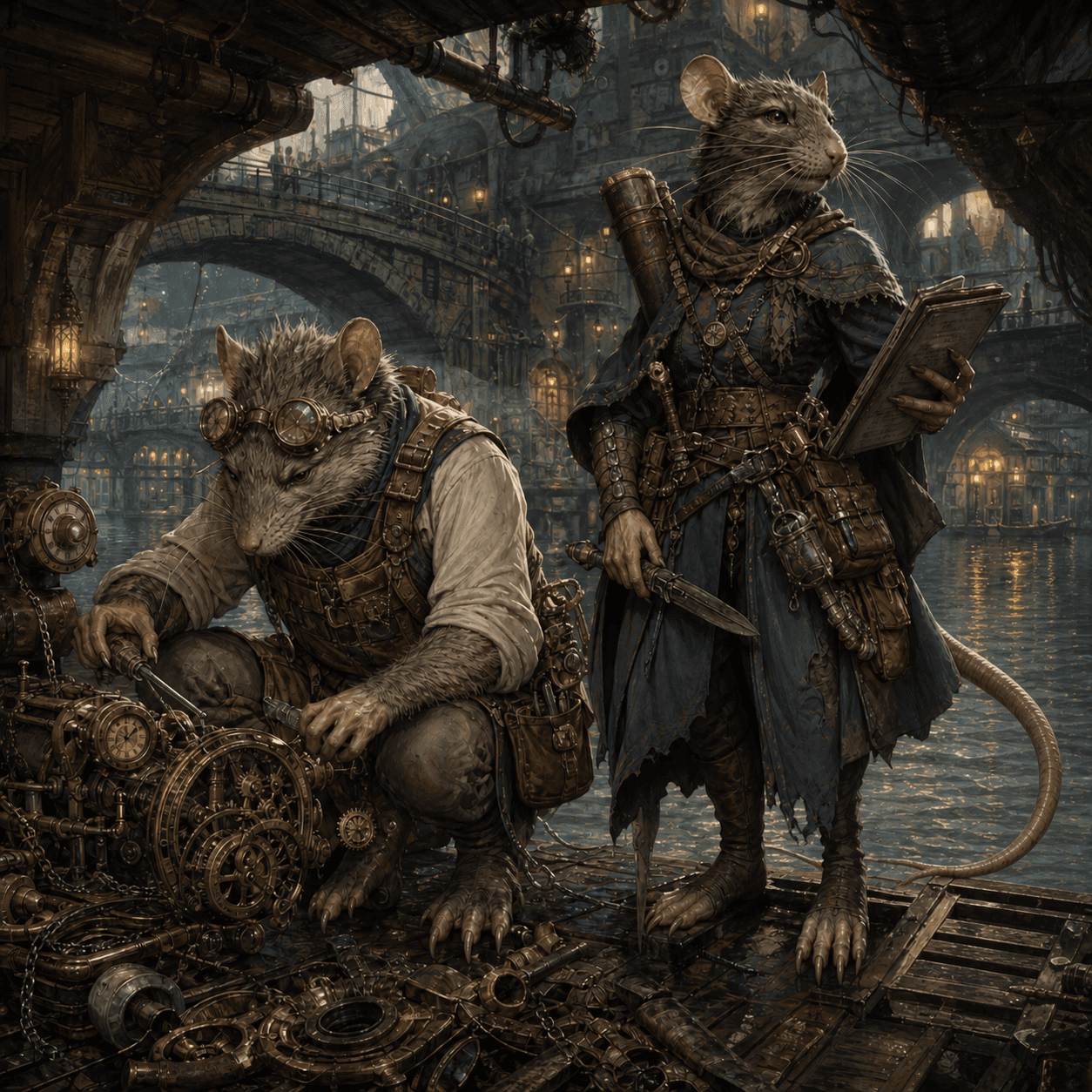
Land Animal-Folk
Rat Folk
Chiaegat
Background Questions
1. Which tunnel district or under-quay was your first home?
2. What broken clockwork device did you fix as a child?
3. Who taught you the rules of favors and debts?
4. What city authority have you angered - or impressed?
Lore & Background
The Ratfolk are the Aldaethu people most closely associated with logistics, storage, distribution, under-streets, salvage, and the movement of essential goods.
They keep civilization supplied.
A granary may be full, but that means little if the grain cannot reach the hungry.
A warehouse may hold medicine, but it is useless if no one knows where it was stored.
A bridge may remain open, but the city still fails if carts are sent down the wrong road.
A Bearfolk garrison may defend the border, but it cannot stand without regular supplies.
The Ratfolk understand that collapse often begins not with total absence, but with misdirection, delay, waste, duplication, theft, and silence.
Their work is rarely celebrated.
People notice a supply system only when it fails.
Ratfolk culture grew around the belief that every object, person, message, and route belongs to a larger web. The purpose of logistics is not simply to accumulate goods.
It is to keep the web moving.
Their place in the Grand Design is commonly described as flow without waste.
What is needed must reach where it is needed, before need becomes disaster.
The Ratfolk and the Grand Design
Ratfolk tradition teaches that the Celestial Dragon gave their people sharp senses, quick hands, flexible bodies, and minds suited to paths, quantities, and hidden connections.
Their purpose was to ensure that the gifts of the other Aldaethu peoples did not remain trapped at their source.
Rabbitfolk grow food.
Cowfolk prepare and distribute meals.
Monkeyfolk design.
Chiaenol and Hippofolk build.
Horsefolk carry messages over long distances.
The Ratfolk coordinate what happens between those visible stages.
They remember:
which storehouse still has grain
which tunnel is blocked
which road has become unsafe
which district has received too much
which district has received nothing
which cart failed to arrive
which official signed the release
which family has quietly stopped appearing at the public table
Scarcity Is Often a Route Problem
Ratfolk teachings distinguish between true scarcity and failed distribution.
A city may believe there is no food while warehouses remain full behind a closed road.
A village may lack medicine because a clerk misclassified the shipment.
A garrison may hoard supplies because no one trusts the next delivery.
A market may appear empty because merchants are withholding goods until prices rise.
Ratfolk are trained to ask:
Does the resource exist?
Where is it?
Who controls access?
What route should it follow?
What interrupted that route?
Who benefits from the interruption?
Waste Is Broken Purpose
Ratfolk consider waste morally serious.
Spoiled grain, abandoned tools, unused cloth, discarded timber, and duplicated labor all represent effort that failed to complete its purpose.
This does not mean every object must be preserved forever.
It means disposal should be deliberate, recorded, and useful when possible.
Hidden Does Not Mean Dishonest
Ratfolk culture makes extensive use of hidden stores, concealed passages, coded inventories, and discreet couriers.
They distinguish secrecy used for protection from secrecy used for exploitation.
A refuge tunnel hidden from raiders serves the Grand Design.
A hidden warehouse used to manufacture famine rejects it.
Appearance
Ratfolk are Small to Medium humanoids with rodent-like features, quick movements, dexterous hands, and long tails.
Their appearances vary widely between lineages and regions.
Common traits include:
grey, brown, white, black, tan, reddish, or patterned fur
narrow or rounded muzzles
prominent whiskers
bright dark eyes
rounded or pointed ears
long, flexible tails
compact builds
quick, precise hand movements
Some Ratfolk possess nearly furless tails and ears, while others are heavily furred.
Their whiskers are highly sensitive to airflow and narrow spaces. Many Ratfolk instinctively pause at a tunnel entrance to feel whether air is moving beyond it.
Tail Markings
Ratfolk tails are often marked with:
route rings
family dyes
warehouse bands
courier knots
mourning wraps
guild seals
coded measurements
A Ratfolk may wrap a section of tail to indicate temporary responsibility for a public store or shipment.
Removing another Ratfolk's route band without permission is a serious insult.
Clothing and Equipment
Ratfolk prefer layered, practical clothing with many secured pockets.
Common items include:
compact ledgers
chalk
string
sealing wax
inventory tags
measuring spoons
foldable bags
hidden pouches
route maps
small repair tools
collapsible lanterns
coded tokens
light climbing gear
Their clothing is designed so that important tools remain accessible even while crawling, climbing, or squeezing through narrow spaces.
Social Structure
Ratfolk organize through warrens, Ledger Circles, warehouse guilds, route families, and under-street neighborhoods.
A warren may be a family household, an entire tunnel district, or a professional community connected by shared stores and routes.
Ratfolk households often include large extended families, apprentices, adopted children, elderly relatives, and unrelated workers who have become permanent members of the warren.
The Warren
A warren is both a place and a social obligation.
Members share responsibility for:
food stores
routes
ventilation
childcare
sanitation
emergency exits
tool maintenance
public reputation
care of injured workers
protection of hidden refuges
Warrens may compete fiercely in trade while still cooperating during crisis.
Route Families
Some Ratfolk live in mobile route families connected to caravans, warehouses, ports, and public markets.
Their identity is tied less to one home and more to a chain of trusted places.
A route family may know every safe cellar, loading yard, side gate, ferry, and rest hall between two cities.
Cache-Kin
Ratfolk recognize a special relationship called Cache-Kin.
Those who share responsibility for a hidden emergency store become bound by mutual duty.
Cache-Kin may come from different lineages and communities.
Revealing the cache for personal profit is treated as betrayal of everyone who depends upon it.
Upbringing
Young Ratfolk learn navigation and inventory through play.
Common childhood games include:
route races
hidden parcel relays
warehouse counting
scent trails
memory corridors
sorting challenges
coded message exchanges
finding alternate exits
identifying what is missing from a shelf
Children are taught that speed without accuracy creates more work for everyone.
A parcel delivered quickly to the wrong place has not been delivered.
The First Parcel
The First Parcel is a common coming-of-age rite.
A young Ratfolk is entrusted with a small but meaningful object and given a route with several required stops.
They must:
protect the parcel
confirm every handoff
avoid unauthorized shortcuts
return with proof of delivery
report any change in the route
The parcel is often ordinary.
The test concerns reliability, not value.
The Empty Shelf
During training, a mentor removes one object from a stocked shelf.
The apprentice must identify what is missing, determine who would notice first, and explain what consequences the absence might cause.
The lesson is that logistics is not counting objects.
It is understanding dependence.
The Three Routes
Before receiving full route responsibility, a young Ratfolk must learn three ways to reach an important destination:
the fastest route
the safest route
the route used when neither of the others remains available
Government
Ledger Circles
Warrens are commonly governed by Ledger Circles.
A Ledger Circle includes respected:
storekeepers
route coordinators
warehouse workers
quartermasters
auditors
tunnel guides
salvage leaders
community elders
Their responsibilities include:
maintaining public inventories
assigning route labor
resolving storage disputes
auditing emergency stores
coordinating with other Pillars
investigating loss and spoilage
protecting confidential refuge information
Double-Ledger Audits
Ratfolk distrust any system controlled by one record keeper.
Important public stores are tracked through independent records maintained by separate teams.
The ledgers are compared regularly.
Differences must be explained.
This system prevents one official from quietly rewriting the truth.
Route Speakers
A Route Speaker represents the people who maintain a specific supply corridor.
They coordinate with:
Horsefolk couriers
Hippofolk port authorities
Chiaenol road crews
Cowfolk markets
Rabbitfolk growers
Bearfolk guards
Elephantfolk legal witnesses
Route Speakers do not own the route.
They speak for those responsible for keeping it functional.
The Logistics Responsibility
Ratfolk do not always hold a formal Great Pillar alone, but their logistics responsibility touches nearly every Pillar.
Their delegates advise the Pillar Conclave on:
reserves
transport capacity
bottlenecks
evacuation routes
emergency distribution
warehouse security
wartime supply
urban flow
A Conclave decision that ignores Ratfolk logistics is often impossible to carry out.
Settlements and Architecture
Ratfolk settlements favor density, connectivity, redundancy, and efficient use of space.
They often exist beneath, behind, within, or alongside larger cities.
Common features include:
narrow connected passages
compact homes
layered storerooms
ventilation shafts
hidden emergency exits
coded junction marks
service tunnels
shared kitchens
salvage yards
repair rooms
dry granaries
raised shelves
flood doors
communal wash chambers
message tubes
roof access
concealed refuge rooms
A well-built warren should never depend upon one route.
If a single collapse, fire, flood, or locked gate can trap the entire community, the design is considered unacceptable.
Ledger-Warren
Ledger-Warren is the principal Ratfolk center of public inventory, auditing, and distribution law.
It began as a network of storehouses beneath a major market district and gradually expanded into a city beneath the city.
Ledger-Warren is known for:
vast public records
bonded warehouses
emergency food stores
independent audit guilds
route arbitration
anti-corruption investigations
coded shelf systems
inventory schools
Its central hall contains the Balance Ledger, a public record comparing what the Confederation claims to possess with what has actually been counted.
Underthread
Underthread is an extensive under-street settlement beneath one of the busiest trade corridors in Aldaethu territory.
Its tunnels connect:
markets
docks
caravansaries
workshops
public kitchens
granaries
council: buildings
emergency shelters
Ratfolk guides can move goods across the district without blocking surface streets.
Underthread is also known for hidden refugee routes and politically sensitive archives.
Quickstore
Quickstore is a major distribution city built around speed of transfer.
Goods arriving by road, canal, caravan, and river are sorted, relabeled, repaired, repacked, and sent onward.
The city is famous for:
modular warehouses
rapid-loading platforms
standardized containers
public weighing stations
salvage markets
food preservation
emergency caravan preparation
Quickstore's efficiency has also made it a center of smuggling, corruption, and political intrigue.
Economy and Trade
Ratfolk participate in nearly every Aldaethu economy because they manage the transition between production and use.
Exports
warehousing
inventory management
salvage
recycling
courier coordination
under-street transport
route mapping
emergency caches
packaging
repair
shipping administration
market logistics
evacuation planning
concealed transport
supply-chain investigation
Imports
grain
cloth
metal tools
paper
wax
rope
containers
glass
oils
preserved food
building materials
locks
writing supplies
alchemical preservatives
Salvage
Ratfolk salvage is regulated by custom.
An object may be claimed if it has been:
formally discarded
abandoned after reasonable notice
recovered from a ruined site with no living owner
surrendered to a public salvage yard
declared unusable by its holder
Taking something merely because it appears unattended is theft.
Public Stores
Ratfolk manage many Confederation emergency reserves.
These stores are rotated regularly so food does not spoil and medicine does not expire.
A reserve that looks full but contains unusable goods is considered a falsified store.
Manufactured Scarcity
Ratfolk are among the first to recognize when merchants or officials create false shortages.
They watch for:
missing shipments
delayed releases
duplicate orders
sudden warehouse closures
false contamination claims
altered ledgers
coordinated price increases
Exposing manufactured scarcity is one of the most respected forms of Ratfolk public service.
Religion: and Philosophy
Ratfolk faith centers on the Celestial Dragon, the Grand Design, and the sacred movement of necessary things.
They believe the Celestial Dragon gave their people awareness of paths, details, quantities, and hidden connections.
Their duty is to prevent the work of the other Aldaethu peoples from being lost between origin and destination.
The Living Web
Ratfolk describe civilization as a web.
Each route connects:
worker to tool
field to table
healer to medicine
message to listener
builder to material
refugee to shelter
child to family
community to community
A broken strand may appear small but can weaken the whole.
The Useful Remainder
Ratfolk teachings hold that many things dismissed as waste still contain purpose.
Broken wood can become fuel.
Cloth scraps can become bandages.
Cracked pottery can line drainage.
Bent metal can be reforged.
Spoiled grain may become compost if not contaminated.
This does not romanticize poverty.
It rejects careless waste.
Shrines of Passage
Ratfolk shrines are often small and hidden near:
warehouse doors
tunnel junctions
market gates
loading platforms
caches
message routes
Offerings include:
a single grain
a thread
a sealed note
a repaired tool
a route token
a coin saved rather than wasted
the name of someone whose supplies arrived safely
The Last Count
When a Ratfolk dies, their household performs a Last Count.
The rite identifies:
what responsibilities remain
which keys must be transferred
what debts are owed
where hidden stores exist
who depended upon the deceased
what work must continue
The purpose is not to reduce a life to possessions.
It ensures that no dependent person is forgotten during mourning.
Warfare and Defense
Ratfolk rarely serve as conventional frontline troops.
Their military strength lies in movement, supply, concealment, evacuation, and disruption.
Supply Warfare
Ratfolk understand that an army without food, water, medicine, tools, or communication will fail regardless of battlefield strength.
They specialize in:
protecting supply routes
relocating stores
identifying enemy depots
disrupting transport
replacing lost routes
concealing emergency reserves
maintaining field inventories
preventing theft
Evacuation
Ratfolk are among the best urban evacuation planners in the Confederation.
They design routes that account for:
children
elders
injured people
blocked streets
smoke
flood
crowd movement
hidden shelters
multiple fallback paths
Sabotage
Ratfolk saboteurs target systems rather than spectacle.
They may:
remove a key shipment
misdirect enemy carts
alter route markings
disable a gate
spoil harnesses
block a tunnel
duplicate false orders
expose hidden hoards
Ratfolk military law forbids sabotaging public food, water, or medicine when civilians will bear the primary harm.
Under-Street Fighters
In tunnels and dense urban terrain, Ratfolk use:
short blades
slings
compact crossbows
smoke
trip lines
collapsible barriers
hidden firing positions
rapid withdrawal routes
They rarely hold a position once the enemy fully understands it.
Relationships with Other Aldaethu
Badgerfolk
Badgerfolk maintain structural safety in the tunnels Ratfolk use.
Ratfolk manage the movement that gives those tunnels purpose.
The two peoples are close partners.
Their most common dispute concerns unauthorized modifications. Ratfolk adapt routes quickly. Badgerfolk insist every change be inspected.
Hippofolk
Hippofolk build ports, canals, bridges, and major roads.
Ratfolk coordinate the goods moving through them.
Ports such as Brass-Quay rely heavily on Ratfolk warehouse systems.
Chiaenol
Chiaenol build and maintain rural tunnels, storage sites, roads, and earthworks.
Ratfolk depend on their stability.
Chiaenol often complain that Ratfolk change passage use faster than plans can be updated.
Cowfolk
Cowfolk prepare, host, and distribute food.
Ratfolk ensure ingredients and supplies reach them.
The relationship is close because both understand that public hunger becomes unrest quickly.
Rabbitfolk
Rabbitfolk grow and store food.
Ratfolk transport it.
Their greatest tensions concern emergency reserves. Rabbitfolk fear losing seed and local stores. Ratfolk see wider regions already starving.
Horsefolk
Horsefolk dominate long-distance courier routes.
Ratfolk coordinate urban handoffs, warehouse movement, and last-stage delivery.
Horsefolk carry the word between cities.
Ratfolk ensure it reaches the right room.
Monkeyfolk
Monkeyfolk design logistics systems, counting devices, route models, and container standards.
Ratfolk test whether those systems work under real pressure.
They are skeptical of plans that assume every worker follows perfect procedure.
Elephantfolk
Elephantfolk preserve legal records and public obligations.
Ratfolk provide practical evidence of what actually moved, arrived, disappeared, or spoiled.
Together they expose false records.
Bearfolk and Pandafolk
Bearfolk protect warehouses, roads, and relief convoys.
Ratfolk supply their garrisons.
Bearfolk often underestimate how many invisible workers keep a defensive line functioning.
Chiaegen
Chiaegen scouts and investigators help trace stolen goods, map dangerous routes, and identify ambush points.
Ratfolk guides help them enter cities without drawing attention.
Caninefolk
Caninefolk guard supply routes and use scent to locate missing people or stolen goods.
Ratfolk appreciate their loyalty but sometimes find pack patrols too visible for discreet work.
Goatfolk
Goatfolk oversee rites around public charity, famine, death, and shared obligation.
Ratfolk work with them to ensure aid reaches intended communities rather than disappearing through administration.
External Relationships
Druis
Ratfolk often work closely with Halfling merchants, couriers, farmers, and hosts.
Both peoples value practical trade and community-scale distribution.
Druaezur
Gnomes create compact tools, locks, sorting devices, pumps, and counting mechanisms used in warehouses and tunnels.
Ratfolk prefer devices that can be repaired locally.
Druazer
Dwarves provide durable hardware, vault doors, shelving, carts, and structural supports.
Ratfolk respect their craftsmanship but find Dwarven storage systems overly rigid.
Aldaemir
Ratfolk trade medicines, fish, reeds, resins, and preserved foods through Aldaemir waterways.
They depend upon reliable ferry law and seasonal route knowledge.
Aldaecül
Ports connecting to the ocean require cooperation with aquatic peoples.
Ratfolk often serve as warehouse intermediaries between land and sea trade.
Human Kingdoms
Human cities offer enormous trade opportunity and equally large risk.
Ratfolk face prejudice in some regions, where they are assumed to be thieves regardless of conduct.
This has led many warrens to maintain meticulous records as protection against false accusation.
Customs and Rites
The First Parcel
A young Ratfolk's first independently completed delivery.
The Open Ledger
Public stores must be available for inspection by authorized community witnesses.
An Open Ledger day allows residents to compare official claims with actual stock.
The Shared Key
When responsibility for a warehouse, cache, or route changes hands, the key is passed in front of witnesses.
Both parties state what is present, what is missing, and what remains unresolved.
The Empty Crate
When supplies fail to arrive during crisis, an empty crate is placed publicly at the distribution point.
The crate remains until the cause is identified.
It prevents officials from pretending the shortage does not exist.
Cache-Marking
Emergency stores use coded symbols indicating:
who may access them
under what conditions
when they were last inspected
what must be replaced after use
The Recovery Table
Recovered goods are placed on a public table before being reassigned.
Claimants may identify property, while unclaimed items are directed toward repair, public use, or salvage.
Taboos
False Inventory
Recording goods that do not exist is among the gravest Ratfolk offenses.
Hidden Spoilage
Contaminated, expired, or spoiled goods must be marked immediately.
Concealing their condition endangers entire communities.
Manufactured Scarcity
Withholding essential goods to increase price or political leverage rejects the Grand Design.
Selling Refuge Routes
Hidden evacuation and sanctuary routes may not be sold or revealed for profit.
Hoarding Public Stores
Emergency reserves belong to the need they were created to answer.
Waste Without Review
Useful materials should not be discarded without determining whether they can be repaired, reused, recycled, or safely repurposed.
The False Shortcut
A route must not be represented as safe merely because it is faster.
Lost Without Report
Anyone who discovers that a parcel, message, person, or shipment has gone missing must report it promptly rather than hiding the mistake.
Current Tensions
Official Ledgers and Actual Stores
Several Confederation inventories claim reserves that Ratfolk auditors cannot physically locate.
Some believe the difference is corruption.
Others suspect years of poor recordkeeping and emergency withdrawals never entered properly.
Black Markets
Unofficial distribution networks have kept some communities alive when formal systems failed.
The same networks also move stolen goods, weapons, and restricted materials.
Ratfolk leaders disagree over whether these routes should be dismantled, regulated, or protected.
Central Control
Zal'Aldaethu officials want standardized inventory systems across the Confederation.
Many local warrens fear that central records would expose refuge sites, private routes, and emergency caches to political misuse.
Prejudice
Ratfolk are frequently blamed first when goods disappear.
This prejudice is strongest in foreign cities but exists within Aldaethu society as well.
Ratfolk advocates argue that constant suspicion allows officials to use them as convenient scapegoats.
Famine and Distribution
Some regions possess food but refuse to release it.
Others are already starving.
Ratfolk route leaders increasingly bypass local authorities to move supplies where they believe need is greatest.
This has saved lives and violated law.
The Broken Web
Road closures, failing bridges, military checkpoints, piracy, and magical disruption have fragmented old supply chains.
Ratfolk must rebuild routes faster than maps and laws can be updated.
Automation and Labor
Monkeyfolk-designed sorting devices and transport systems can move goods more efficiently.
Some Ratfolk welcome them.
Others fear that officials will use efficiency as justification to dismiss workers whose practical knowledge keeps the systems from failing.
Ratfolk Adventurers
Ratfolk leave their warrens and routes for many reasons.
Missing Shipment
A critical supply caravan vanished without explanation.
False Shortage
They discovered evidence that someone is manufacturing scarcity.
Cache-Kin Duty
A hidden refuge store has been compromised.
Ledger Exile
They exposed corruption and were blamed for the loss.
Under-Street Map
They possess part of a forgotten tunnel network beneath an important city.
Last Delivery
They carry a message or parcel entrusted by someone who died before explaining its importance.
Salvage Claim
A ruined site contains tools, goods, or records needed by their community.
Refuge Guide
They lead endangered people through routes that must remain secret.
Broken Web Pilgrimage
They travel to reconnect communities cut off by war, shadow, or disaster.
Grand Design Doubt
They question whether their people exist only to move the wealth and ambitions of more powerful Pillars.
The Empty Warehouse
A sealed public warehouse was opened and found completely empty despite years of recorded deliveries.
Culture Snapshot
Name. Ratfolk
Common Name. Rat Folk
Aldaethu Classification. Land Animal-Folk
Traditional Aldaethu Role. Logistics, storage, distribution, salvage, and under-street transport
Associated Responsibility. Logistics and Under-Streets
Creature Type. Humanoid
Typical Size. Small to Medium
Languages: Common and Aldaethu
Homeland: Zal'Aldaethu under-streets, trade cities, caravan hubs, ports, warehouse districts, and tunnel settlements
Principal Settlements:
Ledger-Warren
Underthread
Quickstore
Government: Warrens governed by Ledger Circles; Route Speakers and independent audit teams oversee shared supply systems
Society: Extended warrens, warehouse guilds, route families, Cache-Kin networks, salvage crews, and under-street neighborhoods
Buildings: Compact homes, layered warehouses, ventilation shafts, hidden exits, service tunnels, dry granaries, salvage yards, repair rooms, refuge chambers, and coded junctions
Exports:
Warehousing
Inventory management
Salvage
Recycling
Shipping administration
Hidden transport
Route mapping
Emergency caches
Packaging
Supply investigation
Evacuation planning
Imports:
Grain
Cloth
Metal tools
Paper
Wax
Rope
Containers
Oils
Preserved food
Locks
Glass
Writing supplies
Diet: Grains, roots, vegetables, cheese, preserved meats, seeds, nuts, fruit, stews, market foods, and carefully reclaimed surplus
Faith. The Celestial Dragon and the Grand Design; Ratfolk purpose understood as maintaining the flow that carries each people's work to where it is needed
Military Role. Quartermasters, urban scouts, saboteurs, evacuation guides, under-street fighters, supply protectors, and route disruptors
Allies: Badgerfolk, Hippofolk, Chiaenol, Cowfolk, Rabbitfolk, Horsefolk, Monkeyfolk, Elephantfolk, Druis, Druaezur, and trade communities dependent on reliable distribution
Common Enemies. Hoarders, corrupt warehouse officials, smugglers who endanger refuge routes, raiders, counterfeiters, supply saboteurs, and those who manufacture scarcity
Core Values:
Efficiency
Accuracy
Adaptability
Discretion
Thrift
Redundancy
Reliability
Prevention of waste
Practical mutual aid
Greatest Taboos:
Falsifying inventory
Concealing spoilage
Manufacturing scarcity
Selling refuge routes
Hoarding public stores
Hiding a lost shipment
Discarding useful goods without review
Declaring an unsafe route secure
History
Before Reth
Ratfolk tradition teaches that the Celestial Dragon gave their people quick hands, sharp senses, and the ability to perceive the hidden routes connecting need to provision.
Their purpose in the Grand Design was to ensure that no gift was wasted simply because it could not reach where it belonged.
Arrival in Reth
During the Aldaethu arrival, Ratfolk organized stores, counted supplies, marked safe routes, tracked separated families, and created the first concealed emergency caches.
Their early work prevented panic and duplication.
While others built camps and negotiated with foreign powers, Ratfolk ensured that food, tools, and medicine reached the right places.
The First Convocation
Ratfolk supported Confederation because distribution already crossed lineage boundaries.
They warned that local stores alone could not protect a scattered people during war.
Their condition was that no central authority should control all caches, inventories, or routes without independent oversight.
This principle became the foundation of the double-ledger system.
The Great Peace
Ratfolk logistics expanded with the Aldaethu road, canal, and market network.
Ledger-Warren became the center of public accounting.
Underthread linked urban districts.
Quickstore standardized the movement of goods through major trade corridors.
Ratfolk systems helped Zal'Aldaethu grow without choking on its own size.
The Second War
Ratfolk maintained refugee routes, emergency stores, hidden supply corridors, and evacuation tunnels.
Some unofficial networks created during the war never disappeared.
These later became both vital mutual-aid systems and powerful black markets.
The Long Shadow
The old web is breaking.
Roads close.
Warehouses lie.
Officials claim supplies that cannot be found.
Local leaders hoard what they have.
Ratfolk increasingly operate between law and necessity, moving goods through unofficial paths when the formal system fails.
Their central question is no longer whether they can keep the web moving.
It is whether the Confederation still agrees on who the web is meant to serve.
Checking your codex…
From the Reth Ancestries (Daggerheart) compendium. Ancestry mechanics unlock when you collect this lineage in Hoard and link your account.