Insectoids
Ant Folk
Caraezor
The Hive Builders
Background Questions
What caste were you born into - worker, soldier, or runner? Do you still serve that role, or did you attempt the Trial of Change?
What hive-song echoes in your dreams? Is it a work rhythm, a battle cadence, or a mourning dirge?
Who did you fail to protect, and how do you carry that burden? Was it an individual, a tunnel section, or something larger?
What surface-dweller first earned your trust? How did they prove themselves, and do they understand what that means in your culture?
Lore
Ant Folk live in structured hives with a true Queen at the center. This is not metaphor or honorary title - the Queen is a biological reality, the mother of the hive, and the institutional continuity that allows Ant Folk civilization to function across generations.
Unlike other insectoid peoples who organize through consensus or council, Ant Folk have clear hierarchy:
The Queen - singular, biological mother, final authority
Caste Elders - senior members of each caste who advise the Queen
Caste Members - workers, soldiers, runners performing their designated roles
Young - pre-caste larvae and pupae, raised communally until maturation
This is not tyranny. The Queen's authority is earned through demonstrated wisdom and care for the hive. A Queen who fails her people can be challenged (though this is vanishingly rare and always traumatic).
Philosophy. The Hymn as Order
Ant Folk interpret the Hymn of Nature as order, labor, and protection. Their core beliefs:
Order prevents chaos. Underground, chaos kills. A tunnel network without planning collapses. A hive without coordination starves.
Labor sustains all. Every role matters. The worker who maintains ventilation shafts is as vital as the soldier who guards the entrance.
Protection is duty. The hive is larger than any individual. You defend it with your life because your life came from it.
This is not cold or mechanical. Ant Folk care deeply about their communities. But they express that care through reliable action rather than emotional display. An Ant Folk who says "I will guard this tunnel" will die before abandoning that post.
Social Structure. The Three Castes
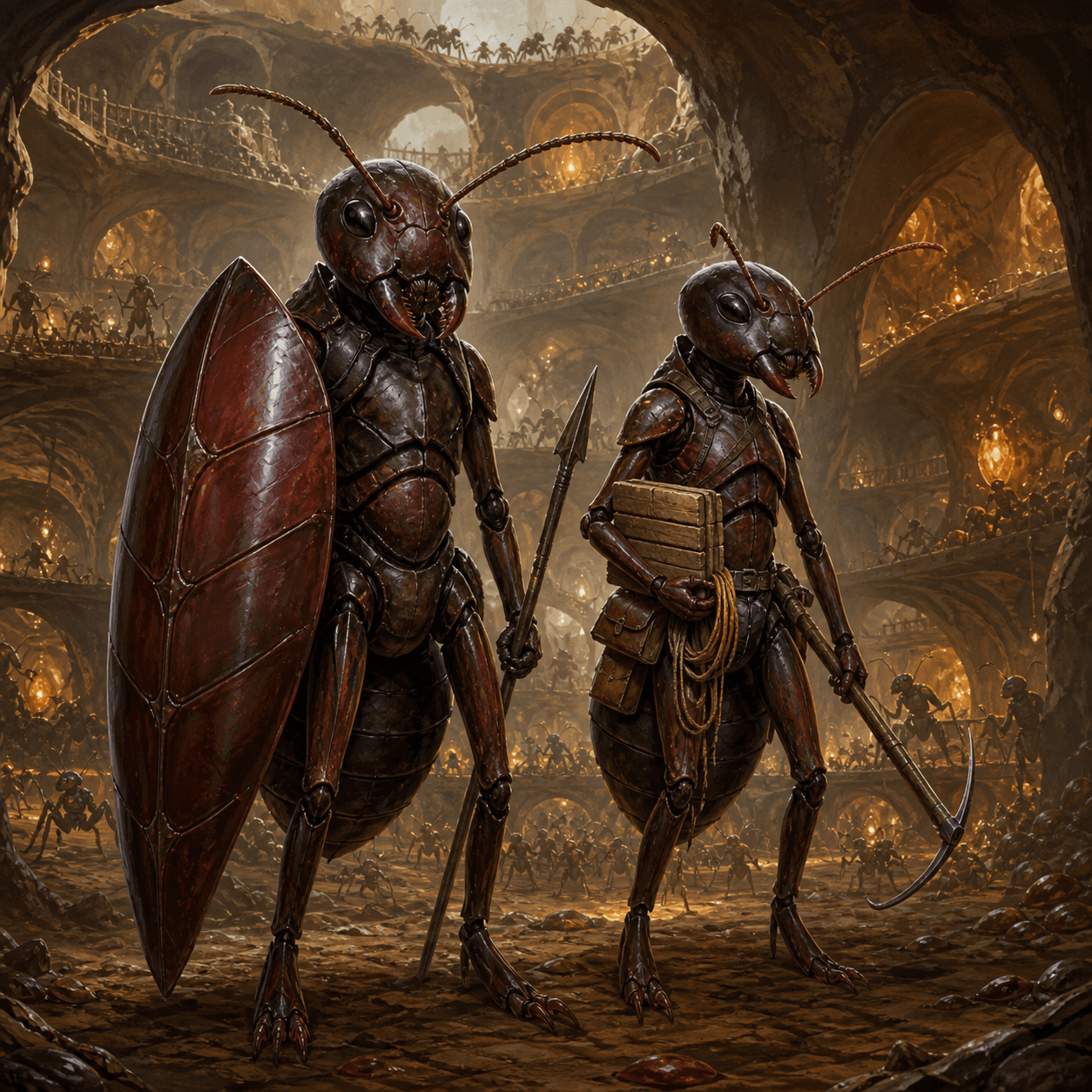
Ant Folk are divided into castes by birth - your physical development determines your role. Each caste is trained from early life for their specific function.
1. Workers (The Foundation)
Physical Traits. Stocky build, powerful mandibles for carrying and shaping, slightly smaller than soldiers.
Role:
Tunnel excavation and maintenance
Food cultivation (fungus gardens, root farms)
Nursery care and larval feeding
Granary management and resource distribution
Ventilation shaft construction
Load-bearing architecture
Philosophy. The hive stands because we hold it.
Training. Workers learn engineering principles through practice - soil composition, load distribution, air flow dynamics. The best workers can "read" stone and soil like text.
Population. 60-70% of any hive.
2. Soldiers (The Shield)
Physical Traits. Larger, heavier carapace, enlarged mandibles designed for combat, stronger but less dexterous.
Role:
Entrance defense and perimeter patrol
Tunnel chokepoint fortification
Threat response (intruders, predators, hostile forces)
Escorting surface trade expeditions
Clearing collapsed tunnels during emergencies
Philosophy. The line does not break.
Training. Soldiers drill constantly - formation fighting in narrow tunnels, coordinated defense against larger opponents, tactical use of terrain. Ant Folk soldiers excel at defensive combat but struggle in open-field battles where their formation tactics don't apply.
Population. 20-25% of any hive.
3. Runners (The Network)
Physical Traits. Lightest build, longest legs, enhanced stamina, smaller mandibles.
Role:
Surface scouting and intelligence gathering
Inter-hive communication (message carrying)
Trade negotiation with surface peoples
Food-source discovery (new roots, grains, minerals)
Emergency rescue operations (finding trapped workers)
Philosophy. The hive needs eyes beyond its walls.
Training. Runners learn navigation, surface-language negotiation, and evasion tactics. They are not frontline combatants - if a runner engages in direct combat, something has gone catastrophically wrong.
Population. 10-15% of any hive.
The Trial of Change (Caste Mobility)
Ant Folk castes are determined by biology at birth - your physical development shapes your role. However, Ant Folk society recognizes that mistakes happen, and that individual aptitude doesn't always match physical form.
The Exception. Any Ant Folk may petition the Queen to change caste through the Trial of Change.
Requirements:
Proof of Aptitude. Demonstrate genuine skill in the target caste (a worker who has been secretly training with soldiers, a soldier who has studied engineering)
Caste Elder Sponsorship. A senior member of the target caste must agree to mentor you
Hive Need. The Queen must determine that the hive benefits from your change (if there are too many soldiers and not enough workers, a soldier petitioning to become a worker will be approved more easily than the reverse)
Public Trial. You must complete a task that proves capability in front of witnesses
Success Rate. Low. Perhaps 1 in 20 attempts succeed. Most Ant Folk never petition because they are content in their birth caste - the system works for most people.
Social Consequences:
Success. You are fully accepted in your new caste, but always carry the identifier "Changed-Caste [Name]" - it's not shameful, but it's notable.
Failure. You return to your original caste with no formal penalty, but the attempt is remembered. Some view failed petitioners as ambitious. Others view them as dissatisfied.
Why This Matters. This exception proves that Ant Folk society, while hierarchical, values competence over rigid adherence to birth. It also creates story opportunities for PCs who left their hive partially because their caste didn't fit them.
Architecture. The Underground Marvels
Ant Folk cities are engineering masterpieces built entirely underground. Surface visitors see a few entrance mounds. Beneath: a three-dimensional network of chambers, tunnels, shafts, and vaults spanning miles.
Core Features:
Load-Bearing Chambers
The deepest chambers are structural - pillars of untouched stone and earth left in precise patterns to support everything above. Workers calculate load distribution instinctively. Damage to a load-bearing chamber can trigger cascading collapse across entire districts.
Ventilation Shafts
Narrow vertical tunnels that create airflow through temperature differential. Hot air rises from deep chambers (where fungus gardens generate heat), drawing fresh air down from surface entrances. Without constant maintenance, the hive suffocates.
Granary Vaults
Sealed chambers where dried food, seeds, and preserved supplies are stored. These are kept deliberately cool and dry. Each vault has a worker assigned to monitor for rot, pests, and moisture. Losing a granary vault means starvation in winter.
Nurseries
The most protected chambers, always positioned deep in the hive's center. Temperature and humidity are precisely controlled. The Queen's chambers adjoin the main nursery. Threatening a nursery is the fastest way to unite every caste in lethal response.
Chokepoints
Every tunnel network has deliberate defensive bottlenecks - narrow passages that can be held by a small number of soldiers against much larger forces. Ant Folk design their homes to be extremely defensible once you're inside. Getting in is the hard part. Getting out alive if you're unwelcome is nearly impossible.
The Three Great Hives
Deepnest
Location. Beneath the dry southern plains Specialty: Deep excavation and mineral extraction Description: The oldest and deepest hive. Deepnest's tunnels extend nearly a mile below surface, accessing mineral veins and underground aquifers others can't reach. Their workers are the finest engineers in Ant Folk society.
Current Challenge. They've encountered something at extreme depth - sealed chambers from a pre-War civilization. The Queen forbade further excavation after three workers disappeared. Some younger soldiers think they should push deeper. The Caste Elders are divided.
Formicon Hold
Location. Mountain foothills, beneath dwarven territories Specialty: Mountain trade and dwarven relations Description: Formicon Hold maintains the most extensive surface trade network. Their runners speak multiple languages and handle most Ant Folk diplomacy with dwarves, gnomes, and mountain humans. They are wealthy by Ant Folk standards but vulnerable to surface politics.
Current Challenge. A dwarven clan claims that their mining operations have "right of territory" over a section of tunnels that Formicon has used for generations. The Queen is negotiating, but some soldiers want to collapse the disputed tunnels and seal them from dwarven access permanently.
Red-Clay Burrow
Location. Eastern forests near river systems Specialty: Agriculture and fungus cultivation Description: Red-Clay Burrow produces more food than any other hive. Their fungus gardens are legendary - vast chambers filled with cultivated mushrooms, lichen, and root-crops that feed not just their own hive but are traded widely.
Current Challenge. Something is corrupting the fungus gardens. A spreading rot that resists all normal treatments. Workers suspect Varjo contamination (deep-underground corruption). The Queen has requested aid from surface druids. Some workers view this as humiliating.
Central Site: The Queen's Chamber
Not a single location (each hive has one), but the concept is universal. The Queen's Chamber serves as:
Planning core - Where long-term hive strategy is decided
Nursery protection hub - Always adjacent to larval chambers
Long-term storage - Critical supplies kept in sealed side-vaults
Dispute resolution - Where the Queen hears petitions and makes final rulings
The Queen rarely leaves this chamber complex. When she does (usually to inspect damage or address a crisis), it's a significant event. Every caste understands: if the Queen is moving, something is seriously wrong.
Economy & Trade
Exports:
Engineering services (tunnel construction, mine reinforcement, structural assessment)
Stone supports and load-bearing pillars (prefabricated architectural elements)
Caravan guards (soldier escorts for dangerous trade routes)
Fungus and cultivated roots (food exports from Red-Clay Burrow)
Imports:
Surface-grown food (grains, fruit - supplements underground diet)
Metals (iron, copper, bronze - Ant Folk don't forge, they trade)
Lumber (rare underground, needed for some construction)
Cloth (Ant Folk wear minimal clothing but value tarps and coverings)
Diet:
Grains and seeds (primary carbohydrate)
Cultivated mushrooms and fungus (primary protein, grown underground)
Roots and tubers (farmed in upper tunnel chambers with surface access)
Minerals (Ant Folk consume trace minerals for carapace health)
Delicacy. Royal Jelly - a nutrient-rich secretion produced in the nurseries, reserved for the Queen and recovering soldiers
Relations: with Other Peoples
Allies:
Beetle Folk (Caraenol). War veterans and fellow structured society. Mutual respect.
Mantids (Caraethu). Trade partners. Mantids respect Ant Folk reliability.
Dwarves. Complicated ally. Territorial disputes but also extensive trade.
Enemies:
Corrupted Varjo creatures. Deep-underground horrors that threaten tunnel integrity
Deep-Termites. Competing insectoid species that excavate recklessly and cause collapses
Surface raiders who target entrance mounds (various)
Cautious/Neutral:
Giant-kin (some). Mountain giants sometimes collapse tunnels accidentally
Dreaenul (deep underdark). Avoided when possible - their magic is unsettling
Mountain humans. Trade partners but unreliable - they don't honor long-term agreements
Language: Common, Caraezer (insectoid dialect)
Outsider Escalation: Protocol
Ant Folk are extremely defensive about tunnel security. How they respond to surface-dwellers depends on where you are:
Surface Trade Halls (Controlled Access)
Surface hall only - You're permitted in the outermost chamber, designed for outsiders
Escorted depot trade - A runner guides you to a specific trade room and waits with you
Single-chamber access - You're allowed into one additional chamber for specific business
Detention for lane breach - If you wander off approved paths, soldiers detain you immediately
Tunnel sealing / controlled collapse - If you persist or threaten the hive, Ant Folk will collapse access tunnels behind you, trapping you in sealed sections
Inside the Hive (Unauthorized)
If you're in the hive without permission:
Immediate soldier response - You're surrounded instantly
Identify yourself - If you're lost or confused, you're escorted out
Resist or threaten - Lethal force. No warning.
Approach the nursery - The entire hive converges. You do not survive.
Note. Ant Folk do not bluff. If they say "leave now or we defend the hive," they mean it absolutely.
Internal Conflicts
Caste-Change Petitioners vs. Caste Elders
The Divide. Young Ant Folk are petitioning for caste changes at higher rates than historically normal. Conservative Elders believe this destabilizes the system. Progressive voices argue that individual aptitude should be valued.
Current Tension: A worker in Deepnest with exceptional combat instincts petitioned to become a soldier. The Soldier Caste Elder sponsored her. She completed the Trial of Change successfully. Now three more workers have petitioned, citing her as proof it can be done. The Worker Caste is short-staffed. The Queen is being pressured to deny future petitions.
Expansion Tunnels vs. Stability
The Divide. Formicon Hold's Queen wants to expand tunnels northward to access better trade routes. The Caste Elders warn that rapid expansion creates structural instability. Soldiers argue that expansion means thinner defensive coverage.
Current Tension: Expansion began anyway. Two minor collapses have occurred. No deaths yet, but workers are refusing to excavate further until structural reviews are completed. The Queen insists the trade benefits outweigh the risks. Workers are starting to openly question her judgment - unheard of in Ant Folk culture.
Dependence on Surface Metals vs. Fear of Surface Wars
The Divide. Ant Folk don't forge. They trade for all metal tools and structural reinforcements. This creates dependence on surface peoples - specifically dwarves. Some Ant Folk want to develop their own metalworking. Others say going to the surface to mine ore defeats the entire purpose of living underground.
Current Tension: A dwarf-clan war has cut off metal supplies to Formicon Hold. They're running out of reinforcement materials. Some soldiers propose raiding the dwarven supply caravans. This would destroy the alliance. The Queen is desperately trying to find alternative suppliers before the soldiers act independently.
Ant Folk Adventurers. Why They Leave
Ant Folk leaving the hive is unusual and often traumatic. Common reasons:
1. The Exiled
Committed a serious crime (endangered the hive, refused orders during crisis, attacked a superior). Permanently expelled. Carries deep shame.
2. The Failed Petitioner
Attempted caste change, failed, and couldn't bear the social weight of returning to their birth role. Left voluntarily to find purpose elsewhere.
3. The Sole Survivor
Their entire hive was destroyed (collapse, war, plague). No Queen, no home. They wander seeking either a new hive to join or vengeance against what destroyed theirs.
4. The Diplomatic Runner
Sent on extended surface mission to establish trade, gather intelligence, or negotiate with distant peoples. May be gone for years.
5. The Curious Scholar
Fascinated by surface architecture, magic, or culture. Officially assigned to study and report back. Unofficially, might never return.
6. The Queen's Agent
Operating under secret orders to investigate a threat, recover something valuable, or represent the hive in matters that can't be handled openly. Other Ant Folk might not know they're on official business.
Lore & Background
Ant Folk live in structured hives with a true Queen at the center. This is not metaphor or honorary title - the Queen is a biological reality, the mother of the hive, and the institutional continuity that allows Ant Folk civilization to function across generations.
Unlike other insectoid peoples who organize through consensus or council, Ant Folk have clear hierarchy:
The Queen - singular, biological mother, final authority
Caste Elders - senior members of each caste who advise the Queen
Caste Members - workers, soldiers, runners performing their designated roles
Young - pre-caste larvae and pupae, raised communally until maturation
This is not tyranny. The Queen's authority is earned through demonstrated wisdom and care for the hive. A Queen who fails her people can be challenged (though this is vanishingly rare and always traumatic).
Philosophy. The Hymn as Order
Ant Folk interpret the Hymn of Nature as order, labor, and protection. Their core beliefs:
Order prevents chaos. Underground, chaos kills. A tunnel network without planning collapses. A hive without coordination starves.
Labor sustains all. Every role matters. The worker who maintains ventilation shafts is as vital as the soldier who guards the entrance.
Protection is duty. The hive is larger than any individual. You defend it with your life because your life came from it.
This is not cold or mechanical. Ant Folk care deeply about their communities. But they express that care through reliable action rather than emotional display. An Ant Folk who says "I will guard this tunnel" will die before abandoning that post.
Social Structure. The Three Castes
Ant Folk are divided into castes by birth - your physical development determines your role. Each caste is trained from early life for their specific function.
1. Workers (The Foundation)
Physical Traits. Stocky build, powerful mandibles for carrying and shaping, slightly smaller than soldiers.
Role:
Tunnel excavation and maintenance
Food cultivation (fungus gardens, root farms)
Nursery care and larval feeding
Granary management and resource distribution
Ventilation shaft construction
Load-bearing architecture
Philosophy. The hive stands because we hold it.
Training. Workers learn engineering principles through practice - soil composition, load distribution, air flow dynamics. The best workers can "read" stone and soil like text.
Population. 60-70% of any hive.
2. Soldiers (The Shield)
Physical Traits. Larger, heavier carapace, enlarged mandibles designed for combat, stronger but less dexterous.
Role:
Entrance defense and perimeter patrol
Tunnel chokepoint fortification
Threat response (intruders, predators, hostile forces)
Escorting surface trade expeditions
Clearing collapsed tunnels during emergencies
Philosophy. The line does not break.
Training. Soldiers drill constantly - formation fighting in narrow tunnels, coordinated defense against larger opponents, tactical use of terrain. Ant Folk soldiers excel at defensive combat but struggle in open-field battles where their formation tactics don't apply.
Population. 20-25% of any hive.
3. Runners (The Network)
Physical Traits. Lightest build, longest legs, enhanced stamina, smaller mandibles.
Role:
Surface scouting and intelligence gathering
Inter-hive communication (message carrying)
Trade negotiation with surface peoples
Food-source discovery (new roots, grains, minerals)
Emergency rescue operations (finding trapped workers)
Philosophy. The hive needs eyes beyond its walls.
Training. Runners learn navigation, surface-language negotiation, and evasion tactics. They are not frontline combatants - if a runner engages in direct combat, something has gone catastrophically wrong.
Population. 10-15% of any hive.
The Trial of Change (Caste Mobility)
Ant Folk castes are determined by biology at birth - your physical development shapes your role. However, Ant Folk society recognizes that mistakes happen, and that individual aptitude doesn't always match physical form.
The Exception. Any Ant Folk may petition the Queen to change caste through the Trial of Change.
Requirements:
Proof of Aptitude. Demonstrate genuine skill in the target caste (a worker who has been secretly training with soldiers, a soldier who has studied engineering)
Caste Elder Sponsorship. A senior member of the target caste must agree to mentor you
Hive Need. The Queen must determine that the hive benefits from your change (if there are too many soldiers and not enough workers, a soldier petitioning to become a worker will be approved more easily than the reverse)
Public Trial. You must complete a task that proves capability in front of witnesses
Success Rate. Low. Perhaps 1 in 20 attempts succeed. Most Ant Folk never petition because they are content in their birth caste - the system works for most people.
Social Consequences:
Success. You are fully accepted in your new caste, but always carry the identifier "Changed-Caste [Name]" - it's not shameful, but it's notable.
Failure. You return to your original caste with no formal penalty, but the attempt is remembered. Some view failed petitioners as ambitious. Others view them as dissatisfied.
Why This Matters. This exception proves that Ant Folk society, while hierarchical, values competence over rigid adherence to birth. It also creates story opportunities for PCs who left their hive partially because their caste didn't fit them.
Architecture. The Underground Marvels
Ant Folk cities are engineering masterpieces built entirely underground. Surface visitors see a few entrance mounds. Beneath: a three-dimensional network of chambers, tunnels, shafts, and vaults spanning miles.
Core Features:
Load-Bearing Chambers
The deepest chambers are structural - pillars of untouched stone and earth left in precise patterns to support everything above. Workers calculate load distribution instinctively. Damage to a load-bearing chamber can trigger cascading collapse across entire districts.
Ventilation Shafts
Narrow vertical tunnels that create airflow through temperature differential. Hot air rises from deep chambers (where fungus gardens generate heat), drawing fresh air down from surface entrances. Without constant maintenance, the hive suffocates.
Granary Vaults
Sealed chambers where dried food, seeds, and preserved supplies are stored. These are kept deliberately cool and dry. Each vault has a worker assigned to monitor for rot, pests, and moisture. Losing a granary vault means starvation in winter.
Nurseries
The most protected chambers, always positioned deep in the hive's center. Temperature and humidity are precisely controlled. The Queen's chambers adjoin the main nursery. Threatening a nursery is the fastest way to unite every caste in lethal response.
Chokepoints
Every tunnel network has deliberate defensive bottlenecks - narrow passages that can be held by a small number of soldiers against much larger forces. Ant Folk design their homes to be extremely defensible once you're inside. Getting in is the hard part. Getting out alive if you're unwelcome is nearly impossible.
The Three Great Hives
Deepnest
Location. Beneath the dry southern plains Specialty: Deep excavation and mineral extraction Description: The oldest and deepest hive. Deepnest's tunnels extend nearly a mile below surface, accessing mineral veins and underground aquifers others can't reach. Their workers are the finest engineers in Ant Folk society.
Current Challenge. They've encountered something at extreme depth - sealed chambers from a pre-War civilization. The Queen forbade further excavation after three workers disappeared. Some younger soldiers think they should push deeper. The Caste Elders are divided.
Formicon Hold
Location. Mountain foothills, beneath dwarven territories Specialty: Mountain trade and dwarven relations Description: Formicon Hold maintains the most extensive surface trade network. Their runners speak multiple languages and handle most Ant Folk diplomacy with dwarves, gnomes, and mountain humans. They are wealthy by Ant Folk standards but vulnerable to surface politics.
Current Challenge. A dwarven clan claims that their mining operations have "right of territory" over a section of tunnels that Formicon has used for generations. The Queen is negotiating, but some soldiers want to collapse the disputed tunnels and seal them from dwarven access permanently.
Red-Clay Burrow
Location. Eastern forests near river systems Specialty: Agriculture and fungus cultivation Description: Red-Clay Burrow produces more food than any other hive. Their fungus gardens are legendary - vast chambers filled with cultivated mushrooms, lichen, and root-crops that feed not just their own hive but are traded widely.
Current Challenge. Something is corrupting the fungus gardens. A spreading rot that resists all normal treatments. Workers suspect Varjo contamination (deep-underground corruption). The Queen has requested aid from surface druids. Some workers view this as humiliating.
Central Site: The Queen's Chamber
Not a single location (each hive has one), but the concept is universal. The Queen's Chamber serves as:
Planning core - Where long-term hive strategy is decided
Nursery protection hub - Always adjacent to larval chambers
Long-term storage - Critical supplies kept in sealed side-vaults
Dispute resolution - Where the Queen hears petitions and makes final rulings
The Queen rarely leaves this chamber complex. When she does (usually to inspect damage or address a crisis), it's a significant event. Every caste understands: if the Queen is moving, something is seriously wrong.
Economy & Trade
Exports:
Engineering services (tunnel construction, mine reinforcement, structural assessment)
Stone supports and load-bearing pillars (prefabricated architectural elements)
Caravan guards (soldier escorts for dangerous trade routes)
Fungus and cultivated roots (food exports from Red-Clay Burrow)
Imports:
Surface-grown food (grains, fruit - supplements underground diet)
Metals (iron, copper, bronze - Ant Folk don't forge, they trade)
Lumber (rare underground, needed for some construction)
Cloth (Ant Folk wear minimal clothing but value tarps and coverings)
Diet:
Grains and seeds (primary carbohydrate)
Cultivated mushrooms and fungus (primary protein, grown underground)
Roots and tubers (farmed in upper tunnel chambers with surface access)
Minerals (Ant Folk consume trace minerals for carapace health)
Delicacy. Royal Jelly - a nutrient-rich secretion produced in the nurseries, reserved for the Queen and recovering soldiers
Relations: with Other Peoples
Allies:
Beetle Folk (Caraenol). War veterans and fellow structured society. Mutual respect.
Mantids (Caraethu). Trade partners. Mantids respect Ant Folk reliability.
Dwarves. Complicated ally. Territorial disputes but also extensive trade.
Enemies:
Corrupted Varjo creatures. Deep-underground horrors that threaten tunnel integrity
Deep-Termites. Competing insectoid species that excavate recklessly and cause collapses
Surface raiders who target entrance mounds (various)
Cautious/Neutral:
Giant-kin (some). Mountain giants sometimes collapse tunnels accidentally
Dreaenul (deep underdark). Avoided when possible - their magic is unsettling
Mountain humans. Trade partners but unreliable - they don't honor long-term agreements
Language: Common, Caraezer (insectoid dialect)
Outsider Escalation: Protocol
Ant Folk are extremely defensive about tunnel security. How they respond to surface-dwellers depends on where you are:
Surface Trade Halls (Controlled Access)
Surface hall only - You're permitted in the outermost chamber, designed for outsiders
Escorted depot trade - A runner guides you to a specific trade room and waits with you
Single-chamber access - You're allowed into one additional chamber for specific business
Detention for lane breach - If you wander off approved paths, soldiers detain you immediately
Tunnel sealing / controlled collapse - If you persist or threaten the hive, Ant Folk will collapse access tunnels behind you, trapping you in sealed sections
Inside the Hive (Unauthorized)
If you're in the hive without permission:
Immediate soldier response - You're surrounded instantly
Identify yourself - If you're lost or confused, you're escorted out
Resist or threaten - Lethal force. No warning.
Approach the nursery - The entire hive converges. You do not survive.
Note. Ant Folk do not bluff. If they say "leave now or we defend the hive," they mean it absolutely.
Internal Conflicts
Caste-Change Petitioners vs. Caste Elders
The Divide. Young Ant Folk are petitioning for caste changes at higher rates than historically normal. Conservative Elders believe this destabilizes the system. Progressive voices argue that individual aptitude should be valued.
Current Tension: A worker in Deepnest with exceptional combat instincts petitioned to become a soldier. The Soldier Caste Elder sponsored her. She completed the Trial of Change successfully. Now three more workers have petitioned, citing her as proof it can be done. The Worker Caste is short-staffed. The Queen is being pressured to deny future petitions.
Expansion Tunnels vs. Stability
The Divide. Formicon Hold's Queen wants to expand tunnels northward to access better trade routes. The Caste Elders warn that rapid expansion creates structural instability. Soldiers argue that expansion means thinner defensive coverage.
Current Tension: Expansion began anyway. Two minor collapses have occurred. No deaths yet, but workers are refusing to excavate further until structural reviews are completed. The Queen insists the trade benefits outweigh the risks. Workers are starting to openly question her judgment - unheard of in Ant Folk culture.
Dependence on Surface Metals vs. Fear of Surface Wars
The Divide. Ant Folk don't forge. They trade for all metal tools and structural reinforcements. This creates dependence on surface peoples - specifically dwarves. Some Ant Folk want to develop their own metalworking. Others say going to the surface to mine ore defeats the entire purpose of living underground.
Current Tension: A dwarf-clan war has cut off metal supplies to Formicon Hold. They're running out of reinforcement materials. Some soldiers propose raiding the dwarven supply caravans. This would destroy the alliance. The Queen is desperately trying to find alternative suppliers before the soldiers act independently.
Ant Folk Adventurers. Why They Leave
Ant Folk leaving the hive is unusual and often traumatic. Common reasons:
1. The Exiled
Committed a serious crime (endangered the hive, refused orders during crisis, attacked a superior). Permanently expelled. Carries deep shame.
2. The Failed Petitioner
Attempted caste change, failed, and couldn't bear the social weight of returning to their birth role. Left voluntarily to find purpose elsewhere.
3. The Sole Survivor
Their entire hive was destroyed (collapse, war, plague). No Queen, no home. They wander seeking either a new hive to join or vengeance against what destroyed theirs.
4. The Diplomatic Runner
Sent on extended surface mission to establish trade, gather intelligence, or negotiate with distant peoples. May be gone for years.
5. The Curious Scholar
Fascinated by surface architecture, magic, or culture. Officially assigned to study and report back. Unofficially, might never return.
6. The Queen's Agent
Operating under secret orders to investigate a threat, recover something valuable, or represent the hive in matters that can't be handled openly. Other Ant Folk might not know they're on official business.
Biological Dimorphism
Among Caraezor, caste usually matters more visibly than sex. Queens and other reproductive forms are larger, often marked by wing scars, brood-heavy abdomens, or ceremonial hive plating; males are rarer, lighter, and often winged; workers and soldiers show the functional traits of their caste. All forms remain chitinous antfolk without mammalian secondary sex traits.
Checking your codex…
From the Reth Ancestries (Daggerheart) compendium. Ancestry mechanics unlock when you collect this lineage in Hoard and link your account.