Insectoids
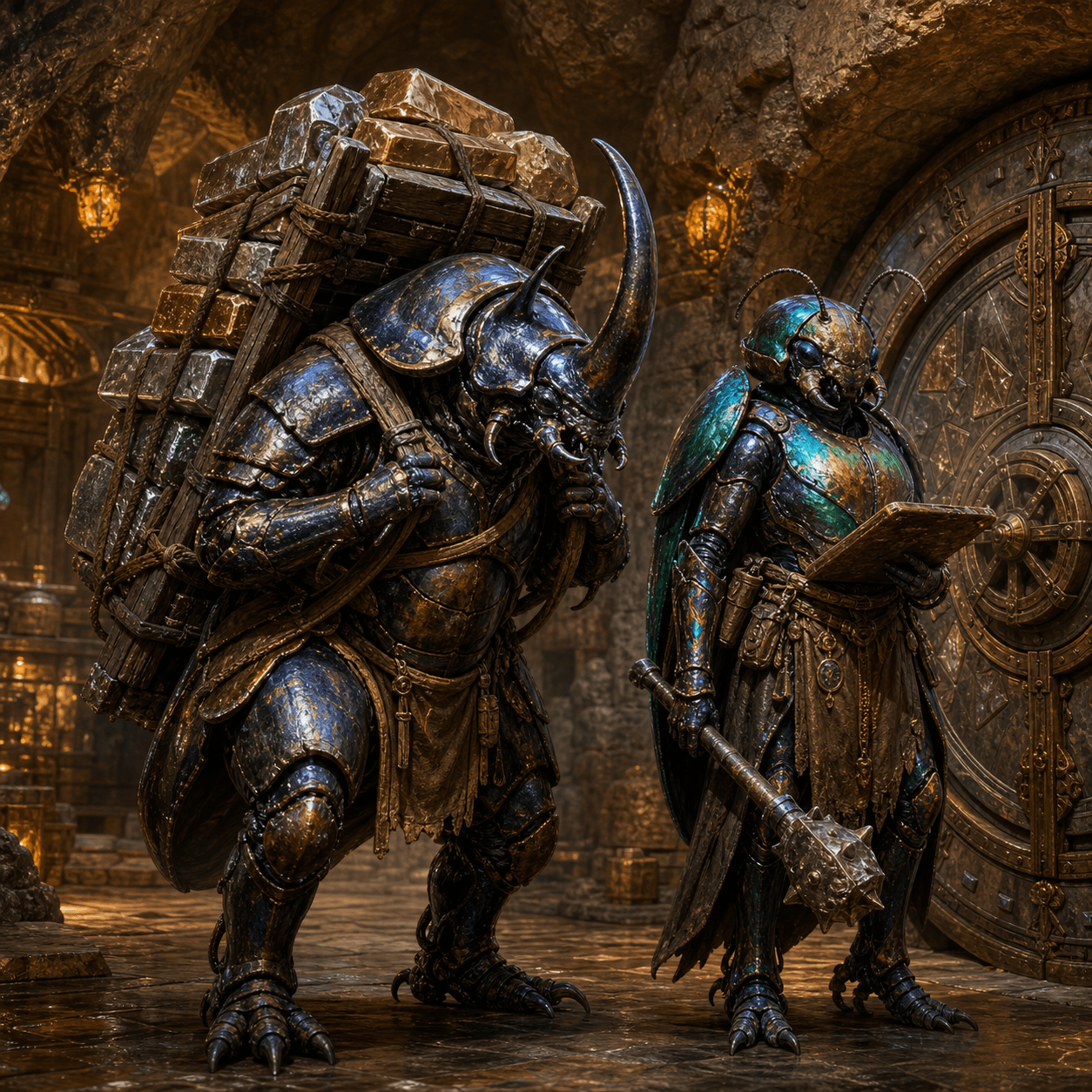
Beetle Folk
Caraenol
The Broken Shields
Background Questions
What battle scar still aches when the weather changes? Is it physical, or something deeper that no healer can touch?
Who did you lose in the final war, and who do you blame? Was it the enemy, your commanders, or yourself for surviving?
What war-banner or symbol do you still carry? Is it from your original regiment, or did you claim it from a fallen comrade?
What faction still owes you a debt of honor? Will they pay it, or have they "forgotten" inconvenient promises made in blood?
Lore
Beetle Folk were the frontline soldiers in the Second War, fighting primarily for the Scorpion Folk as shock troops, shield-walls, and siege breakers. When the war turned catastrophic and the Batfolk - who had been allies - became aggressors, Beetle Folk absorbed the worst of the violence.
They held lines that should have broken. They escorted refugee columns through hostile territory. They died in place so others could retreat. They were the shield that didn't break even when every tactical reason said they should run.
And when the war finally ended, there was no home to return to.
The Scorpion Folk were scattered, betrayed, nearly extinct. The military structure Beetle Folk had served within collapsed. The alliance that had given their sacrifices meaning dissolved into historical footnote.
Beetle Folk became wanderers.
Philosophy. The Hymn as Endurance and Duty
Beetle Folk interpret the Hymn of Nature as endurance, duty, and the principle that a body built to hold a line should not be wasted on cruelty or panic.
Core Beliefs:
Endurance is purpose. You were built to withstand. Use that gift to protect, not to oppress.
Duty must be chosen. Blind obedience led to the war. Now, you choose what you defend.
A shield does not break once given. If you say you'll protect someone, you protect them or you die trying. There is no middle ground.
This is not mindless stubbornness. This is conscious, deliberate commitment. Modern Beetle Folk are deeply skeptical of authority and grand causes. But once they personally commit to something - a person, a community, a contract - they are absolutely unwavering.
Social Structure. Post-War Fragments
Beetle Folk have no centralized homeland. The Second War destroyed whatever unified culture they once had. What remains is scattered:
Rare Conclaves (Temporary Settlements)
Groups of 20-50 Beetle Folk who gather seasonally at remembered sites - old battlefields, refugee camps that became permanent, defensible ruins. They share news, arrange marriages, teach the young the Contract Code, and then disperse.
These are not cities. They're reunions with the possibility of becoming cities if circumstances ever stabilize enough.
Temporary Camps (Mobile Groups)
Smaller bands of 5-15 Beetle Folk who travel together, usually under contract to the same employer or pursuing the same goal. They might stay together for years or disband after a single job.
Loyalty within these camps is intense. You eat together, fight together, mourn together. But the group knows it's temporary. When the contract ends, you part ways. Maybe you'll meet again. Maybe you won't.
Solitary Veterans (The Wanderers)
Many Beetle Folk travel alone, taking contracts from town to town. They're not antisocial - they simply can't bear the weight of forming new bonds after losing everyone in the war.
They'll work with others. They'll honor a contract. But they don't stay. The idea of having a "home" feels dangerous, like tempting the universe to take it away again.
The Contract Code. Beetle Folk Ethics
After the war, scattered Beetle Folk developed a shared ethical framework to replace the military hierarchy they'd lost. This code isn't law (there's no authority to enforce it) - it's cultural consensus about what honorable behavior looks like.
The Contract Code (most widely accepted version):
1. The shield does not break once given.
If you agree to protect someone or something, you do it completely or you die trying. No half-measures. No "I did my best." Success or death.
Practical Application. Beetle Folk will explicitly clarify terms before accepting a protection contract. "Protect this caravan to the city" might mean "until it reaches the gates" or "until every person inside is safely home." The difference matters. Once terms are agreed, they're absolute.
2. The line does not run.
When you choose to stand, you stand. Retreat requires explicit agreement or command failure. Fleeing because you're afraid is not acceptable.
Practical Application. This doesn't mean suicidal stupidity. Tactical withdrawal is fine if it's part of the plan. Running because the fight got hard is not fine. Beetle Folk who abandon their position without cause lose standing with other Beetle Folk permanently.
3. The helpless are not hunted.
Non-combatants, children, the wounded, civilians - you don't prey on weakness. Ever. That's what monsters do.
Practical Application. Beetle Folk will refuse contracts that involve terrorizing populations, harming refugees, or targeting families. They'll sometimes take contracts to stop those doing such things, often for no payment at all.
4. Payment is agreed before blood is shed.
You discuss terms clearly. You know what you're getting and what you're protecting. No hidden clauses. No "I thought you understood."
Practical Application. Beetle Folk are famous for meticulous contracts. Everything is written down if possible. Witnesses are brought in. This protects both parties - you know exactly what you owe and what you're owed.
5. A banner carried is honored; a banner stolen is repaid.
Military honors, regimental symbols, war-banners - these matter. You don't disrespect them. You don't steal them. If you see a banner from your own war being defiled, you repay that insult.
Practical Application. This is why mocking Carapace Cairn is so dangerous. The banners there represent thousands of dead. Beetle Folk who hear about desecration will travel hundreds of miles to make examples of the perpetrators.
Carapace Cairn. The Sacred Ruin
Location. Exact location is not widely advertised, but Beetle Folk know where it is. Those who need to find it, find it.
What It Is. The ruins of a fortress where Beetle Folk made their last organized stand during the final phase of the Second War. Thousands died there. The survivors claimed the site as memorial ground.
What Happens There:
Vow Renewals. Beetle Folk come here to reaffirm their commitment to the Contract Code
Banner Remembrance. Every regiment that fought in the war has a marker here (even enemy regiments - the fallen deserve respect)
Memorial Rites. Names of the dead are carved into stone. New names are added as veterans die.
Contract Oaths. Some Beetle Folk formalize major contracts here, swearing before the dead that they'll honor their word
The Offering Custom. When you arrive at Carapace Cairn, you're offered a drink by whoever maintains the site (usually 2-3 elderly Beetle Folk who've made it their life's work). The drink is fermented grain alcohol, harsh and strong.
The Meaning:
Accept and drink. You honor the dead. You're welcome here. Agreements made afterward carry weight.
Decline to drink. You name yourself enemy. Leave immediately or face consequences.
Leave it untouched in the middle. You're neutral. Not friend, not foe. You won't be attacked, but you won't be helped either.
Why This Matters. Beetle Folk are scattered with no unified government, but Carapace Cairn is where they're still united. Threaten it, mock it, or loot it, and you'll make enemies of Beetle Folk across the entire world who've never met each other but will coordinate to end you.
The Three Fragments
Beetle Folk don't have "cities" in the traditional sense, but three locations serve as major gathering points:
Carapace Cairn (The Pilgrimage Site)
Function. Memorial, cultural heart, oath-ground Population: 5-10 permanent residents (caretakers), hundreds during pilgrimage season Description: Ancient fortress ruins, now maintained as sacred space. Banners from every regiment that fought, stone walls covered in carved names, a central cairn built from the shields of the fallen.
Current Challenge. A human noble has offered to "restore" the ruins and turn it into a proper monument with Beetle Folk as paid guardians. Some young Beetle Folk see this as opportunity (steady employment, protection). Veterans are furious at the idea of outsiders "owning" the Cairn.
Thorn-Camp (The Northern Conclave)
Function. Seasonal gathering, contract coordination Population: 40-60 (varies seasonally) Location: Northern plains near human/dwarf trade routes Description: Semi-permanent camp built around a natural spring. Beetle Folk gather here in spring and autumn to share news, teach young, and coordinate contracts for the coming season.
Current Challenge. Increased banditry in the region. Beetle Folk have been hired to deal with it, but the bandits are also Beetle Folk - veterans who decided the Contract Code doesn't apply to rich merchants who profited from the war. It's not a fight anyone wants.
Iron-Mound (The Eastern Fragment)
Function. Fortified settlement, craft center Population: 80-100 (most permanent Beetle Folk community) Location: Eastern foothills Description: Built into a defensible hill, Iron-Mound is where Beetle Folk who want stability settle. They trade metalwork (repairing armor, forging simple weapons) and offer long-term guard services to the nearby region.
Current Challenge. The settlement is slowly becoming a town. Non-Beetle Folk are moving in. Some residents welcome this (growth, prosperity, future). Others fear losing Beetle Folk identity in a generation.
Central Site: Carapace Cairn
While not a political capital (Beetle Folk have no central government), the Cairn functions as spiritual center. What happens there matters to every Beetle Folk everywhere.
Economy & Trade
Exports:
Contract shieldwork (bodyguards, caravan escorts, fortification defense)
Mercenary services (with strict ethical limits - see Contract Code)
Military training (some Beetle Folk teach combat tactics to militia groups)
Armor repair and maintenance (expertise born from necessity)
Imports:
Grain (staple food, preferred preserved)
Metal for armor maintenance
Travel supplies (Beetle Folk are constantly moving)
Writing materials (contracts must be documented)
Diet:
Dried fruit (long shelf-life, portable)
Root vegetables (hearty, filling)
Hardy plants (anything that grows in poor soil and keeps well)
Preserved meat (rare luxury, usually from contract payment)
Delicacy. Honey-mead - a fermented drink made from wild honey. Beetle Folk consider it celebratory. Often shared at Carapace Cairn during remembrance rites.
Relations: with Other Peoples
Allies:
Owlkin. Surprising alliance. Owlkin value wisdom and witness; Beetle Folk value honor and duty. They've found common ground as mercenary partners and information brokers.
Scorpion Folk (complicated). The alliance that defined the war. Most Beetle Folk still feel loyalty to Scorpion Folk, but the relationship is strained by mutual trauma and scattered populations.
Enemies:
Batfolk. The betrayal is not forgotten. Most Beetle Folk refuse contracts involving Batfolk unless it's specifically to oppose them. Some seek active revenge.
War Profiteers. Merchants and nobles who got rich selling weapons during the war while soldiers died. Beetle Folk have long memories.
Neutral/Cautious:
Most other peoples. Beetle Folk will work with almost anyone if the contract is honorable. But they don't form deep alliances easily anymore.
Language: Common, Caraezer (insectoid dialect)
Outsider Escalation: Protocol
Beetle Folk camps and gatherings:
Perimeter challenge - Sentries stop you, ask your business
Terms demanded - What do you want? State it clearly. Deception is detected quickly.
Escorted within camp lanes - If your business is legitimate, you're guided to appropriate areas
Expelled for disrespecting dead/banners - Mock the fallen or their symbols, you're removed immediately
Lethal response if you threaten noncombatants - Beetle Folk will kill anyone threatening the helpless without hesitation
At Carapace Cairn:
The drink custom applies (accept, decline, or leave it)
Looting or vandalism is met with death
Disputes are settled before witnesses (the Cairn is neutral ground for honorable conflict resolution)
Internal Conflicts
Settle-and-Rebuild vs. Keep-Wandering
The Divide. Some Beetle Folk (especially younger ones who barely remember the war) want to establish permanent communities like Iron-Mound. Veterans argue that attachment to place is what got them destroyed once.
Current Tension: Iron-Mound's growth is forcing the question: should Beetle Folk try to become a unified people again, or remain scattered to avoid being targeted? There's no consensus and the argument gets heated.
Strict Code vs. Desperate Contracts
The Divide. The Contract Code says "the helpless are not hunted" and "payment is agreed before blood." But what if the only available contract violates those principles slightly? What if you're starving and someone offers good money for morally gray work?
Current Tension: A group of Beetle Folk at Thorn-Camp took a contract to "clear out squatters" from a noble's land. The squatters were refugee families. The Beetle Folk didn't realize until they arrived. They refused the contract and left. Now they're broke and the noble is spreading word that Beetle Folk can't be trusted to complete jobs. Other Beetle Folk are furious at them for taking the contract in the first place.
Conclave Leaders vs. Solitary Veterans Who Refuse Authority
The Divide. At places like Thorn-Camp, informal leadership emerges - usually senior veterans who coordinate contracts and settle disputes. Some solitary Beetle Folk reject even this minimal authority, arguing that hierarchy was what led to the war.
Current Tension: A respected elder at Thorn-Camp tried to forbid younger Beetle Folk from taking a particular contract she deemed dishonorable. Half the camp agreed with her. Half said she has no right to command. The camp is splitting.
Beetle Folk Adventurers. Why They Leave
Beetle Folk are natural adventurers - wandering is their default state:
1. The Contract Seeker
Taking mercenary work to survive. Joins adventuring parties as hired muscle initially, might stay for deeper reasons.
2. The Banner Hunter
Hunting for stolen regimental banners, war trophies taken by enemies, or artifacts from their old unit. Will travel anywhere for this.
3. The Oath-Bound
Swore a specific vow at Carapace Cairn and is pursuing it obsessively. The party might not even know what the vow was until it becomes relevant.
4. The Survivor's Guilt
Everyone they served with died. They're trying to earn the right to have survived by protecting others now.
5. The Peacetime Lost
Excellent at war, terrible at peace. Doesn't know what to do with themselves without orders and structure. Adventuring provides purpose.
6. The Young Hopeful
Born after the war, raised on stories of glory. Wants to prove they're worthy of the Contract Code even though they never fought.
Lore & Background
Beetle Folk were the frontline soldiers in the Second War, fighting primarily for the Scorpion Folk as shock troops, shield-walls, and siege breakers. When the war turned catastrophic and the Batfolk - who had been allies - became aggressors, Beetle Folk absorbed the worst of the violence.
They held lines that should have broken. They escorted refugee columns through hostile territory. They died in place so others could retreat. They were the shield that didn't break even when every tactical reason said they should run.
And when the war finally ended, there was no home to return to.
The Scorpion Folk were scattered, betrayed, nearly extinct. The military structure Beetle Folk had served within collapsed. The alliance that had given their sacrifices meaning dissolved into historical footnote.
Beetle Folk became wanderers.
Philosophy. The Hymn as Endurance and Duty
Beetle Folk interpret the Hymn of Nature as endurance, duty, and the principle that a body built to hold a line should not be wasted on cruelty or panic.
Core Beliefs:
Endurance is purpose. You were built to withstand. Use that gift to protect, not to oppress.
Duty must be chosen. Blind obedience led to the war. Now, you choose what you defend.
A shield does not break once given. If you say you'll protect someone, you protect them or you die trying. There is no middle ground.
This is not mindless stubbornness. This is conscious, deliberate commitment. Modern Beetle Folk are deeply skeptical of authority and grand causes. But once they personally commit to something - a person, a community, a contract - they are absolutely unwavering.
Social Structure. Post-War Fragments
Beetle Folk have no centralized homeland. The Second War destroyed whatever unified culture they once had. What remains is scattered:
Rare Conclaves (Temporary Settlements)
Groups of 20-50 Beetle Folk who gather seasonally at remembered sites - old battlefields, refugee camps that became permanent, defensible ruins. They share news, arrange marriages, teach the young the Contract Code, and then disperse.
These are not cities. They're reunions with the possibility of becoming cities if circumstances ever stabilize enough.
Temporary Camps (Mobile Groups)
Smaller bands of 5-15 Beetle Folk who travel together, usually under contract to the same employer or pursuing the same goal. They might stay together for years or disband after a single job.
Loyalty within these camps is intense. You eat together, fight together, mourn together. But the group knows it's temporary. When the contract ends, you part ways. Maybe you'll meet again. Maybe you won't.
Solitary Veterans (The Wanderers)
Many Beetle Folk travel alone, taking contracts from town to town. They're not antisocial - they simply can't bear the weight of forming new bonds after losing everyone in the war.
They'll work with others. They'll honor a contract. But they don't stay. The idea of having a "home" feels dangerous, like tempting the universe to take it away again.
The Contract Code. Beetle Folk Ethics
After the war, scattered Beetle Folk developed a shared ethical framework to replace the military hierarchy they'd lost. This code isn't law (there's no authority to enforce it) - it's cultural consensus about what honorable behavior looks like.
The Contract Code (most widely accepted version):
1. The shield does not break once given.
If you agree to protect someone or something, you do it completely or you die trying. No half-measures. No "I did my best." Success or death.
Practical Application. Beetle Folk will explicitly clarify terms before accepting a protection contract. "Protect this caravan to the city" might mean "until it reaches the gates" or "until every person inside is safely home." The difference matters. Once terms are agreed, they're absolute.
2. The line does not run.
When you choose to stand, you stand. Retreat requires explicit agreement or command failure. Fleeing because you're afraid is not acceptable.
Practical Application. This doesn't mean suicidal stupidity. Tactical withdrawal is fine if it's part of the plan. Running because the fight got hard is not fine. Beetle Folk who abandon their position without cause lose standing with other Beetle Folk permanently.
3. The helpless are not hunted.
Non-combatants, children, the wounded, civilians - you don't prey on weakness. Ever. That's what monsters do.
Practical Application. Beetle Folk will refuse contracts that involve terrorizing populations, harming refugees, or targeting families. They'll sometimes take contracts to stop those doing such things, often for no payment at all.
4. Payment is agreed before blood is shed.
You discuss terms clearly. You know what you're getting and what you're protecting. No hidden clauses. No "I thought you understood."
Practical Application. Beetle Folk are famous for meticulous contracts. Everything is written down if possible. Witnesses are brought in. This protects both parties - you know exactly what you owe and what you're owed.
5. A banner carried is honored; a banner stolen is repaid.
Military honors, regimental symbols, war-banners - these matter. You don't disrespect them. You don't steal them. If you see a banner from your own war being defiled, you repay that insult.
Practical Application. This is why mocking Carapace Cairn is so dangerous. The banners there represent thousands of dead. Beetle Folk who hear about desecration will travel hundreds of miles to make examples of the perpetrators.
Carapace Cairn. The Sacred Ruin
Location. Exact location is not widely advertised, but Beetle Folk know where it is. Those who need to find it, find it.
What It Is. The ruins of a fortress where Beetle Folk made their last organized stand during the final phase of the Second War. Thousands died there. The survivors claimed the site as memorial ground.
What Happens There:
Vow Renewals. Beetle Folk come here to reaffirm their commitment to the Contract Code
Banner Remembrance. Every regiment that fought in the war has a marker here (even enemy regiments - the fallen deserve respect)
Memorial Rites. Names of the dead are carved into stone. New names are added as veterans die.
Contract Oaths. Some Beetle Folk formalize major contracts here, swearing before the dead that they'll honor their word
The Offering Custom. When you arrive at Carapace Cairn, you're offered a drink by whoever maintains the site (usually 2-3 elderly Beetle Folk who've made it their life's work). The drink is fermented grain alcohol, harsh and strong.
The Meaning:
Accept and drink. You honor the dead. You're welcome here. Agreements made afterward carry weight.
Decline to drink. You name yourself enemy. Leave immediately or face consequences.
Leave it untouched in the middle. You're neutral. Not friend, not foe. You won't be attacked, but you won't be helped either.
Why This Matters. Beetle Folk are scattered with no unified government, but Carapace Cairn is where they're still united. Threaten it, mock it, or loot it, and you'll make enemies of Beetle Folk across the entire world who've never met each other but will coordinate to end you.
The Three Fragments
Beetle Folk don't have "cities" in the traditional sense, but three locations serve as major gathering points:
Carapace Cairn (The Pilgrimage Site)
Function. Memorial, cultural heart, oath-ground Population: 5-10 permanent residents (caretakers), hundreds during pilgrimage season Description: Ancient fortress ruins, now maintained as sacred space. Banners from every regiment that fought, stone walls covered in carved names, a central cairn built from the shields of the fallen.
Current Challenge. A human noble has offered to "restore" the ruins and turn it into a proper monument with Beetle Folk as paid guardians. Some young Beetle Folk see this as opportunity (steady employment, protection). Veterans are furious at the idea of outsiders "owning" the Cairn.
Thorn-Camp (The Northern Conclave)
Function. Seasonal gathering, contract coordination Population: 40-60 (varies seasonally) Location: Northern plains near human/dwarf trade routes Description: Semi-permanent camp built around a natural spring. Beetle Folk gather here in spring and autumn to share news, teach young, and coordinate contracts for the coming season.
Current Challenge. Increased banditry in the region. Beetle Folk have been hired to deal with it, but the bandits are also Beetle Folk - veterans who decided the Contract Code doesn't apply to rich merchants who profited from the war. It's not a fight anyone wants.
Iron-Mound (The Eastern Fragment)
Function. Fortified settlement, craft center Population: 80-100 (most permanent Beetle Folk community) Location: Eastern foothills Description: Built into a defensible hill, Iron-Mound is where Beetle Folk who want stability settle. They trade metalwork (repairing armor, forging simple weapons) and offer long-term guard services to the nearby region.
Current Challenge. The settlement is slowly becoming a town. Non-Beetle Folk are moving in. Some residents welcome this (growth, prosperity, future). Others fear losing Beetle Folk identity in a generation.
Central Site: Carapace Cairn
While not a political capital (Beetle Folk have no central government), the Cairn functions as spiritual center. What happens there matters to every Beetle Folk everywhere.
Economy & Trade
Exports:
Contract shieldwork (bodyguards, caravan escorts, fortification defense)
Mercenary services (with strict ethical limits - see Contract Code)
Military training (some Beetle Folk teach combat tactics to militia groups)
Armor repair and maintenance (expertise born from necessity)
Imports:
Grain (staple food, preferred preserved)
Metal for armor maintenance
Travel supplies (Beetle Folk are constantly moving)
Writing materials (contracts must be documented)
Diet:
Dried fruit (long shelf-life, portable)
Root vegetables (hearty, filling)
Hardy plants (anything that grows in poor soil and keeps well)
Preserved meat (rare luxury, usually from contract payment)
Delicacy. Honey-mead - a fermented drink made from wild honey. Beetle Folk consider it celebratory. Often shared at Carapace Cairn during remembrance rites.
Relations: with Other Peoples
Allies:
Owlkin. Surprising alliance. Owlkin value wisdom and witness; Beetle Folk value honor and duty. They've found common ground as mercenary partners and information brokers.
Scorpion Folk (complicated). The alliance that defined the war. Most Beetle Folk still feel loyalty to Scorpion Folk, but the relationship is strained by mutual trauma and scattered populations.
Enemies:
Batfolk. The betrayal is not forgotten. Most Beetle Folk refuse contracts involving Batfolk unless it's specifically to oppose them. Some seek active revenge.
War Profiteers. Merchants and nobles who got rich selling weapons during the war while soldiers died. Beetle Folk have long memories.
Neutral/Cautious:
Most other peoples. Beetle Folk will work with almost anyone if the contract is honorable. But they don't form deep alliances easily anymore.
Language: Common, Caraezer (insectoid dialect)
Outsider Escalation: Protocol
Beetle Folk camps and gatherings:
Perimeter challenge - Sentries stop you, ask your business
Terms demanded - What do you want? State it clearly. Deception is detected quickly.
Escorted within camp lanes - If your business is legitimate, you're guided to appropriate areas
Expelled for disrespecting dead/banners - Mock the fallen or their symbols, you're removed immediately
Lethal response if you threaten noncombatants - Beetle Folk will kill anyone threatening the helpless without hesitation
At Carapace Cairn:
The drink custom applies (accept, decline, or leave it)
Looting or vandalism is met with death
Disputes are settled before witnesses (the Cairn is neutral ground for honorable conflict resolution)
Internal Conflicts
Settle-and-Rebuild vs. Keep-Wandering
The Divide. Some Beetle Folk (especially younger ones who barely remember the war) want to establish permanent communities like Iron-Mound. Veterans argue that attachment to place is what got them destroyed once.
Current Tension: Iron-Mound's growth is forcing the question: should Beetle Folk try to become a unified people again, or remain scattered to avoid being targeted? There's no consensus and the argument gets heated.
Strict Code vs. Desperate Contracts
The Divide. The Contract Code says "the helpless are not hunted" and "payment is agreed before blood." But what if the only available contract violates those principles slightly? What if you're starving and someone offers good money for morally gray work?
Current Tension: A group of Beetle Folk at Thorn-Camp took a contract to "clear out squatters" from a noble's land. The squatters were refugee families. The Beetle Folk didn't realize until they arrived. They refused the contract and left. Now they're broke and the noble is spreading word that Beetle Folk can't be trusted to complete jobs. Other Beetle Folk are furious at them for taking the contract in the first place.
Conclave Leaders vs. Solitary Veterans Who Refuse Authority
The Divide. At places like Thorn-Camp, informal leadership emerges - usually senior veterans who coordinate contracts and settle disputes. Some solitary Beetle Folk reject even this minimal authority, arguing that hierarchy was what led to the war.
Current Tension: A respected elder at Thorn-Camp tried to forbid younger Beetle Folk from taking a particular contract she deemed dishonorable. Half the camp agreed with her. Half said she has no right to command. The camp is splitting.
Beetle Folk Adventurers. Why They Leave
Beetle Folk are natural adventurers - wandering is their default state:
1. The Contract Seeker
Taking mercenary work to survive. Joins adventuring parties as hired muscle initially, might stay for deeper reasons.
2. The Banner Hunter
Hunting for stolen regimental banners, war trophies taken by enemies, or artifacts from their old unit. Will travel anywhere for this.
3. The Oath-Bound
Swore a specific vow at Carapace Cairn and is pursuing it obsessively. The party might not even know what the vow was until it becomes relevant.
4. The Survivor's Guilt
Everyone they served with died. They're trying to earn the right to have survived by protecting others now.
5. The Peacetime Lost
Excellent at war, terrible at peace. Doesn't know what to do with themselves without orders and structure. Adventuring provides purpose.
6. The Young Hopeful
Born after the war, raised on stories of glory. Wants to prove they're worthy of the Contract Code even though they never fought.
Biological Dimorphism
Caraenol dimorphism appears in horn, mandible, elytra, shell, and abdomen shape. Some lines produce males with larger display horns or ridged crests, while females may carry broader shell backs, heavier abdomens, or deeper carapace coloration. The body remains beetle-like and armored, with differences expressed through exoskeleton and shell structure.
Checking your codex…
From the Reth Ancestries (Daggerheart) compendium. Ancestry mechanics unlock when you collect this lineage in Hoard and link your account.