Insectoids
Dragonfly Folk
Caraemar
The River Wardens
Background Questions
What river or lake gave your brood life? Is it still there, or has it dried up, been dammed, or become corrupted?
What omen did you witness in the reflection of water? Did it come true? Do you still trust what you see in water?
Who did you save from drowning, and do they still remember? Or did you fail to save someone, and does that haunt you?
What current or wind pattern do you trust like a friend? Where does it lead, and why does it matter to you?
Lore
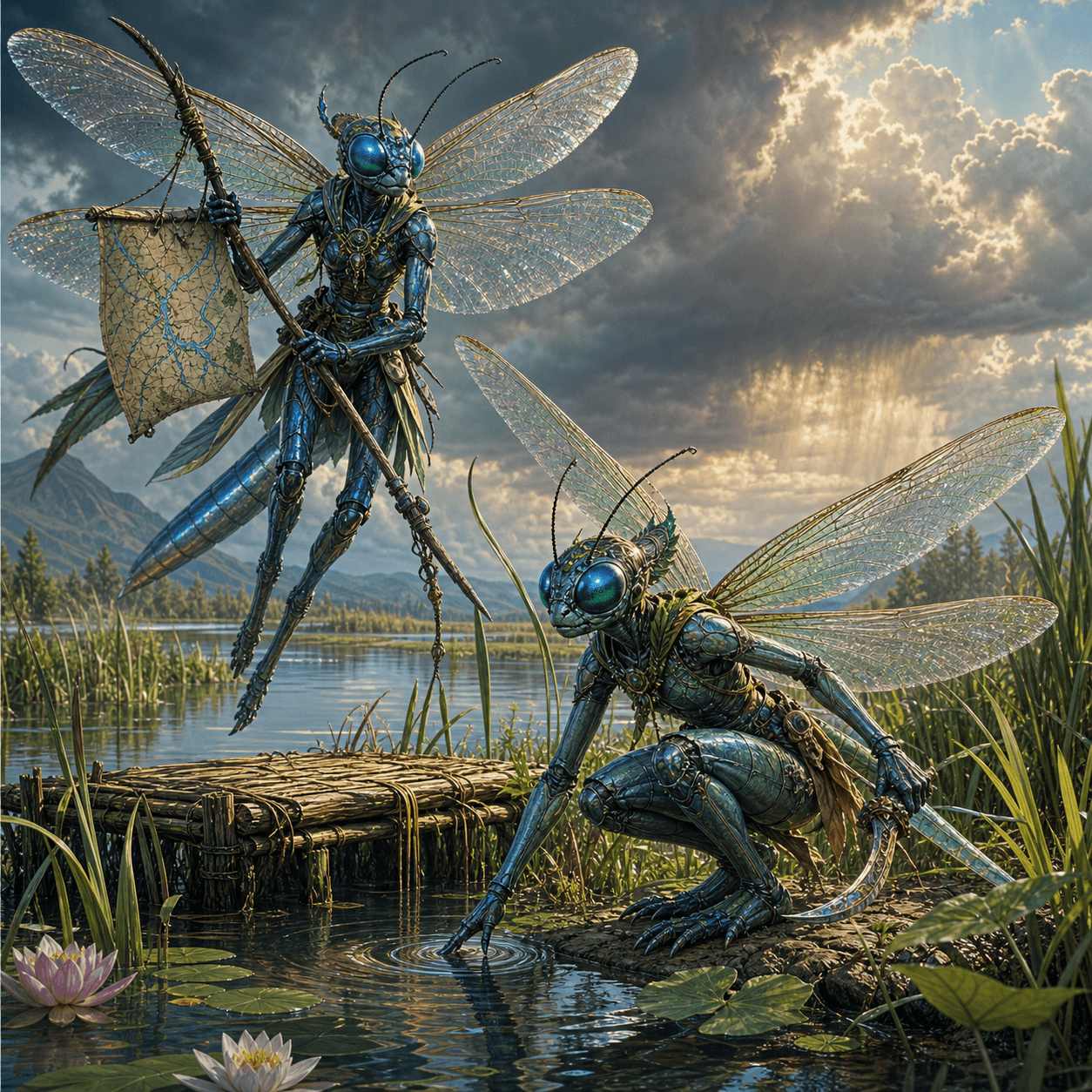
Dragonfly Folk are fast, alert, and fiercely protective of clean water. They are not warriors by nature - they are stewards. But stewardship, when threatened, becomes defense.
Their entire culture is built around mapping and preservation. They track:
Rivers, lakes, creeks, streams
Marsh lanes and seasonal flood plains
Safe crossings and dangerous rapids
Spawn sites and breeding grounds
Water quality and contamination sources
This is not academic interest. This is survival infrastructure. Water moves. Routes change. Floods rewrite the landscape. The Dragonfly Folk remember, record, and maintain safe passage through it all.
Philosophy. The Hymn as Flow
Dragonfly Folk interpret the Hymn of Nature as flow, life, and continuity. Water does not stop. Life does not pause. The river that fed your grandparents will feed your grandchildren - if you protect it.
Core Beliefs:
Water is life. Not metaphorically. Literally. Every living thing depends on it.
Flow must be preserved. Blocking channels, fouling sources, or disrupting spawn is a crime against the future.
Memory is duty. Knowing where water goes, where it fails, and how to fix it is not optional knowledge. It is generational obligation.
This is not worship of water as a god. This is recognition of water as the foundation of everything else.
Social Structure. The Castes
Dragonfly Folk organize by wing coloration, which signals caste roles. The specific colors vary by city (each settlement has its own palette), but the role categories are consistent across all Dragonfly communities.
The Four Primary Castes
1. Wardens (Security & Protection)
Wing Pattern. Typically bold, contrasting colors (red/black, blue/orange)
Role:
Route security and patrol
Brood-site protection (nurseries are vulnerable)
Border enforcement
Threat response
Philosophy. The river flows freely only when it is safe to approach.
Training. Combat-focused. Wardens learn spear, net, and rapid-strike tactics optimized for aerial mobility. They drill in formation flying and coordinated water-surface attacks.
2. Guides (Navigation & Travel)
Wing Pattern. Typically flowing, graduated colors (greens, blues, silvers)
Role:
Leading travelers through safe routes
Operating river crossings and marsh ferries
Piloting boats through dangerous rapids
Teaching safe water travel
Philosophy. A path exists. We show you where.
Training. Geographic memorization, rescue techniques, client management. Guides must know dozens of routes and be able to assess traveler capability quickly.
3. Gardeners (Cultivation & Maintenance)
Wing Pattern. Typically earth tones with green (browns, greens, soft yellows)
Role:
Maintaining water gardens (food cultivation)
Reedcraft and structural plant management
Erosion control and bank stabilization
Managing spawn sites for edible fish
Philosophy. The river gives, but only if we give back.
Training. Botany, water chemistry basics, sustainable harvesting, and replanting techniques. Gardeners work in cycles tied to seasons.
4. Archivists (Records & Administration)
Wing Pattern. Typically muted, scholarly colors (grays, pale blues, white accents)
Role:
Maintaining the Water-Map Vault
Recording flood patterns and seasonal changes
Adjudicating trade-route disputes
Teaching the young the history of waterways
Philosophy. What is forgotten is lost. What is lost kills.
Training. Literacy (rare among insectoid peoples), cartography, oral history preservation, negotiation. Archivists are the memory of the people.
Caste Assignment
At Birth. Wing colors manifest during the final molt before adulthood (around age 12-14 in human years). The colors determine initial caste.
Limited Mobility. Dragonfly Folk can petition to switch castes, but only if:
They demonstrate aptitude in the new role
The community has a need for additional members in that caste
A senior member of the target caste agrees to mentor them
Switching castes is uncommon. Most Dragonfly Folk are content in their roles - the system works because it matches natural ability to social need.
The Four Non-Negotiables
Dragonfly Folk have four absolute laws. Break these and you will be driven out or killed, depending on the severity.
1. Do Not Foul Water
Deliberately poisoning, polluting, or contaminating a water source is the gravest crime.
Examples. Dumping waste upstream of a brood-site. Using toxic magic near a spring. Sabotaging a well.
Punishment. Death. Immediate. No trial.
2. Do Not Block Channels
Damming, redirecting, or obstructing water flow without community approval destroys ecosystems and communities downstream.
Examples. Building unauthorized dams. Collapsing riverbanks to change flow. Blocking irrigation channels.
Punishment. Forced restoration of flow + exile if damage is severe.
3. Do Not Take Brood Sites
Nursery pools are sacred. Dragonfly larvae require still, clean water. Taking or fouling a brood-site is attacking the next generation.
Examples. Draining a nursery pool. Fishing in marked brood zones. Building over spawning grounds.
Punishment. Exile after compensation paid. Death if larvae died.
4. Do Not Fish During Spawn
Fish spawn sites are marked and protected seasonally. Taking fish during spawn crashes populations for years.
Examples. Ignoring seasonal markers. Commercial fishing in spawn zones. Poaching marked waters.
Punishment. Confiscation of catch + tools. Repeat offenders are expelled.
Cities: & Territory
Homeland: Ranta rivers, lakes, freshwater wetlands - anywhere water flows or pools cleanly.
Principal Cities:
Brightwater Nest
Location. Major river confluence in southern Ranta Specialty: Trade hub and diplomatic center Description: Built on stilts over the meeting point of three rivers, Brightwater is the most cosmopolitan Dragonfly city. Outsiders are common here. The city's Archivists maintain the most complete river-map collection in existence. Current Issue: Increased piracy upstream. Wardens are stretched thin.
Glimmerbank
Location. Lake-shore settlement in central wetlands Specialty: Water gardening and food production Description: Glimmerbank feeds much of the Dragonfly population through cultivated water-gardens. The lake's surface is covered in managed kelp, lotus, and rice platforms. Gardeners here have developed techniques other settlements are trying to replicate. Current Issue: Invasive species (introduced by careless traders) threatening native plants.
Reedwind
Location. Shallow marsh delta near coast Specialty: Brood-site protection and Warden training Description: Reedwind is the most militarized Dragonfly settlement, built around protecting a massive nursery complex. The best Wardens train here. Outsiders are not welcome without formal invitation. Current Issue: Large Avian predators have begun targeting the nursery. Wardens are considering offensive action into Avian territory.
Central Site: The Water-Map Vault (location varies by city, but Brightwater Nest holds the master archive)
A heavily guarded hall where:
Flood records dating back centuries are preserved
Route markers and safe-passage agreements are recorded
Stewardship decisions are debated and finalized
Caste disputes are adjudicated
The Vault is the institutional memory of the people. Losing it would be catastrophic.
Economy & Trade
Exports:
River-guide services (the most reliable in Reth)
Decorative wing-arts (shed wing fragments used in jewelry)
Marsh-route maps (updated seasonally, highly valuable)
Water quality assessments (hired by cities concerned about contamination)
Imports:
Metal tools (for construction and maintenance)
Dried fruit (supplement to fish-heavy diet)
Cloth (Dragonfly Folk wear light, flowing garments)
Diet:
Fish (primary protein, sustainably harvested)
Marsh insects (seasonally available)
Sweet plants (lotus root, water chestnuts, cattail shoots)
Cultivated algae (nutritional supplement)
Relations: with Other Peoples
Allies:
Amphibians (various). Natural partnership. Both peoples need clean water.
Mantids (Caraethu). Respectful distance. Both value precision and patience.
Enemies:
Large Avians. Prey on Dragonfly broods. Generations of conflict.
Varjo predators. Deep-cave creatures that hunt in subterranean rivers. Wardens know how to fight them but losses are high.
Neutral but Tense:
Surface humans. Useful trade partners, but humans build dams, pollute water, and often don't respect spawn seasons until forced.
Language: Common, Caraezer (insectoid dialect)
Outsider Escalation: Protocol
How Dragonfly Folk respond to strangers in their waterways:
Distant warning - Wing-flash signals visible from far away, indicating "turn back"
Checkpoint escort - Wardens intercept and guide you to an approved visitor area
Barred from inner channels - You're restricted to outer routes; interior waterways closed
"Lost current" misdirection - Guides deliberately lead you to dead-end channels and confusing loops
Seizure of gear - If you've violated rules (fishing during spawn, fouling water), your tools are confiscated
Removal by force - Wardens physically eject you from territory
Lethal response - If water is actively threatened (poisoning attempt, brood-site attack), Wardens kill immediately
Note. Dragonfly Folk will skip steps if you're deliberately harming water. A trader who dumps waste might get one warning. Someone pouring poison into a nursery pool will be killed on sight.
Internal Conflicts
Open Trade vs. Strict Control
The Divide. Brightwater Nest advocates for increased trade with surface peoples (brings resources, builds alliances). Reedwind believes outsiders are the source of most water contamination and wants stricter border control.
Current Tension: Brightwater signed a trade agreement with a human merchant consortium that Reedwind views as dangerous. Wardens from Reedwind have begun "accidentally" detaining Brightwater's trade partners at checkpoints.
Guide Castes vs. Warden Castes
The Divide. Guides prioritize access and safe passage (their job is getting people through). Wardens prioritize protection and exclusion (their job is keeping threats out). These goals sometimes conflict.
Current Tension: A recent incident where Guides led a merchant group through a route that Wardens had closed for security reasons. The merchants were fine. The Wardens are furious. The Guides say the closure was unnecessary paranoia.
Route Marker Disputes After Floods
The Divide. When floods shift riverbeds and erase landmarks, different Archivists sometimes record conflicting information about where routes "should" be reestablished.
Current Tension: A major flood three years ago completely rewrote the eastern marshlands. Two Archivist factions have competing maps. Trade convoys don't know which routes are official. Some have gotten lost and drowned.
Dragonfly Adventurers. Why They Leave
Dragonfly Folk leaving their waterways is unusual but not unheard of:
The Failed Warden. A brood-site was attacked on their watch. They left in shame.
The Exiled Guide. Led travelers into danger (deliberately or through incompetence). Can't guide at home anymore.
The Archivist on Mission. Sent to map distant waterways or recover lost records from ancient sites.
The Revenge Seeker. Large Avians killed someone they loved. They're hunting the specific creature responsible.
The Drought Survivor. Their home waterway dried up. They're seeking a new community or a way to restore it.
The Hybrid Caste. Their wing colors didn't match any standard pattern. Viewed as unlucky or blessed, depending on the settlement. Left to find their own path.
Lore & Background
Dragonfly Folk are fast, alert, and fiercely protective of clean water. They are not warriors by nature - they are stewards. But stewardship, when threatened, becomes defense.
Their entire culture is built around mapping and preservation. They track:
Rivers, lakes, creeks, streams
Marsh lanes and seasonal flood plains
Safe crossings and dangerous rapids
Spawn sites and breeding grounds
Water quality and contamination sources
This is not academic interest. This is survival infrastructure. Water moves. Routes change. Floods rewrite the landscape. The Dragonfly Folk remember, record, and maintain safe passage through it all.
Philosophy. The Hymn as Flow
Dragonfly Folk interpret the Hymn of Nature as flow, life, and continuity. Water does not stop. Life does not pause. The river that fed your grandparents will feed your grandchildren - if you protect it.
Core Beliefs:
Water is life. Not metaphorically. Literally. Every living thing depends on it.
Flow must be preserved. Blocking channels, fouling sources, or disrupting spawn is a crime against the future.
Memory is duty. Knowing where water goes, where it fails, and how to fix it is not optional knowledge. It is generational obligation.
This is not worship of water as a god. This is recognition of water as the foundation of everything else.
Social Structure. The Castes
Dragonfly Folk organize by wing coloration, which signals caste roles. The specific colors vary by city (each settlement has its own palette), but the role categories are consistent across all Dragonfly communities.
The Four Primary Castes
1. Wardens (Security & Protection)
Wing Pattern. Typically bold, contrasting colors (red/black, blue/orange)
Role:
Route security and patrol
Brood-site protection (nurseries are vulnerable)
Border enforcement
Threat response
Philosophy. The river flows freely only when it is safe to approach.
Training. Combat-focused. Wardens learn spear, net, and rapid-strike tactics optimized for aerial mobility. They drill in formation flying and coordinated water-surface attacks.
2. Guides (Navigation & Travel)
Wing Pattern. Typically flowing, graduated colors (greens, blues, silvers)
Role:
Leading travelers through safe routes
Operating river crossings and marsh ferries
Piloting boats through dangerous rapids
Teaching safe water travel
Philosophy. A path exists. We show you where.
Training. Geographic memorization, rescue techniques, client management. Guides must know dozens of routes and be able to assess traveler capability quickly.
3. Gardeners (Cultivation & Maintenance)
Wing Pattern. Typically earth tones with green (browns, greens, soft yellows)
Role:
Maintaining water gardens (food cultivation)
Reedcraft and structural plant management
Erosion control and bank stabilization
Managing spawn sites for edible fish
Philosophy. The river gives, but only if we give back.
Training. Botany, water chemistry basics, sustainable harvesting, and replanting techniques. Gardeners work in cycles tied to seasons.
4. Archivists (Records & Administration)
Wing Pattern. Typically muted, scholarly colors (grays, pale blues, white accents)
Role:
Maintaining the Water-Map Vault
Recording flood patterns and seasonal changes
Adjudicating trade-route disputes
Teaching the young the history of waterways
Philosophy. What is forgotten is lost. What is lost kills.
Training. Literacy (rare among insectoid peoples), cartography, oral history preservation, negotiation. Archivists are the memory of the people.
Caste Assignment
At Birth. Wing colors manifest during the final molt before adulthood (around age 12-14 in human years). The colors determine initial caste.
Limited Mobility. Dragonfly Folk can petition to switch castes, but only if:
They demonstrate aptitude in the new role
The community has a need for additional members in that caste
A senior member of the target caste agrees to mentor them
Switching castes is uncommon. Most Dragonfly Folk are content in their roles - the system works because it matches natural ability to social need.
The Four Non-Negotiables
Dragonfly Folk have four absolute laws. Break these and you will be driven out or killed, depending on the severity.
1. Do Not Foul Water
Deliberately poisoning, polluting, or contaminating a water source is the gravest crime.
Examples. Dumping waste upstream of a brood-site. Using toxic magic near a spring. Sabotaging a well.
Punishment. Death. Immediate. No trial.
2. Do Not Block Channels
Damming, redirecting, or obstructing water flow without community approval destroys ecosystems and communities downstream.
Examples. Building unauthorized dams. Collapsing riverbanks to change flow. Blocking irrigation channels.
Punishment. Forced restoration of flow + exile if damage is severe.
3. Do Not Take Brood Sites
Nursery pools are sacred. Dragonfly larvae require still, clean water. Taking or fouling a brood-site is attacking the next generation.
Examples. Draining a nursery pool. Fishing in marked brood zones. Building over spawning grounds.
Punishment. Exile after compensation paid. Death if larvae died.
4. Do Not Fish During Spawn
Fish spawn sites are marked and protected seasonally. Taking fish during spawn crashes populations for years.
Examples. Ignoring seasonal markers. Commercial fishing in spawn zones. Poaching marked waters.
Punishment. Confiscation of catch + tools. Repeat offenders are expelled.
Cities: & Territory
Homeland: Ranta rivers, lakes, freshwater wetlands - anywhere water flows or pools cleanly.
Principal Cities:
Brightwater Nest
Location. Major river confluence in southern Ranta Specialty: Trade hub and diplomatic center Description: Built on stilts over the meeting point of three rivers, Brightwater is the most cosmopolitan Dragonfly city. Outsiders are common here. The city's Archivists maintain the most complete river-map collection in existence. Current Issue: Increased piracy upstream. Wardens are stretched thin.
Glimmerbank
Location. Lake-shore settlement in central wetlands Specialty: Water gardening and food production Description: Glimmerbank feeds much of the Dragonfly population through cultivated water-gardens. The lake's surface is covered in managed kelp, lotus, and rice platforms. Gardeners here have developed techniques other settlements are trying to replicate. Current Issue: Invasive species (introduced by careless traders) threatening native plants.
Reedwind
Location. Shallow marsh delta near coast Specialty: Brood-site protection and Warden training Description: Reedwind is the most militarized Dragonfly settlement, built around protecting a massive nursery complex. The best Wardens train here. Outsiders are not welcome without formal invitation. Current Issue: Large Avian predators have begun targeting the nursery. Wardens are considering offensive action into Avian territory.
Central Site: The Water-Map Vault (location varies by city, but Brightwater Nest holds the master archive)
A heavily guarded hall where:
Flood records dating back centuries are preserved
Route markers and safe-passage agreements are recorded
Stewardship decisions are debated and finalized
Caste disputes are adjudicated
The Vault is the institutional memory of the people. Losing it would be catastrophic.
Economy & Trade
Exports:
River-guide services (the most reliable in Reth)
Decorative wing-arts (shed wing fragments used in jewelry)
Marsh-route maps (updated seasonally, highly valuable)
Water quality assessments (hired by cities concerned about contamination)
Imports:
Metal tools (for construction and maintenance)
Dried fruit (supplement to fish-heavy diet)
Cloth (Dragonfly Folk wear light, flowing garments)
Diet:
Fish (primary protein, sustainably harvested)
Marsh insects (seasonally available)
Sweet plants (lotus root, water chestnuts, cattail shoots)
Cultivated algae (nutritional supplement)
Relations: with Other Peoples
Allies:
Amphibians (various). Natural partnership. Both peoples need clean water.
Mantids (Caraethu). Respectful distance. Both value precision and patience.
Enemies:
Large Avians. Prey on Dragonfly broods. Generations of conflict.
Varjo predators. Deep-cave creatures that hunt in subterranean rivers. Wardens know how to fight them but losses are high.
Neutral but Tense:
Surface humans. Useful trade partners, but humans build dams, pollute water, and often don't respect spawn seasons until forced.
Language: Common, Caraezer (insectoid dialect)
Outsider Escalation: Protocol
How Dragonfly Folk respond to strangers in their waterways:
Distant warning - Wing-flash signals visible from far away, indicating "turn back"
Checkpoint escort - Wardens intercept and guide you to an approved visitor area
Barred from inner channels - You're restricted to outer routes; interior waterways closed
"Lost current" misdirection - Guides deliberately lead you to dead-end channels and confusing loops
Seizure of gear - If you've violated rules (fishing during spawn, fouling water), your tools are confiscated
Removal by force - Wardens physically eject you from territory
Lethal response - If water is actively threatened (poisoning attempt, brood-site attack), Wardens kill immediately
Note. Dragonfly Folk will skip steps if you're deliberately harming water. A trader who dumps waste might get one warning. Someone pouring poison into a nursery pool will be killed on sight.
Internal Conflicts
Open Trade vs. Strict Control
The Divide. Brightwater Nest advocates for increased trade with surface peoples (brings resources, builds alliances). Reedwind believes outsiders are the source of most water contamination and wants stricter border control.
Current Tension: Brightwater signed a trade agreement with a human merchant consortium that Reedwind views as dangerous. Wardens from Reedwind have begun "accidentally" detaining Brightwater's trade partners at checkpoints.
Guide Castes vs. Warden Castes
The Divide. Guides prioritize access and safe passage (their job is getting people through). Wardens prioritize protection and exclusion (their job is keeping threats out). These goals sometimes conflict.
Current Tension: A recent incident where Guides led a merchant group through a route that Wardens had closed for security reasons. The merchants were fine. The Wardens are furious. The Guides say the closure was unnecessary paranoia.
Route Marker Disputes After Floods
The Divide. When floods shift riverbeds and erase landmarks, different Archivists sometimes record conflicting information about where routes "should" be reestablished.
Current Tension: A major flood three years ago completely rewrote the eastern marshlands. Two Archivist factions have competing maps. Trade convoys don't know which routes are official. Some have gotten lost and drowned.
Dragonfly Adventurers. Why They Leave
Dragonfly Folk leaving their waterways is unusual but not unheard of:
The Failed Warden. A brood-site was attacked on their watch. They left in shame.
The Exiled Guide. Led travelers into danger (deliberately or through incompetence). Can't guide at home anymore.
The Archivist on Mission. Sent to map distant waterways or recover lost records from ancient sites.
The Revenge Seeker. Large Avians killed someone they loved. They're hunting the specific creature responsible.
The Drought Survivor. Their home waterway dried up. They're seeking a new community or a way to restore it.
The Hybrid Caste. Their wing colors didn't match any standard pattern. Viewed as unlucky or blessed, depending on the settlement. Left to find their own path.
Biological Dimorphism
Caraemar dimorphism shows through wing color, abdomen length, eye banding, and waterline markings. Females often carry broader, stronger abdomens associated with brood-site protection and egg-laying rites, while males more often show brighter territorial wing flashes. Neither sex develops mammalian chests; their bodies remain segmented and insectile.
Checking your codex…
From the Reth Ancestries (Daggerheart) compendium. Ancestry mechanics unlock when you collect this lineage in Hoard and link your account.