Insectoids
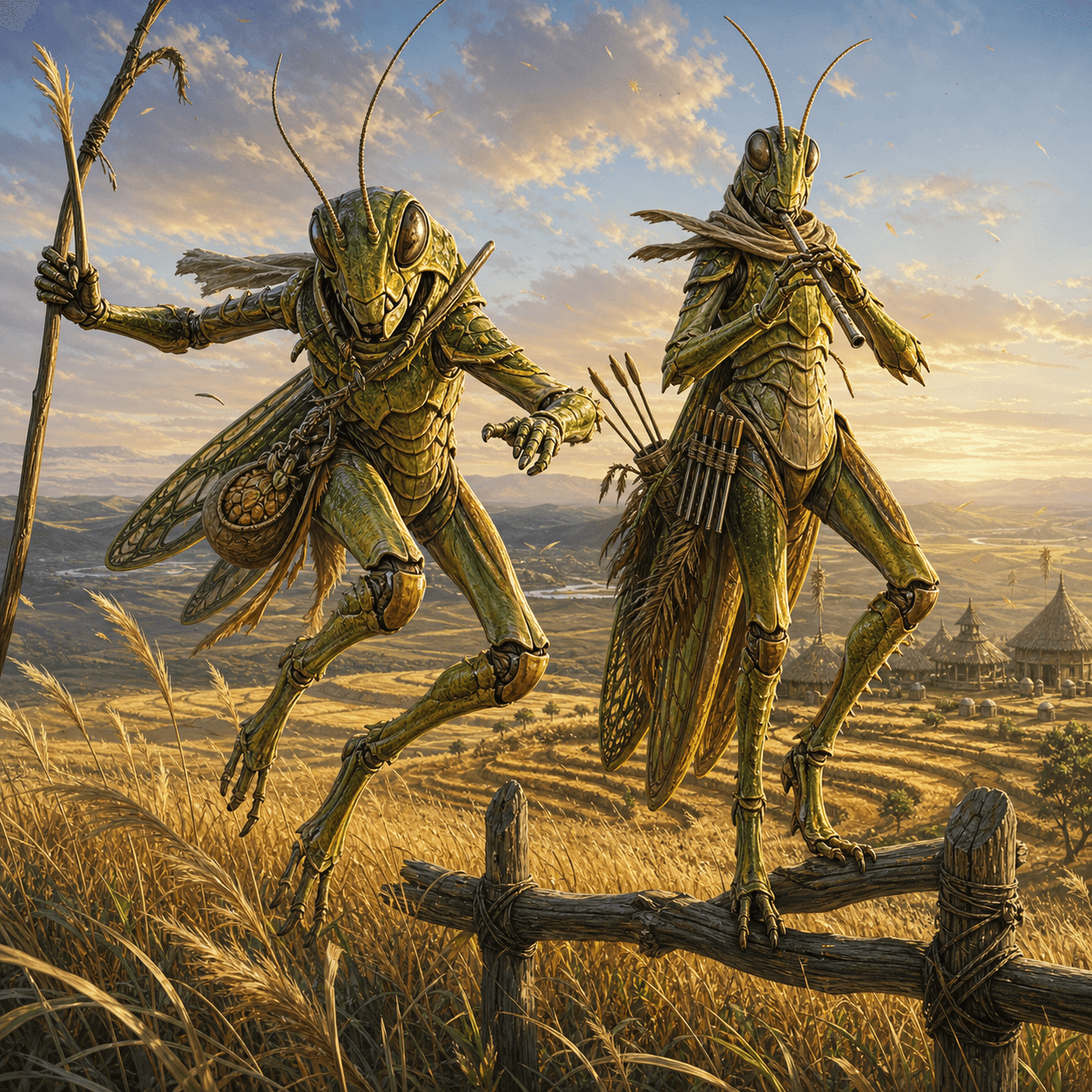
Grasshopper Folk
Caraethe
The Meadow Singers
Background Questions
What meadow or steppe is your home, and what spirits dwell there? Do you still hear them when you're far away?
When did you learn to leap farther than your clutchmates? Was it natural talent, desperation, or something stranger?
What sound brings you joy? A specific rhythm, a bird's call, wind through grass - why does it matter?
Who in your past taught you a song you still whisper to the wind? Are they alive? Do they know what they gave you?
Lore
Grasshopper Folk live by movement and season. They are not conquerors or builders of permanent cities - they are migrants who know the land better than those who try to own it.
Their culture is fundamentally nomadic, designed around the understanding that the best meadow this season will be barren next season, and the frozen steppe you abandon in winter will bloom with food in summer.
They have three known permanent centers - Leapsong Circle, Meadowhome, and Tall-Grass Spire - but these function more as anchor points than true capitals. The population moves between them seasonally, with smaller bands splitting off to follow specific migration routes when weather demands.
Philosophy. The Hymn as Breath and Rhythm
Grasshopper Folk interpret the Hymn of Nature as breath, rhythm, and survival through motion. To them:
Standing still is death. Not metaphorically. The plains don't support permanent population density.
Movement is wisdom. Reading the season, knowing when to leave, following the food - this is intelligence.
Rhythm is unity. The community that moves together, signals together, and breathes together survives.
Music is not decoration. Music is coordination. When your entire culture depends on knowing when to pack up and move, when a predator is near, or where the next water source lies, you develop complex signal systems that work across vast distances in low-visibility terrain.
Social Structure. Runners and Circles
The Seasonal Circles
Grasshopper communities organize around Circles - groups of families that migrate together along established routes.
Circle Names. Often reference the route itself:
The South-Bend Circle (travels the southern arc)
The High-Grass Circle (moves through tallgrass prairie)
The Winter-Stone Circle (knows the winter shelters)
Circle Size. 50-200 individuals, depending on route resources.
Leadership. Usually a Route-Elder - the oldest Grasshopper who knows the route completely, including all the hidden water caches, safe camping sites, and danger zones. Not a commander. A living map.
The Runners
Runners are Grasshopper Folk who specialize in long-distance messaging between Circles and the three permanent centers.
What They Do:
Carry news, warnings, and coordination signals
Scout ahead for hazards (predators, floods, hostile forces)
Maintain the trail markers that guide migration routes
Serve as liaisons between settled peoples and nomadic Circles
Training. Runners learn:
The full rhythm-code (see below)
Every major route and connector path
How to read weather at distance
Combat evasion (Runners don't fight; they escape)
Status. High. Runners are respected because they keep the whole migration network functioning. A Circle without access to Runners is isolated and vulnerable.
Communication. The Leg-Songs
Grasshopper Folk have a biological advantage in long-distance communication: they can produce incredibly loud, rhythmic sounds by rubbing their legs together - a chirring, rasping cadence that carries for miles across open plains.
The Rhythm-Code. A standardized set of patterns used for signals:
Basic Signals (Universal):
Danger-Close. Three sharp chirrs, pause, repeat
Predator-Air. Long rising chirr (mimics a hawk's cry)
Predator-Ground. Short staccato bursts (mimics a running beat)
All-Clear. Single long, descending chirr
Regroup. Alternating high-low pattern
Water-Found. Bubbling rhythm (mimics flowing water)
Complex Messages. Runners and skilled musicians can layer multiple patterns to convey detailed information. This is not a language (you can't have a conversation), but you can communicate what, where, when, and how urgent.
Limitations:
Requires line of sound (doesn't work through walls or dense forest)
Wind can distort distant signals
Predators learn to recognize the patterns (dangerous)
Architecture. Designed to Move
Grasshopper settlements are temporary by design:
Standard Structure:
Pole frames - lightweight wood or bamboo skeletons that can be disassembled in an hour
Woven panels - grass, reed, or hide walls that roll up for transport
Hidden storage pits - Dried food and emergency supplies buried along route at known markers
Trail markers - Subtle (stacked stones, carved grass knots) that only Grasshopper Folk recognize
The Three Permanent Sites. Even the "permanent" centers can be abandoned if necessary. They're built to last, but the people understand: if survival demands moving, we move.
Leapsong Circle
Location. Central Niityt grasslands Function: Cultural and ceremonial heart Description: A massive clearing where the ground has been worn flat by generations of dancing, drumming, and ritual gatherings. No permanent buildings - just a sacred space where Circles converge for festivals. Current Issue: Human farmers are encroaching. Some want to plow the Circle. Grasshopper Folk are getting desperate.
Meadowhome
Location. Eastern plains near forest border Function: Trade interface with settled peoples Description: The only Grasshopper community with semi-permanent structures (still designed for quick abandonment). Merchants from human, elf, and dwarf communities come here to trade. Grasshopper Runners coordinate deliveries. Current Issue: Increased banditry on trade routes. Runners are being targeted.
Tall-Grass Spire
Location. Northern steppe Function: Winter shelter and archive Description: A natural rock formation surrounded by deep grass. The only truly defensible Grasshopper position. Elders store oral histories here, teaching the young during winter months when travel is impossible. Current Issue: Griffin nests nearby. Attacks increasing.
Central Site: The Route Circle
Not a single location - every Circle maintains its own Route Circle, a temporary gathering ring where:
Seasonal migration lanes are debated and agreed
Runner duties are assigned
Inter-Circle marriages are arranged
Disputes are settled through drumming contests (seriously - rhythm battles resolve arguments)
Economy & Trade
Exports:
Messenger runner services (the fastest land communication in Reth)
Musical instruments (drums, scrapers, wind-chimes made from grass and bone)
Rhythm-codes (some wealthy merchants pay to learn basic signals)
Grassland navigation guides (temporary hire for caravans crossing plains)
Imports:
Wood (plains have few trees; lumber is precious)
Dyes (Grasshopper Folk decorate elaborately during festivals)
Metal tools (they don't forge; they trade for it)
Diet:
Leaves and grasses (primary nutrition)
Grains (harvested from wild grass seeds)
Flowers (both food and medicine)
Roots (dug from prairie soil)
Delicacy. Honey-dew (a sweet plant sap they cultivate in hidden patches)
Relations: with Other Peoples
Allies:
Mantids (Caraethu). Mutual respect for patience and observation.
Ant Folk (Caraezor). Trading partners. Ant Folk value Grasshopper reconnaissance.
Enemies:
Predatory Lizards. Hunt Grasshopper Folk in plains zones. Generations of conflict.
Griffins. Aerial predators that target young and elders. Major threat.
Large Birds (Eagles, Hawks). Opportunistic predators.
Complicated:
Human farmers. Sometimes allies (trade, mutual defense). Sometimes enemies (humans plow migration routes, destroy nesting grounds).
Language: Common, Caraezer (insectoid dialect)
Outsider Escalation: Protocol
How Grasshopper Folk respond to strangers:
Warning drums - Distant rhythm signals. "You are being watched"
Offered safe lane - A Runner appears, shows you a path that avoids nesting sites
Denied access to gathering rings - You're kept away from Route Circles and sacred sites
Misdirection across tall grass - If you ignore warnings, Runners lead you in circles until you give up or accept guidance
Coordinated retreat-and-strike - If you attack, the entire Circle vanishes into grass, then strikes from unexpected angles
Swarm defense - If you threaten young, elders, or sacred sites, every adult converges with coordinated leg-song signals
Note. Grasshopper Folk avoid direct confrontation until absolutely necessary. Their survival strategy is be somewhere else when trouble arrives.
Internal Conflicts
Protect Farms vs. Keep Moving
The Divide. Some Grasshopper Circles have established semi-permanent farming plots (wild grain management, cultivated tuber fields). Traditional nomads view this as dangerous attachment that makes them targets.
Current Tension: A Circle that stopped moving for three seasons was wiped out by Lizard Folk raiders who learned where they'd be. Traditionalists say, "We told you." Farmers say, "We had no choice - the migration routes are blocked by human settlements."
Runner Guilds vs. Settled Growers
The Divide. Runners maintain the nomadic network and view themselves as essential. Settled Grasshopper communities (like Meadowhome) argue that Runners drain resources by demanding hospitality without contributing to food production.
Current Tension: Meadowhome refused to provision a Runner band last winter, claiming they had nothing to spare. The Runners reported this to multiple Circles. Now Meadowhome is being socially excluded from the network. Trade is suffering.
Route Disputes When Predators Shift
The Divide. Migration routes are established over generations, but predator territories change. When a traditional route becomes lethal, Circles must decide: risk the known path or take an experimental alternative.
Current Tension: Griffins have nested along the northern winter route. Some Circles want to fight the griffins. Others want to find a new route (which might fail). A third faction wants to negotiate with Mantid allies for coordinated hunting. No consensus. Winter is approaching.
Grasshopper Adventurers. Why They Leave
Grasshopper Folk joining adventuring parties is more common than you'd expect:
The Runner Without a Route. Their Circle was destroyed. They keep running because it's all they know.
The Scout Looking for Safe Paths. Sent ahead to find new migration routes through changing territory.
The Exiled Drummer. Broke taboo (usually related to endangering the Circle through reckless music or false signals). Cast out but still alive.
The Survivor. Griffins, Lizards, or human farmers killed their family. They're seeking strength or vengeance.
The Curious Musician. Wants to learn songs from other cultures. Sent with blessing (or sneaked away without it).
The Winter-Bored Youth. Spent too many months in Tall-Grass Spire listening to elders. Left to see the world during spring thaw.
Lore & Background
Grasshopper Folk live by movement and season. They are not conquerors or builders of permanent cities - they are migrants who know the land better than those who try to own it.
Their culture is fundamentally nomadic, designed around the understanding that the best meadow this season will be barren next season, and the frozen steppe you abandon in winter will bloom with food in summer.
They have three known permanent centers - Leapsong Circle, Meadowhome, and Tall-Grass Spire - but these function more as anchor points than true capitals. The population moves between them seasonally, with smaller bands splitting off to follow specific migration routes when weather demands.
Philosophy. The Hymn as Breath and Rhythm
Grasshopper Folk interpret the Hymn of Nature as breath, rhythm, and survival through motion. To them:
Standing still is death. Not metaphorically. The plains don't support permanent population density.
Movement is wisdom. Reading the season, knowing when to leave, following the food - this is intelligence.
Rhythm is unity. The community that moves together, signals together, and breathes together survives.
Music is not decoration. Music is coordination. When your entire culture depends on knowing when to pack up and move, when a predator is near, or where the next water source lies, you develop complex signal systems that work across vast distances in low-visibility terrain.
Social Structure. Runners and Circles
The Seasonal Circles
Grasshopper communities organize around Circles - groups of families that migrate together along established routes.
Circle Names. Often reference the route itself:
The South-Bend Circle (travels the southern arc)
The High-Grass Circle (moves through tallgrass prairie)
The Winter-Stone Circle (knows the winter shelters)
Circle Size. 50-200 individuals, depending on route resources.
Leadership. Usually a Route-Elder - the oldest Grasshopper who knows the route completely, including all the hidden water caches, safe camping sites, and danger zones. Not a commander. A living map.
The Runners
Runners are Grasshopper Folk who specialize in long-distance messaging between Circles and the three permanent centers.
What They Do:
Carry news, warnings, and coordination signals
Scout ahead for hazards (predators, floods, hostile forces)
Maintain the trail markers that guide migration routes
Serve as liaisons between settled peoples and nomadic Circles
Training. Runners learn:
The full rhythm-code (see below)
Every major route and connector path
How to read weather at distance
Combat evasion (Runners don't fight; they escape)
Status. High. Runners are respected because they keep the whole migration network functioning. A Circle without access to Runners is isolated and vulnerable.
Communication. The Leg-Songs
Grasshopper Folk have a biological advantage in long-distance communication: they can produce incredibly loud, rhythmic sounds by rubbing their legs together - a chirring, rasping cadence that carries for miles across open plains.
The Rhythm-Code. A standardized set of patterns used for signals:
Basic Signals (Universal):
Danger-Close. Three sharp chirrs, pause, repeat
Predator-Air. Long rising chirr (mimics a hawk's cry)
Predator-Ground. Short staccato bursts (mimics a running beat)
All-Clear. Single long, descending chirr
Regroup. Alternating high-low pattern
Water-Found. Bubbling rhythm (mimics flowing water)
Complex Messages. Runners and skilled musicians can layer multiple patterns to convey detailed information. This is not a language (you can't have a conversation), but you can communicate what, where, when, and how urgent.
Limitations:
Requires line of sound (doesn't work through walls or dense forest)
Wind can distort distant signals
Predators learn to recognize the patterns (dangerous)
Architecture. Designed to Move
Grasshopper settlements are temporary by design:
Standard Structure:
Pole frames - lightweight wood or bamboo skeletons that can be disassembled in an hour
Woven panels - grass, reed, or hide walls that roll up for transport
Hidden storage pits - Dried food and emergency supplies buried along route at known markers
Trail markers - Subtle (stacked stones, carved grass knots) that only Grasshopper Folk recognize
The Three Permanent Sites. Even the "permanent" centers can be abandoned if necessary. They're built to last, but the people understand: if survival demands moving, we move.
Leapsong Circle
Location. Central Niityt grasslands Function: Cultural and ceremonial heart Description: A massive clearing where the ground has been worn flat by generations of dancing, drumming, and ritual gatherings. No permanent buildings - just a sacred space where Circles converge for festivals. Current Issue: Human farmers are encroaching. Some want to plow the Circle. Grasshopper Folk are getting desperate.
Meadowhome
Location. Eastern plains near forest border Function: Trade interface with settled peoples Description: The only Grasshopper community with semi-permanent structures (still designed for quick abandonment). Merchants from human, elf, and dwarf communities come here to trade. Grasshopper Runners coordinate deliveries. Current Issue: Increased banditry on trade routes. Runners are being targeted.
Tall-Grass Spire
Location. Northern steppe Function: Winter shelter and archive Description: A natural rock formation surrounded by deep grass. The only truly defensible Grasshopper position. Elders store oral histories here, teaching the young during winter months when travel is impossible. Current Issue: Griffin nests nearby. Attacks increasing.
Central Site: The Route Circle
Not a single location - every Circle maintains its own Route Circle, a temporary gathering ring where:
Seasonal migration lanes are debated and agreed
Runner duties are assigned
Inter-Circle marriages are arranged
Disputes are settled through drumming contests (seriously - rhythm battles resolve arguments)
Economy & Trade
Exports:
Messenger runner services (the fastest land communication in Reth)
Musical instruments (drums, scrapers, wind-chimes made from grass and bone)
Rhythm-codes (some wealthy merchants pay to learn basic signals)
Grassland navigation guides (temporary hire for caravans crossing plains)
Imports:
Wood (plains have few trees; lumber is precious)
Dyes (Grasshopper Folk decorate elaborately during festivals)
Metal tools (they don't forge; they trade for it)
Diet:
Leaves and grasses (primary nutrition)
Grains (harvested from wild grass seeds)
Flowers (both food and medicine)
Roots (dug from prairie soil)
Delicacy. Honey-dew (a sweet plant sap they cultivate in hidden patches)
Relations: with Other Peoples
Allies:
Mantids (Caraethu). Mutual respect for patience and observation.
Ant Folk (Caraezor). Trading partners. Ant Folk value Grasshopper reconnaissance.
Enemies:
Predatory Lizards. Hunt Grasshopper Folk in plains zones. Generations of conflict.
Griffins. Aerial predators that target young and elders. Major threat.
Large Birds (Eagles, Hawks). Opportunistic predators.
Complicated:
Human farmers. Sometimes allies (trade, mutual defense). Sometimes enemies (humans plow migration routes, destroy nesting grounds).
Language: Common, Caraezer (insectoid dialect)
Outsider Escalation: Protocol
How Grasshopper Folk respond to strangers:
Warning drums - Distant rhythm signals. "You are being watched"
Offered safe lane - A Runner appears, shows you a path that avoids nesting sites
Denied access to gathering rings - You're kept away from Route Circles and sacred sites
Misdirection across tall grass - If you ignore warnings, Runners lead you in circles until you give up or accept guidance
Coordinated retreat-and-strike - If you attack, the entire Circle vanishes into grass, then strikes from unexpected angles
Swarm defense - If you threaten young, elders, or sacred sites, every adult converges with coordinated leg-song signals
Note. Grasshopper Folk avoid direct confrontation until absolutely necessary. Their survival strategy is be somewhere else when trouble arrives.
Internal Conflicts
Protect Farms vs. Keep Moving
The Divide. Some Grasshopper Circles have established semi-permanent farming plots (wild grain management, cultivated tuber fields). Traditional nomads view this as dangerous attachment that makes them targets.
Current Tension: A Circle that stopped moving for three seasons was wiped out by Lizard Folk raiders who learned where they'd be. Traditionalists say, "We told you." Farmers say, "We had no choice - the migration routes are blocked by human settlements."
Runner Guilds vs. Settled Growers
The Divide. Runners maintain the nomadic network and view themselves as essential. Settled Grasshopper communities (like Meadowhome) argue that Runners drain resources by demanding hospitality without contributing to food production.
Current Tension: Meadowhome refused to provision a Runner band last winter, claiming they had nothing to spare. The Runners reported this to multiple Circles. Now Meadowhome is being socially excluded from the network. Trade is suffering.
Route Disputes When Predators Shift
The Divide. Migration routes are established over generations, but predator territories change. When a traditional route becomes lethal, Circles must decide: risk the known path or take an experimental alternative.
Current Tension: Griffins have nested along the northern winter route. Some Circles want to fight the griffins. Others want to find a new route (which might fail). A third faction wants to negotiate with Mantid allies for coordinated hunting. No consensus. Winter is approaching.
Grasshopper Adventurers. Why They Leave
Grasshopper Folk joining adventuring parties is more common than you'd expect:
The Runner Without a Route. Their Circle was destroyed. They keep running because it's all they know.
The Scout Looking for Safe Paths. Sent ahead to find new migration routes through changing territory.
The Exiled Drummer. Broke taboo (usually related to endangering the Circle through reckless music or false signals). Cast out but still alive.
The Survivor. Griffins, Lizards, or human farmers killed their family. They're seeking strength or vengeance.
The Curious Musician. Wants to learn songs from other cultures. Sent with blessing (or sneaked away without it).
The Winter-Bored Youth. Spent too many months in Tall-Grass Spire listening to elders. Left to see the world during spring thaw.
Biological Dimorphism
Caraethe females are commonly larger through the abdomen and jumping legs, with heavier grassland-built frames and ovipositor-like silhouettes in some lineages. Males are often slimmer, louder in display-song traditions, and more brightly marked along the wings or legs. The difference is read in limb, abdomen, wing, and sound, not human body shape.
Checking your codex…
From the Reth Ancestries (Daggerheart) compendium. Ancestry mechanics unlock when you collect this lineage in Hoard and link your account.