Insectoids
Mantid
Caraethu
The Ritual Hunters
Background Questions
Who taught you the rites of the Ritual Hunt? Was it your clutch-mother, a revered elder, or someone outside your people who saw something in you?
What predator nearly took your life during your first solo trial? How does that experience shape how you hunt now?
What sacred prey are your people sworn never to harm? Is it a creature, a species, or something more specific to your clutch's beliefs?
Who in your clutch sees you as their protector? Are you living up to that expectation, or running from it?
Lore
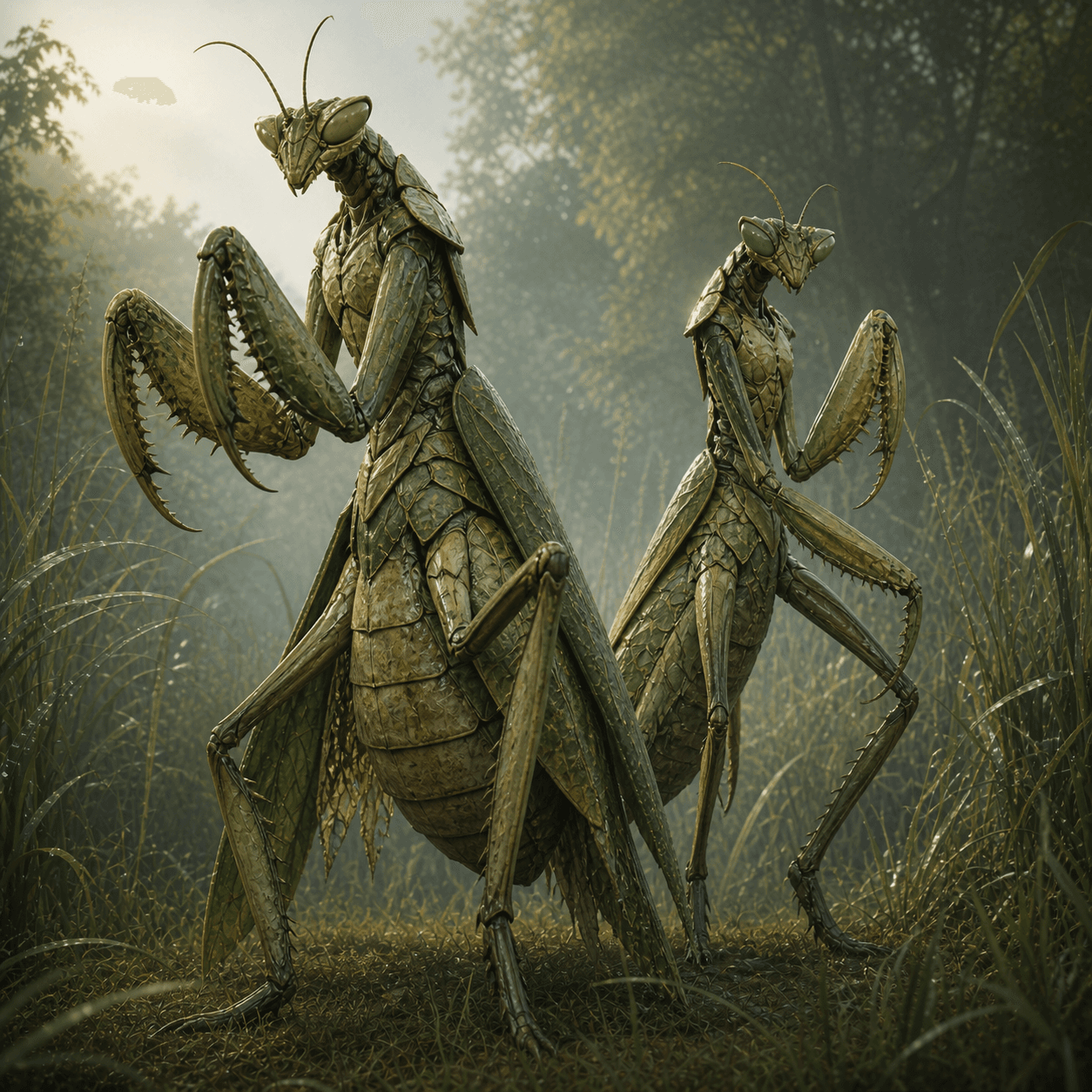
Mantids are quiet, ritual-bound hunters who value silence, patience, and precision above all else. They do not shout. They do not boast. They move when movement serves, and they wait when waiting wins.
Their communities are closed-off and self-contained, operating with leadership structures that vary wildly by settlement:
Some follow a tribal chief chosen through combat or consensus
Others keep a small council of experienced hunters
Still others defer to a religious interpreter who reads the Hymn of Nature through hunt law and restraint
There is no centralized Mantid authority across Reth. Each settlement governs itself.
Philosophy. The Hymn as Patience
Mantids interpret the Hymn of Nature as patience, clean necessity, and restraint. Their philosophy can be summarized as:
Take what is needed. No more.
Do not waste. Every kill has a purpose.
Do not show off. Pride invites danger.
Do not bring danger back to the clutch. The young must be protected above all else.
This is not pacifism. Mantids are apex predators. But they are purposeful predators. A Mantid who kills for display, who wastes meat, or who hunts recklessly near clutch-grounds is not impressive - they are dangerous to everyone.
Social Structure. Clutch and Hunt
Communal Clutch Care
Young Mantids (called clutch-kin until they complete their first solo trial) are raised communally. Every adult in a settlement shares responsibility for feeding, teaching, and protecting the young.
This is not viewed as charity or kindness. It is shared duty - as fundamental as breathing. A Mantid who neglects clutch-duty without reason (injury, hunt obligation) loses standing in the community.
Biological parents are acknowledged but not given special authority. The clutch belongs to everyone. An orphaned Mantid is not pitied; they simply have more teachers.
The Ritual Hunt
A Ritual Hunt is not just killing something difficult. It is a personal vow with social weight.
The Process:
The hunter declares their target (specific creature, specific criminal, specific threat)
They paint the target's likeness or mark onto reed paper
They wear this mark as a necklace, visible to all
They pursue the hunt until success or formal withdrawal
Why This Matters:
If the hunt goes wrong (the hunter dies, innocents are harmed, the target escapes and retaliates), the community knows exactly whose decision it was
The mark is accountability made visible
Completing a marked hunt earns respect
Abandoning one (without formal withdrawal and explanation) earns suspicion
Formal Withdrawal. A hunter may withdraw from a marked hunt by bringing the reed paper to the Stillring and publicly explaining why. This is not shameful if the reason is sound ("I was wrong about the threat," "The target has fled beyond my ability to pursue," "I am needed here more"). It is shameful if the reason is pride or fear.
The Stillring
Every Mantid settlement has a Stillring - a quiet circle of reed posts and marked tree trunks where:
Hunters swear new marks
Disputes are settled (often through ritual combat, sometimes through elder mediation)
Clutch-guard rotations are assigned
Community decisions are made through consensus
The Stillring is sacred space. Violence here (except during formal duels) is one of the few crimes Mantids exile for immediately.
The Two Great Taboos
1. Endangering the Clutch
Bringing danger to where the young are kept - through recklessness, pride, or deliberate malice - is the gravest crime.
Examples:
Leading predators back to the settlement
Starting fights near clutch-grounds
Revealing settlement locations to outsiders who prove hostile
Punishment. Exile. Always exile. The risk is too high to allow a second chance.
2. The Spoiled Hunt
Killing for sport or deliberately spoiling a hunt are both violations of the Hymn.
What counts as spoiling:
Wounding prey and leaving it to suffer when you don't intend to finish the kill
Wasting meat or resources from a successful hunt
Lore & Background
Mantids are quiet, ritual-bound hunters who value silence, patience, and precision above all else. They do not shout. They do not boast. They move when movement serves, and they wait when waiting wins.
Their communities are closed-off and self-contained, operating with leadership structures that vary wildly by settlement:
Some follow a tribal chief chosen through combat or consensus
Others keep a small council of experienced hunters
Still others defer to a religious interpreter who reads the Hymn of Nature through hunt law and restraint
There is no centralized Mantid authority across Reth. Each settlement governs itself.
Philosophy. The Hymn as Patience
Mantids interpret the Hymn of Nature as patience, clean necessity, and restraint. Their philosophy can be summarized as:
Take what is needed. No more.
Do not waste. Every kill has a purpose.
Do not show off. Pride invites danger.
Do not bring danger back to the clutch. The young must be protected above all else.
This is not pacifism. Mantids are apex predators. But they are purposeful predators. A Mantid who kills for display, who wastes meat, or who hunts recklessly near clutch-grounds is not impressive - they are dangerous to everyone.
Social Structure. Clutch and Hunt
Communal Clutch Care
Young Mantids (called clutch-kin until they complete their first solo trial) are raised communally. Every adult in a settlement shares responsibility for feeding, teaching, and protecting the young.
This is not viewed as charity or kindness. It is shared duty - as fundamental as breathing. A Mantid who neglects clutch-duty without reason (injury, hunt obligation) loses standing in the community.
Biological parents are acknowledged but not given special authority. The clutch belongs to everyone. An orphaned Mantid is not pitied; they simply have more teachers.
The Ritual Hunt
A Ritual Hunt is not just killing something difficult. It is a personal vow with social weight.
The Process:
The hunter declares their target (specific creature, specific criminal, specific threat)
They paint the target's likeness or mark onto reed paper
They wear this mark as a necklace, visible to all
They pursue the hunt until success or formal withdrawal
Why This Matters:
If the hunt goes wrong (the hunter dies, innocents are harmed, the target escapes and retaliates), the community knows exactly whose decision it was
The mark is accountability made visible
Completing a marked hunt earns respect
Abandoning one (without formal withdrawal and explanation) earns suspicion
Formal Withdrawal. A hunter may withdraw from a marked hunt by bringing the reed paper to the Stillring and publicly explaining why. This is not shameful if the reason is sound ("I was wrong about the threat," "The target has fled beyond my ability to pursue," "I am needed here more"). It is shameful if the reason is pride or fear.
The Stillring
Every Mantid settlement has a Stillring - a quiet circle of reed posts and marked tree trunks where:
Hunters swear new marks
Disputes are settled (often through ritual combat, sometimes through elder mediation)
Clutch-guard rotations are assigned
Community decisions are made through consensus
The Stillring is sacred space. Violence here (except during formal duels) is one of the few crimes Mantids exile for immediately.
The Two Great Taboos
1. Endangering the Clutch
Bringing danger to where the young are kept - through recklessness, pride, or deliberate malice - is the gravest crime.
Examples:
Leading predators back to the settlement
Starting fights near clutch-grounds
Revealing settlement locations to outsiders who prove hostile
Punishment. Exile. Always exile. The risk is too high to allow a second chance.
2. The Spoiled Hunt
Killing for sport or deliberately spoiling a hunt are both violations of the Hymn.
What counts as spoiling:
Wounding prey and leaving it to suffer when you don't intend to finish the kill
Wasting meat or resources from a successful hunt
Killing something just to feel power (especially if you don't even use the body)
Sabotaging another hunter's marked hunt out of jealousy or spite
Punishment. Varies by severity. Minor waste might be shaming and loss of status. Deliberate malicious spoiling (ruining someone else's hunt) can lead to exile or formal duel.
Cities: & Territory
Homeland: Grassland reeds, forest canopy borders - anywhere vertical cover and patience give advantage.
Principal Cities:
High-Branch Roosts. Canopy-level settlements built into massive trees, connected by woven bridges only Mantids can navigate easily
Reedspire. A wetland settlement built on stilts among dense reed forests, nearly invisible from ground level
Quiet Nest. A valley settlement known for producing the finest reed-paper and hosting the longest-running Stillring in Mantid history
Central Site: The Stillring (varies by settlement, but concept is universal)
Economy & Trade
Exports:
Meat (expertly butchered, nothing wasted)
Fine-cut bonecraft (Mantid precision makes them exceptional bone-carvers)
Reed-paper (used for writing, ritual marks, and art)
Imports:
Cloth (Mantids wear minimal clothing but value wraps and carrying slings)
Pigments (for ritual marks and clutch decorations)
Diet:
Insects (primary protein)
Small game (hunted with precision)
Aromatic herbs (valued for both flavor and ritual use)
Relations: with Other Peoples
Allies:
Dragonfly Folk (Caraemar). Mutual respect. Both value patience and precision.
Ant Folk (Caraezor). Trade partners. Mantids respect their discipline.
Enemies:
Snakefolk. Ancient territorial disputes and hunting ground conflicts
Draegul raiders. Predators who threaten clutches earn permanent enmity
Language: Common, Caraezer (insectoid dialect)
Outsider Escalation: Protocol
How Mantids respond to strangers in their territory:
Unseen watch - You're observed but not contacted
Boundary misdirection - Subtle signs push you toward the border
Single clear warning - One Mantid appears, explains you're trespassing, points you out
Escort out - Multiple Mantids appear and physically guide you to the border
Removal by force - Non-lethal takedown and forcible ejection
Clutch threat = lethal response - If you approach clutch-grounds after warnings, Mantids will kill you
Note. Mantids rarely skip steps unless you're actively threatening young. If you're cooperative at any stage, they'll de-escalate.
Internal Conflicts
Strict Ritualists vs. Practical Border Scouts
The Divide. Some Mantids believe every hunt must be formally marked and conducted with full ritual. Border scouts argue that threats don't wait for ceremony - sometimes you kill what needs killing and explain later.
Current Tension: Draegul raids have increased. Scouts who kill raiders without marking them first are saving lives but violating tradition. Elders are divided.
Communal Clutch Duty vs. Glory-Seekers
The Divide. Traditional Mantids prioritize clutch-duty above personal achievement. Younger Mantids (especially those who've traveled) sometimes pursue marked hunts for reputation rather than necessity.
Current Tension: A small but growing number of young Mantids are marking hunts for creatures far from home, leaving for months or years. Elders worry this is abandoning clutch responsibility for selfish glory.
Isolation vs. Selective Trade
The Divide. Some settlements want to maintain complete isolation (safer for clutches). Others argue controlled trade brings resources that make the community stronger.
Current Tension: High-Branch Roosts has begun regular trade with Dragonfly Folk river-guides. Quiet Nest views this as dangerous precedent. The two settlements are not speaking.
Mantid Adventurers. Why They Leave
Despite being community-focused, Mantids do leave home. Common reasons:
The Marked Hunt. Following a target that fled their territory
The Failed Protector. Someone under their protection died. They left in shame or seeking redemption.
The Exile. Violated taboo (usually clutch-endangerment) and was cast out
The Seeker. Wants to learn hunting techniques from other cultures
The Scout. Sent to establish trade contacts or gather intelligence on distant threats
The Orphaned Clutch. Their entire settlement was destroyed. They wander seeking a new community or vengeance.
Biological Dimorphism
Caraethu dimorphism follows mantis traits rather than mammalian ones. Females are often taller and heavier through the abdomen and thorax, with broader raptorial forearms and stronger clutch-guard builds. Males tend to be lighter, longer-winged, and more agile, with slimmer abdominal segments. Both remain fully chitinous, with plated thoraxes rather than human secondary sex traits.
Checking your codex…
From the Reth Ancestries (Daggerheart) compendium. Ancestry mechanics unlock when you collect this lineage in Hoard and link your account.