Insectoids
Scorpion Folk
Caraeter
Background Questions
What vision drove your tribe to withdraw from the war?
What secret tradition are you sworn never to reveal?
What desert creature taught you your first lesson in survival?
How does your clan mark adulthood?
Lore
Scorpion Folk are theological, cautious, and intentionally hard to reach. Their desert homeland is Khar-Duo, and their true routes are protected by layered secrecy: trained scouts, false burrow networks, and a cultural rule that only certain adults learn the real paths. Outsiders who chase rumors find dead ends, decoy entrances, and misleading surface signs.
They worship the Hymn of Nature as survival, consequence, and the hard law of the desert. Their leader, the Arch Shaman, is chosen through a Vision Gathering - elders meet, burn sacred desert resins and drink bitter vision-cactus tea, then wait for the Hymn's will to make itself known through shared visions and consensus.
They live underground in sandstone structures, using terrain control and discipline rather than open war. Their economy centers on hidden gem mines beneath Khar-Duo. Silk is not their export; it is an import acquired through Spider Folk trade.
Homeland: Khar-Duo (deep desert)
Principal Cities: Zash-Teth, Sand-Crawl, Burrow-Keep
Central Site: The Vision Vault (sealed sandstone chamber for Vision Gatherings, lineage records, and oath-keeping)
Chief Export: Gems (cut stones and raw finds from hidden mines)
Chief Import: Spider silk items; spiced cactus & fruits
Diet: Spiced cacti, cactus fruits
Allies: Desert Amphibians; Spider Folk (trade tie)
Enemies: Snake Folk; Batfolk (war memory)
Language: Common, Caraezer
Outsider Escalation: false trails and decoys → shadowing from below → warning markers → restrained/removed → lethal if a true entrance is breached or a clan chamber is threatened
Internal Conflicts: isolation doctrine vs trade necessity; rival vision interpretations among elders; youth pressure to see the surface vs elders' fear of repeating the war
Lore & Background
Overview
Scorpion Folk are theological, cautious, and intentionally hard to reach. Their desert homeland is Khar-Duo, in the deep desert, and their true routes are protected by layered secrecy - trained scouts, false burrow networks, and a cultural rule that only certain adults learn the real paths. Outsiders who chase rumors find dead ends, decoy entrances, and misleading surface signs. This is not paranoia. It is the doctrine of a people who watched their surface civilization get destroyed in a war engineered against them, withdrew underground, and decided never to make that mistake again.
They deal with the wider world exclusively through Desert Amphibian intermediaries. Goods go out. Silk and spices and fruit come in. No Caraeter name is attached to the transaction. The arrangement has worked for a hundred years. They see no reason to revise it.
The War and What It Cost
The War of Wing and Venom began with engineered lies and ended with the destruction of the Caraeter's surface civilization. Talsazer framed an assassination to ignite conflict between the Bat Folk and the Scorpion Folk, then released a plague in the Scorpion Folk capital to deepen the hatred before either side could think clearly. By the time General Raza'keth and Bat Folk Shaman Khyla Nightwind uncovered the truth - that the war had been manufactured, that neither people was the actual enemy - they were already years into a conflict that had taken everything the Caraeter had built on the surface.
Raza'keth and Khyla forged the Sundering Scarab together at a crafting temple. Talsazer destroyed the temple when the ritual completed. Both were buried. Khar-Duo was already ash. The Bat Folk withdrew - no one has agreed on why - and the war ended in a silence that felt nothing like peace.
A Caraeter child retrieved the Scarab from the rubble before loyalists could claim it. She carried it into the hidden holds and eventually to the Lifespring buried beneath the old temple site. She became the Seer - The One Who Wears Black - and lives there still, an agent of the Lightbringers, guardian of the artifact that ended the war that destroyed her people's surface world. Keth-Zar, the current Arch Shaman, knows she exists. He does not know what she guards.
Social Structure & Upbringing
Caraeter society is a theological society led by the Arch Shaman, who holds both spiritual and political authority. The two are not separable in Caraeter understanding. Policy is spiritual decision-making applied to practical circumstances. The Arch Shaman is chosen through a Vision Gathering - elders meet, use mind-altering desert substances, and wait for the Hymn's will to make itself known through shared visions and consensus. The title of the current Arch Shaman is Keth-Zar. That is a title, not a name.
Below the Arch Shaman, the three underground cities each maintain councils of senior shamans who govern local matters and advise on wider ones. What Zash-Teth produces, Sand-Crawl may need, and Burrow-Keep connects them. The cities cooperate as a matter of survival. Open conflict between them has not occurred since the retreat underground. The Arch Shaman's authority exists partly to ensure it does not.
Young Caraeter are raised inside the cities. They know the underground architecture, the tunnel systems, the ways out that are not the ways in. Coming of age involves a solo navigation of the route between two cities through unmapped connective tunnels. There is no time limit. The point is that every adult Caraeter knows the underground better than any outsider ever will. Only certain adults then learn the real surface routes - this knowledge is earned, not assumed.
Appearance
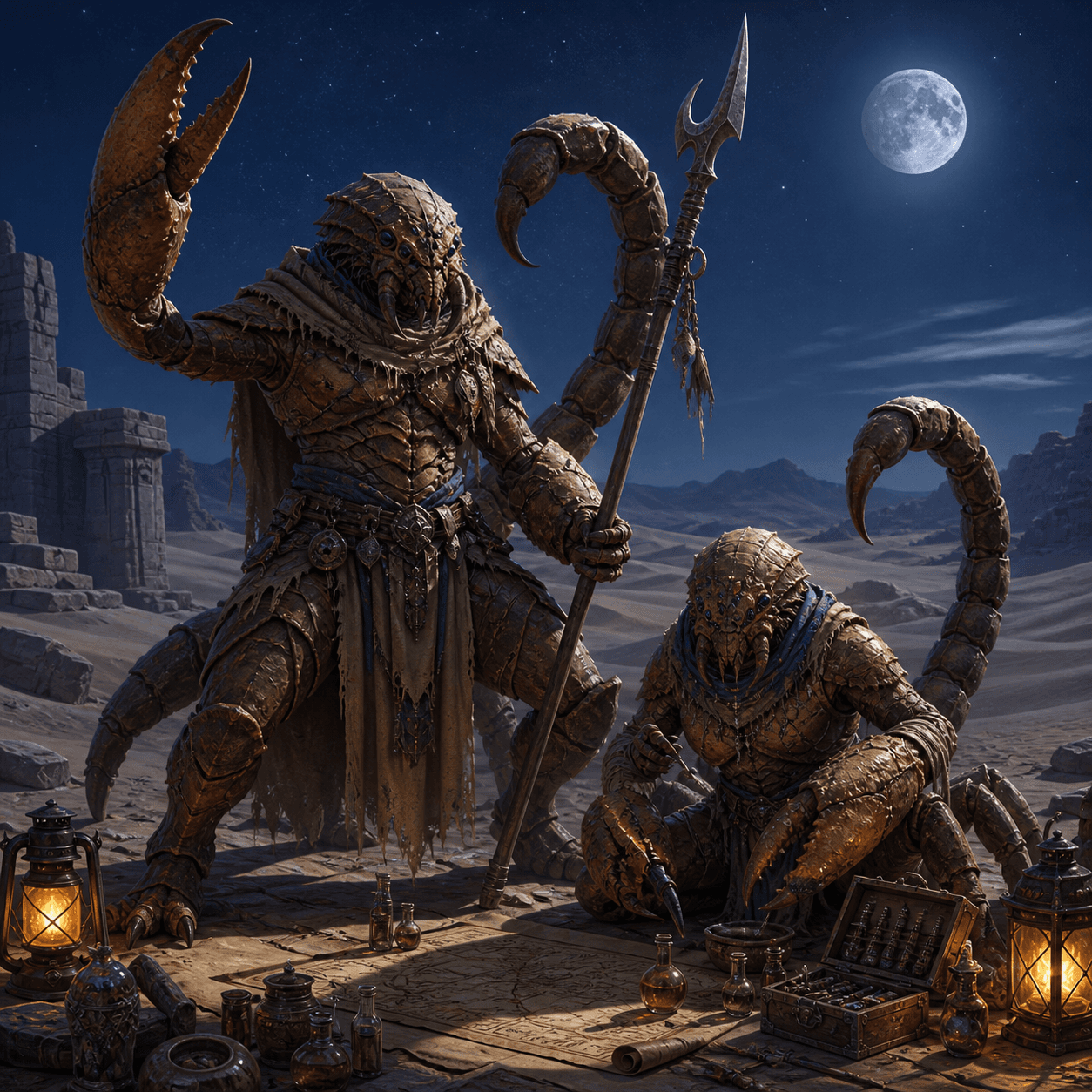
Caraeter are scorpionoid humanoids - heavily built through the torso and upper limbs, with a functional sting tail and chitin plating across the back, shoulders, and upper arms. Their coloring runs from deep red-brown through dark amber to near-black, with older bloodlines showing a faint iridescence in the chitin under underground light. Their eyes are adapted for low-light and absolute darkness - compound, wide-set, and reflective.
They dress in layered cloth over their natural chitin - practical, dark-colored, designed for underground movement. The tail is always visible. Caraeter do not conceal it. What they do conceal is their faces, often under hoods and wrappings, particularly when dealing with outsiders through intermediaries. The Desert Amphibians who carry their trade goods see what the Caraeter permit them to see.
Religion: & Philosophy
The Caraeter worship the Hymn of Nature as survival, consequence, and the hard law of the desert. The desert teaches what holds and what does not. The venom teaches consequence. The underground teaches patience and the cost of exposure. Their shamanic tradition is built around reading - of dreams, of physical signs, of the behavior of deep tunnel creatures, of the stability of underground geology. What the shamans read shapes policy. The dream of extinction that pulled the Caraeter underground was not treated as a metaphor. It was read as information, acted on immediately, and has not been revisited.
The Arch Shaman is chosen through a Vision Gathering - not appointed, not inherited. Elders gather in the Vision Vault, use the mind-altering desert substances their tradition has cultivated across generations, and wait for the Hymn's will to make itself known through shared visions and consensus. The process is not fast. It is not meant to be. The wrong Arch Shaman is a catastrophe the Caraeter cannot afford.
Relationships with Other Ancestries
The Caraeter deal with the world through Desert Amphibian intermediaries specifically because they prefer their actual location, numbers, and capabilities to remain unknown to outside peoples. This has been successful. Hundred-year-old rumors about where the underground cities are have not been confirmed. Peoples who have tried to find them have found decoys and dead ends.
Their relationship with the Caraenal (Spider Folk) is a trade tie and a wartime memory. The Spider Folk silk they import is one of the things the underground cities could not produce themselves. The wartime bond is remembered. It does not need to be formalized to be real.
The Batfolk are enemies - the war memory runs deep. The knowledge that Talsazer engineered the conflict does not erase what the war cost. It complicates what it means to hold the Batfolk responsible. The Caraeter are still working through what that means. The Snake Folk are also held as enemies, for reasons that predate the war and are not widely discussed with outsiders.
Military Presence
The Caraeter do not project force and have not since the retreat underground. What they have is a complete underground civilization that has been optimizing its defensive architecture for a hundred years. The unmapped connective tunnels that every adult Caraeter navigates as a coming-of-age rite are also, functionally, a defensive maze. Their sting is venomous. Their terrain is theirs. Anyone who comes to them comes into their terrain. This has been sufficient.
Cultural Traits
The Caraeter survived what should have destroyed them, went underground, built three cities, and have not asked the surface world for anything since. There is a particular kind of pride in that, held very quietly. They do not perform strength. They do not perform grief. What they perform is continuity - the daily maintenance of a civilization that the surface world largely believes does not exist anymore, which the Caraeter find more useful than correcting the assumption.
The youth press against this. They want to see the surface. The elders' answer is the war. Whether that answer continues to hold is one of the Caraeter's central unresolved tensions.
Species Name. Caraeter
Languages: Common and Caraezer
Homeland: Khar-Duo - deep desert
Principal Cities: Zash-Teth, Sand-Crawl, Burrow-Keep
Central Site: The Vision Vault - sealed sandstone chamber for Vision Gatherings, lineage records, and oath-keeping
Government: Theological society led by the Arch Shaman (current title: Keth-Zar). Arch Shaman chosen through Vision Gathering. City councils of senior shamans handle local governance.
Buildings: Underground obsidian and sandstone structures. Three cities connected by tunnel networks including unmapped connective routes known only to adult Caraeter.
Religion: The Hymn of Nature as survival, consequence, and the hard law of the desert.
Export: Gems - cut stones and raw finds from hidden mines beneath Khar-Duo
Import: Spider silk items (from Caraenal trade); spiced cactus and fruits
Diet: Spiced cacti, cactus fruits
Allies: Desert Amphibians (trade intermediaries); Caraenal (Spider Folk) - trade tie and wartime bond
Enemies: Batfolk (war memory); Snake Folk
Naming Convention. Descriptive titles with outsiders. Keth-Zar is the title of the Arch Shaman, not a personal name.
Outsider Escalation: False trails and decoys → shadowing from below → warning markers → restrained and removed → lethal if a true entrance is breached or a clan chamber is threatened
Internal Conflicts: Isolation doctrine vs trade necessity; rival vision interpretations among elders; youth pressure to see the surface vs elders' fear of repeating the war
Aldaedra- Saurids
Biological Dimorphism
Caraeter dimorphism is read through the mesosoma, metasoma, pectines, pincers, and venom-bearing tail. Females are often broader and heavier through the body, while males in some clans are leaner with longer tails or more pronounced sensory structures. Both are scorpion folk first: chitin, plates, claws, and tail define the silhouette rather than mammalian anatomy.
Checking your codex…
From the Reth Ancestries (Daggerheart) compendium. Ancestry mechanics unlock when you collect this lineage in Hoard and link your account.