Insectoids
Spider Folk
Caraenal
Background Questions
What masterpiece of silkwork did you leave behind?
Why did your kin flee the Batfolk territory?
Who in your hometown still waits for your return?
What tale of grief binds your clan together?
Lore
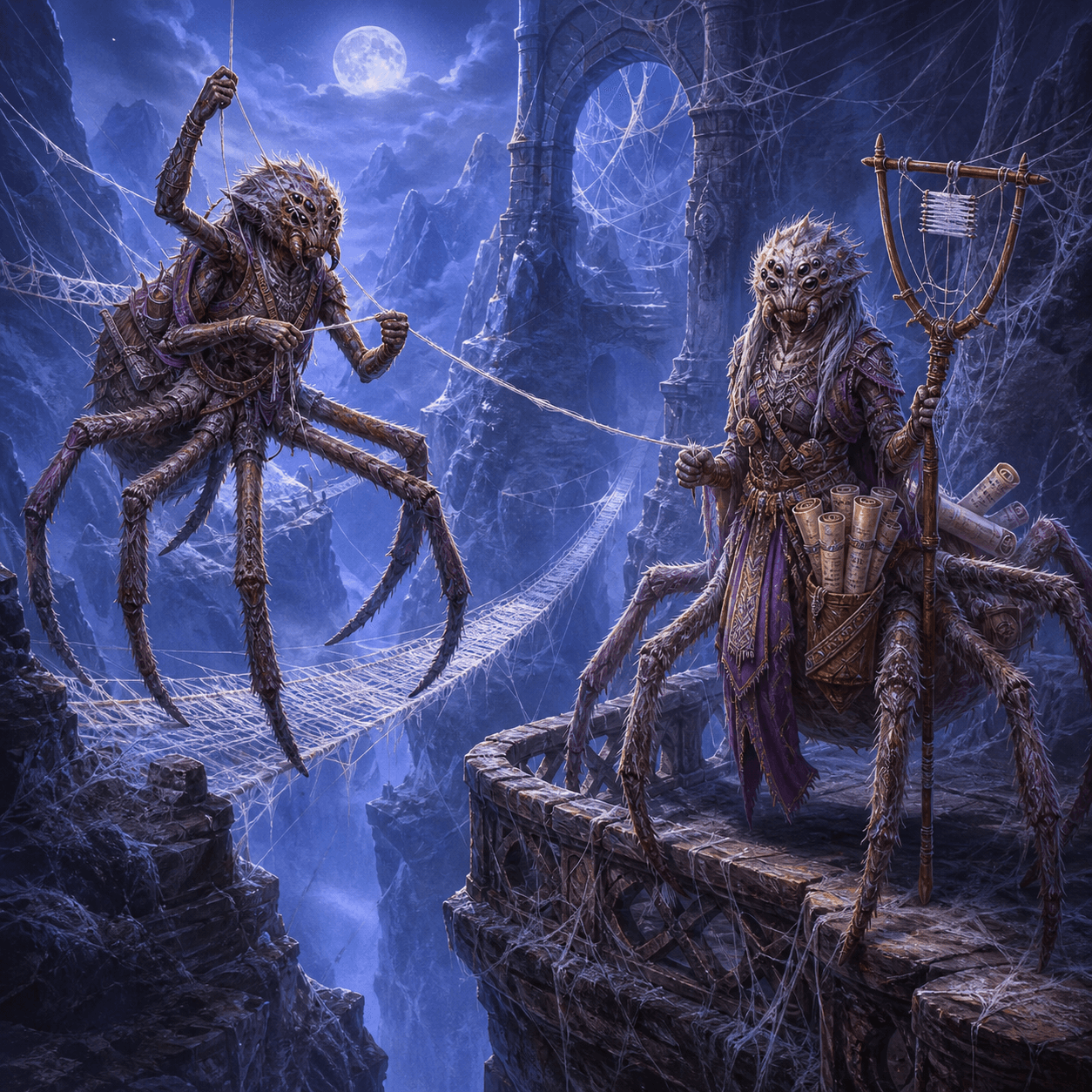
Spider Folk dwell in the central-east mountains near the Spider Gate, in a region they call the Great Web. Their settlements are underground cavern networks threaded with engineered silk-lattices that function as bridges, load supports, sound control, and layered barriers. Few non-spiders can navigate these spaces without getting lost or restrained, and the Spider Folk prefer it that way.
They worship the Hymn of Nature as craft, patience, and binding strength - the belief that what holds is worthy. Authority tends to sit with pattern-houses and workshops that produce reliable silkwork and keep trade stable.
During the Second War, Spider Folk aided the Scorpion Folk, using web engineering and bows meant to bring down Batfolk flyers. That alliance is remembered in old patterns and heirloom designs still taught in certain workshops.
Trade is controlled through designated halls. Outsiders meet Spider Folk on fixed lanes, with strict rules: do not cut silk, do not burn webbing, do not touch hatch chambers, and do not wander.
Homeland: The Great Web (central-east mountains near the Spider Gate)
Principal Cities: Silkdeep, Loom-Hall, Underpeak
Central Site: The Pattern Vault (where core patterns, workshop debts, and trade oaths are recorded)
Chief Export: Spider silk items
Chief Import: Fish
Diet: Hazelnut pies, Bottle Drum Fly
Allies: Dwarves; Scorpion Folk (wartime bond remembered)
Enemies: Batfolk
Language: Common, Caraezer
Outsider Escalation: watched → rules stated once → escorted trade lane → restrained and questioned → expelled → lethal if you threaten hatch chambers or burn silkworks
Internal Conflicts: isolationists vs trade houses; old-war grief factions; pattern theft accusations between workshops
Lore & Background
Spider Folk dwell in the central-east mountains near the Spider Gate, in a region they call the Great Web. Their settlements are underground cavern networks threaded with engineered silk-lattices that function as bridges, load supports, sound control, and layered barriers. Few non-spiders can navigate these spaces without getting lost or restrained, and the Caraenal prefer it that way. They are skilled weavers and craftsmen - their silk is valued across Reth for its incredible durability, waterproof make, and flexibility. No one else makes it. This is not an accident.
They are moderately welcoming to those who make the journey to reach them. The journey itself is the first filter. You do not stumble into Caraenal territory. You either know where you are going and what you are asking for, or you do not arrive at all.
Role Among the Caraezer
During the War of Wing and Venom, the Caraenal sided with the Scorpion Folk. They used web engineering and bows designed to bring down Batfolk flyers, and secured cavern corridors that would otherwise have been cut apart. That alliance is remembered in old patterns and heirloom designs still taught in certain workshops. The Batfolk are enemies. This has not changed.
Since the war, the Caraenal have returned to what they were before it - a people who control access to their homeland and to their silk, deal with outsiders on their own terms, and prefer the rest of Reth to find them slightly difficult to approach.
Social Structure & Upbringing
Authority in Caraenal society sits with pattern-houses and workshops - the organizations that produce reliable silkwork and keep trade stable. A pattern-house that maintains quality and honors its debts accumulates standing. One that does not loses access to the trade lanes, and without the trade lanes, it loses everything. Leadership is not hereditary in a formal sense. It accrues to whoever runs the operations that matter.
The Pattern Vault is the central site of Caraenal governance - a sealed chamber where core patterns, workshop debts, and trade oaths are recorded. Disputes between pattern-houses are settled by reference to the Vault's records. An oath recorded in the Vault is binding. An oath not recorded there is an informal arrangement and treated accordingly.
Young Caraenal learn silk production before they learn most other things. The process is technical, physically demanding, and rewards patience - which is culturally reinforced from early on. Coming of age is marked when a young Caraenal produces their first full bolt of finished silk, graded by the pattern-house elders, priced, and sold. The proceeds go to the young weaver. What they do with it tells the community something about who they are becoming.
Appearance
Caraenal are arachnoid humanoids - multiple limbs, with the upper pair adapted for fine manipulation and the rest for movement and anchoring. Their chitin runs from pale cream to deep amber-brown to near-black depending on which part of the Great Web their bloodline comes from. Their eyes are compound and low-light adapted. They move with a quietness that is structural rather than trained - multiple contact points distribute weight, and there is no single heavy footfall.
Caraenal dress is typically their own silk, layered and functional. What outsiders sometimes mistake for decorative webbing on their clothing is structural - designed to hold tools, goods, or weapons at specific angles for quick access. Their hold-spaces are built for their body type: narrow corridors, multiple ceiling anchor points, light sources positioned for compound eye vision rather than human vision. Outsiders find their holds disorienting. This is not accidental.
Religion: & Philosophy
The Caraenal worship the Hymn of Nature as craft, patience, and binding strength - the belief that what holds is worthy. This is not a metaphor for them. The silk that holds a bridge together under load is the most direct expression of the divine they recognize. Work that lasts is sacred. Work that fails is not. Their spiritual practitioners read the physical webs of the hold for omen and meaning - a web damaged in a specific way speaks of disruption coming; a web that forms an unusual configuration is read for what it predicts. This is information management given sacred weight, because in a space where every structural thread matters, the stakes are real.
Relationships with Other Ancestries
The Caraenal trade relationship with the Lionfish Folk (Sandrü) is significant - the Sandrü buy silk for underweave and pay in controlled goods the Caraenal cannot easily produce underground. Trade is controlled through designated halls. Outsiders meet Caraenal on fixed lanes, with strict rules: do not cut silk, do not burn webbing, do not touch hatch chambers, and do not wander.
Their alliance with the Druazer (Dwarves) is their most stable long-term relationship - shared underground territory, complementary craft traditions, and a mutual respect for work done correctly. Their bond with the Caraeter (Scorpion Folk) is older and quieter - a wartime alliance remembered in heirloom patterns, not formalized in any treaty. They know each other. They do not need to meet regularly to maintain that.
The Batfolk are enemies. The war-era grievance has not been resolved and has not been addressed. The Caraenal do not raise it unprompted. They do not forget it either.
Military Presence
The Caraenal do not maintain a standing army. They maintain web-lines, choke points, and the institutional knowledge of exactly how to make their holds impassable to any force larger than a small party. During the War of Wing and Venom they demonstrated organized Caraenal fighters in cavern environments: web-based ambush, coordinated archery from ceiling anchor points, the ability to vanish into their own holds between engagements faster than any pursuing force could follow. They have kept the knowledge current.
Cultural Traits
The Caraenal are patient, precise, and deeply invested in controlling the terms of any interaction they participate in. The silk, the tolls, the titles given to outsiders, the position of the web-lines - all of it is considered. Visitors who treat their holds as a simple market and leave are tolerated. Visitors who pay attention to what they are seeing earn a different quality of engagement. The Caraenal notice when someone is paying attention.
Species Name. Caraenal
Languages: Common and Caraezer
Homeland: The Great Web - central-east mountains near the Spider Gate
Principal Cities: Silkdeep, Loom-Hall, Underpeak
Central Site: The Pattern Vault - where core patterns, workshop debts, and trade oaths are recorded
Government: Authority sits with pattern-houses and workshops that produce reliable silkwork and keep trade stable. Disputes settled by reference to the Pattern Vault.
Buildings: Underground cavern networks threaded with engineered silk-lattices - bridges, load supports, sound control, layered barriers. Built for Caraenal movement. Outsiders get lost.
Religion: The Hymn of Nature as craft, patience, and binding strength. What holds is worthy.
Export: Spider silk items - durable, waterproof, flexible. The highest quality textile in the region.
Import: Fish
Diet: Hazelnut pies, Bottle Drum Fly
Allies: Druazer (Dwarves); Caraeter (Scorpion Folk) - wartime bond remembered in patterns
Enemies: Batfolk
Naming Convention. Descriptive titles with outsiders. The name given reflects what the Caraenal observe in you.
Outsider Escalation: Watched → rules stated once → escorted trade lane → restrained and questioned → expelled → lethal if you threaten hatch chambers or burn silkworks
Internal Conflicts: Isolationists vs trade houses; old-war grief factions; pattern theft accusations between workshops
Biological Dimorphism
Caraenal females are often larger-bodied, with more prominent abdomens, silk glands, and weight-bearing spinneret structures. Males tend to be leaner, longer-legged, and may show more ornate pedipalps or courtship markings. Their anatomy remains arachnid and chitinous; gender is not shown through mammalian breasts or human torso shape.
Checking your codex…
From the Reth Ancestries (Daggerheart) compendium. Ancestry mechanics unlock when you collect this lineage in Hoard and link your account.