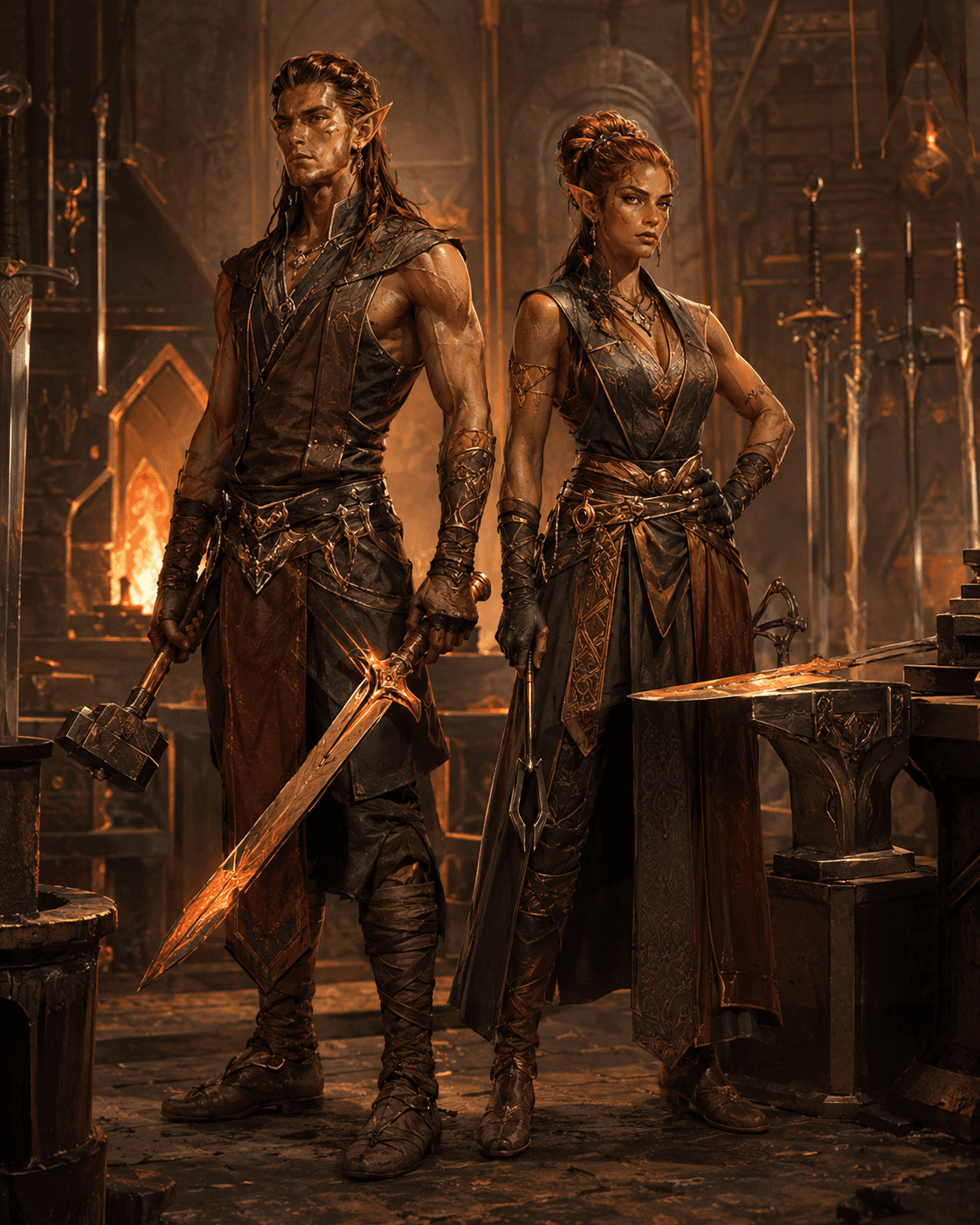
Elves
Druthal-Aurinko - - Sun Court
Fire Elf
Homeland: Aurinko sunlands, heat-forges, and exposed signal routes
Government: Sun Courts led by a Voice with solar stewards who keep ritual calendars and defense doctrine for exposed lands.
Society: Fast-moving and direct, but still Court-bound. They are tasked with guarding sun routes and keeping signal lines working across open country.
Buildings: Sun domes, mirrored terraces, heat-stone baths, and bright halls built to endure glare and temperature swings.
Trade:
• Export: Lenswork, signal lore, heat-treated craft, sun-hardened goods
• Import: Water stores, timber, ore, grain
Lore & Background
Druthal-Aurinko - Fire Elves
Sun Court
Homeland
Aurinko sunlands, volcanic margins, heat-forges, forge-cities, and exposed high-temperature regions where fire, metal, and sunlight shape daily life.
Government
Sun Courts are led by a Voice, supported by master smiths, forge stewards, and keepers of ritual calendars.
Practical authority is strongly tied to responsibility.
Those who oversee:
great forges
weapon halls
communal heatworks
defensive foundries
fire safety
metal stores
carry considerable influence within the Court.
The Voice represents Aurinko externally, but the Court does not expect a diplomat to dictate forge practice to a master who has spent centuries at the work.
Society
Aurinko Druthal are the great fire-workers of the Elven Courts.
Their culture is built around the controlled transformation of material through heat.
Where a Teräs Elf studies discipline through the finished blade, an Aurinko Elf studies the fire that makes the blade possible.
They are renowned as:
weaponsmiths
armorers
forge masters
metal refiners
heat-workers
kiln builders
glassworkers
makers of heat-treated tools
Fire is not treated as inherently destructive.
To Aurinko thought, fire reveals what a material can become.
Ore becomes metal.
Metal becomes a weapon.
Sand becomes glass.
Clay becomes permanent.
Food becomes preserved.
Impurity burns away.
But fire without control destroys the very thing it was meant to transform.
That distinction lies at the heart of Aurinko philosophy.
Heat without discipline is ruin.
Heat with purpose is creation.
Aurinko are often direct in speech and decisive in action. A forge does not allow endless hesitation: temperatures change, metal cools, and mistakes become permanent.
This gives many Aurinko communities a reputation for bluntness, but their directness is usually practical rather than hostile.
They value people who can:
recognize the moment to act
commit once the decision is made
accept correction
remake failed work rather than hide it
Buildings
Aurinko settlements are designed around heat.
Common structures include:
massive forge halls
heat-stone baths
vented workshops
mirrored courtyards
sun domes
cooling channels
kiln districts
weapon halls
fire-resistant storehouses
bright public halls built to withstand extreme temperature swings
Their great forges are rarely isolated industrial spaces.
They are social centers.
Contracts are made beside them.
Apprentices are tested there.
Weapons are named there.
Some Court disputes are settled only after both parties have worked beside the same fire long enough to stop speaking carelessly.
Trade
Exports
masterwork weapons
armor
heat-treated tools
forged fittings
specialized alloys
furnace craft
glasswork
kiln goods
weapon repair
forge expertise
Imports
raw ore
rare metals
charcoal and other fuels
timber
water stores
grain
leather
cloth
specialized mineral salts
Aurinko trade relationships are particularly strong with peoples who control mines, ore roads, forests, and major caravan routes.
Their reliance on imported raw materials also prevents the Sun Court from becoming economically self-contained.
They may be masters of the forge, but a forge without ore is only a hot room.
Aurinko - The Sun Court
Aurinko are the Fire Elves of the Druthal Courts.
Their culture is centered on the forge and on the principle that controlled heat can transform what already exists into something stronger, more useful, or entirely new.
Aurinko communities are renowned throughout Reth for:
weaponsmithing
armorcraft
metallurgy
metal refining
specialized alloys
toolmaking
furnace construction
kilnwork
glassmaking
repair and reforging
Their great forges are not merely workshops. They are civic institutions.
Weapons and armor carry consequences beyond the smith who makes them. A poorly tempered blade can fail a defender. A weak fastening can bring down a gate. Armor with a hidden flaw may kill the person who trusted it.
For that reason, Aurinko culture places enormous importance on accountability in craft.
An apprentice who makes a mistake is expected to identify it.
A master who hides one has committed a far more serious failure.
The Aurinko saying is:
Heat without discipline is ruin. Heat with purpose is creation.
Fire as Transformation
Aurinko philosophy does not treat fire primarily as destruction.
Fire changes things.
Ore cannot become a blade without ceasing to be ore.
Sand cannot become glass without being transformed.
A damaged weapon may have to lose its old shape before it can be made useful again.
This principle extends beyond smithing.
Aurinko often understand:
education
hardship
adulthood
grief
political change
personal reinvention
through the metaphor of the forge.
Pressure reveals weakness.
Heat permits change.
Discipline determines what survives.
Their cultural strength is the willingness to remake what has failed.
Their danger is believing that everything can - or should - be reforged.
The Forge and Society
Aurinko settlements place forge halls at the center of civic life.
Master smiths and forge stewards carry considerable social authority because their work directly affects:
defense
construction
agriculture
trade
transportation
everyday tools
The prestige of a smith depends less upon elaborate titles than upon what leaves their workshop and whether it performs as promised.
A famous name can be damaged by one knowingly poor piece of work.
Conversely, an apprentice of modest lineage can earn enormous respect through consistently excellent craft.
Weapons and Armor
Aurinko are particularly famous as the premier Druthal weaponsmiths and armorers.
They reject the idea that one universal weapon represents perfect craftsmanship.
The correct weapon depends on:
wielder
fighting style
environment
intended opponent
maintenance requirements
A Ranta weapon must endure salt.
A Kylmä weapon must function in extreme cold.
A Vuori weapon may strike stone.
A Giant's weapon must withstand loads inappropriate for a smaller bearer.
The Aurinko smith therefore begins not with:
"What is the finest weapon I can make?"
but:
"Who must trust this, and what must it survive?"
Aurinko and Teräs
Outsiders frequently confuse Aurinko and Teräs because both cultures have strong associations with weapons.
Druthal make a clear distinction.
Aurinko masters the making of the weapon.
Teräs masters its disciplined use.
Aurinko focuses upon:
metallurgy
heat
balance
forging
repair
material transformation
Teräs focuses upon:
martial form
controlled violence
duel law
technique
restraint
The two Courts cooperate extensively and argue almost as frequently.
That rivalry is generally productive.
A Teräs warrior tells the smith what a weapon must accomplish.
An Aurinko smith sometimes tells the warrior that their fighting style should adapt to what better craft has made possible.
Aurinko and Druazer
Aurinko also maintain particularly strong relationships with Druazer forge cultures.
Both peoples respect workmanship that can be tested in the real world.
Their philosophies differ subtly.
Druazer craft often emphasizes:
durability
structural reliability
endurance
repeatability
Aurinko craft emphasizes:
transformation
heat control
material potential
balance
adaptation to purpose
Their combined workshops can produce extraordinary results.
They can also produce arguments capable of lasting several generations.
Signals and Beacons
Aurinko's older signal tradition should remain, but as a secondary aspect.
Their expertise with fire naturally made them skilled builders and keepers of:
beacon fires
signal braziers
mirrored warning systems
heat-resistant towers
long-distance forge signals
The open Aurinko landscape made these systems especially effective.
Thus their reputation for rapid warning grew from their mastery of controlled flame, rather than being the reason the Court exists.
Cultural Traits
Transformation through discipline. Craft proven by use. Failure admitted and corrected.
Aurinko Druthal believe potential means little until something has survived the forge.
They apply this metaphor constantly to people.
Pressure reveals.
Heat changes.
Failure teaches.
What emerges afterward matters more than what entered.
Their strongest cultural virtue is the willingness to remake.
Their greatest weakness is believing everything can - or should - be reforged.
Some things need to be left as they are.
Some things, once broken, should not be remade.
Checking your codex…
From the Reth Ancestries (Daggerheart) compendium. Ancestry mechanics unlock when you collect this lineage in Hoard and link your account.