Forest-Folk (Tree-Kin)
Fungoid
Ciraemir
Lore
Overview
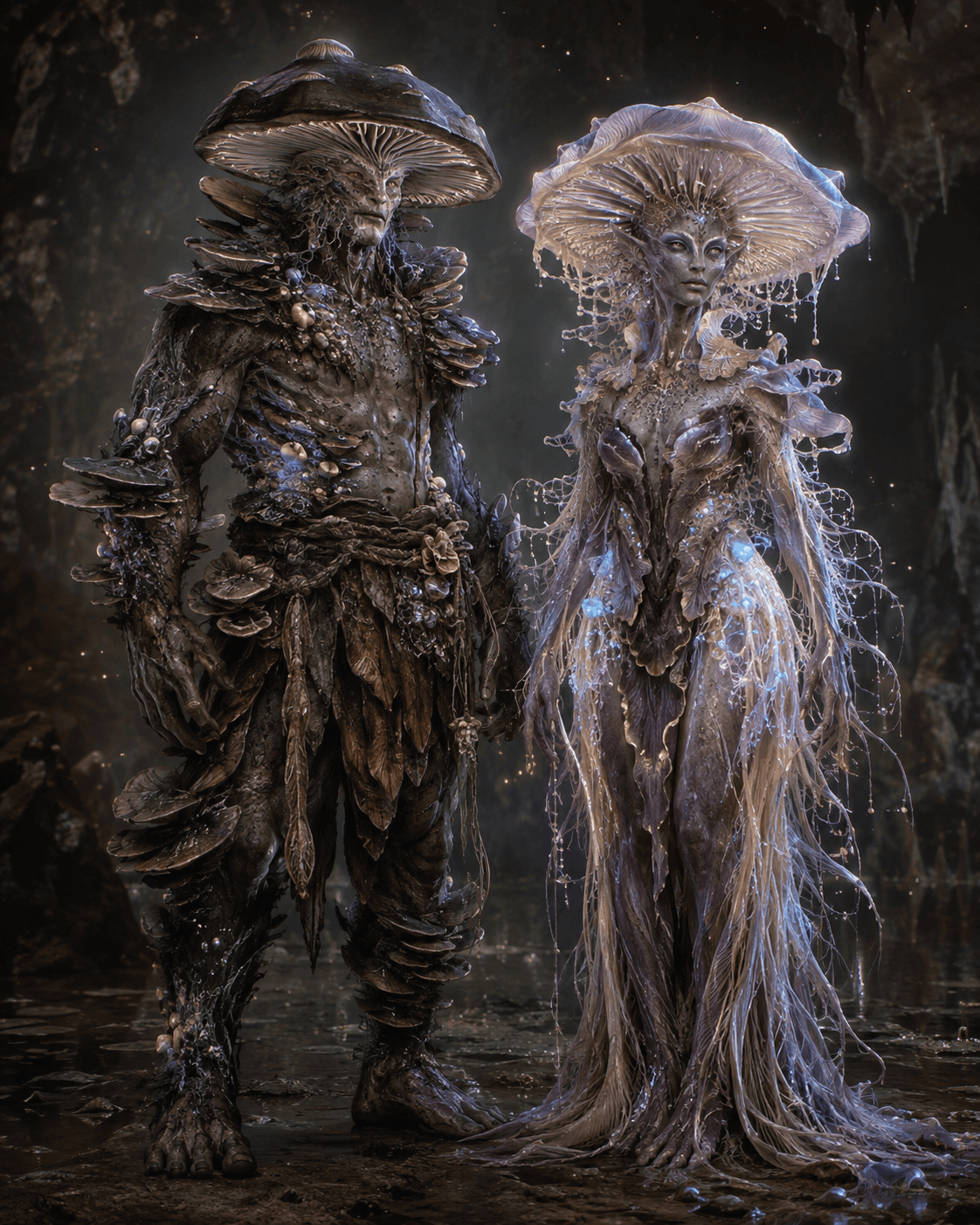
The Ciraemir, called Fungoids by much of Reth, are fungal kin placed among the Aldaecir and Dryad peoples: born from the mycelial networks that thrive beneath forests, within caves, across the Underdark, and throughout the darker reaches of the swamps.
They are not plants. They are not animated mushrooms. They are a distinct form of life whose bodies emerge from complex networks of fungal growth.
A Ciraemir may appear suddenly to an outsider. To the colony that produced them, their birth may have taken years. Threads spread. Spores travel. Decay becomes nourishment. Nutrients gather. Then somewhere within the network, awareness begins.
The Ciraemir understand life through a truth many surface peoples prefer not to contemplate: nothing living survives by refusing to become something else. Death feeds life. Rot makes soil. Fallen trees become nurseries. Bones return minerals to the earth. To the Ciraemir, decay is not the opposite of life. It is one of life's processes.
Individual and Colony
Ciraemir are not a hive mind. Every Ciraemir is an individual with personal memories, desires, fears, personality, and identity. But individuality exists alongside a biological connection to broader fungal networks.
A Ciraemir may emerge from a colony containing fungal matter centuries older than their current body. Fragments of sensation can remain within that network. This produces a cultural understanding of memory very different from that of most peoples: a place can remember, soil can remember, and the colony can remember.
Birth and Growth
Ciraemir reproduction varies between colonies. Some grow from established mycelial beds. Others emerge after spores from several Ciraemir intermingle within fertile ground. A new Ciraemir may spend their earliest consciousness physically attached to the colony that produced them. Eventually, they separate.
This first separation carries enormous cultural significance. To leave the colony is to become capable of experiencing something the colony cannot. Travel is often seen as a form of gathering memory.
Social Structure & Upbringing
Ciraemir communities are generally called colonies, though the word describes both the people and the mycelial organism surrounding their settlement. Leadership tends to emerge through memory, demonstrated judgment, knowledge of the environment, ability to interpret the network, and responsibility for younger growth.
Physical age can be misleading. A Ciraemir body might be young while carrying impressions from an ancient colony. Ciraemir therefore tend to respect depth of connection more than appearance.
Appearance
Ciraemir are among the most physically diverse peoples of Reth. Their bodies can incorporate traits resembling mushrooms, shelf fungi, puffballs, morels, coral fungi, stinkhorns, cup fungi, bracket fungi, delicate cave molds, and bioluminescent fungal growth.
Most possess a roughly humanoid body plan, but proportions vary considerably. Common traits include mushroom caps, layered growths, gill structures, fibrous skin, soft fungal flesh, tough woody surfaces, clusters of small caps, glowing spore pores, and branching fungal crowns.
Death and the Body
Death is one of the greatest cultural differences between Ciraemir and many other peoples. Ciraemir grieve, form relationships, and mourn the loss of individuals, but they generally do not treat decomposition as desecration.
A dead Ciraemir body is commonly returned to fungal earth where its nutrients can rejoin the colony. The body returns. The person does not. What may remain are impressions: memory without personality, a trace rather than a ghost.
Religion: & Philosophy
Ciraemir spiritual traditions tend to emphasize cycles, transformation, decomposition, hidden networks, death feeding life, and communities larger than the visible individual. Many find affinity with divine traditions associated with Mirosh, Osheth, and Thuosh, but Ciraemir are not universally bound to any one deity.
One common teaching says. "The cap is not the whole fungus." A person is more than their body. A nation is more than its ruler. A visible problem may be only the fruiting body of something much larger beneath the surface.
Relationships
Ciraemir colonies frequently share underground territory with Goblin communities. Long-standing settlements may become deeply interdependent: Goblins understand tunnel safety, warning systems, salvage, and concealed routes, while Ciraemir understand cave ecology, rot, moisture, fungal food, and environmental change.
Varjo Druthal value the Fungoids' sensitivity to changes within deep environments. Ciraemir appreciate the Druthal understanding that darkness is not inherently corrupt.
Deep Dwarves and Ciraemir frequently encounter one another where mines approach living fungal systems. Good relationships can produce stable underground settlements. Bad ones begin when excavation destroys a colony mistaken for ordinary mold.
Ciraemir inhabiting Suo regions often form strong relationships with wetland peoples. Forest Fungoids are grouped with Aldaecir Tree Folk and Druaecir Dryads through shared ecological stewardship, though their fungal nature remains distinct.
Military Presence
Ciraemir warfare favors environments where controlling space matters more than charging directly into an opponent. They are effective at cave defense, ambush, obscuring vision, warning networks, poisonous terrain, attrition, and detecting intrusion.
Cultural Traits
Everything returns. Nothing returns unchanged. Ciraemir tend to possess an unusually patient relationship with change. Their greatest cultural virtue is the ability to see possibility inside decay. Their danger is becoming too comfortable with loss because they know something will eventually grow afterward.
Taboos
Colony Burning. Deliberately burning a sentient Ciraemir mycelial colony is treated as an attack upon the people themselves.
Sterilization as Warfare. Salt, alchemy, magic, or poison used specifically to render inhabited fungal soil permanently sterile is considered especially horrific.
Memory Theft. Taking fungal tissue from a sentient colony for magical memory extraction without permission is a serious violation.
The Unreturned Dead. Preventing remains from naturally returning to the world for purposes of control, humiliation, or undeath is deeply offensive to many Ciraemir.
Outsiders and Escalation
Ciraemir colonies generally prefer warning and environmental pressure over immediate violence. A typical escalation is spores marking the intruder, altered scents and fungal warnings, paths becoming difficult to follow, clouds obscuring visibility, irritating or debilitating defensive spores, and coordinated defense by the colony.
Geography & Relations
Homeland: Cave systems, Varjo Underdark regions, deep forest hollows, rotting ancient woodlands, and dark Suo wetlands.
Principal Locations. No single universal capital. Major colonies occur in deep fungal forests, cave networks, drowned ruins, and old swamp-growth regions.
Exports: Medicines, edible fungi, rare spores, dyes, fermentation cultures, cave guides, fungal alchemy, environmental knowledge.
Imports: Metal tools, cloth, pottery, stories, surface crops, crafted containers, books and records.
Allies: Goblin communities, Varjo Druthal, many Aldaemir, Druaecir, and Aldaecir where ecological interests align.
Enemies: No universal racial enemy. Strong hostility is common toward necromancers, deliberate colony-burners, blight spreaders, and those who sterilize living fungal ground.
Council: Practice: Ciraemir political representation is inconsistent. Individual colonies are highly independent and may distrust distant representatives claiming to speak for fungal communities they have never physically joined.
Ancestral Form. None. Ciraemir are fungal people rather than creature-descended Aldae and do not use transformation amulets.
Lore & Background
The Ciraemir, called Fungoids by much of Reth, are a people born from the fungal networks that thrive beneath forests, within caves, across the Underdark, and throughout the darker reaches of the swamps.
They are not plants.
They are not animated mushrooms.
They are a distinct form of life whose bodies emerge from complex networks of fungal growth.
A Ciraemir may appear suddenly to an outsider.
To the colony that produced them, their birth may have taken years.
Threads spread.
Spores travel.
Decay becomes nourishment.
Nutrients gather.
Then somewhere within the network, awareness begins.
The Ciraemir understand life through a truth many surface peoples prefer not to contemplate:
Nothing living survives by refusing to become something else.
Death feeds life.
Rot makes soil.
Fallen trees become nurseries.
Bones return minerals to the earth.
To the Ciraemir, decay is not the opposite of life.
It is one of life's processes.
Individual and Colony
Ciraemir are not a hive mind.
Every Ciraemir is an individual with:
personal memories
desires
fears
personality
identity
But individuality exists alongside a biological connection to broader fungal networks.
A Ciraemir may emerge from a colony containing fungal matter centuries older than their current body.
Fragments of sensation can remain within that network.
This produces a cultural understanding of memory very different from that of most peoples.
A memory does not necessarily belong only to the mind that first experienced it.
A place can remember.
Soil can remember.
The colony can remember.
But those memories are incomplete.
A mycelial network does not keep histories like a Valta archive.
It remembers pressure.
Chemical change.
Heat.
Blood.
Footsteps.
Rot.
Magic.
The arrival and disappearance of living things.
Ciraemir historians therefore combine oral history with living environmental memory.
Birth and Growth
Ciraemir reproduction varies between colonies.
Some grow from established mycelial beds.
Others emerge after spores from several Ciraemir intermingle within fertile ground.
A new Ciraemir may spend their earliest consciousness physically attached to the colony that produced them.
Eventually, they separate.
This first separation carries enormous cultural significance.
To leave the colony is to become capable of experiencing something the colony cannot.
Travel is therefore often seen as a form of gathering memory.
A returning Ciraemir does not merely bring stories home.
They bring experiences that may eventually become part of the colony itself.
Social Structure & Upbringing
Ciraemir communities are generally called colonies, though the word describes both the people and the mycelial organism surrounding their settlement.
Leadership tends to emerge through:
memory
demonstrated judgment
knowledge of the environment
ability to interpret the network
responsibility for younger growth
Physical age can be misleading.
A Ciraemir body might be young while carrying impressions from an ancient colony.
Likewise, an elderly Ciraemir separated from their original network for decades may possess less local memory than a much younger resident.
Ciraemir therefore tend to respect depth of connection more than appearance.
Appearance
Ciraemir are among the most physically diverse peoples of Reth.
Their bodies can incorporate traits resembling:
mushrooms
shelf fungi
puffballs
morels
coral fungi
stinkhorns
cup fungi
bracket fungi
delicate cave molds
bioluminescent fungal growth
Most possess a roughly humanoid body plan, but proportions vary considerably.
Common traits include:
mushroom caps
layered growths
gill structures
fibrous skin
soft fungal flesh
tough woody surfaces
clusters of small caps
glowing spore pores
branching fungal crowns
Skin colors can include:
ivory
brown
grey
red
yellow
violet
blue
black
green
orange
Bioluminescence is common among lineages from deep caves and the Underdark, though it is usually faint rather than bright enough to replace a lantern.
Some Ciraemir release visible spores when:
frightened
excited
angry
embarrassed
Younger Ciraemir occasionally find this mortifying.
Death and the Body
Death is one of the greatest cultural differences between Ciraemir and many other peoples.
Ciraemir grieve.
They form relationships.
They mourn the loss of individuals.
But they generally do not treat decomposition as desecration.
A dead Ciraemir body is commonly returned to fungal earth where its nutrients can rejoin the colony.
The distinction is important:
the body returns. The person does not.
Ciraemir do not normally believe that consuming or decomposing remains resurrects the dead individual.
What may remain are impressions.
Memory without personality.
A trace rather than a ghost.
This is why many Ciraemir find necromancy deeply unsettling.
Decay allows the dead to return naturally to the world.
Necromancy can trap remains in a state where they are neither properly living nor properly returning.
Religion: & Philosophy
Ciraemir spiritual traditions tend to emphasize:
cycles
transformation
decomposition
hidden networks
death feeding life
communities larger than the visible individual
Many find affinity with divine traditions associated with:
Mirosh and wetland transformation
Osheth and hidden depths
Thüosh and living ecological cycles
But Ciraemir are not universally bound to any one deity.
One of their most common philosophical teachings is:
"The cap is not the whole fungus."
It is used in several ways.
A person is more than their body.
A nation is more than its ruler.
A visible problem may be only the fruiting body of something much larger beneath the surface.
Ciraemir adventurers have an annoying habit of using this phrase immediately before telling everyone that the obvious problem is probably not the real problem.
They are frequently correct.
Relationships with Other Ancestries
Goblins and Other Varjo Peoples
Ciraemir colonies frequently share underground territory with Goblin communities.
The relationship is often practical.
Goblins understand:
tunnel safety
warning systems
salvage
concealed routes
Ciraemir understand:
cave ecology
rot
moisture
fungal food
environmental changes
Long-standing settlements may become deeply interdependent.
Varjo Druthal
Varjo Druthal value the Fungoids' sensitivity to changes within deep environments.
Ciraemir appreciate the Druthal understanding that darkness is not inherently corrupt.
Disagreements most often concern information.
Varjo may believe a dangerous discovery should remain sealed.
Ciraemir may argue that knowledge already absorbed by a living network cannot meaningfully be treated as though it exists inside one locked book.
Druazer-Varjo
Deep Dwarves and Ciraemir frequently encounter one another where mines approach living fungal systems.
Good relationships can produce extremely stable underground settlements.
Bad ones begin when excavation destroys a colony that the miners mistook for ordinary mold.
Aldaemir
Ciraemir inhabiting Suo regions often form strong relationships with wetland peoples.
Both understand:
decomposition
medicine
poison
wetland renewal
Druaecir and Aldaecir
Forest Fungoids often share ecological interests with both Dryads and Treefolk.
The relationship is usually cooperative, though Druaecir sometimes become uncomfortable with how enthusiastically Ciraemir discuss the useful decomposition of dead trees.
The Ciraemir generally consider this sensitivity charming.
Military Presence
Ciraemir warfare favors environments where controlling space matters more than charging directly into an opponent.
They are effective at:
cave defense
ambush
obscuring vision
warning networks
poisonous terrain
attrition
detecting intrusion
Some colonies release dense spore clouds when threatened.
Others cultivate defensive fungus capable of:
producing foul odors
marking intruders
causing irritation
rapidly revealing disturbed ground
Ciraemir rarely approach warfare as conquest.
A colony generally fights because something threatens the environment required for its continued existence.
Destroying every enemy is often less important than making the area impossible or undesirable for the enemy to occupy.
Cultural Traits
Everything returns. Nothing returns unchanged.
Ciraemir tend to possess an unusually patient relationship with change.
A collapsed tunnel may eventually become a fungal chamber.
A fallen tree becomes food.
A ruined city becomes habitat.
This does not make them passive.
It means they distinguish between loss and ending.
Their greatest cultural virtue is the ability to see possibility inside decay.
Their danger is becoming too comfortable with loss because they know something will eventually grow afterward.
To another people, saying:
"Something will grow here again."
may be comforting.
It may also be exactly the wrong thing to say while their house is still burning.
Ciraemir travelers learn this distinction quickly.
Common Fungoid Forms
These dispositions are suggestions for inspiration, not biological requirements.
Taboos
Ciraemir cultures vary, but several actions are widely condemned.
● Colony Burning: Deliberately burning a sentient Ciraemir mycelial colony is treated as an attack upon the people themselves.
● Sterilization as Warfare: Salt, alchemy, magic, or poison used specifically to render inhabited fungal soil permanently sterile is considered especially horrific.
● Memory Theft: Taking fungal tissue from a sentient colony for magical memory extraction without permission is a serious violation.
● The Unreturned Dead: Preventing remains from naturally returning to the world for purposes of control, humiliation, or undeath is deeply offensive to many Ciraemir.
Outsiders and Escalation
Ciraemir colonies generally prefer warning and environmental pressure over immediate violence.
A typical escalation is:
Spores marking the intruder → altered scents and fungal warnings → paths becoming difficult to follow → clouds obscuring visibility → irritating or debilitating defensive spores → coordinated defense by the colony.
An outsider who notices unusual mushrooms appearing repeatedly along their route may already have been warned several times without realizing it.
Geography & Relations
● Homeland: Cave systems, Varjo Underdark regions, deep forest hollows, rotting ancient woodlands, and dark Suo wetlands.
● Principal Locations: No single universal capital. Major colonies occur in deep fungal forests, cave networks, drowned ruins, and old swamp-growth regions.
● Exports: Medicines, edible fungi, rare spores, dyes, fermentation cultures, cave guides, fungal alchemy, environmental knowledge
● Imports: Metal tools, cloth, pottery, stories, surface crops, crafted containers, books and records
● Allies: Goblin communities, Varjo Druthal, many Aldaemir, Druaecir and Aldaecir where ecological interests align
● Enemies: No universal racial enemy. Strong hostility is common toward necromancers, deliberate colony-burners, blight spreaders, and those who sterilize living fungal ground.
● Council Practice: Ciraemir political representation is inconsistent. Individual colonies are highly independent and may distrust distant representatives claiming to speak for fungal communities they have never physically joined.
● Ancestral Form: None. Ciraemir are fungal people rather than creature-descended Aldae and do not use transformation amulets.
Aldaedre (Dragonkin)
Checking your codex…
From the Reth Ancestries (Daggerheart) compendium. Ancestry mechanics unlock when you collect this lineage in Hoard and link your account.